
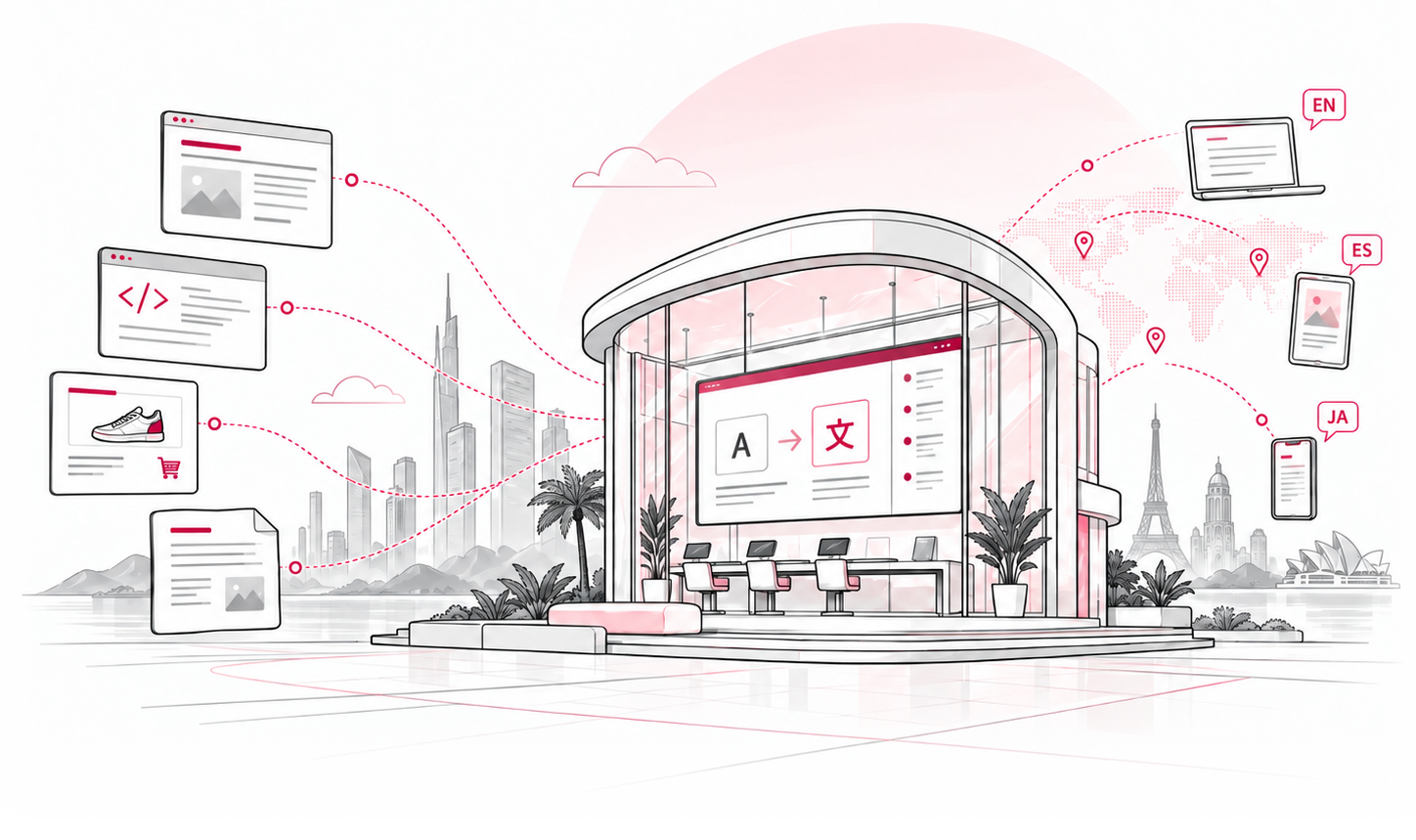
Your Content Never Stops Changing. Neither Should Localization.
Enterprise content used to move in relatively predictable publishing cycles. Today, websites change daily. Software ships continuously. Ecommerce catalogs expand. Support teams publish new knowledge. Product information evolves across channels. Marketing teams create more campaign variations for more audiences and markets.
AI is accelerating that content velocity even further. Generative AI makes it possible to create, update, personalize, and repurpose business content at unprecedented speed—from product descriptions and help articles to training materials, summaries, customer communications, and digital experiences.
Yet translation is still frequently managed as a sequence of isolated projects: collect the content, package it, send it for translation, wait, review it, reimport it, and repeat the process when something changes.
That model creates multilingual lag. Source content moves forward while translated versions wait for the next localization cycle. Product information becomes available in one language before others. Help centers drift out of sync. Software releases accumulate untranslated strings. Regional websites run different generations of the same content.
Continuous translation replaces that stop-and-start model with an ongoing multilingual content operation designed for content velocity.
From Translation Projects to Continuous Multilingual Operations
Traditional translation is organized around projects. Continuously changing content needs an operating model built around recurring change.
Content Waits for the Next Translation Cycle
The Change Itself Becomes the Unit of Work
Translate the Change, Not Everything Around It
Most enterprise updates are incremental. Continuous translation focuses the workflow on what actually changed while protecting the language assets your organization has already approved.
AI Makes Continuous Translation Intelligent
Continuous translation is not simply machine translation running more frequently. AI can help understand content, apply language knowledge, select the right process, evaluate output, and focus professional expertise where it creates the greatest value.
Understand
Interpret content type, context, audience, purpose, language requirements, and business importance before deciding how content should move.
Reuse
Search approved Translation Memory, terminology, style guidance, reference content, and existing multilingual assets before creating new language.
Route
Direct content into the appropriate workflow based on audience, market, risk, timing, terminology, and review expectations.
Translate
Apply the right production approach—from AI translation to AI-assisted professional review, expert human translation, or specialized workflows.
Evaluate
Use automated quality controls and AI-assisted evaluation to surface terminology, consistency, completeness, formatting, and confidence issues.
Escalate
Move uncertain, sensitive, complex, high-value, or high-risk content to qualified linguists, specialists, or authorized stakeholders.
Continuous Doesn’t Mean Uncontrolled
The fastest possible workflow is not automatically the right workflow. Different content streams can use different combinations of AI, professional expertise, review, quality assurance, and approval.
Automation accelerates the workflow. Governance determines how far automation should go. Workflow decisions can reflect the content’s audience, market, business impact, regulatory requirements, terminology, turnaround, and approval needs.
Multilingual Content That Never Falls Behind
Fast translation is useful. Current translation is more important. Continuous workflows help every language stay aligned with the authoritative source as your content evolves.
One Continuous Workflow Across Your Content Ecosystem
Your content already lives inside business systems. Translation should connect to that ecosystem—not require teams to repeatedly export, email, upload, download, and reimport every update.
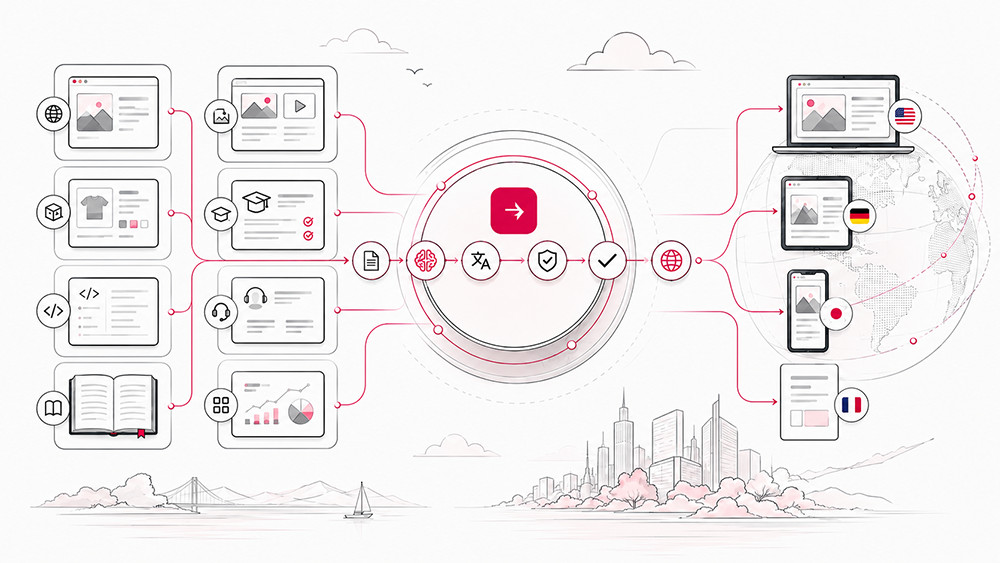
With event-driven integration, a content update can initiate the multilingual workflow instead of waiting for someone to manually create another translation project. The Stepes Translation API supports programmatic content submission, asynchronous processing, project and job tracking, multilingual results, and signed webhook events so downstream systems can continue the content lifecycle.
Continuous Translation Beyond Software
Continuous localization became closely associated with agile software development, but the same operating model now applies wherever enterprise content changes faster than traditional translation projects can comfortably follow.
Websites & CMS Content
Corporate websites, landing pages, product pages, resource centers, metadata, forms, and regional experiences constantly evolve. Continuous website translation helps new and revised content move through translation, review, publishing, and multilingual SEO workflows.
Software & Applications
UI strings, navigation, dialogs, notifications, onboarding flows, feature descriptions, release notes, and help content change with every release. Continuous software localization brings translation closer to product development.
Ecommerce & Product Content
New SKUs appear, specifications change, promotions launch, and product descriptions evolve. Continuous translation helps global commerce teams localize the changing product information customers need to discover and purchase products.
Knowledge & Customer Support
Knowledge bases, help centers, FAQs, troubleshooting content, chatbot knowledge, ticket macros, and customer communications continuously respond to new products, issues, questions, and policies.
Marketing Content
Landing pages, email programs, product launches, campaign variations, social content, digital promotions, and regional updates can all create ongoing localization demand while brand voice and market quality still matter.
Technical & Product Documentation
Specifications, manuals, operating procedures, instructions, release information, safety content, and technical knowledge require multilingual updates throughout the product lifecycle.
Built for Agile and CI/CD Localization
Software development moved from infrequent major releases to continuous iteration. Continuous localization brings multilingual content into the same product lifecycle so translation can happen alongside development instead of waiting downstream.
Your Language Assets Get Smarter With Every Release
A continuous localization program should accumulate knowledge—not accumulate rework. Every translation your organization approves can become an asset for the next content update.
Translation Memory
Approved source and target content can be identified and reused in future work, reducing repetitive translation while supporting consistency across releases.
Terminology
Validated product names, technical terms, brand language, regulated expressions, and market conventions stay available across recurring workflows.
Style & Language Guidance
Voice, tone, writing conventions, audience expectations, and project instructions guide recurring decisions beyond individual words and phrases.
Reviewer Feedback
Approved corrections can inform future cycles instead of disappearing inside one completed project.
Context
Product, interface, page, document, and audience context helps AI systems and professional linguists make better decisions about meaning and usage.
Market Preferences
Language-specific decisions and regional guidance can remain available for the teams and workflows that need them.
From Content Change to Global Release
Continuous translation connects technology, professional language services, quality controls, and enterprise systems into one coordinated lifecycle designed around your content, markets, and risk.
Connect
Connect content sources and delivery workflows through APIs, established integrations, files, or other appropriate content-transfer methods.
Detect
Identify content that is new or changed and determine what requires multilingual processing.
Reuse
Apply approved Translation Memory, terminology, style guidance, and existing multilingual knowledge before translating new content.
Route & Translate
Select the appropriate path according to content type, audience, language, business impact, turnaround, and quality requirements.
Validate
Apply automated QA, AI-assisted quality evaluation, professional review, in-context validation, testing, or stakeholder approval as required.
Release
Return approved multilingual content to the appropriate destination or downstream workflow, ready for the next source change.
Designed for Enterprise Content Velocity
Continuous translation turns localization from a recurring operational bottleneck into a more scalable global content capability.
Faster Global Releases
Reduce the delay between source updates and multilingual availability by moving translation closer to content creation, development, and publishing.
Less Manual Coordination
Automate repetitive intake, routing, status updates, content transfer, review notifications, and delivery steps where appropriate.
Lower Repetitive Translation Effort
Focus production and review on new and changed content while maximizing approved Translation Memory and terminology assets.
Better Content Parity
Keep multilingual experiences more closely synchronized with authoritative source information as products and digital experiences evolve.
More Consistent Global Language
Apply shared language assets across recurring updates to reduce unnecessary variation in product, technical, brand, and customer-facing terminology.
Human Expertise Where It Matters
Focus qualified linguists, reviewers, and subject-matter experts on content requiring judgment, nuance, technical knowledge, cultural adaptation, or added assurance.
Technology Keeps Content Moving. People Protect What Matters.
Enterprise continuous translation requires more than software—and more than linguistic capacity alone. Stepes brings both into one governed multilingual operating model.
Intelligent Translation Technology
Use AI translation, Translation Memory, terminology management, automated quality controls, APIs, webhooks, workflow automation, and program visibility to reduce repetitive work and keep multilingual content moving.
Professional Language Expertise
Apply experienced translators, editors, localization specialists, subject-matter linguists, and reviewers when content requires linguistic judgment, market understanding, technical knowledge, creativity, or additional quality assurance.
Continuous Translation & Continuous Localization FAQs
Practical answers about continuous localization, AI, human review, CI/CD, Translation Memory, quality, and enterprise integration.
Continuous translation is an ongoing approach to multilingual content in which new and changed source content can move through translation, review, quality validation, and delivery as part of a repeatable workflow. Instead of collecting every update into a separate translation project, organizations can connect translation more directly to the lifecycle of websites, software, product information, knowledge bases, customer support, marketing content, documentation, and other frequently changing information.
Continuous localization integrates translation and localization into an ongoing content or product-development process rather than treating localization as a separate final stage. The term is especially common in software development, where localization can operate alongside agile and CI/CD workflows so new and changed product content moves toward multilingual release as part of regular development cycles.
The terms overlap significantly. Continuous translation focuses on keeping translatable content moving through an ongoing multilingual workflow. Continuous localization often describes a broader process that may also include technical integration, locale adaptation, contextual review, testing, and release coordination. Stepes uses continuous translation more broadly across software and other frequently changing enterprise content.
Traditional translation is commonly organized around discrete projects: content is collected, submitted, translated, reviewed, delivered, and then the process begins again for the next update. Continuous translation is designed around recurring change. New or modified content can be detected, existing translations can be reused, workflow rules can select the appropriate translation and review process, and completed content can return to the business through a repeatable delivery path.
No. CI/CD is an important continuous-localization use case for software companies, but continuous translation can support any content environment with frequent updates, including websites and CMS content, product catalogs, ecommerce platforms, knowledge bases, help centers, technical documentation, customer-support content, training systems, and structured enterprise data.
Agile localization aligns translation and localization with iterative development or content-production cycles. Instead of waiting until a product or content release is complete, localization happens throughout the process in smaller increments. Continuous localization builds on this principle by using repeatable integrations and workflows to keep frequent updates moving across languages with less manual intervention.
AI can support multiple stages of the continuous translation lifecycle. Depending on the workflow, AI can help analyze content and context, apply approved terminology, generate translations, evaluate linguistic output, identify potential quality issues, assist professional linguists, and support intelligent workflow routing. The appropriate use of AI depends on the content’s purpose, audience, business impact, language, quality requirements, and risk.
No. Continuous refers to the way localization responds to recurring content changes. It does not require every translation to bypass human review or approval. A workflow can include professional linguistic review, subject-matter validation, in-country feedback, localization testing, legal or regulatory review, and authorized stakeholder approval before content is released.
Yes. Professional linguists remain important for content requiring linguistic judgment, subject-matter expertise, cultural understanding, brand sensitivity, creative adaptation, or higher levels of assurance. Continuous workflows can use professional translators throughout the process or selectively apply human expertise where it creates the most value.
Translation Memory stores previously translated source content together with approved translations. When identical or similar content appears in future updates, the workflow can identify those matches and reuse them when appropriate. This is especially valuable for frequent releases containing a mix of unchanged, repeated, modified, and completely new content.
Terminology management establishes approved translations and usage guidance for product names, technical terminology, brand language, regulated expressions, and other important terms. Applying that terminology throughout recurring translation workflows improves consistency and reduces downstream corrections across translators, reviewers, and AI systems.
Continuous translation is particularly valuable for frequently updated websites, CMS content, software interfaces, SaaS products, mobile applications, product information, ecommerce catalogs, knowledge bases, help centers, customer support, AI-generated or AI-assisted content, technical documentation, marketing content, training content, and release documentation.
Stepes supports API-powered and automated translation workflows for organizations that need to connect localization with content, product, development, and enterprise systems. The appropriate integration model depends on your systems, content architecture, publishing process, security requirements, and localization workflow.
Quality begins with matching the workflow to the content. Stepes can combine Translation Memory, terminology, AI-powered translation, automated quality checks, professional linguistic review, subject-matter expertise, contextual validation, testing, and stakeholder approvals according to each content stream’s requirements.
Yes. A mature continuous localization program should not assume every content type requires the same process. Routine knowledge content, product data, customer-facing marketing, technical documentation, legal content, and regulated information may each require different combinations of AI translation, professional translation, review, quality assurance, and approval.
Keep Global Content Moving With Your Business
Your products will keep evolving. Your teams will keep publishing. AI will keep increasing the speed and volume of content creation. Stepes connects AI, workflow automation, Translation Memory, terminology, professional linguists, quality controls, APIs, and enterprise content operations into an always-on multilingual workflow designed around change.
Make every relevant content change a global content change.