
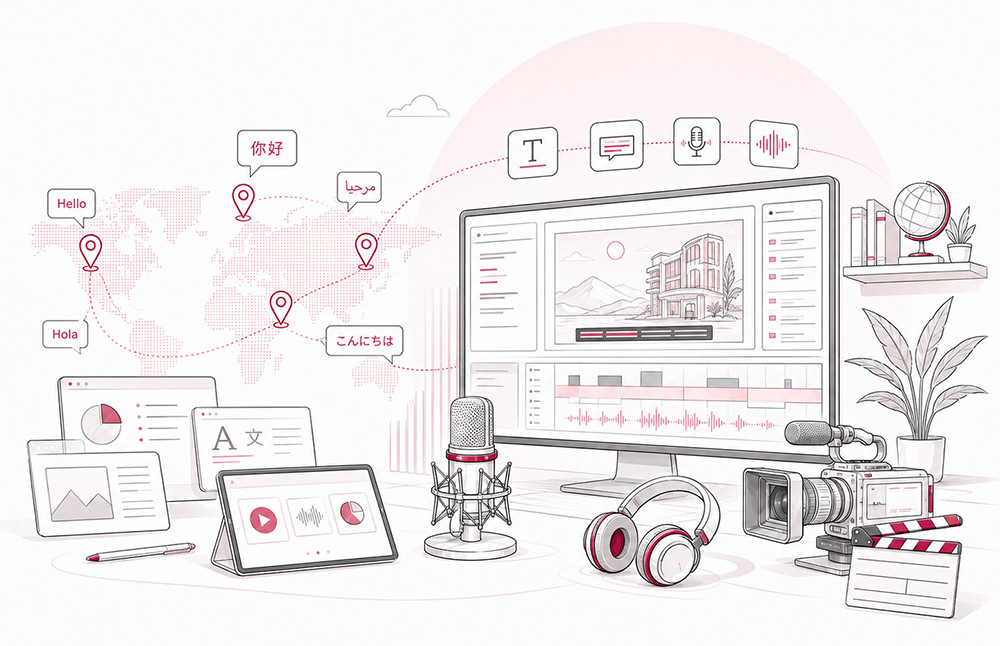
Multimedia Content Is Made of Connected Parts
Multimedia localization adapts the complete combination of language, audio, visuals, timing, graphics, and media production for audiences in different languages and markets.
A single multimedia asset can contain far more translatable content than its spoken script. Narration may need to match subtitles. Product terminology shown in a graphic must agree with what the audience hears. Longer translations can affect animation timing, while updated software screens may require corresponding changes to voice, captions, callouts, and demonstrations.
Stepes brings language and multimedia production into one coordinated workflow so the components your audience sees and hears remain accurate, consistent, synchronized, and ready for global delivery.
Spoken Content
Narration, dialogue, interviews, presentations, product explanations, and other recorded speech.
Visible Language
Subtitles, captions, titles, labels, lower thirds, interface text, callouts, and animated copy.
Visual Assets
Graphics, diagrams, screenshots, illustrations, presentation content, and motion elements.
Media Production
Timing, synchronization, audio editing, video engineering, reintegration, rendering, and multilingual output.
Complete Multimedia Localization Services
Choose individual capabilities or bring the full project into one connected multilingual production workflow.
Multimedia Translation
Translate scripts, narration, dialogue, presentations, product messaging, instructional content, and other multimedia text with professional linguists who understand audience, subject matter, tone, and context.
Subtitle Translation and Captioning
Create translated subtitles and captions that are clear, concise, readable, and synchronized with the source media, including timing, segmentation, speaker information, and common delivery formats.
Explore Video Translation ServicesVoiceover and Dubbing
Produce multilingual narration with professional human voice talent or AI-enabled voice options, supported by script preparation, pronunciation guidance, timing, synchronization, editing, and integration.
Explore Voice Over ServicesTranscription and Time Coding
Convert spoken source content into accurate written scripts for translation, subtitles, voice production, review, or archival use, with speaker information and timestamps where required.
Explore Transcription ServicesOn-Screen Text and Graphics Localization
Translate and reintegrate titles, lower thirds, labels, diagrams, callouts, screenshots, interface text, animation text, and other visible language inside the multimedia experience.
Audio and Video Production
Coordinate audio editing, synchronization, mixing, voice replacement, subtitle integration, visual-text replacement, timing adjustments, rendering, and production-ready multilingual output.
Interactive and Presentation Media
Localize presentations, product demonstrations, employee communications, webinars, screen-based training, software walkthroughs, and other experiences that combine language with visual or interactive components.
Explore eLearning LocalizationMultimedia Localization Engineering and QA
Combine linguistic review with multimedia engineering and in-context QA to identify issues involving timing, synchronization, layout, audio, visual presentation, terminology, untranslated content, or final output.
One Experience. Multiple Media Layers.
Each media layer has its own localization requirements, but audiences experience them together. Stepes coordinates them so every language version communicates as one coherent experience.
Scripts · dialogue · descriptions · interface text
Narration · human voice · AI voice · dubbing
Subtitles · captions · lower thirds · titles
Language, voice, visuals, interaction, and production stay connected.
Graphics · diagrams · screenshots · animation
Presentations · demonstrations · learning media
Timing · engineering · reintegration · rendering
A revised product term can appear in narration, subtitles, an interface screenshot, an animated callout, and a training slide. Managing these components together helps reduce conflicting translations, production rework, and inconsistent audience experiences.
Use AI for Speed. Keep Experts in Control.
AI is transforming multimedia production—from transcription and translation to subtitle generation and synthetic voice. The greatest value comes from using these technologies selectively, with the right quality controls for the content and audience.
AI-Enabled Production
AI and automation can accelerate high-volume and repetitive production steps while preserving a structured path to professional review.
- Transcription
- Initial translation
- Terminology extraction
- Subtitle generation and alignment
- Content analysis
- Synthetic voice production
- Change detection
- Automated quality checks
Professional Human Expertise
Experts remain essential where meaning, audience expectations, production judgment, and release quality matter.
- Linguistic meaning and nuance
- Brand voice and cultural fit
- Technical terminology
- Specialized subject matter
- Pronunciation and spoken fluency
- Timing and pacing decisions
- Visual and contextual judgment
- Final release quality
There is no single production model that is right for every multimedia asset. Stepes configures the workflow around your quality requirements, audience, risk, volume, update frequency, and production goals.
Explore AI Translation ServicesOne Vocabulary Across Every Media Layer
Product names, technical terms, brand language, feature names, and specialized terminology should not change simply because the audience encounters them in a different medium.
Stepes helps keep multilingual terminology connected across narration, subtitles, graphics, software screens, presentations, video, and interactive content so approved language decisions can carry forward as your media library grows.
From Source Assets to Production-Ready Multilingual Media
Stepes connects translation, multimedia production, engineering, and quality assurance through a workflow designed around the actual source files and final deliverables.
Source Asset Review
Review files, languages, editable assets, duration, technical requirements, channels, and delivery expectations.
Content and Media Inventory
Identify scripts, voice tracks, subtitles, graphics, screenshots, presentations, UI text, animations, and supporting assets.
Localization Preparation
Prepare translation memory, terminology, style guidance, pronunciation lists, references, reviewer instructions, and production specifications.
Translation and Review
Translate with the appropriate linguistic workflow, adapting spoken, subtitle, and visual text for its media context.
Multimedia Production
Create multilingual voice, subtitles, captions, localized graphics, screenshots, and other production assets.
Reintegration and Engineering
Synchronize, replace, edit, reintegrate, adjust timing, render, and prepare the required outputs.
In-Context Quality Assurance
Review linguistic accuracy, terminology, timing, pronunciation, alignment, visual fit, RTL display, and final output.
Final Multilingual Delivery
Deliver agreed source assets, subtitles, audio, localized graphics, production files, rendered media, and final outputs.
A translation can be correct in a spreadsheet and still fail after production. In-context QA helps identify subtitle timing, text overflow, pronunciation, audio alignment, outdated screenshots, missing translations, right-to-left presentation, and other issues before localized content reaches the audience.
When the Source Changes, Update What Changed
Multimedia localization does not end after the first international release. Product demonstrations evolve, training is revised, interfaces change, campaigns receive new messaging, and new languages are added.
Stepes supports continuous multimedia localization by identifying what changed, reusing what remains approved, and updating the affected language and media components instead of recreating an entire multilingual asset from the beginning.
Localize Multimedia Across the Customer and Employee Journey
Support multilingual media across customer engagement, product adoption, workforce training, corporate communication, and specialized industry needs.
Training and Learning
Employee onboarding, compliance training, product education, technical instruction, customer academies, and recorded learning content.
eLearning LocalizationMarketing and Brand
Campaign videos, product launches, branded presentations, social content, promotional media, explainers, customer stories, and event media.
Product and Technical Content
Product demonstrations, software walkthroughs, tutorials, installation media, maintenance instruction, troubleshooting content, and feature demonstrations.
Corporate Communications
Executive communications, company presentations, webinars, employee messages, town halls, recorded events, and internal campaigns.
Regulated and Specialized Content
Healthcare, life sciences, financial, legal, manufacturing, technology, and other specialized media requiring disciplined terminology, expertise, and QA.
Work With the Multimedia Assets You Already Use
Multimedia projects often arrive as packages rather than individual files. Stepes works with common video, audio, subtitle, script, graphic, presentation, and production formats and can review custom or mixed-content environments when required.
Video and Motion
Coordinate transcription, translation, subtitles, captions, voiceover, on-screen text, and final media production.
Audio Content
Support narration, interviews, presentations, training audio, recorded instruction, and other spoken content.
Subtitles and Captions
Preserve timing, segmentation, reading considerations, speaker information, and synchronization.
Time-Coded Scripts
Protect time codes and speaker information through translation, review, subtitle, and voice-production workflows.
What to Send Us for an Accurate Multimedia Quote
The right source materials help Stepes determine the translatable content, production requirements, linguistic workflow, engineering scope, schedule, and final deliverables.
Do not worry if every source component is not available. Send the representative assets you have, and Stepes can review the package to determine the most practical localization approach.
Discuss Your Multimedia ProjectSource Media
- Source multimedia files
- Editable video or production assets
- Scripts or transcripts
- Subtitle or caption files
- Separate audio tracks
- Editable graphics and presentations
- Fonts and linked assets
Language Assets
- Existing translations
- Translation memory
- Terminology and glossaries
- Pronunciation guidance
- Style or brand guidance
- Reviewer requirements
Delivery Requirements
- Target languages and locales
- Human or AI voice requirements
- Subtitle or caption requirements
- Final delivery formats
- Publishing channels
- Expected launch date
Multimedia Localization Built for Enterprise Content
Global multimedia programs need a repeatable way to coordinate language, production, quality, reuse, and updates as content expands across markets.
Complete Multimedia Production Expertise
Bring translation, voice, subtitles, graphics localization, multimedia engineering, and QA into one coordinated workflow.
Human + AI Flexibility
Apply professional translation, AI-assisted production, synthetic or human voice, automation, and targeted review according to content and risk.
Consistent Language Governance
Use translation memory, terminology, style guidance, pronunciation preferences, and previous approvals across media.
In-Context Quality Assurance
Review language inside the audio, visual, interactive, or rendered experience—not only within extracted text.
Specialized Linguistic Expertise
Match language professionals to technical, medical, legal, financial, marketing, software, training, and other specialized multimedia.
Scalable Global Workflows
Support a single asset, coordinated multilingual launch, recurring content stream, or evolving global media library in 100+ languages.
Multimedia Localization Services FAQs
Practical answers about multimedia scope, subtitles, voice, AI, terminology, files, quality, accessibility, updates, timelines, and pricing.
Multimedia localization adapts the complete combination of language, voice, audio, subtitles, captions, visuals, graphics, timing, and production elements for audiences in another language or market. Unlike text-only translation, it considers how translated language behaves inside the finished experience and can include transcription, voiceover, dubbing, subtitle production, visual-text localization, engineering, reintegration, and in-context QA.
Video translation focuses specifically on the language and production components of video, such as scripts, narration, subtitles, captions, dubbing, graphics, and final video output. Multimedia localization is broader and can coordinate video with audio, presentations, graphics, interactive media, product demonstrations, training assets, and other media components as part of one multilingual experience.
Stepes supports corporate, marketing, training, product, technical, educational, and specialized multimedia, including product demonstrations, presentations, webinars, training content, tutorials, corporate communications, software walkthroughs, marketing media, recorded events, instructional content, audio programs, subtitles, and mixed-media production packages.
Yes. Projects can use subtitles, human voiceover, AI voice, dubbing, or a combination based on audience, budget, production requirements, intended channel, and quality expectations. Stepes can coordinate translation, script preparation, timing, voice production, subtitle creation, engineering, and QA in the same workflow.
Stepes supports AI-enabled voice production for appropriate multimedia workflows as well as professional human voice talent. AI voice can be effective for scalable and frequently updated content, while human voice remains valuable when natural performance, brand expression, specialized pronunciation, emotional delivery, or higher-stakes communication is important.
Yes. Multimedia localization can include titles, lower thirds, diagrams, screenshots, callouts, labels, interface text, presentation graphics, animation text, and other visual language. Editable source files are recommended because they make it easier to adjust translated text for language-specific length, fonts, direction, and layout.
Yes. Existing translations, translation memory, glossaries, terminology, prior subtitles, approved scripts, and other multilingual assets can often be incorporated into a new workflow. Stepes can review these resources to determine what can be reused and where new translation, review, or production work is required.
Yes, when the source files and production structure allow it. Stepes can compare versions, identify affected language and media components, reuse approved content, update changed translations or production assets, and focus QA on the revised areas and surrounding context.
Stepes can use shared translation memory, approved terminology, style guidance, pronunciation instructions, previous translations, and reviewer feedback across the project. This helps keep product names, technical terms, brand language, and specialized concepts consistent across voice, captions, graphics, presentations, and product screens.
Quality assurance can combine linguistic review with technical and in-context multimedia checks. Depending on scope, Stepes can review translation accuracy, terminology, pronunciation, subtitle timing, caption synchronization, audio alignment, visual text, layout, missing translations, graphics, right-to-left presentation, media output, and final production specifications.
Yes. Captions and transcripts can be incorporated into multimedia localization to support accessibility objectives. Specific requirements depend on the content, publishing environment, audience, jurisdiction, and standards applicable to the project, so Stepes prepares caption and subtitle assets according to the agreed timing, format, linguistic, and production requirements.
Stepes works with common video, audio, subtitle, caption, script, graphic, presentation, and production formats. Examples include MP4, MOV, AVI, WMV, MKV, WEBM, MPEG, MP3, WAV, SRT, VTT, ASS, SBV, TTML, SUB, DOCX, XLSX, and CSV. Custom, proprietary, and mixed production environments can be reviewed before the final workflow is confirmed.
Yes, whenever available. Editable production files make it easier to identify translatable components, replace visual text, adjust layouts, update animation, manage audio tracks, reuse existing content, and deliver maintainable multilingual versions. A rendered reference file is also valuable for visual and timing context.
Turnaround depends on source duration and complexity, target languages, translation and review requirements, voice-production method, subtitle scope, graphic work, source-file condition, engineering requirements, and final delivery specifications. Stepes reviews the source assets and requested deliverables before confirming the project schedule.
Pricing depends on the services required rather than media duration alone. Common factors include translatable word volume, transcription, languages, subtitle timing, human or AI voice production, voice casting, graphics localization, engineering, media editing, file preparation, review requirements, and final QA. Existing translations and reusable assets can also affect cost.
Bring Your Global Multimedia Together
Your audience experiences voice, language, visuals, timing, and message as one piece of content. Stepes brings translation, AI-enabled workflows, multilingual voice, subtitles, graphics localization, engineering, terminology management, and in-context QA together so every language version works as one coherent experience.
Start with the assets you have.
Share representative files, target languages, and production requirements. We'll help define the right multimedia localization workflow.
Talk to an Expert