
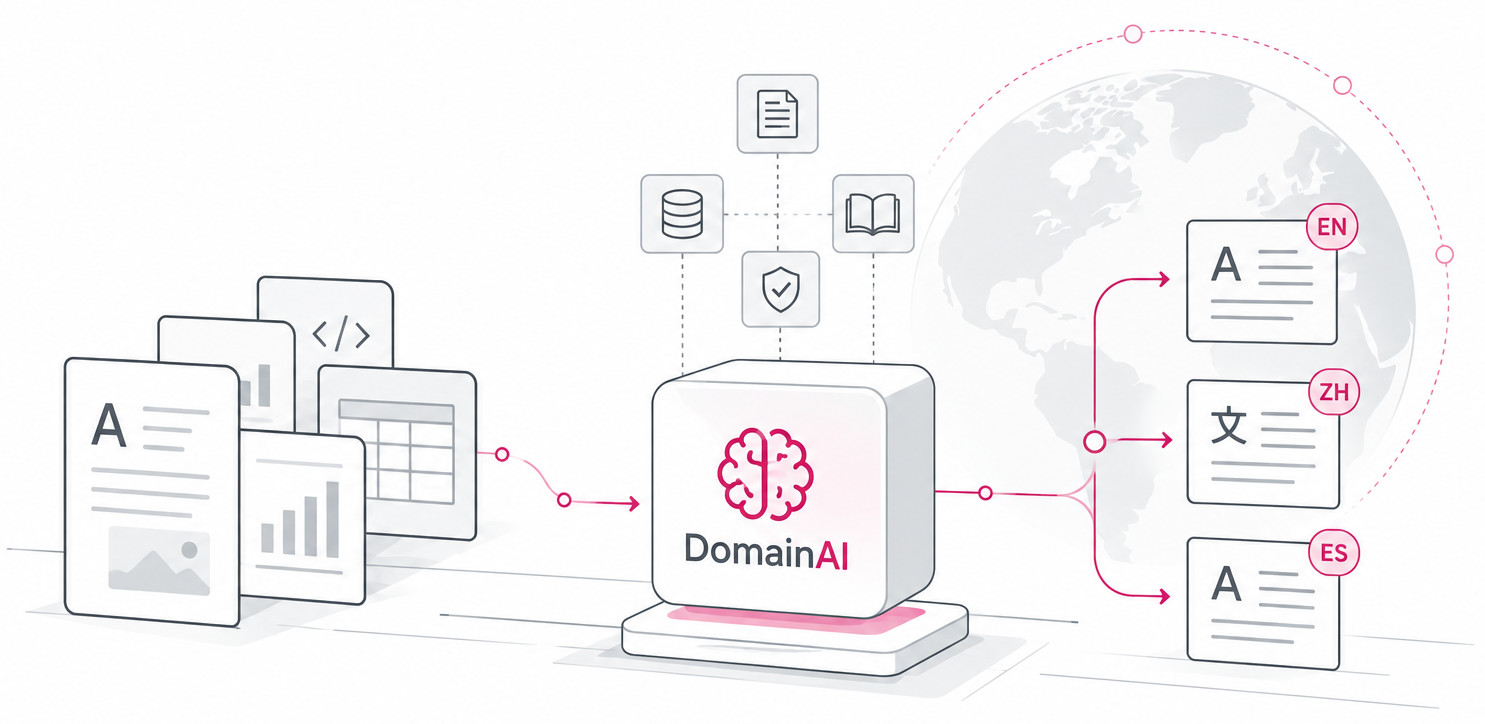
Built Around Your Content
Enterprise Translation Isn't One-Size-Fits-All.
A technical manual, a financial disclosure, and a software interface each demand a different kind of accuracy.
Fluent text alone is not enough. Teams need the terminology, context, quality controls, and review that suit how the content will actually be used.
DomainAI helps Stepes bring those requirements into the AI-assisted translation process—so the workflow responds to the content, not the other way around.
Explore the Stepes AI Translation PlatformTechnical documentation
Pressure relief valves, safety instructions, measured values
The same component names and critical instructions often appear across manuals, service procedures, and technical updates.
Financial content
Investor communications, statements, disclosures
Disclosures and reporting materials contain figures, defined terms, and market-specific language that require more than surface fluency.
Digital products
User interface strings, support articles, release notes
Interface strings must read naturally while fitting technical constraints and preserving the software experience.
Illustrative requirements for common enterprise content types.
Why Domain Intelligence Matters
AI Can Sound Right and Still Get Important Details Wrong.
Generic AI may produce natural-sounding text while missing a specialized term, changing a number, or overlooking a critical qualification. Enterprise translation requires a more controlled approach.
Meaning in Context
Technical expressions, regulatory language, legal definitions, and brand terminology need to be interpreted for the actual subject and audience.
Consistency Across Content
Terminology and approved translations should remain stable across product updates, teams, countries, and repeat publications.
Review Proportionate to Risk
Internal reference material and safety-critical instructions should not follow the same validation path. Content purpose determines the safeguards.
DomainAI Capabilities
Specialized translation is strongest when content knowledge, approved language, automation, and review work together.
Content-Aware Analysis
Evaluate the content’s domain, structure, audience, format, terminology needs, and intended use to help guide the translation approach.
Domain-Specific AI Guidance
Apply relevant subject-matter context, project instructions, approved references, and language conventions during AI-assisted translation.
Terminology & Translation Memory
Bring approved terms and previously validated bilingual content into recurring work to improve consistency and reduce unnecessary retranslation.
Workflow Selection & Routing
Choose suitable combinations of AI drafting, translation-memory reuse, professional post-editing, specialist review, and human-led work.
Automated Quality Checks
Help surface missing content, terminology deviations, altered numbers, protected strings, tags, and formatting issues for correction or further review.
Professional Validation
Involve qualified linguists and subject-matter reviewers where meaning, cultural suitability, compliance requirements, or business impact call for human judgment.
How DomainAI Works
Content-aware guidance informs each stage of a managed multilingual production workflow.
Understand
Evaluate content, language pairs, file structure, intended use, and quality expectations.
Prepare
Bring in glossaries, translation memories, style guidance, and reference documents.
Translate
Apply selected AI and professional workflows with appropriate domain guidance.
Check
Identify potential terminology, number, completeness, and structural issues.
Validate & deliver
Complete agreed linguistic review, technical QA, formatting, and approved delivery.
Language assets improve with every approved project.
Approved terminology, reviewer decisions, and validated translations can strengthen future projects and recurring releases.
Intelligence for Specialized Enterprise Content
Different industries have different language, regulatory, technical, and audience requirements. DomainAI adapts the translation approach to those realities.
Life Sciences & Healthcare
Medical devices, clinical content, patient communications, and scientific materials need specialist terminology and appropriate validation.
Medical Translation ServicesLegal & Compliance
Contracts, policies, and consequential legal documents need defined-term consistency, context, and controlled review.
Legal Translation ServicesBanking & Financial Services
Disclosures, reporting, and customer communications demand precise figures, specialized language, and reliable review.
Financial Translation ServicesManufacturing & Engineering
Specifications, operating instructions, and service manuals require controlled technical language and protection of critical details.
Manufacturing Translation ServicesSoftware & Technology
Applications, user interfaces, knowledge bases, and release notes need consistent product language and protected code elements.
Software Translation ServicesCorporate & Digital Content
Websites, training, marketing, and internal content need the right balance of speed, brand voice, localization, and oversight.
Website Translation ServicesAI + Professional Expertise
Choose the Right Level of Human Review.
DomainAI is not a promise that AI alone is suitable for every translation. The right workflow depends on content impact, visibility, regulatory obligations, and quality expectations.
Suitable informational and lower-risk content
AI-Accelerated
AI translation, approved reference assets, and automated checks help teams move efficiently when the content and intended use permit greater automation.
Customer-facing and business-critical content
Professionally Reviewed AI
Professional linguists review AI-assisted output for meaning, terminology, completeness, fluency, tone, and audience suitability.
Specialized and higher-impact content
Expert-Validated or Human-Led
Qualified specialists, independent review, and additional assurance are applied where required. A human-led workflow can be recommended when AI is unsuitable.
The best workflow is determined by the content's purpose and risk—not simply by how much can be automated.
Connect Intelligence With Your Language Operations.
DomainAI operates in the broader Stepes translation environment, supporting enterprise content handling, language assets, professional review, and controlled multilingual delivery.
Language assets
Approved glossaries, translation memories, style guides, and reference content help maintain consistency across ongoing multilingual programs.
Enterprise integration
Translation APIs and connected workflows support content exchange, managed projects, review, and delivery within broader business operations.
Multilingual coverage
Stepes supports translation across more than 100 languages. AI workflow suitability is evaluated by language pair, domain, and quality requirements.
Security & governance
Enterprise engagements consider access, confidentiality, approved processing technologies, retention, and documented review requirements.
Enterprise Evaluation
Test DomainAI With Your Own Content.
A focused pilot makes it easier to understand where AI-assisted translation creates value and what level of professional review your content requires.
Discuss a DomainAI PilotSelect representative content
Choose realistic samples, languages, formats, and subject matter.
Agree on evaluation criteria
Define accuracy, terminology, completeness, review effort, and turnaround goals.
Translate and validate
Evaluate the proposed workflow with qualified linguistic or subject-matter reviewers.
Plan for production
Identify suitable content types, required controls, and next-step opportunities.
Common Questions About DomainAI
Explore how domain intelligence, AI translation, professional review, language assets, and enterprise governance work together.
What is Stepes DomainAI?
DomainAI is Stepes’ domain-aware AI translation intelligence capability. It brings AI-assisted translation, specialized language guidance, approved terminology, translation memory, quality checks, and professional expertise together within managed enterprise workflows.
How is DomainAI different from a general-purpose AI translator?
General-purpose translation tools focus mainly on generating translated text. DomainAI considers the content’s domain, intended use, approved language assets, quality requirements, and appropriate review approach throughout a managed workflow.
Is DomainAI the same as the Stepes AI Translation Platform?
No. DomainAI provides content-aware translation intelligence and guidance. The Stepes AI Translation Platform supports the broader infrastructure for multilingual projects, language assets, quality review, professional workflows, integrations, and delivery.
Can DomainAI use our terminology and translation memory?
Yes. DomainAI-supported workflows can incorporate client-approved glossaries, translation memories, style guides, and reference materials. Preparation and integration depend on the assets and scope.
Does DomainAI replace professional translators?
No. DomainAI helps apply the right balance of automation and professional expertise. Customer-facing, specialized, regulated, or higher-impact materials may require qualified linguistic review, subject-matter validation, or human-led translation.
Can DomainAI support legal, financial, medical, and technical content?
Yes. Workflows can be configured for specialized subject matter. The level of AI assistance and professional validation depends on the content, language pair, applicable requirements, and intended use.
What languages and file formats are supported?
Stepes provides translation services in more than 100 languages and supports common enterprise document and structured-content formats. DomainAI-enabled workflow suitability depends on the language pair, file, subject matter, and quality requirements.
How is confidential content handled?
Stepes supports managed enterprise translation workflows. Data handling, technology approvals, confidentiality, access, hosting, and additional security requirements are evaluated with customers as part of project scoping.
Can we connect DomainAI to existing systems?
DomainAI capabilities work within the Stepes translation environment, which supports translation APIs and managed content workflows. Integration options depend on the systems, content formats, security requirements, and agreed technical scope.
Can we run a pilot before wider adoption?
Yes. Stepes can scope a representative evaluation with agreed language pairs, materials, quality criteria, review methods, deliverables, timelines, and commercial terms.
See DomainAI in Action
Smarter AI Translation Starts With the Right Intelligence.
Explore how content-aware AI, approved terminology, quality controls, and professional expertise can improve your enterprise translation workflow.
Enterprise Translation. Professional Expertise. Smarter Workflows.