SOFTWARE & SAAS
Software & SaaS Translation Services for Global Growth
Stepes helps software and SaaS companies create consistent multilingual experiences across products, websites, documentation, training, marketing, and customer support.
Our AI-powered translation technology, professional linguists, and connected localization workflows help global product teams move faster while maintaining quality, terminology, security, and brand consistency across every market.
CONNECTED CUSTOMER EXPERIENCE
Language Solutions for the Entire Software Customer Journey
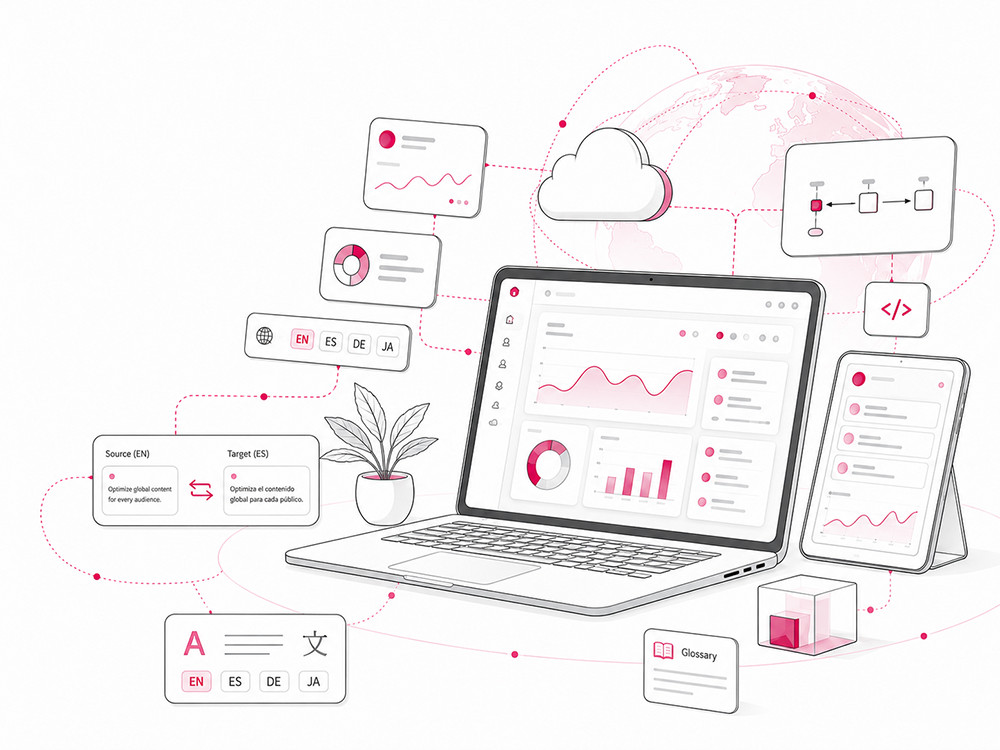
Global software success requires more than translating interface strings. Customers interact with your company through product experiences, websites, onboarding flows, documentation, training, campaigns, support channels, legal materials, and ongoing product communications.
Stepes helps software and SaaS companies manage these connected experiences through one scalable global language program. We support the content customers encounter from initial product discovery and free-trial registration to implementation, daily product use, customer support, renewal, and expansion.
Whether you are launching a SaaS product in new markets, expanding an enterprise software platform, supporting multilingual users, or coordinating continuous global releases, Stepes provides the technology, linguistic expertise, and operational support needed to scale confidently.
Global Content OperationsMODERN SOFTWARE OPERATIONS
Global Software Moves Fast. Localization Must Keep Pace.
Stepes designs multilingual programs around the realities of agile development, distributed ownership, fragmented strings, growing content volumes, and continuous product change.
Rapid Product Releases
New features, interface updates, bug fixes, onboarding improvements, and release communications may need localization on weekly, daily, or continuous schedules. Stepes helps multilingual content move alongside product development instead of becoming a downstream bottleneck.
Distributed Content Ownership
Product, engineering, marketing, customer success, support, legal, security, and learning teams often manage different parts of the global customer experience. Shared terminology, translation memories, quality standards, and centralized workflows keep them aligned.
Limited Linguistic Context
Short UI strings can be ambiguous when separated from their screen, function, or workflow. Screenshots, character limits, developer notes, metadata, and in-context review help linguists make decisions that fit the real product experience.
Expanding Content Volumes
Many companies begin with product UI and quickly expand into websites, help centers, training, campaigns, legal content, and customer communications. Stepes provides one language partner across this growing content ecosystem.
Market-Specific Requirements
Regional language variants, writing systems, currencies, dates, units, payment terminology, privacy requirements, and cultural expectations all shape a usable local experience. Stepes supports locale-level adaptation, not word-for-word translation alone.
Quality Across Continuous Updates
Frequent releases can introduce inconsistent terminology, outdated translations, and duplicated work. Translation memory, terminology management, automated QA, professional review, and structured feedback help protect quality over time.
END-TO-END COVERAGE
Localize Every Product and Customer Touchpoint
Stepes supports the complete multilingual content ecosystem surrounding software and SaaS products, from the interface itself to every channel customers use to discover, adopt, learn, and get support.
Product Interfaces and In-App Content
Localize navigation, dashboards, settings, notifications, error messages, search, billing experiences, embedded help, onboarding, and role-based interfaces across web, desktop, and cloud products.
Mobile Applications
Create localized iOS and Android experiences across mobile UI, onboarding, push notifications, subscriptions, app-store content, support, and device-specific linguistic and cosmetic QA.
Websites and Digital Acquisition
Translate corporate sites, product pages, landing pages, pricing content, feature comparisons, campaigns, conversion flows, and multilingual search content that help buyers discover and evaluate your software.
Technical Documentation
Make complex products easier to implement and use with multilingual user guides, administrator documentation, developer resources, technical specifications, integrations, release notes, and troubleshooting content.
Help Centers and Knowledge Bases
Keep FAQs, how-to articles, troubleshooting procedures, embedded assistance, support macros, chatbot knowledge, service communications, and product updates synchronized with the localized product experience.
Marketing and Sales Content
Adapt product positioning, campaigns, presentations, demonstrations, email programs, customer stories, white papers, partner materials, and digital advertising while protecting brand voice.
Learning and Customer Enablement
Localize product academies, onboarding courses, certification programs, partner training, interactive tutorials, webinars, assessments, videos, subtitles, and voiceover for global users.
Legal, Privacy, and Security Content
Translate terms of service, privacy policies, subscription agreements, data-processing information, security documentation, trust-center materials, licensing terms, and compliance communications.
Built for Modern Software and SaaS Businesses
Different software categories create different localization requirements. Stepes adapts linguistic resources, workflow design, and quality controls to the product, audience, content type, release model, and level of risk.
B2B SaaS Platforms
Complex role-based interfaces, integrations, onboarding programs, administrator content, customer training, and recurring support needs.
Enterprise Software
Multi-module products, implementation materials, administrator documentation, partner enablement, and long-term release programs.
Cloud and Infrastructure
Technical interfaces, developer documentation, service communications, security content, and global customer support.
Developer Tools and APIs
Developer portals, API references, SDK content, command-line strings, implementation guidance, and technical communities.
Cybersecurity Software
Security interfaces, alerts, policy content, threat information, technical reports, and trust-center materials.
Fintech and Regulated SaaS
Specialized terminology, legal disclosures, security, privacy, quality controls, and jurisdiction-sensitive customer content.
Productivity and Collaboration
High-volume UI content, notifications, templates, mobile experiences, onboarding, and user education.
Consumer Software and Apps
Localized UX, subscriptions, acquisition campaigns, reviews, support, and market-specific engagement across devices.
Building AI products, models, or multilingual data programs? Explore Stepes solutions for AI & Machine Learning.
CROSS-FUNCTIONAL PROGRAMS
One Localization Program for Every Global Team
Give each business team the language workflows it needs while maintaining shared terminology, quality standards, visibility, and governance across the organization.
Enterprise Translation ManagementProduct and Engineering
Interface localization, source readiness, release alignment, APIs, automation, repositories, and in-product testing.
Localization Teams
Centralized projects, linguistic assets, terminology, translation memories, quality processes, reviewers, reporting, and supplier coordination.
Marketing
Websites, campaigns, product messaging, customer stories, sales content, brand voice, and multilingual SEO.
Customer Success and Support
Onboarding, help centers, training, support communications, knowledge resources, and terminology aligned with the product UI.
Legal and Security
Agreements, policies, disclosures, trust-center content, security documentation, and compliance communications through controlled workflows.
Learning and Enablement
Product academies, customer certification, partner programs, employee learning, multimedia, assessments, and supporting materials.
Procurement and Operations
Centralized governance, language-spend visibility, quality standards, service levels, and scalable global vendor operations.
Support Every Stage of Global Product Delivery
Stepes helps software companies build localization into product planning, development, launch, and continuous improvement instead of treating translation as a final production step.
Global Readiness
Assess products, audiences, markets, languages, systems, release frequency, quality expectations, and stakeholder responsibilities.
Source Preparation
Identify ambiguous strings, inconsistent terminology, embedded text, hard-coded formats, character limits, and localization-sensitive UI components.
Workflow Design
Match AI, translation memory, professional translation, review, QA, and approval stages to each content type and risk level.
Localization
Localize product, documentation, websites, marketing, training, support, legal, and customer-facing content through connected workflows.
In-Market Validation
Review linguistic quality, terminology, usability, formatting, visual presentation, and market appropriateness in context.
Global Release
Coordinate multilingual product delivery with websites, documentation, campaigns, training, and customer-support readiness.
Continuous Improvement
Reuse approved language, apply reviewer feedback, update terminology, and improve consistency and efficiency across future releases.
RESPONSIBLE AUTOMATION
AI-Powered Translation With the Right Level of Human Expertise
A support article, product button, campaign, privacy policy, and technical integration guide should not all follow the same translation workflow. Stepes matches automation and professional expertise to content purpose, visibility, complexity, and business risk.
High-Volume and Rapidly Changing Content
AI translation, approved terminology, automated QA, and targeted human review can accelerate support, knowledge-base, employee-facing, and operational content.
Product Interfaces and Documentation
Translation memory, terminology management, AI-assisted production, professional linguistic review, context, and software-specific QA protect precision and consistency.
Marketing and Brand Content
Professional translation and transcreation preserve intent, tone, persuasion, cultural relevance, and recognizable brand voice in each market.
Legal, Privacy, and Security Content
Specialist linguists, controlled workflows, approved terminology, and structured review support business-critical and higher-risk materials.
Training and Multimedia
Integrated production can combine translation, subtitles, voiceover, on-screen text adaptation, synchronization, and functional course QA.
CONNECTED WORKFLOWS
Connect Localization to Agile Product Development
Localization should move with product development, not wait at the end of it. Stepes supports connected workflows that reduce manual coordination and keep translation aligned with recurring releases.
- API-driven translation requests and automated project creation
- Content handoff, retrieval, workflow triggers, and approvals
- Translation-memory reuse and terminology synchronization
- Recurring string updates, version coordination, and release visibility
- Centralized project tracking and scalable professional review
PRODUCT LANGUAGE GOVERNANCE
Keep Product Language Consistent Across Every Channel
The name used for a feature in the interface should appear correctly in documentation, websites, training, support, legal content, and release communications. Stepes helps teams manage this consistency at scale.
Terminology Management
Manage product and feature names, technical vocabulary, approved translations, abbreviations, protected terms, definitions, and locale-specific usage guidance.
Terminology ManagementTranslation Memory
Reuse approved translations across releases and related content to reduce repeated work, preserve customer-approved language, and improve consistency.
Translation MemoryStyle and Voice
Maintain appropriate tone, formality, punctuation, capitalization, writing conventions, and brand voice across product, technical, support, and marketing content.
Style and VoiceCross-Content Alignment
Keep the language used in the interface aligned with documentation, websites, training, support, legal content, and release communications.
Cross-Content AlignmentDIGITAL PRODUCT QUALITY
Quality Controls Built for Software Experiences
Software translation quality includes more than linguistic accuracy. Localized content must display correctly, function as intended, fit the interface, and remain consistent with the surrounding product experience.
Translation Quality AssuranceLinguistic accuracy, fluency, grammar, terminology, tone, style, and locale appropriateness
Missing translations, number mismatches, tag errors, placeholder errors, punctuation, and formatting
Screenshot, preview, and in-product review for ambiguous strings and contextual decisions
Text truncation, overlap, line breaks, font support, encoding, alignment, and right-to-left display
Functional checks for language selection, navigation, links, workflows, input, and locale behavior
Structured reviewer feedback, issue resolution, and reuse of approved corrections across future releases
SECURITY & GOVERNANCE
Secure Localization for Business-Critical Software Content
Software localization programs can involve confidential roadmaps, unreleased features, proprietary technical materials, security documentation, and customer information. Stepes supports enterprise programs through controlled access, secure processes, and documented quality workflows.
Confidentiality agreements and customer-specific requirements
Controlled project access and secure content transfer
Role-based review, approval, and project visibility
Documented quality processes and data-handling controls
Security review support for enterprise programs
Additional oversight for regulated and higher-risk content
Software Translation in 100+ Languages
Stepes supports major global markets and specialized regional requirements with professional linguists selected for language, subject matter, content type, and project needs.
Our workflows account for regional variants, formality, right-to-left display, Asian writing systems, fonts, character encoding, dates, numbers, currencies, units, addresses, and local product or subscription terminology.
Explore Supported LanguagesA Global Language Partner for the Complete Software Business
Stepes combines software localization expertise, broad content coverage, connected technology, professional language resources, and enterprise program control.
Software Industry Expertise
Work with linguists and production teams familiar with cloud products, digital UX, technical terminology, documentation, support, and frequent product change.
One Partner Across the Customer Journey
Coordinate product, website, documentation, marketing, training, legal, knowledge-base, and support localization through one global language program.
AI + Human Workflows
Combine AI translation, translation memory, terminology, automated QA, professional linguists, subject-matter expertise, and structured review according to business need.
In-Context Quality
Use screenshots, notes, metadata, previews, and in-product review to improve decisions for short strings and digital experiences.
Agile Global Operations
Support recurring releases, frequent updates, multiple products, distributed stakeholders, and coordinated multilingual launches as your program grows.
Enterprise Control
Centralize terminology, translation memories, quality standards, project visibility, automation, review, and reporting across teams and languages.
GLOBAL PROGRAM MODELS
Built for Every Stage of Global Software Growth
Stepes supports software companies at different stages of global growth, from a first multilingual launch to centralized enterprise language operations.
Launch a SaaS Product in New Markets
Coordinate product localization with websites, onboarding, documentation, campaigns, training, legal content, and customer-support readiness so customers can discover, adopt, and use the product successfully.
Establish Continuous Localization
Connect recurring product updates with scalable translation, review, QA, delivery, terminology, and translation-memory reuse across every release.
Expand Multilingual Customer Support
Align help centers, knowledge bases, embedded assistance, training, support communications, and chatbot knowledge with the localized interface and documentation.
Manage Regulated or High-Risk Content
Apply specialist linguists, controlled review, security requirements, and additional quality oversight to product, privacy, security, legal, healthcare, financial, or compliance-related content.
Consolidate Global Language Operations
Bring disconnected product, marketing, support, documentation, and learning translation activities into a coordinated program with shared workflows, assets, and visibility.
Software and SaaS Localization Resources
Explore practical guidance for SaaS localization strategy, continuous delivery, global product readiness, quality assurance, and software testing.
LOCALIZATION GUIDE
SaaS Localization Guide
Plan a multilingual SaaS program across product experiences, websites, onboarding, documentation, support, and recurring releases.
Read the GuideCONTINUOUS LOCALIZATION
Continuous Software Localization
Connect agile development with translation, review, terminology, quality assurance, and multilingual release coordination.
Read the GuideQUALITY & TESTING
Software Localization Testing Checklist
Review linguistic, cosmetic, functional, layout, encoding, and locale behavior before releasing software in global markets.
Read the GuideGLOBAL PRODUCT READINESS
Internationalization vs. Localization
Understand how internationalization prepares software for global use and how localization adapts the experience for each market.
Read the GuideSoftware & SaaS Translation FAQ
Find answers about software translation, localization, continuous releases, integrations, quality, security, file formats, and global language support.
Ask Our Software Localization TeamSoftware and SaaS translation services help technology companies make their products and related content available in multiple languages. The scope may include interfaces, websites, mobile applications, documentation, help centers, onboarding, training, marketing, legal content, and customer support. A complete program can also include terminology, translation memory, localization engineering, quality assurance, testing, workflow automation, and continuous product updates.
Software translation converts product text from one language into another. Software localization adapts the complete product experience for a target locale. In addition to translation, localization may address layout, character limits, currencies, dates, numbers, fonts, writing direction, graphics, functionality, and local user expectations. Translation is therefore an essential part of localization, but not the entire process.
A SaaS company may need to localize its product interface, mobile applications, corporate and product websites, onboarding, documentation, help center, customer training, product videos, campaigns, sales materials, legal policies, security content, release notes, and customer-support communications. The right scope depends on the customer journey, target market, product maturity, support model, and global growth strategy.
Yes. Stepes supports recurring and continuous localization workflows for products that change frequently. Translation APIs, workflow automation, translation memory, terminology management, automated quality checks, professional review, and structured delivery can help keep multilingual content aligned with agile development and release schedules.
Stepes uses terminology databases, translation memories, style guidance, automated checks, professional review, and customer feedback to help maintain consistency. Approved terms can be shared across interface strings, documentation, websites, training, marketing, support, and legal materials so users encounter the same product language across every touchpoint.
Stepes provides API-enabled translation capabilities that can connect localization with software applications, content systems, and business workflows. APIs and automation can support project creation, content transfer, status updates, translation retrieval, and recurring processing. The appropriate integration model depends on your technical environment, content format, release process, and governance requirements.
Stepes supports linguistic, cosmetic, and functional localization testing according to project requirements. Testing may evaluate terminology, accuracy, untranslated content, truncation, text expansion, line breaks, fonts, encoding, layout, right-to-left display, navigation, links, input behavior, and locale-specific functionality using screenshots, preview environments, builds, devices, or customer-provided access.
Yes. Stepes supports right-to-left languages and Asian writing systems. Localization can address bidirectional layout, alignment, font support, character encoding, text expansion, input behavior, punctuation, line breaking, and locale-specific formatting. The exact testing and engineering requirements depend on the product architecture and target locale.
Stepes uses AI to accelerate translation, improve scalability, and support high-volume or frequently updated content. AI workflows can be combined with translation memory, approved terminology, automated QA, professional post-editing, linguistic review, in-context validation, and software testing. Human involvement is selected according to content purpose, audience, visibility, complexity, and business risk.
Stepes supports confidential software localization through controlled project access, secure content transfer, confidentiality agreements, structured workflows, defined review permissions, and documented quality processes. Customer-specific security and data-handling requirements can be reviewed during program setup, including needs related to unreleased products, proprietary technical content, and regulated information.
Stepes supports a broad range of software, structured content, document, web, mobile, multimedia, and localization formats. These may include resource files, XML, JSON, XLIFF, YAML, properties files, spreadsheets, content exports, documents, subtitles, and other structured formats. File handling is configured to protect tags, variables, placeholders, code elements, and formatting during translation.
Yes. Stepes translates help centers, knowledge bases, troubleshooting articles, onboarding materials, customer academies, certification programs, product videos, support communications, FAQs, chatbot knowledge, and embedded assistance. Shared terminology and translation memories help keep this content aligned with the localized product interface and technical documentation.
Build a Global Software Experience
Create a consistent multilingual experience across your product, website, documentation, marketing, training, and customer support with one scalable global language program.