
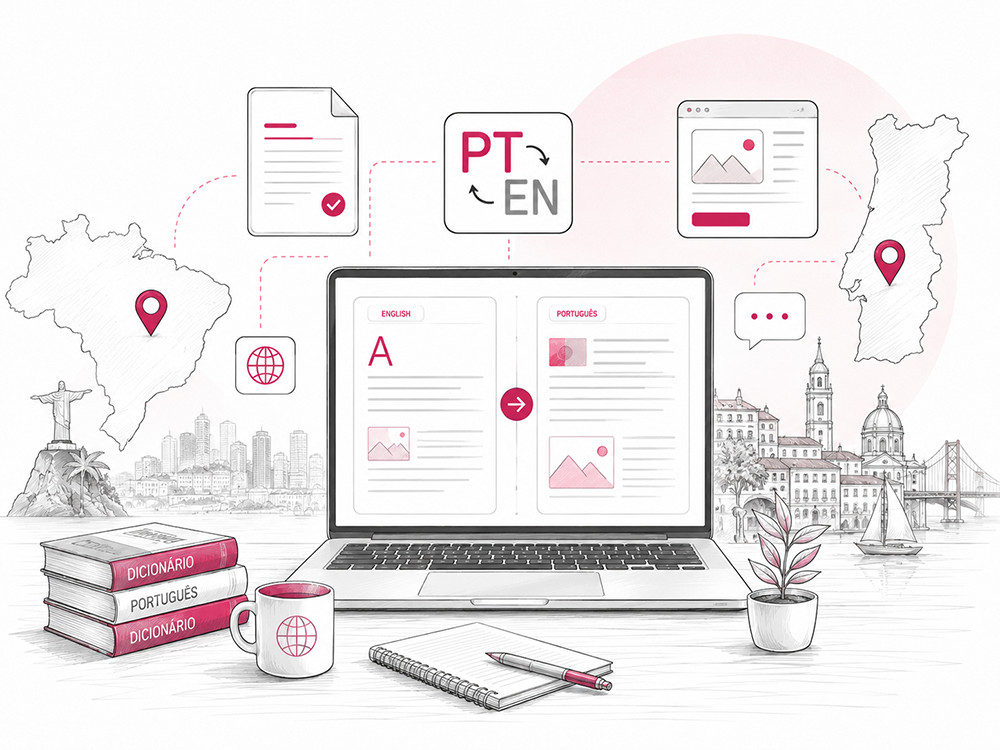
A Global Business Language
Portuguese Translation Built for Global Business
Portuguese connects organizations with customers, employees, regulators, healthcare professionals, and commercial partners across South America, Europe, Africa, and Asia. For most global companies, Brazil represents the largest Portuguese-language opportunity, while Portugal provides access to a highly connected European market and the broader European Union.
These markets share a language, but they do not share one localization standard. Vocabulary, tone, terminology, regulatory language, formatting, search behavior, and audience expectations can differ significantly.
Stepes helps your organization choose and deliver the right Portuguese for every market, content type, channel, and business objective.
Explore All Translation LanguagesMarket-Specific Portuguese
Brazilian Portuguese and European Portuguese Are Distinct Locales
Professional localization must account for differences in vocabulary, grammar, tone, pronunciation, digital conventions, search behavior, and regulatory terminology. A translation that feels natural in São Paulo may sound foreign in Lisbon, even when the basic meaning remains understandable.
Brazilian Portuguese
Localized for Brazilian customers, patients, regulators, employees, and digital users, with Brazilian terminology, tone, formatting, search language, and institutional references.
European Portuguese
Written and reviewed specifically for Portugal, including Portugal-specific vocabulary, software conventions, forms of address, euro formatting, and EU-facing communications.
Additional Lusophone Markets
Adapted when required for Angola, Mozambique, Cabo Verde, Guinea-Bissau, São Tomé and Príncipe, and other Portuguese-speaking audiences.
| Localization Dimension | Brazilian Portuguese | European Portuguese |
|---|---|---|
| Primary market | Brazil | Portugal |
| Vocabulary and syntax | Brazilian terminology and grammar conventions | Portugal-specific terminology and grammar conventions |
| Digital experience | Brazilian UI, ecommerce, search, and support language | Portugal-specific UI, search, and customer language |
| Currency and formats | Brazilian real and Brazilian date, number, and address formats | Euro and Portuguese date, number, and address formats |
| Regulatory language | Brazilian agencies, institutions, and ANVISA terminology | Portuguese and European Union institutions and terminology |
| Multimedia | Brazilian pronunciation, voice talent, and delivery | European Portuguese pronunciation, voice talent, and delivery |
Primary market
Vocabulary and syntax
Digital experience
Currency and formats
Regulatory language
Multimedia
Portuguese Markets We Support
One Language, Market-Specific Localization Strategies
Stepes configures Portuguese translation according to the intended country, audience, industry, and use case rather than applying a universal Portuguese version across unrelated markets.
Brazilian Portuguese Translation
Brazil is the commercial center of most enterprise Portuguese programs. Stepes supports companies entering the market, launching products, expanding local operations, supporting Brazilian employees, or managing continuous content.
- Customer experiences and digital commerce
- Software, SaaS, and product localization
- Technical, operational, and employee content
- Healthcare, regulatory, legal, and financial communications
European Portuguese Translation
Content for Portugal uses native European Portuguese terminology, phrasing, grammar, tone, and digital conventions rather than repurposed Brazilian content.
- Websites, ecommerce, and software
- Marketing and customer support
- Financial, legal, and EU-facing content
- Technical, medical, and employee communications
Global Lusophone Markets
Market-specific review can help adapt institutional language, terminology, audience expectations, and cultural context for Portuguese-speaking countries beyond Brazil and Portugal.
- Angola and Mozambique
- Cabo Verde and Guinea-Bissau
- São Tomé and Príncipe
- Equatorial Guinea and Timor-Leste
Complete Language Coverage
Portuguese Translation for Every Content Type
A product launch can involve a website, interface, technical manual, campaign, training video, support center, and regulatory documentation. Stepes provides one coordinated Portuguese solution across the entire content ecosystem.
Portuguese Document Translation
Translate business, legal, operational, financial, research, and regulatory documents while preserving structure, formatting, and usability.
- Reports and presentations
- Contracts and corporate records
- Policies and employee communications
- Product literature and research content
Portuguese Website Translation
Build localized digital experiences for customers in Brazil, Portugal, and additional Portuguese-speaking markets.
- Corporate and product websites
- Ecommerce and landing pages
- SEO metadata and navigation
- Help centers and customer portals
Portuguese Software Localization
Localize applications without disrupting technical syntax, interface context, or development and release cycles.
- UI strings and mobile apps
- SaaS and desktop platforms
- Release notes and app-store content
- Linguistic and functional testing
Portuguese Technical Translation
Protect technical meaning and terminology across the documentation used to install, operate, maintain, and service products.
- User and installation manuals
- Engineering specifications
- Maintenance and safety procedures
- Schematics, labels, and training
Portuguese Multimedia Localization
Extend Portuguese localization to video, audio, webinars, and interactive learning with market-appropriate voices and delivery.
- Subtitling and captioning
- Voiceover and dubbing
- Webinars and training videos
- E-learning and multimedia QA
Certified Translation and Interpreting
Support official documents, professional meetings, and specialized conversations with the appropriate Portuguese language service.
- Certified document translation
- Business and technical meetings
- Remote and on-site interpreting
- Conferences and healthcare settings
Subject-Matter Expertise
Industry-Specialized Portuguese Translation
Industry expertise matters when terminology carries technical, financial, legal, regulatory, or safety implications. Stepes assigns Portuguese linguists according to language credentials and subject-matter experience, then applies terminology and quality controls around the customer’s content.
Healthcare and Life Sciences
Medical devices, pharmaceuticals, clinical research, diagnostics, digital health, patient communications, eCOA, regulatory content, and medical software.
Medical Translation ServicesSoftware, SaaS, and Artificial Intelligence
User interfaces, mobile applications, cloud platforms, product documentation, AI assistants, multilingual data, customer support, and continuous localization.
Software and SaaS TranslationManufacturing, Engineering, and Aviation
Operating manuals, work instructions, product specifications, safety documentation, maintenance procedures, training, and supply-chain communications.
Manufacturing Translation ServicesEnergy and Natural Resources
Oil and gas, renewable energy, utilities, power infrastructure, engineering documentation, environmental content, field operations, and workforce training.
Energy Translation ServicesFinancial Services and Fintech
Banking applications, payment systems, insurance, customer communications, disclosures, compliance content, cybersecurity, and investor materials.
Financial Translation ServicesEcommerce and Retail
Product catalogs, online marketplaces, storefronts, checkout experiences, campaigns, packaging, retail operations, returns, and customer support.
Retail and Ecommerce TranslationLegal and Compliance
Commercial agreements, policies, privacy content, corporate governance, employment materials, investigations, and regulatory communications.
Legal Translation ServicesBrazilian Healthcare and Life Sciences
Portuguese Translation for Brazil’s Regulated Healthcare Market
Brazil is Latin America’s largest healthcare market, with approximately $135 billion in healthcare spending. For medical-device, pharmaceutical, clinical, diagnostic, and digital-health organizations, Brazilian Portuguese translation can be closely connected to regulatory communication, product access, patient safety, and correct product use.
Brazilian medical-device rules require relevant labeling and instructions for use to be available in Portuguese. Software as a medical device can also require Portuguese-language menus, explanations, or use instructions according to the applicable pathway.
Medical and Regulatory Content
- Labels, packaging, and instructions for use
- Regulatory submissions and technical documentation
- Clinical protocols, informed consent, eCOA, and eDiary
- Patient information, medical training, and pharmacovigilance
- Healthcare software interfaces and digital-health content
Quality Controls for Regulated Content
- Native Brazilian Portuguese medical linguists
- Subject-matter review and approved medical terminology
- Independent linguistic review and automated QA
- Numerical, unit, label, and layout validation
- Version control, documented approvals, and certificates
Digital Localization
Portuguese Experiences That Support Search, Conversion, and Product Adoption
Digital localization must address how people search, navigate, interact, and complete tasks in each market. Brazilian and European Portuguese may require separate keywords, metadata, terminology, interfaces, formatting, testing, and performance measurement.
Portuguese Website Translation and Multilingual SEO
Brazilian website localization and European Portuguese website translation require more than literal wording. Each market can use different search language, customer expectations, digital conventions, and calls to action.
- Market-specific keyword and search-intent research
- Titles, metadata, headings, page copy, and internal links
- Navigation, forms, messages, help content, and customer journeys
- Dedicated language URLs, hreflang, mobile parity, and crawlable content
- Connectors, APIs, proxy workflows, and continuous updates
Portuguese Software and App Localization
Software localization combines linguistic quality with technical accuracy, product context, locale behavior, and functional testing across each release.
- pt-BR and pt-PT resource-file localization
- Variables, placeholders, tags, plural rules, and length limits
- Screenshot and in-context translation support
- Truncation, layout, terminology, and functional localization QA
- Repository, API, and continuous localization workflows
AI Translation for Portuguese, Governed by Native Experts
AI can accelerate Portuguese translation, but Portuguese machine translation quality varies by model, locale, subject matter, and available context. Fluent output is not automatically accurate, market-appropriate, or ready for business use. Models may mix Brazilian and European terminology, alter approved names, apply the wrong regulatory language, or select the wrong meaning for a technical term.
Stepes matches the workflow to the content’s purpose, audience, visibility, and risk instead of applying the same level of automation to every file.
AI Translation With Automated Controls
A streamlined workflow for content used primarily for internal understanding, supported by language identification, terminology checks, and optional review.
AI Translation With Professional Post-Editing
Native Portuguese linguists review meaning, completeness, terminology, grammar, style, locale consistency, and audience suitability for customer-facing and operational content.
Expert Translation and Independent Validation
Regulated, legal, safety-critical, and high-visibility content can include specialist translation, independent review, subject-matter validation, formal approval, and documented version control.
Consistency, Control, and Scale
Portuguese Terminology and Enterprise Translation Workflows
Centralized language assets and connected workflows help keep Portuguese content consistent across websites, software, documentation, support, marketing, regulated content, departments, and release cycles.
Consistent Portuguese Terminology
Brazilian and European Portuguese resources can be maintained separately so approved language is reused without introducing terms from the wrong market.
Connected Enterprise Workflows
Stepes supports individual projects and ongoing Portuguese operations across teams, repositories, reviewers, products, and markets.
A Portuguese Translation Workflow Matched to Your Content
Every project begins with the intended market and use case. Stepes then configures the language resources, linguists, technology, quality controls, and review process around the content.
Define the Portuguese Market
Confirm Brazil, Portugal, multiple Portuguese locales, or another Lusophone audience before language assets and reviewers are assigned.
Analyze the Content
Evaluate file formats, volume, subject matter, audience, reuse, risk, security, quality requirements, and delivery schedule.
Prepare Terminology and References
Apply existing translation memories, glossaries, style guides, screenshots, product references, and previously approved content.
Select the Translation Workflow
Choose human translation, AI-assisted translation, post-editing, independent review, subject-matter validation, or certified translation.
Translate and Localize
Native Portuguese linguists work with the approved terminology, market conventions, context, and content-specific instructions.
Validate Quality
Perform linguistic review, automated QA, terminology checks, numerical validation, layout review, or functional testing as required.
Review and Approve
Give customer reviewers a structured way to resolve terminology decisions, provide feedback, and approve the final content.
Deliver and Reuse
Return content in the required format and retain approved translations and terminology for future releases and related projects.
Why Global Companies Choose Stepes for Portuguese Translation
Stepes combines native market expertise, industry specialization, language assets, quality controls, and connected technology to support both one-time projects and long-term Portuguese content programs.
Brazilian and European Portuguese Expertise
Stepes treats pt-BR and pt-PT as distinct locales, helping prevent mixed terminology and market-inappropriate language.
Native, Subject-Matter-Qualified Linguists
Translators and reviewers are selected according to the intended market, content type, industry, and required expertise.
AI-Powered Efficiency With Human Control
Use AI where it adds speed and scale, with professional linguistic governance matched to customer visibility and content risk.
Regulated and Technical Content Support
Specialized workflows support life sciences, software, engineering, manufacturing, energy, finance, and other terminology-intensive fields.
Terminology and Translation Memory
Approved language assets improve consistency, reuse, turnaround, and control across products, teams, markets, and channels.
Connected Enterprise Workflows
Portals, APIs, automation, role-based approvals, quality controls, and reporting support both one-time projects and continuous programs.
Enterprise Applications
Portuguese Translation for Real Enterprise Needs
Configure the program around the customer journey, product lifecycle, regulatory pathway, workforce, or content operation your organization needs to support.
Launch a Product in Brazil
Coordinate Brazilian Portuguese websites, software, product documentation, labels, marketing, training, and customer support.
Prepare Medical Content for Brazil
Translate IFUs, labeling, regulatory content, patient materials, clinical documents, and healthcare software with specialized controls.
Localize a SaaS Platform
Manage product strings, help content, release notes, app-store assets, and support content through a continuous workflow.
Support Manufacturing Operations
Translate manuals, work instructions, safety procedures, quality documentation, training, and employee communications.
Expand Ecommerce Operations
Localize product discovery, catalogs, checkout, payment messages, delivery information, returns, and customer support.
Serve Brazil and Portugal
Maintain separate pt-BR and pt-PT terminology, translation memories, metadata, testing, and approvals within one program.
Portuguese Translation Services FAQ
Practical answers about Portuguese variants, regulated content, AI translation, websites, software, pricing, turnaround, security, and ongoing programs.
What is the difference between Brazilian and European Portuguese?
Brazilian and European Portuguese differ in vocabulary, grammar, syntax, pronunciation, tone, forms of address, and common digital terminology. The differences are noticeable in marketing, software, ecommerce, technical documentation, and regulated content. Stepes manages the two variants as separate locales with market-specific linguists, terminology, translation memories, and review processes.
Which Portuguese variant should my company use?
Content for Brazil should normally use Brazilian Portuguese, or pt-BR. Content for Portugal should use European Portuguese, or pt-PT. Content for Angola, Mozambique, and other Portuguese-speaking markets may require additional market review. Stepes confirms the country, audience, industry, and use case before configuring the workflow.
Can one Portuguese translation be used in both Brazil and Portugal?
A single version may be understandable in both countries, but it is rarely the best choice for polished customer-facing or professional content. Market-specific terminology, tone, formatting, search language, and regulatory references can affect acceptance and usability. Organizations serving both markets should usually maintain separate versions.
Does Stepes translate both English to Portuguese and Portuguese to English?
Yes. Stepes supports English-to-Portuguese, Portuguese-to-English, and Portuguese translation involving other supported languages. Linguists are selected according to the language direction, target locale, industry, and intended use.
Does Stepes provide certified Portuguese translations?
Yes. Stepes can provide a signed certificate of translation for qualifying projects. Requirements may differ by court, regulator, university, government agency, or other receiving authority, so the intended use should be confirmed before translation.
Can Stepes translate medical-device labeling for Brazil?
Yes. Stepes translates Brazilian Portuguese labels, instructions for use, user manuals, regulatory materials, safety content, and medical-device software. Workflows can include specialist translation, independent review, approved terminology, automated QA, layout validation, and certificates of translation.
Does ANVISA require medical-device information in Portuguese?
Brazilian medical-device regulations require relevant label and instructions-for-use information to be available in Portuguese. Exact documentation requirements depend on the product and regulatory pathway, so companies should confirm current requirements with qualified regulatory professionals.
Can Stepes localize Portuguese websites for SEO?
Yes. Portuguese website localization can include market-specific keyword research, page content, metadata, headings, navigation, calls to action, image text, forms, help content, and ongoing updates. Brazilian and European Portuguese SEO should be planned separately because search terminology and user intent can differ.
Does Stepes provide Portuguese software and mobile-app localization?
Yes. Stepes supports user-interface strings, resource files, app-store content, documentation, help centers, release notes, linguistic testing, and continuous localization. Technical controls help protect placeholders, variables, tags, and other non-translatable elements.
Can AI translation be used for Portuguese content?
Yes, but the workflow should reflect the content’s risk and required quality. AI may be suitable for internal or low-risk content, while customer-facing, technical, medical, legal, and regulated content normally requires professional review. Stepes applies locale-specific terminology and native validation to reduce the risk of mixed Brazilian and European Portuguese.
How does Stepes prevent Brazilian and European Portuguese from being mixed?
Stepes can use separate locale codes, translation memories, glossaries, style guides, AI instructions, linguist teams, and QA rules for pt-BR and pt-PT. These controls help identify and prevent terms from the wrong market from entering the translation.
Which industries do your Portuguese translators specialize in?
Stepes supports healthcare and life sciences, software and SaaS, artificial intelligence, manufacturing, engineering, aviation, energy, financial services, ecommerce, legal services, and other specialized industries. Linguists are assigned according to language qualifications and subject-matter experience.
How much does Portuguese translation cost?
Portuguese translation rates vary by locale, source language, word volume, file format, subject matter, turnaround, repetition, and required review process. English-to-Portuguese translation cost can also change according to whether the content needs AI-assisted translation, professional post-editing, independent review, desktop publishing, or regulated-content controls. Translation memory can reduce the amount of repeated content requiring new translation.
Portuguese Translation Cost GuideHow quickly can Portuguese translation be completed?
Turnaround depends on content volume, complexity, file preparation, and quality requirements. Stepes can use multiple qualified linguists, translation memory, workflow automation, and appropriate AI assistance to accelerate large projects while maintaining terminology and review controls.
Which Portuguese-speaking markets does Stepes support?
Stepes supports Brazilian Portuguese, European Portuguese, and Portuguese for additional markets such as Angola, Mozambique, Cabo Verde, Guinea-Bissau, São Tomé and Príncipe, Equatorial Guinea, and Timor-Leste. Market-specific review may be recommended depending on the audience and content.
Can Stepes manage recurring Portuguese translation programs?
Yes. Stepes supports ongoing websites, software releases, product documentation, customer support, regulatory updates, marketing content, and other continuous programs. APIs, connectors, translation memory, terminology management, approval workflows, and reporting can be combined into a scalable enterprise solution.
How does Stepes protect confidential Portuguese content?
Security controls can include secure file handling, role-based access, controlled reviewer permissions, defined workflows, and traceable approvals. Specific security and governance requirements are reviewed when configuring the program.
Can our in-country reviewers participate in the approval process?
Yes. Your in-country linguists, local employees, product specialists, legal teams, and regulatory reviewers can participate through defined review and approval steps. Their decisions can be captured and incorporated into terminology resources for future projects.
Translate Your Content for Brazil, Portugal, and Portuguese-Speaking Markets
Whether you are entering Brazil, localizing software for Portugal, preparing regulated healthcare content, or managing an ongoing Portuguese program, Stepes combines native linguistic expertise, industry specialization, AI-powered workflows, terminology governance, and enterprise quality controls to help your organization communicate accurately and scale efficiently.