
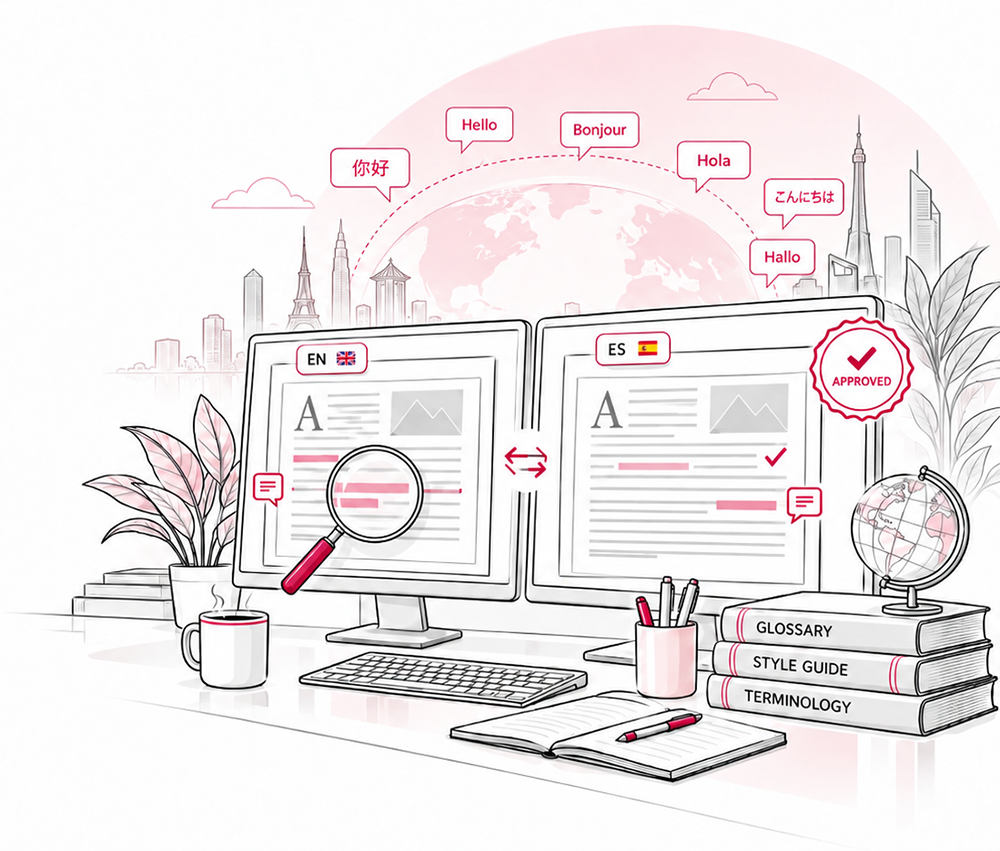
Independent Translation Review From Any Source
Keep the workflow that works for your organization and add the professional quality control your content requires.
Keep Your Translation Workflow. Add an Independent Quality Layer.
Organizations increasingly create multilingual content through a combination of translation agencies, internal teams, regional offices, translation memory, machine translation, generative AI, and other language technologies. What matters at the review stage is not where the translation came from, but whether it accurately communicates the original meaning and is ready for its intended use.
Stepes provides independent source-to-target review across languages, content types, and production methods, from a single document to an ongoing multilingual quality program.
Another Translation Provider
Verify work delivered by an existing language service provider without disrupting the current relationship or production workflow.
Internal or In-Country Teams
Professionally review translations created by bilingual employees, distributors, regional teams, or other internal resources.
Freelance Translators
Add an independent second-linguist review when important or specialized content needs another quality layer.
Legacy Translations
Evaluate existing documents, websites, product content, terminology, and translation memories before reuse or migration.
AI and Machine Translation
Apply professional human review to multilingual content generated by AI models, MT engines, or enterprise language technologies.
Stepes Translations
Add independent revision, specialist validation, or additional review layers when project requirements call for greater control.
What Professional Translation Review Checks
Professional review goes beyond whether the translated text sounds good. It verifies whether the translation is accurate, consistent, appropriate, and fit for its intended purpose.
Accuracy & Meaning
Verify that the translation preserves the source meaning, intent, logic, qualifications, and context without mistranslations, omissions, or unintended additions.
Terminology
Check approved glossaries, technical vocabulary, product names, defined terms, acronyms, do-not-translate terms, and cross-file consistency.
Fluency & Readability
Evaluate grammar, syntax, spelling, punctuation, sentence structure, clarity, naturalness, and target-language expression.
Consistency
Review repeated terminology, style, capitalization, labels, product naming, numbers, references, and reused content across files.
Locale & Audience Fit
Confirm regional language conventions, tone, formality, cultural suitability, dates, numbers, units, and market-specific language preferences.
Completeness & Content Integrity
Check numbers, measurements, URLs, variables, placeholders, tags, labels, interface strings, missing content, and formatting-sensitive elements.
Choose the Right Level of Translation Review
An internal communication, a customer-facing product page, a technical safety instruction, and a regulatory document do not require the same review depth. Stepes helps match the quality workflow to the content, audience, risk, and intended use.
Translation Proofreading
Target-language review focused on grammar, spelling, punctuation, readability, fluency, and stylistic polish when the underlying translation has already been validated.
Bilingual Translation Review
Source-to-target comparison for meaning, accuracy, completeness, terminology, consistency, and language quality when you need to validate an existing translation against its original source.
Independent Linguistic Revision
A qualified second linguist independently reviews and corrects an existing translation for important customer-facing, technical, specialized, or business-critical content.
Linguistic Quality Assessment
Structured evaluation using agreed error categories, severity levels, acceptance criteria, and reporting when the goal is to measure translation quality.
Subject-Matter Review
Specialist review for terminology and domain accuracy in medical, legal, financial, engineering, scientific, software, manufacturing, or other complex content.
Enterprise Quality Assurance
Broader governance across terminology, translation memory, automated QA, review workflows, approvals, reporting, and continuous improvement.
How Our Translation Review Process Works
A dependable review begins by understanding what the content is, who will use it, and what level of quality is required.
Submit the source and translation
Provide the original content, the existing translation, and any available glossaries, style guides, translation memories, approved references, or market-specific instructions.
Define the review requirements
We align the review scope with the target audience, locale, subject matter, publication channel, business or regulatory significance, reviewer qualifications, and required deliverables.
Perform expert source-to-target review
A qualified linguist evaluates the translation against the original source for meaning, completeness, terminology, fluency, consistency, locale fit, and other agreed quality criteria.
Correct and resolve findings
Confirmed issues are corrected. Reviewer questions, source ambiguities, terminology decisions, alternative wording, and subject-matter questions can be documented when additional input is needed.
Complete final QA and delivery
Stepes verifies that approved changes have been applied and delivers the requested outputs, from corrected translations and tracked changes to comments, linguistic quality assessment (LQA) findings, or publication-ready files.
Independent Third-Party Translation Review
Sometimes the best way to address a translation concern is to obtain an independent opinion. Stepes can work strictly as a quality-review partner without requiring you to change your existing translation supplier, internal process, or localization technology.
Investigate quality concerns
Independently examine translations when regional teams, customers, employees, or subject-matter experts raise questions about quality.
Benchmark an existing provider
Review representative samples to understand linguistic performance across languages, content types, or projects.
Validate high-impact content
Add an independent review layer before important multilingual content is published, submitted, distributed, or released.
Assess legacy translations
Evaluate older multilingual assets before reuse, migration, translation-memory import, or republication.
Support vendor selection
Compare translation samples against defined criteria instead of relying only on subjective preferences.
Verify corrective work
Review revised content to confirm that previously identified issues were addressed consistently and completely.
From Translation Corrections to Structured Quality Assessment
Choose the review output your organization needs, from a corrected final translation to annotated findings, linguistic quality assessment scorecards, and supplier-quality assessments.
Corrected Translation
A professional reviewer directly corrects confirmed issues and returns a revised translation ready for the next stage of your workflow.
Annotated Linguistic Review
Corrections can be accompanied by comments or explanations when client stakeholders, original translators, or subject-matter experts need additional visibility.
Linguistic QA Scorecard
Findings can be categorized by error type and severity to distinguish minor language issues from errors that materially affect meaning, usability, consistency, or risk.
Translation Vendor Quality Assessment
Representative samples can be reviewed across agreed languages and content types to identify recurring patterns, compare performance against agreed criteria, and support supplier decisions.
Match Reviewer Expertise to the Content
The right reviewer is not simply someone who speaks the target language. Stepes can align reviewer selection with the locale, subject matter, content function, and level of risk involved.
Language & Locale
Professional reviewers should bring the language proficiency and market-specific knowledge needed for the target audience and locale.
Subject-Matter Expertise
Domain knowledge can be matched to medical, legal, financial, technical, scientific, software, manufacturing, or other specialized content.
Content Type & Purpose
Reviewer experience should reflect how the content functions, from customer-facing marketing and user interfaces to contracts, manuals, and regulated documentation.
Risk & Review Requirement
Reviewer qualifications and review depth can be aligned with business impact, regulatory significance, safety considerations, and intended use.
Streamlined In-Country and Client Review
Your regional teams and internal experts often hold valuable product, market, regulatory, and terminology knowledge. Stepes helps turn that knowledge into controlled, actionable multilingual feedback.
Professional linguists can help distinguish objective translation errors from stylistic preferences, clarify proposed changes, reconcile conflicting feedback, and ensure accepted revisions remain linguistically correct.
Approved language decisions can also be incorporated into terminology resources and translation memory rather than remaining scattered across emails, spreadsheets, PDFs, and individual projects.
Bring the right stakeholders into one quality process
- In-country marketing teams
- Product managers
- Regulatory specialists
- Medical or technical subject-matter experts
- Legal and compliance teams
- Regional sales organizations
- Terminology owners
- Localization managers
- Content owners
- Final approvers
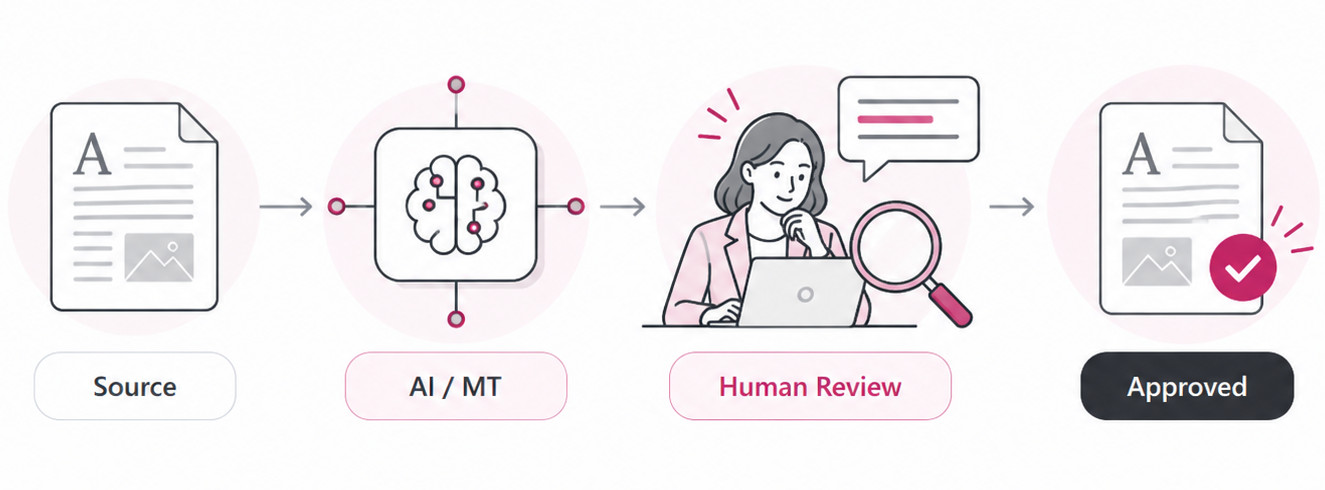
Human Review for AI and Machine-Translated Content
AI and machine translation have expanded the speed and scale of multilingual content creation. But the appropriate level of human review still depends on what the content says, who will use it, and what happens if the translation is wrong.
A fluent translation is not necessarily a validated translation. Stepes can review automated output for source meaning, terminology, omissions, qualifications, numbers, context, regional language, and other requirements that may not be obvious from fluency alone.
Expert Translation Review Across Critical Content Types
Review requirements can be adapted according to the content's visibility, complexity, audience, lifecycle, and potential impact.
Life Sciences & Medical Devices
Review multilingual content where precision supports patient understanding, clinical activities, product use, regulatory submissions, or healthcare communication.
- Instructions for use
- Labels & safety information
- Clinical documents
- Regulatory documentation
- Patient-facing materials
- Medical communications
Legal & Financial Content
Verify terminology, qualifications, numerical information, defined terms, and source meaning where small wording changes can materially affect understanding.
- Contracts & agreements
- Corporate policies
- Compliance materials
- Disclosures
- Financial reports
- Business-critical correspondence
Technical & Manufacturing Content
Check translations that support real-world products, processes, users, equipment, and operations for terminology and functional accuracy.
- User manuals
- Installation instructions
- Technical specifications
- Engineering documents
- Standard operating procedures
- Maintenance & service content
Software, Marketing & Digital Content
Review language in context across digital experiences, product interfaces, web content, campaigns, help content, and customer communications.
- Websites
- Applications
- User interfaces
- Product content
- Help centers
- Marketing campaigns
Translation Review for Regulated Content
Regulated multilingual content may require more disciplined review than general business communication. Stepes supports review workflows aligned to the specific content, jurisdiction, customer instructions, and applicable approval process.
Depending on the project, review may need to address accurate source-to-target correspondence, controlled terminology, reviewer qualifications, specialist knowledge, version consistency, traceable corrections, structured approval, and regulatory or client-specific formatting requirements.
For example, multilingual medicinal product information in Europe is subject to formal linguistic review requirements. These processes illustrate why regulated translation quality involves more than grammatical correctness.
Turn Review Feedback Into Lasting Translation Quality
A corrected term, approved product name, clarified phrase, or preferred expression should not need to be rediscovered every time new content is translated.
Terminology Management
Validated terminology can be added to controlled glossaries so preferred product, technical, legal, regulatory, or brand language is applied more consistently.
Translation Memory
Approved source-and-target content can be retained for reuse when the same or similar text appears in future projects.
Style Guidance
Recurring preferences involving tone, capitalization, formatting, phrasing, or audience conventions can be documented for future linguists.
Reviewer Feedback
Repeated findings can reveal opportunities to improve translation instructions, terminology controls, resource selection, or upstream processes.
AI & Machine Translation Guidance
Validated terminology, approved translations, and recurring review findings can also inform prompts, reference assets, glossaries, and human-review rules for future AI- and MT-assisted workflows.
Professional Review Backed by Structured Quality Processes
Enterprise translation review requires more than finding someone who speaks the target language. Stepes combines professional linguists, subject-matter expertise, terminology management, translation memory, modern language technology, and structured quality processes across more than 100 languages.
ISO-Certified Translation ServicesProfessional native-language reviewers
Reviewer selection reflects language pair, locale, content type, subject matter, and project requirements.
Source-to-target validation
Bilingual review identifies meaning and completeness issues that target-only proofreading may not reveal.
Flexible quality models
Choose corrective review, independent revision, specialist review, structured LQA, or broader quality workflows.
Terminology and translation memory
Approved language assets help maintain consistency across projects, products, languages, and recurring releases.
Relevant ISO certifications
Stepes maintains ISO 17100 for translation services, ISO 9001 for quality management, and ISO 13485 for medical-device quality management.
Translation Review Services FAQ
Answers to common questions about bilingual review, third-party review, AI translation review, LQA, specialist review, and project delivery.
Translation review is the professional evaluation of an existing translation to determine whether it accurately reflects its source and meets the linguistic, terminology, consistency, locale, and quality requirements defined for the project. A bilingual reviewer typically compares the translated content directly with the original source.
Translation review usually includes source-to-target comparison and can identify mistranslations, omissions, terminology errors, altered meaning, and other bilingual issues. Proofreading primarily focuses on grammar, spelling, punctuation, readability, and stylistic polish in the target language.
Yes. You can provide the source content and translations from another provider, and Stepes can independently evaluate and correct them without requiring you to change your existing supplier.
Yes. We can review translations created by bilingual employees, regional offices, distributors, internal localization teams, subject-matter experts, or other company resources.
Yes. Stepes provides professional human review for translations generated by AI models, enterprise LLMs, machine translation systems, and other automated technologies. Our dedicated AI Translation Review Services page covers AI-specific review workflows in greater depth.
General translation review is source-agnostic and can cover translations produced by humans, agencies, internal teams, AI, MT, or other workflows. AI Translation Review Services focuses specifically on quality risks and validation requirements associated with AI-generated multilingual content.
Translation review evaluates multilingual content that already exists. Machine translation post-editing uses machine-generated output as the starting point within a defined translation production workflow and edits it to an agreed quality level.
Both options are available. Depending on the project, Stepes can provide a corrected final translation, tracked changes, reviewer comments, annotated findings, structured linguistic quality assessment (LQA) results, or a combination of deliverables.
Yes. When structured quality assessment is requested, findings can be classified using agreed error categories and severity levels to provide measurable quality information for benchmarking, supplier evaluation, monitoring, or process improvement.
Yes. Stepes supports specialized review across fields including life sciences, medical devices, legal services, finance, engineering, manufacturing, software, and technology. Reviewer selection is aligned with the language, subject matter, content type, and required review level.
Yes. Client employees, regional teams, technical experts, regulatory specialists, marketing teams, and other stakeholders can participate. Stepes can help reconcile feedback, clarify linguistic issues, and retain approved terminology and language decisions for future projects.
Stepes supports a wide range of business, publishing, technical, localization, and digital file formats. Depending on the project, review may involve Microsoft Office files, PDFs, structured localization files, website or software content, technical documentation, and other multilingual formats.
Pricing depends on language pair, word count, subject matter, file format, current translation quality, required review depth, turnaround time, and requested deliverables. A light verification review requires a different level of effort from extensive corrective or specialist review.
Turnaround depends on language combination, content volume, subject matter, current translation quality, review depth, file complexity, and the number of reviewers involved. Stepes supports standard and expedited review workflows where feasible.
No. Stepes can work entirely as an independent quality-review partner while you continue using your existing provider, internal workflow, AI platform, or localization technology.
Need an Independent Review of Your Translation?
Whether your translation was produced by another language company, an internal team, a freelance translator, machine translation, AI, or Stepes, our reviewers can help identify issues before the content reaches your audience.