
Global Digital Learning
eLearning Translation & Localization Services
Translate complete digital learning experiences for employees, customers, partners, and learners worldwide. Stepes brings native linguists, multimedia specialists, course engineers, and functional QA together to deliver accurate, engaging, deployment-ready eLearning in 100+ languages.
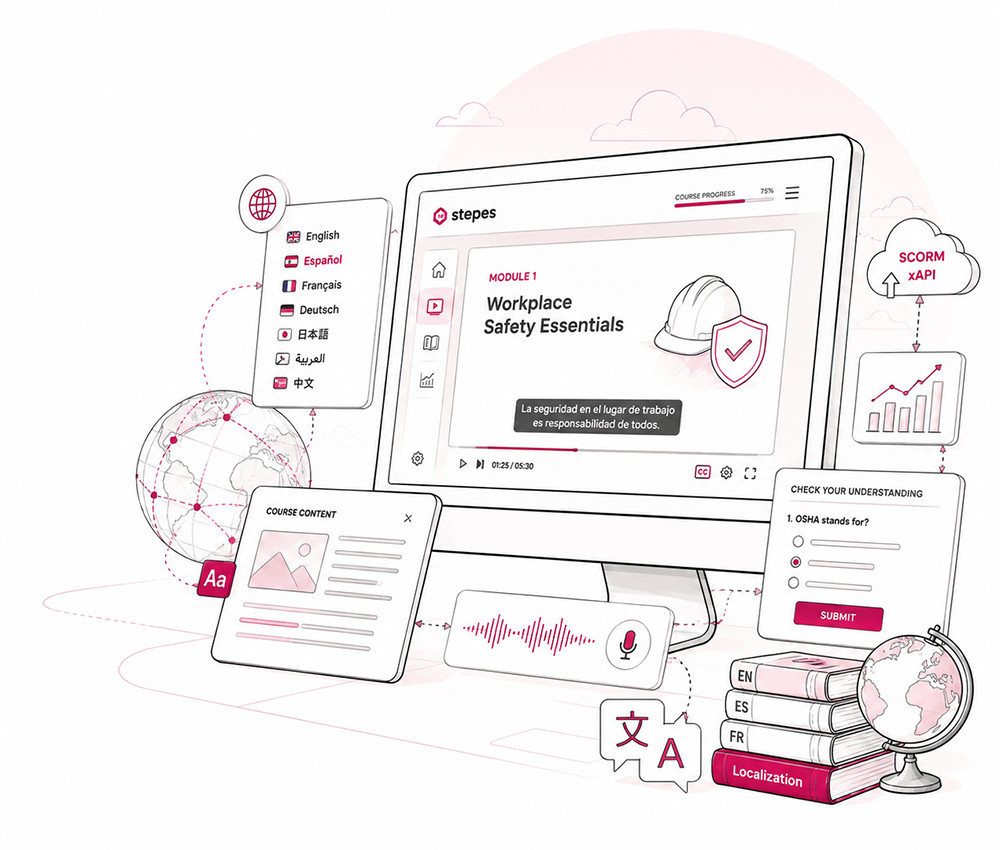
Complete Course Localization
From Source Files to LMS Deployment
An eLearning course is a connected learning system made up of instructional text, narration, video, animation, assessments, interactive logic, visual assets, technical packaging, and learner tracking. Successful localization must preserve the complete experience across languages.
Stepes supports organizations that need translated language assets as well as teams seeking complete multilingual course production. Our workflow can extend from source review and translation through multimedia production, course engineering, testing, and publish-ready delivery.
Translation-Only Delivery
For organizations with internal eLearning developers, Stepes can deliver professionally translated assets ready for your production team.
- Translated scripts and spreadsheets
- XLIFF and structured resource files
- Subtitle and caption files
- Voiceover and multimedia assets
- Terminology and translation memory
Complete Course Localization
For end-to-end delivery, Stepes manages language production, multimedia, course rebuilding, technical QA, and final package preparation.
- Source-file review and content inventory
- Translation and linguistic review
- Voiceover, subtitles, video, and graphics
- Course reintegration and engineering
- SCORM and LMS-ready testing
Every Component of Your eLearning Course
Stepes localizes the visible content learners experience together with the embedded media, interactions, and technical resources required to make each course function correctly.
Course Text and Interface
Translate lesson content, slide text, navigation, menus, tooltips, prompts, feedback, completion messages, certificates, and downloadable learner resources.
- Lessons and modules
- Buttons and navigation
- Prompts and feedback
- Certificates and resources
Assessments and Interactions
Localize questions, answer choices, knowledge checks, simulations, branching scenarios, drag-and-drop activities, scoring feedback, and gamified learning elements.
- Quizzes and knowledge checks
- Branching scenarios
- Simulations
- Scoring and feedback
Audio and Narration
Produce multilingual narration, character dialogue, instructor audio, pronunciation guidance, human voiceover, AI voiceover, and synchronized replacement audio.
- Human voice talent
- AI voice with expert review
- Pronunciation control
- Audio editing and mastering
Video and Animation
Translate speech, subtitles, captions, on-screen graphics, lower thirds, software demonstrations, product walkthroughs, webinars, and animated training content.
- Subtitles and captions
- Dubbing and narration
- On-screen text
- Timing and rendering
Graphics and Visual Assets
Update screenshots, diagrams, charts, infographics, interface captures, image-based labels, callouts, embedded PDFs, job aids, and supporting documents.
- Screenshots and diagrams
- Charts and infographics
- Localized graphics
- Supporting documents
Technical Course Components
Handle SCORM manifests, HTML5, XML, JSON, JavaScript-driven text, XLIFF, variables, layers, triggers, states, branching logic, metadata, and package naming.
- Structured resources
- Variables and triggers
- SCORM metadata
- Language-specific packages
Built for the Tools Your Learning Teams Already Use
Stepes adapts the localization workflow to your authoring environment, course standards, package structure, and LMS requirements. Native project files usually provide the most reliable path to complete course localization.
Articulate Storyline 360
Localize project files, slides, layers, object states, triggers, variables, assessments, embedded media, voiceover timing, and published SCORM output.
Articulate Storyline TranslationArticulate Rise 360
Support structured XLIFF workflows, responsive text expansion, interactive blocks, knowledge checks, embedded media, mobile display, and language-version QA.
Rise 360 Translation ServicesAdobe Captivate and Additional Platforms
Translate Captivate, Lectora, iSpring, Elucidat, Adapt, Camtasia, PowerPoint-based courseware, custom HTML5 courses, and proprietary authoring environments.
Discuss Your Course EnvironmentMultilingual Course Audio
Narration Production and Synchronization
Localize the Complete Multimedia Learning Experience
Stepes integrates language services with audio, video, subtitle, graphics, and course-production expertise so learners receive a coordinated experience across every media layer.
- Native human voice talent
- AI voiceover with expert review
- Voice casting and pronunciation control
- Subtitles and closed captions
- Video dubbing and narration
- On-screen text and graphics
- Software demonstration updates
- Animation and slide timing
- Audio editing and mastering
- Final rendering and reintegration
A Proven Process for Translation, Engineering, and Testing
Our workflow connects linguistic preparation, multimedia production, course engineering, and quality assurance from the beginning so every language version moves through a controlled production path.
Source Review and Technical Discovery
Review source files, authoring technology, multimedia, interactions, target languages, LMS environment, deliverables, and schedule before production begins.
Content Inventory and Scope Confirmation
Identify translatable course text, audio, video, graphics, assessments, reference files, published packages, and non-translatable technical content.
Localization Preparation
Prepare translation memory, terminology, style guidance, pronunciation lists, file-handling rules, references, and reviewer instructions.
Translation and Linguistic Review
Native linguists preserve instructional clarity, learning objectives, subject terminology, brand voice, regulatory meaning, and local language conventions.
Voiceover and Multimedia Production
Create the required narration, subtitles, localized video, graphics, screenshots, audio edits, timing adjustments, and other multilingual media.
Course Engineering and Reintegration
Rebuild localized content in Storyline, Rise, Captivate, SCORM, HTML5, or the source environment while preserving variables, triggers, logic, and learner flow.
Linguistic and Functional QA
Review the course in context for language, layout, navigation, assessments, audio, video, fonts, browsers, responsive behavior, and interactive functionality.
LMS Validation and Final Delivery
Validate launch, bookmarking, resume behavior, completion, scoring, reporting, package integrity, and the agreed final source and delivery files.
Complete Course QA
Test the Learning Experience, Not Just the Translation
A course can be linguistically correct and still fail when text is truncated, an answer is scored incorrectly, narration does not play, or the LMS cannot record completion. Stepes combines linguistic, visual, functional, and technical QA.
- Text expansion and contraction
- Right-to-left course behavior
- CJK and complex-script rendering
- Broken variables or missing strings
- Audio clipping and subtitle errors
- Completion and scoring failures
Slide and Interface Text
Accuracy, fluency, terminology, context, line breaks, truncation, overlap, buttons, navigation, and language display.
Assessments
Question clarity, answer accuracy, feedback, attempts, scoring, branching, completion logic, and pass-or-fail behavior.
Audio
Script accuracy, pronunciation, tone, volume, file mapping, playback, clipping, timing, and synchronization.
Video
Subtitle accuracy, caption timing, on-screen text, audio alignment, playback, rendering, and visual quality.
Interactive Content
Hotspots, triggers, variables, layers, states, drag-and-drop activities, simulations, and learner navigation.
SCORM and LMS
Course launch, bookmarking, resume behavior, completion, scores, reporting, package loading, and browser compatibility.
Mobile and Responsive Courses
Readability, touch targets, media scaling, responsive layouts, orientation changes, and small-screen navigation.
RTL and Complex Scripts
Text direction, interface mirroring, fonts, encoding, punctuation, line wrapping, mixed-language content, and visual alignment.
AI + Human Expertise
AI Efficiency Without Losing Instructional Quality
AI can accelerate translation, transcription, terminology extraction, voice generation, subtitle production, change detection, and automated QA. Expert linguists and engineers remain responsible for context, terminology, instructional clarity, pronunciation, course functionality, and final release quality.
Expert Human Translation
Use professional human translation for regulated, safety-critical, customer-facing, brand-sensitive, or highly interactive learning where nuance and accountability are essential.
- Qualified subject linguists
- Full contextual review
- Risk-appropriate approvals
AI Translation With Expert Post-Editing
Combine AI speed with professional linguistic review for large employee-training libraries, product education, repetitive content, and multilingual rollouts with controlled quality.
- Translation memory reuse
- Approved terminology
- Professional post-editing
AI-First Translation With Targeted Review
Apply focused review to high-visibility sections, terminology, assessments, learner interactions, and critical content when lower-risk internal courses change frequently.
- Content-aware routing
- Targeted quality checks
- Human release control
Continuous Localization
Keep Every Language Current as Courses Evolve
Organizations often localize an initial course successfully but struggle to maintain many language versions when the source changes. Stepes supports recurring releases, annual compliance updates, product revisions, policy changes, new modules, and regional adaptations.
We identify changed content, reuse approved translations, update affected media, rebuild impacted language courses, test the relevant components, and maintain clear version histories. This reduces duplicated work while helping every language remain aligned with the current source.
eLearning Translation for Every Stage of the Learner Journey
Support employees, customers, partners, technicians, and professional learners with multilingual content designed for their role, context, and learning objective.
Employee Onboarding
Company orientation, HR policies, workplace expectations, systems training, benefits, codes of conduct, and role-specific learning paths.
Compliance and Safety
Workplace safety, data privacy, cybersecurity, anti-bribery, ethics, quality systems, environmental requirements, and regulated training.
Product and Technical Training
Software onboarding, equipment operation, installation, maintenance, troubleshooting, feature education, and technical certification.
Customer Education
Customer academies, self-service learning, product walkthroughs, feature training, best-practice courses, and certification programs.
Partner and Channel Enablement
Product knowledge, sales certification, reseller onboarding, technical support training, brand standards, and partner communications.
Professional Education
Continuing education, academic courseware, credentialing programs, student assessments, faculty training, and industry certification.
Subject-Matter Expertise
Specialized Training for Global Industries
Effective training translation requires linguists who understand the subject, audience, terminology, and operational context. Stepes builds language teams around each course’s industry and learning requirements.
Life Sciences and Healthcare
Clinical training, medical devices, pharmaceutical operations, quality systems, patient safety, pharmacovigilance, and healthcare compliance.
Healthcare Translation ServicesManufacturing and Industrial
Equipment operation, field service, workplace safety, assembly, maintenance, quality control, production processes, and supply chain training.
Manufacturing Translation ServicesSoftware and SaaS
Product onboarding, feature training, customer education, technical certification, software demonstrations, cybersecurity, and customer success programs.
Software & SaaS Translation ServicesFinancial Services and Insurance
AML, KYC, data privacy, risk management, internal controls, product education, agent training, and compliance learning.
Insurance Translation ServicesRetail and Customer Experience
Product knowledge, sales training, store operations, customer service, employee onboarding, brand standards, and seasonal programs.
Retail & E-commerce Translation ServicesEducation and EdTech
Digital curricula, online courses, assessments, student resources, faculty training, professional education, and learning applications.
Education Translation ServicesOne Team From Translation Through Release
Bring the language, multimedia, course engineering, quality, and ongoing maintenance behind global digital learning into one coordinated production program.
One Coordinated Production Team
Bring native linguists, multimedia specialists, course engineers, and QA reviewers into one connected workflow from source review through release.
A Workflow Matched to the Content
Apply expert human translation, AI-assisted production, targeted review, human or AI voiceover, and additional controls according to audience, risk, and update frequency.
Reusable Language Assets
Maintain approved terminology, translation memory, pronunciation guidance, and style decisions so new modules and course updates remain consistent.
Release-Ready Course Validation
Review language, layouts, media, interactions, assessments, package behavior, and LMS functionality before each localized course is delivered.
Explore Our eLearning Translation Expertise
Explore focused services for the authoring platforms, course formats, multimedia requirements, and supporting training materials within your global learning program.
Consistent Learning Experiences in 100+ Languages
Stepes supports major global languages, regional variants, right-to-left languages, CJK languages, complex scripts, and coordinated multilingual course launches.
Language-Specific Engineering
Our teams account for text expansion, font support, character encoding, date and number formats, voice accent, pronunciation, language codes, course-package naming, and responsive layout requirements.
- Spanish for the United States, Latin America, and Spain
- Canadian and European French
- Brazilian and European Portuguese
- Simplified and Traditional Chinese
- Japanese and Korean
- Arabic and Hebrew
- German, Italian, Dutch, and Nordic languages
- Vietnamese, Thai, Indonesian, and Malay
- Hindi and other South Asian languages
- Central and Eastern European languages
What to Send Us for an Accurate Quote
The right source materials help Stepes evaluate the translatable content, multimedia scope, engineering requirements, LMS testing, timeline, and final deliverables. Native authoring files usually provide the most efficient and reliable workflow.
When native files are unavailable, we can review published packages, exported text, scripts, media, and other available resources to determine what can be translated and rebuilt.
- Native authoring files
- Published SCORM packages
- XLIFF or structured text exports
- Audio and video source files
- Scripts and transcripts
- Editable graphics and fonts
- Target languages and locales
- Human or AI voiceover requirements
- LMS and testing requirements
- Expected launch date
- Existing translation memory and terminology
- Reviewer and approval requirements
eLearning Translation Services FAQs
Explore common questions about authoring files, SCORM, multimedia, voiceover, course engineering, quality assurance, timelines, pricing, and ongoing multilingual course maintenance.
Files, Formats, and Authoring Tools
What is the difference between eLearning translation and eLearning localization?
eLearning translation converts written or spoken course content into another language. eLearning localization adapts the complete learning experience, which can include text, narration, subtitles, graphics, screenshots, assessments, layouts, timing, interactions, SCORM packaging, and LMS testing.
What eLearning authoring tools does Stepes support?
Stepes supports Articulate Storyline, Rise 360, Adobe Captivate, Lectora, iSpring, Elucidat, Adapt, Camtasia, PowerPoint-based courseware, custom HTML5 environments, and other proprietary authoring systems. We review each course to confirm the most effective workflow.
Can Stepes work directly from Articulate Storyline or Captivate files?
Yes. Native project files usually provide the best foundation for complete localization because they give direct access to text, layers, triggers, variables, media, assessments, and publishing settings. We can also provide translation-only deliverables when your team manages reintegration.
Can you translate a published SCORM package without the original authoring files?
Sometimes. Feasibility depends on the package structure, course technology, available scripts and media, and expected final deliverables. Native authoring files are preferred, but Stepes can review a published package and explain what level of localization is practical.
Do you translate quizzes, variables, and branching logic?
Yes. Stepes translates learner-facing questions, answer choices, prompts, feedback, and variables. Functional QA can verify scoring, attempts, branching, triggers, completion behavior, and learner flow after the translated content is reintegrated.
Multimedia, Testing, and Review
Can Stepes localize embedded video and animation?
Yes. Our services can include transcription, translation, voiceover, subtitles, closed captions, on-screen text, graphics replacement, timing adjustments, audio mixing, rendering, and reintegration into the course.
Does Stepes provide both human and AI voiceover?
Yes. We support professional human voice talent, AI voiceover with expert linguistic and pronunciation review, and blended production models. The best approach depends on the audience, content risk, update frequency, budget, and desired learner experience.
How do you synchronize translated narration with animation?
Translated narration may be longer or shorter than the source. Our multimedia engineers adjust slide timing, animations, visual cues, pauses, and media placement so that the translated narration remains coordinated with the course.
How does Stepes test translated SCORM courses?
Testing can include course launch, navigation, assessments, scoring, completion status, bookmarking, resume behavior, audio and video playback, language display, package loading, browser behavior, and reporting. The exact testing scope is agreed before production begins.
Can Stepes test courses in our LMS?
Yes, when LMS access and testing are included in the project scope. We can validate a localized course in the client environment or a compatible testing environment, depending on access, security, and technical requirements.
How do you manage text expansion and right-to-left languages?
Stepes adjusts layouts, text boxes, fonts, alignment, spacing, interface direction, and visual elements for each language. For right-to-left languages, we also review mirroring, punctuation, mixed-language content, navigation, and media placement.
Can our in-country reviewers participate?
Yes. Stepes can include client reviewers for terminology approval, linguistic feedback, subject-matter validation, and final signoff. A defined review process and consolidated feedback help avoid conflicting changes and unnecessary rework.
Pricing, Delivery, and Ongoing Programs
How is eLearning translation priced?
Pricing depends on the production scope, including translation volume, languages, voiceover minutes, video duration, subtitles, graphics, course engineering, source-file condition, functional testing, and LMS validation. Stepes reviews the materials and provides a quotation based on the required deliverables.
How long does an eLearning localization project take?
Timelines depend on course length, language count, multimedia, authoring platform, engineering complexity, voiceover model, reviewer participation, and testing. Large programs can be delivered in language waves or course batches to support earlier launches.
Can translation memory reduce the cost of future course updates?
Yes. Translation memory identifies approved content that can be reused in later versions. This can improve consistency, reduce repeated translation effort, and shorten turnaround for annual updates, new releases, and regional adaptations.
What files should we provide for a quotation?
Provide native authoring files when possible, along with published packages, XLIFF or text exports, scripts, transcripts, audio, video, editable graphics, target languages, LMS information, voiceover preferences, timeline, and expected deliverables.
What final files will we receive?
Deliverables may include published SCORM or HTML5 packages, localized source files, translated scripts, voiceover audio, subtitles, localized videos, updated graphics, translation memory, terminology resources, and QA records. The final package is confirmed at kickoff.
Can Stepes support continuously updated course libraries?
Yes. Stepes supports ongoing eLearning localization using translation memory, terminology management, changed-content workflows, multimedia updates, rolling delivery, version control, and language-specific course maintenance.
Take Your eLearning Programs Global
Share your source files, target languages, multimedia requirements, LMS environment, and launch schedule. Our eLearning localization team will review the course structure, recommend the right workflow, and provide a clear quotation and delivery plan.