
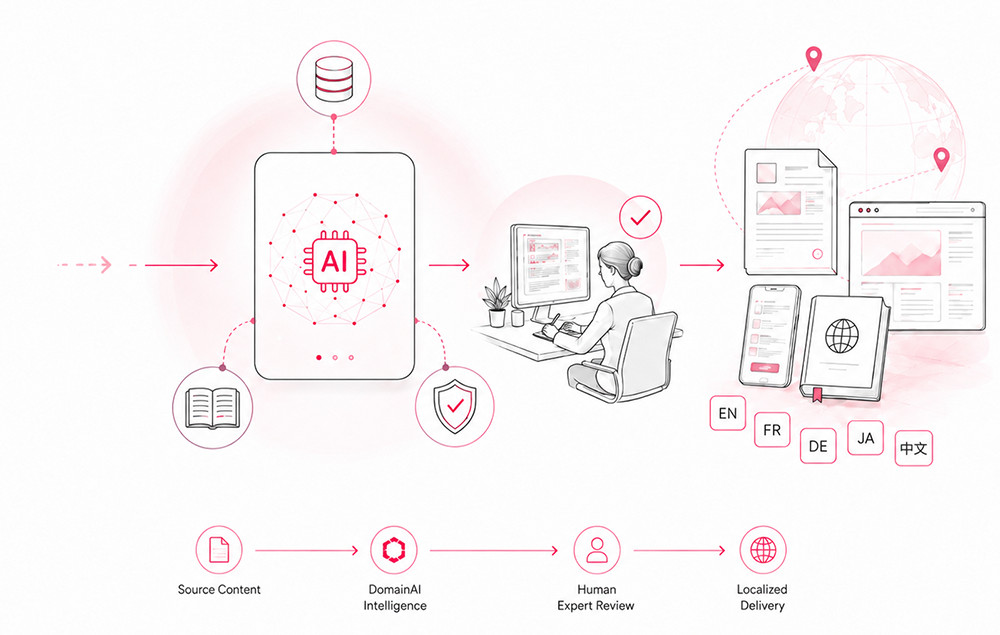
Enterprise AI Translation Built Around Your Content
AI translation is most effective when the technology, language assets, professional expertise, and quality controls are designed around the content’s purpose—not applied as a one-size-fits-all shortcut.
AI translation services use artificial intelligence to accelerate multilingual content production within a managed workflow. Depending on your requirements, that workflow can combine neural machine translation, large language models, translation memory, approved terminology, automated quality checks, professional linguistic review, subject-matter validation, file engineering, and final-format quality assurance.
The objective is not simply to generate translated text. It is to deliver multilingual content that is appropriate for its audience, consistent with your approved language, technically intact, and ready for its intended use.
A high-volume internal knowledge base, a public product page, a software interface, and a regulated medical document should not automatically follow the same production process. Stepes evaluates what the content does, who will read it, and what could happen if the translation is incomplete or incorrect before recommending a workflow.
Stepes DomainAI adds content-aware intelligence to this process by helping assess content, apply approved terminology and translation memory, identify quality risks, and recommend the appropriate level of professional review within a managed Stepes workflow.
Translate More Content
Expand multilingual coverage across documents, digital channels, product experiences, support resources, and recurring enterprise communications.
Accelerate Global Delivery
Move suitable content into translation faster, process multiple languages in parallel, and shorten recurring release cycles.
Improve Language Consistency
Apply approved terminology, previously translated content, product language, and locale guidance throughout production.
Maintain the Right Level of Control
Match automation, professional review, subject-matter validation, and approval to the purpose and risk of each content type.
WORKFLOW DESIGN
Choose the Right Level of AI and Human Review
Stepes combines content-aware workflow guidance with professional project and linguistic judgment to select the production model according to the content’s audience, visibility, language pair, complexity, regulatory exposure, and consequences of an error.
Fast Multilingual Access for Suitable Content
Use AI translation, translation memory, approved terminology, and automated checks to provide rapid access to lower-risk or short-lived information.
- Internal reference materials
- Research and content discovery
- Draft documents
- Temporary communications
- High-volume informational content
- Lower-visibility operational materials
Publish-Ready Content With Expert Linguistic Review
Professional linguists compare the AI-generated translation with the source and validate meaning, completeness, terminology, fluency, tone, locale conventions, and technical elements.
- Corporate websites
- Product information
- Knowledge bases
- Customer-support content
- Technical documentation
- Software interfaces
- Training and e-commerce content
Higher Assurance for Specialized and High-Impact Content
Where AI is appropriate, Stepes can add qualified linguistic review, subject-matter expertise, terminology verification, additional QA, and formal approval workflows.
- Medical and life sciences materials
- Medical device documentation
- Legal and compliance content
- Financial communications
- Regulatory documentation
- Safety-related materials
- Specialized engineering content
AI is not assumed to be suitable for every high-impact document. Stepes reviews the content, intended use, language pair, available references, and required assurance level before recommending the workflow.
Learn How AI and Human Review Work TogetherStepes DomainAI, Translation Technology, and Approved Language Assets
Stepes combines content-aware AI guidance, appropriate translation models, reusable language assets, automated quality controls, and professional expertise. No single model or engine is assumed to be best for every language, subject, or use case.
Content-Aware Translation Intelligence Inside a Managed Workflow
DomainAI helps Stepes adapt multilingual workflows to different content types, industries, terminology requirements, and quality expectations. It helps determine where AI can accelerate production, where approved language assets should guide the output, and where professional or specialist review is required.
Explore DomainAI on the Stepes AI Translation PlatformContent-Aware Workflow Recommendations
Align AI translation, professional review, terminology controls, and QA with your content type, intended use, and quality requirements.
Approved Language Asset Application
Bring approved terminology, translation memory, and previously validated language into the workflow to strengthen multilingual consistency.
Quality Risk Identification
Identify content that may require stronger review, specialist expertise, additional QA, or a more human-led translation approach.
Review-Level Guidance
Help match professional linguistic review and subject-matter validation to the audience, complexity, visibility, and potential impact of the content.
AI Translation Models
Stepes can apply neural machine translation, large language models, and other approved translation technologies according to language performance, content structure, confidentiality, and the required level of validation.
Translation Memory
Translation memory stores source content with its approved translation so identical or similar material can be reused or adapted across product releases, websites, software, documentation, and recurring programs.
Explore Translation MemoryTerminology Management
Approved termbases can govern product names, technical terms, regulated phrases, abbreviations, preferred translations, prohibited variants, definitions, and market-specific guidance.
Explore Terminology ManagementAutomated QA and Quality Signals
Automated checks can flag repeatable issues involving terminology, missing content, numbers, tags, variables, placeholders, untranslated text, locale formatting, and inconsistent translations.
Explore Translation Quality AssuranceProfessional Linguists
Professional translators and reviewers compare the target with the source and evaluate meaning, completeness, terminology, fluency, tone, locale conventions, and readiness for the intended audience.
Subject-Matter Expertise
Medical, legal, financial, scientific, engineering, and other specialist reviewers can be added when translation decisions require deeper domain knowledge or higher assurance.
How Stepes AI Translation Services Work
Stepes manages AI translation as a complete multilingual production process—from content assessment and language-asset preparation through professional review, technical validation, and delivery.
Content-aware analysis helps guide workflow decisions, while Stepes project teams and linguists remain accountable for final scope, review, quality, and delivery. Different content within the same program can follow different paths.
Define the Content and Intended Use
Confirm languages, regional variants, audience, publication channel, subject matter, quality expectations, required human review, file formats, turnaround, confidentiality, and business or regulatory risk.
Assess AI Translation Suitability
Use DomainAI-supported content assessment together with professional judgment to review source clarity, repetition, terminology density, language-pair performance, specialized language, file structures, formatting requirements, and the consequences of an error.
Prepare Linguistic Assets
Organize translation memories, approved glossaries, style guides, reference translations, product names, do-not-translate lists, brand guidance, locale instructions, and prior approvals.
Select the Production Workflow
Determine the appropriate combination of AI translation, translation-memory reuse, professional translation, post-editing, subject-matter validation, automated QA, client approval, and file engineering.
Generate the Initial Translation
Process approved content through the selected workflow while protecting document hierarchy, tags, markup, variables, software keys, product identifiers, repeated content, links, and relevant formatting information.
Apply Automated Quality Checks
Identify missing or untranslated content, terminology deviations, changed numbers, locale inconsistencies, tag and placeholder errors, protected-content changes, and repeated-source inconsistencies.
Perform Human Review Where Required
Professional linguists and specialists evaluate accuracy, completeness, terminology, grammar, fluency, tone, style, audience fit, locale appropriateness, technical meaning, and usability.
Validate, Deliver, and Improve
Complete the required linguistic, technical, visual, or functional checks, deliver the agreed files, and incorporate approved corrections into future translation memories, termbases, and project instructions.
AI Translation Quality Beyond Fluent-Sounding Text
AI-generated translations can appear natural while still containing errors that matter. Quality must preserve meaning, instructions, terminology, structure, and business intent—not merely produce polished sentences.
A warning can lose an important condition. A negative statement can be reversed. A product code, measurement, variable, or cross-reference can change. A translation can also be linguistically correct but unsuitable for the intended locale or audience.
Explore Stepes Translation Quality AssuranceAccuracy and Completeness
Identify mistranslations, omissions, unsupported additions, reversed meaning, incorrect relationships, ambiguous references, and changes in emphasis or scope.
Terminology
Verify product names, technical vocabulary, medical, legal, and financial language, brand expressions, regulated phrases, acronyms, and preferred or prohibited variants.
Numbers and Factual Elements
Review dates, measurements, units, currencies, percentages, dosages, quantities, names, addresses, product identifiers, references, and version numbers.
Consistency and Locale Fit
Align repeated content, interface terms, headings, regional vocabulary, spelling, tone, date and number formats, units, punctuation, and market-specific usage.
Technical Integrity
Protect tags, markup, software variables, placeholders, keys, links, character limits, plural rules, right-to-left behavior, encoding, and file structure.
Final-Format Quality
Check text expansion, page and slide layout, line breaks, tables, typography, truncation, interface display, image text, subtitle timing, and functional behavior in context.
AI TRANSLATION PILOT
Test AI Translation Before You Scale
A representative pilot helps your organization make evidence-based decisions before applying AI translation across larger volumes, more languages, or business-critical content.
Instead of testing only simple sentences, Stepes can evaluate the terminology, file formats, language pairs, structures, and quality challenges found in the real production program. The results show where AI creates value, how approved language assets should support the workflow, how much professional review is required, and where a human-led approach may be more effective.
Plan an AI Translation PilotSelect Representative Content
Use realistic documents, strings, terminology, file formats, language pairs, tables, tags, variables, customer-facing passages, and specialized segments.
Define Evaluation Criteria
Measure accuracy, completeness, terminology, fluency, consistency, style, locale conventions, formatting, technical integrity, and fitness for purpose.
Review With Qualified Linguists
Native-language professionals compare the target with the source, with subject-matter expertise added for technical, medical, legal, financial, or regulated content.
Recommend the Production Model
Document which content can use greater automation, which requires professional or expert validation, and where human-led translation may be more effective.
AI Translation for Documents, Digital Content, and Product Experiences
Stepes supports AI-powered translation workflows across the content enterprises create, update, publish, and manage every day.
Business Documents
Translate reports, presentations, spreadsheets, policies, communications, proposals, reference materials, and other enterprise files with the required formatting and final-file QA.
Websites and Knowledge Bases
Support multilingual corporate websites, product pages, help centers, knowledge articles, customer portals, landing pages, and frequently updated web content.
Software and Applications
Translate interfaces, messages, menus, prompts, release notes, help content, and product communications while protecting variables, keys, placeholders, markup, and application logic.
Technical Documentation
Translate manuals, specifications, engineering documents, installation instructions, maintenance procedures, safety materials, and structured product documentation.
Training and eLearning
Localize employee training, compliance courses, learning modules, assessments, instructor materials, narration scripts, subtitles, and downloadable resources.
Customer Support Content
Translate knowledge articles, troubleshooting instructions, standard responses, service updates, chat content, customer communications, and other recurring support resources.
Marketing and E-Commerce
Translate product descriptions, catalogs, landing pages, emails, campaigns, marketplace content, and customer communications, with human refinement where tone and persuasion matter.
Multimedia Content
Translate scripts, transcripts, subtitles, captions, on-screen text, narration content, and supporting visual assets together with timing, voice-over, graphics, and delivery requirements.
Industry-Specific AI Translation With the Right Level of Review
Every industry has its own terminology, content risks, approval requirements, and expectations for multilingual quality. Stepes aligns the workflow with the subject matter and intended use.
Life Sciences and Healthcare
Support appropriate clinical, scientific, operational, educational, and internal content while applying stronger professional validation to patient-facing, safety-related, regulatory, or medically significant materials.
Life Sciences Translation ServicesMedical Devices
Coordinate IFUs, eIFUs, labeling, software interfaces, technical documentation, training, quality content, and safety information with medical device terminology, version control, and final-format QA.
Medical Device Translation ServicesLegal and Compliance
Translate contracts, policies, compliance communications, legal reference materials, and corporate documentation with careful treatment of obligations, definitions, conditions, and jurisdiction-sensitive language.
Legal Translation ServicesFinancial Services and Insurance
Support banking communications, insurance materials, reports, policies, investor information, fintech content, and compliance training with terminology and numerical controls.
Financial Translation ServicesManufacturing and Engineering
Translate manuals, specifications, product content, safety information, maintenance instructions, training, and supplier communications with technical terminology and file-aware QA.
Manufacturing Translation ServicesSoftware and SaaS
Connect AI translation, translation memory, terminology, software-file processing, professional review, and linguistic testing for interfaces, documentation, support content, and recurring releases.
Software and SaaS TranslationRetail and E-Commerce
Scale frequently changing product catalogs, marketplace listings, promotions, policies, customer support, and digital commerce experiences across global markets.
Retail and E-Commerce TranslationGovernment and Public Sector
Support multilingual public information, digital services, training, program materials, internal communications, and community outreach with appropriate accessibility, confidentiality, and quality review.
Government Translation ServicesAI Translation in 100+ Languages
Stepes supports major commercial languages, important regional variants, and less commonly served markets for global business, digital content, technical documentation, regulated industries, and customer communication.
The correct target locale can affect vocabulary, terminology, spelling, tone, dates, units, currencies, typography, and regulatory conventions. AI performance and recommended review levels can also vary by language pair, subject matter, source quality, available linguistic assets, model support, and intended use.
View All Translation LanguagesPreserve the Structure of Enterprise Content
Enterprise files can contain styles, links, formulas, variables, tags, code, timing data, graphics, tables, and publishing instructions that matter as much as the translated words.
Business and Office Documents
Microsoft Word · PowerPoint · Excel · OpenDocument files · Text and tabular data · Cloud-document exports
PDFs and Scanned Content
Text-based PDFs · Scanned PDFs · Forms · Image-based documents · OCR workflows · Reconstructed editable output
Design and Publishing Files
Adobe InDesign · Adobe Illustrator · Adobe Photoshop · QuarkXPress · Multilingual desktop publishing · Final visual QA
Software and Structured Content
JSON · XML · YAML · XLIFF · HTML · Resource and localization exchange files
Technical, Multimedia, and eLearning
DITA and FrameMaker · MadCap Flare · Markdown · Subtitle files · Time-coded scripts · SCORM and courseware formats
Complex files may require text extraction, OCR, conversion, file engineering, parser configuration, desktop publishing, image editing, reintegration, visual QA, or functional validation. Native editable source files generally provide better control than flattened PDFs or images.
Explore Translation File Format SupportFrom One-Time Projects to Connected AI Translation Programs
Stepes can support a single document as well as recurring multilingual operations across teams, content systems, products, and markets.
Order AI Translation Online
Upload defined project files, select the source and target languages, describe the required deliverables, and receive a quote for the appropriate translation and review workflow.
- Individual documents and standard files
- Known language and delivery requirements
- One-time or clearly scoped projects
- Fast project initiation
Build an Ongoing Enterprise Workflow
Connect recurring content, multiple teams, software releases, knowledge bases, review groups, APIs, DomainAI workflow intelligence, and centralized language assets within a managed enterprise program.
SECURITY & GOVERNANCE
Secure AI Translation for Enterprise Content
Enterprise AI translation should be evaluated not only by output quality, but also by how content, people, technology, files, and reusable language assets are managed.
Organizations with sensitive, regulated, or confidential content can discuss vendor onboarding, approved technology environments, workflow controls, contractual requirements, retention, and project-specific security needs with the Stepes enterprise team.
Review Stepes Enterprise SecurityControlled Content Intake
Submit files through approved online or enterprise channels together with language, deadline, review, and handling requirements.
Authorized Project Access
Limit files, instructions, comments, and deliverables to approved project participants according to their responsibilities.
Confidentiality Requirements
Apply confidentiality obligations and project-specific requirements to professional linguists, reviewers, and delivery teams.
Approved Translation Workflows
Establish the authorized AI approach, technology environment, linguistic resources, human-review steps, and handling instructions before production begins.
Controlled Language Assets
Govern translation memories, termbases, reviewer comments, approved translations, and reusable multilingual resources with the same care as project files.
Secure Delivery and Retention
Manage delivery, retention, deletion, and approved language-asset reuse according to agreed enterprise and project requirements.
Why Global Teams Choose Stepes for AI Translation
Stepes combines AI translation technology with professional language expertise, controlled linguistic assets, project management, and quality assurance to deliver multilingual content—not just raw automated output.
Stepes DomainAI + Human Workflows
DomainAI works within a managed process that coordinates translation technology, approved language assets, professional linguists, review, QA, formatting, project management, and delivery.
Professional Language Expertise
Qualified linguists interpret meaning, resolve ambiguity, apply terminology, adapt tone, and determine whether the translation is suitable for its audience.
Translation Memory and Terminology Control
Previously approved language helps align new content with established product, technical, brand, legal, medical, financial, and regulated terminology.
Risk-Based Workflow Design
The production model is aligned with the content, language pair, audience, visibility, complexity, and consequences of an error.
Industry-Specific Support
Specialist resources can be matched to regulated, technical, scientific, financial, legal, commercial, and customer-facing content.
Enterprise Quality Controls
Automated QA, professional linguistic review, subject-matter validation, file-aware checks, and documented approvals can be applied according to the project.
100+ Languages
Support major commercial languages, regional variants, and less commonly served markets within one global program.
Flexible Delivery Models
Use Stepes for one-time projects, recurring programs, AI-plus-human translation, human-led translation, client-provided AI output, MTPE, or connected enterprise workflows.
Frequently Asked Questions About AI Translation Services
Clear answers to common questions about AI translation quality, human review, file support, security, pricing, and enterprise program planning.
For a project-specific recommendation, upload representative files and share your target languages, intended use, and delivery requirements.
Get an AI Translation QuoteTranslate Faster Without Giving Up Quality or Control
Whether you need rapid multilingual access to a single document or a managed enterprise program with professional review, terminology control, translation memory, integrations, and quality assurance, Stepes can help you build the right AI translation workflow.