
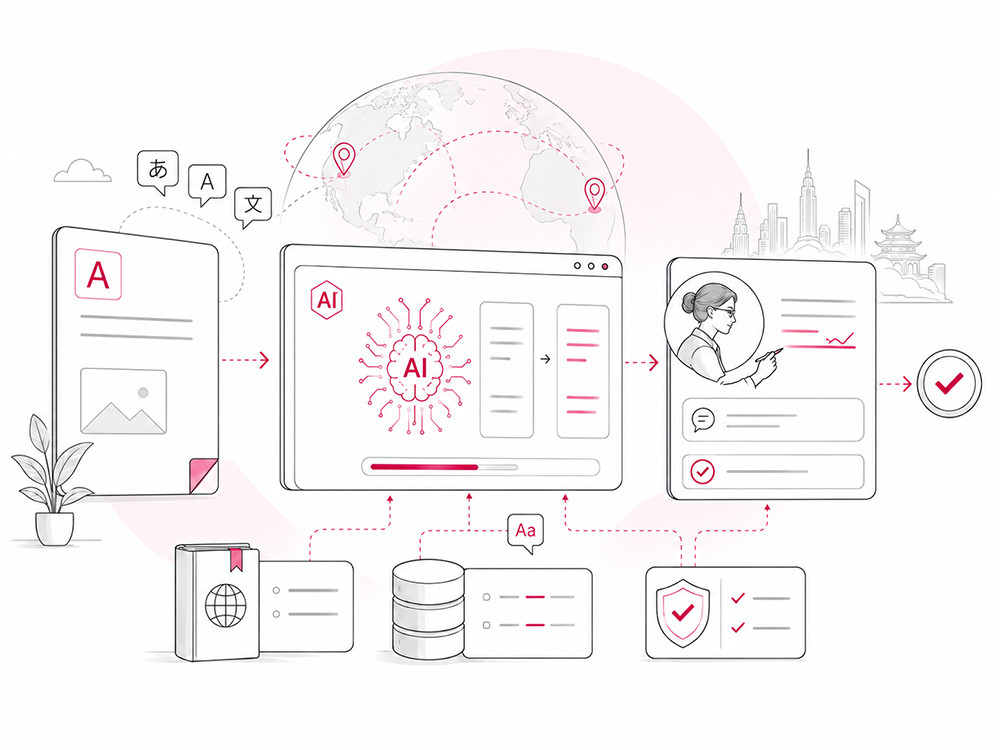
What Is AI Translation With Human Review?
AI translation with human review is a managed workflow in which an approved AI or machine translation system produces or assists with the initial translation, and qualified language professionals evaluate and refine the output against the source content, approved terminology, target audience, and intended use.
It is often described as human-in-the-loop translation because professional reviewers remain involved in the decisions that require linguistic judgment, subject expertise, contextual understanding, and accountability.
-
More Than Target-Language Proofreading
Professional reviewers compare the translation with the source to identify meaning errors, omissions, unsupported additions, altered data, and terminology problems that may not be visible in the target text alone.
-
More Than One Fixed Review Level
Human involvement can range from targeted validation to complete bilingual review, specialist validation, independent revision, and formal approval.
-
More Than a Translation Engine
Translation memory, terminology, source quality, reference context, reviewer expertise, quality criteria, and final-format validation all influence the result.
AI Efficiency
Accelerate initial translation and repeatable workflow tasks.
Professional Judgment
Validate meaning, terminology, tone, and context.
Language Governance
Apply approved translation memory, terminology, and style.
Defined Quality Controls
Match review and approval to the intended use.
Enterprise Visibility
Manage multilingual work through connected, accountable roles.
Enterprise Translation Needs More Than Raw AI Output
AI translation can process multilingual content quickly and produce increasingly fluent language. But fluency alone does not prove that a translation preserves the intended meaning, uses the correct terminology, maintains critical relationships, or is appropriate for its audience.
AI Improves Speed and Scale
AI can accelerate first-pass translation, repetitive-content processing, translation-memory use, terminology assistance, workflow routing, and large-volume production.
Human Review Resolves Meaning and Context
Professional language experts evaluate accuracy, ambiguity, domain terminology, tone, cultural expectations, final-context suitability, and the intended effect on the reader.
Managed Workflows Make Quality Repeatable
Translation memory, terminology, review instructions, automated QA, reviewer qualifications, approvals, and feedback create a controlled enterprise process.
The right question is not whether AI or humans should translate everything. It is which combination of automation, professional expertise, and validation is appropriate for each content stream.
Match Human Review to the Content’s Purpose and Risk
Stepes evaluates intended use, audience, visibility, subject complexity, error impact, regulatory or contractual implications, content lifespan, source quality, language pair, available language assets, and initial AI output before recommending a workflow.
AI Translation With Automated Controls
Internal drafts, search-enablement content, temporary reference materials, and high-volume information with limited downstream impact.
- Approved translation memory and terminology instructions
- Missing-content, number, unit, tag, and placeholder checks
- Language and locale validation
- Targeted sampling or exception review where appropriate
This workflow is not a substitute for professional linguistic review when accuracy, brand voice, compliance, safety, or external publication matters.
AI Translation With Targeted Human Review
Repeatable operational content, selected knowledge-base material, internal training, routine support updates, and lower-risk product information.
- Review of higher-risk or uncertain segments
- Terminology, completeness, and numerical validation
- Sample-based linguistic evaluation
- Correction and escalation of material issues
Targeted review improves oversight without representing that every sentence has received complete professional bilingual validation.
AI Translation With Full Professional Linguistic Review
Websites, customer communications, product content, software interfaces, training materials, technical documentation, and other customer-facing content.
- Complete source-to-target review of every translated segment
- Accuracy, completeness, terminology, grammar, and fluency
- Brand voice, style, locale, and contextual suitability
- Readiness for the defined approval or release process
Every translated segment is evaluated against the source and the agreed project requirements.
AI Translation With Specialist or Independent Validation
Medical and life sciences content, legal and compliance materials, financial communications, safety-related documentation, and other business-critical uses.
- Domain-qualified linguistic review
- Subject-matter validation or independent revision where required
- Structured issue resolution and documented approvals
- Client, in-country, or final-format validation as appropriate
The exact process is established according to the content, market, applicable requirements, and client specifications.
Human-Led Translation
Creative, emotionally sensitive, ambiguous, highly consequential, or technically unsuitable content where direct professional translation offers the better outcome.
- Professional translation from the source
- Specialist, editorial, or transcreation expertise as needed
- Independent review and approval where required
- Full use of terminology, style, and quality controls
A responsible AI translation program includes a clear path for deciding when not to use AI.
How the Stepes AI + Human Translation Workflow Works
Stepes configures each workflow around the content, languages, intended use, quality expectations, and enterprise operating requirements.
Define the Content and Intended Use
Establish languages, locales, audience, subject matter, publication channel, business impact, confidentiality, review responsibilities, and acceptance criteria.
Assess AI Suitability
Evaluate source quality, structure, language-pair performance, domain complexity, available language assets, expected editing effort, and the impact of an error.
Prepare Language Assets and Context
Apply approved translation memory, terminology, style guidance, reference content, screenshots, product metadata, character limits, and market instructions.
Select the Approved AI Approach
Use Stepes-managed or client-approved neural machine translation, large language models, enterprise AI systems, or client-provided output according to the project.
Generate and Prepare the Translation
Preserve file structure, tags, variables, placeholders, protected content, repeated text, translation-memory matches, and other elements required for review and delivery.
Route to Qualified Reviewers
Assign native-language professionals according to language, locale, subject expertise, content type, review model, and required independence.
Review, Validate, and Resolve Issues
Combine bilingual review, automated QA, terminology validation, source queries, specialist input, stakeholder approval, and final-context inspection as required.
Deliver, Report, and Reuse Approved Language
Deliver approved multilingual content and capture terminology decisions, quality findings, reviewer feedback, and validated translations for future workflows.
Approved reviewer corrections can strengthen translation memories, terminology resources, quality rules, and future workflow instructions. How feedback is used to adapt an AI model depends on the selected technology, permissions, and program configuration.
AI Accelerates the Workflow. Professional Linguists Own the Judgment.
AI and human professionals contribute different capabilities to a successful translation program. Automated quality signals can prioritize attention, but they are workflow inputs—not independent proof that a translation is correct.
AI and Automation Support
- Initial translation generation
- Translation-memory matching
- Terminology suggestions
- Repetitive-content processing
- File and structural automation
- Pattern and anomaly detection
- Workflow routing and quality signals
- High-volume multilingual processing
Professional Linguists Are Responsible For
- Confirming the intended source meaning
- Identifying mistranslations, omissions, and unsupported additions
- Applying approved domain terminology in context
- Resolving ambiguity and preserving critical relationships
- Maintaining brand voice, tone, and audience fit
- Evaluating locale and cultural suitability
- Reviewing content in its final context
- Escalating material risks and confirming release readiness
What Professional Human Review Covers
The applicable review criteria depend on the content and project specifications. A comprehensive source-to-target review can address the following dimensions.
Accuracy and Meaning
Mistranslations, altered instructions, incorrect relationships, missing qualifications, unresolved ambiguity, technical meaning, and factual distortion.
Completeness
Omissions, unsupported additions, missing labels or footnotes, empty target segments, skipped lists or tables, and source content left untranslated.
Terminology
Product, technical, medical, legal, regulatory, and brand terminology, including approved variants, abbreviations, and do-not-translate content.
Linguistic Quality
Grammar, syntax, spelling, punctuation, word choice, fluency, readability, and natural target-language expression.
Style, Tone, and Brand Voice
Formality, audience fit, brand personality, instructional voice, reading level, persuasive intent, and consistency with approved style guidance.
Locale and Cultural Suitability
Dates, time, currency, measurements, addresses, regional vocabulary, capitalization, cultural references, and market-appropriate conventions.
Data and Reference Integrity
Measurements, percentages, prices, dosages, dates, part numbers, cross-references, citations, URLs, tables, figures, and regulatory references.
Technical and In-Context Quality
Variables, tags, placeholders, markup, character limits, file structure, truncation, line breaks, layout expansion, interface display, and functional usability.
Define Translation Quality Before Production Begins
“High quality” should not be treated as a vague promise. Translation quality becomes more consistent and measurable when the organization defines what the content must achieve, which errors matter most, who is authorized to approve it, and what evidence is required before release.
Establish Acceptance Criteria
Define intended use, audience, risk, terminology, style, error tolerance, review coverage, approval responsibilities, and final-delivery requirements.
Classify Findings
Use clear quality dimensions such as accuracy, completeness, terminology, fluency, style, locale, technical integrity, formatting, and compliance with instructions.
Choose Review Coverage
Use sampling for appropriate lower-risk, high-volume evaluation and complete review when every segment requires professional bilingual validation.
Document the Outcome
Deliver corrected files, tracked changes, queries, error classifications, quality findings, terminology updates, recommendations, and approval records as required.
Critical
An issue that could significantly affect safety, rights, compliance, essential meaning, or the ability to use the content.
Major
An important error that materially affects accuracy, clarity, terminology, brand requirements, or user understanding.
Minor
A localized issue that does not substantially change meaning but should be corrected to meet the agreed standard.
Preferential
A valid stylistic alternative or reviewer preference that does not represent an objective translation error.
Better Language Assets Create Better AI Translation
The performance of an AI translation workflow depends not only on the model, but also on the approved language resources, instructions, source quality, and context supplied to it.
Translation Memory
Reuse previously approved source and target content to preserve wording, improve update consistency, reduce unnecessary retranslation, and give reviewers a stronger baseline.
Translation MemoryTerminology Management
Control product names, technical concepts, legal and medical terms, abbreviations, approved variants, prohibited language, and do-not-translate content across AI and human workflows.
Terminology ManagementStyle and Audience Guidance
Define brand voice, tone, formality, reading level, regional preferences, sentence style, punctuation, capitalization, measurement conventions, and other market requirements.
Context-Rich Translation
Provide screenshots, interface locations, product metadata, component names, previous versions, reference documents, speaker information, visual scenes, and publication context so short or ambiguous segments can be interpreted correctly.
Source-Content Readiness
Identify ambiguity, inconsistent terminology, fragmented sentences, unclear references, missing context, conflicting instructions, uncontrolled abbreviations, and outdated source material before the same issue propagates across every language.
Manage AI and Human Review in One Connected Workflow
At enterprise scale, AI translation with human review is a connected operating model involving content intake, language assets, technology, reviewers, subject-matter experts, approvals, reporting, and delivery.
- Centralized intakeSubmit files, structured content, software resources, websites, and recurring translation requests through a consistent process.
- Configurable routingAssign AI, human review, QA, and approval paths according to content type, language, team, market, or risk.
- Governed language assetsApply translation memory, terminology, style guidance, and approved reference content consistently.
- Qualified reviewer assignmentRoute work by language, locale, domain expertise, content type, and service requirements.
- Automated QA and approvalsCheck objective issues and coordinate linguistic, specialist, in-country, and final release approvals.
- APIs and enterprise integrationsConnect content systems, repositories, business applications, and structured pipelines to the same AI + human review workflow.
- Visibility and continuous improvementTrack status, questions, approvals, delivery, quality findings, and validated feedback across the program.
Control How Enterprise Content Is Processed
Organizations adopting AI translation need clear control over the technology, content, users, reviewers, data handling, and approvals involved in the workflow.
Practical, Risk-Based Oversight
Stepes can configure project-specific workflows around approved technology, controlled access, confidentiality obligations, reviewer responsibilities, and defined release authority.
Enterprise SecurityApproved Technology
Confirm permitted translation systems, suitable content categories, restricted content, model responsibilities, human-review requirements, and exception procedures.
Controlled Access
Limit access to authorized client users, assigned linguists, project managers, subject-matter experts, in-country reviewers, and final approvers.
Confidentiality and Content Handling
Apply secure submission and delivery, project-specific handling instructions, retention requirements, restrictions on secondary use, and escalation procedures.
Purposeful Human Oversight
Define which content requires human review, what reviewers evaluate, which issues require escalation, and who can approve terminology or authorize final release.
Documented Governance
Maintain role clarity, issue traceability, quality evidence, approvals, and workflow decisions appropriate to the content’s risk and intended use.
Apply the Right Review Model to Each Content Type
The following examples provide common starting points. Stepes confirms the appropriate workflow after reviewing the content, languages, intended use, audience, and quality requirements.
These are typical starting points, not automatic classifications. Language-pair performance, source quality, market requirements, available language assets, and the consequences of an error can change the recommended workflow.
When AI Should Not Be the Starting Point
Stepes evaluates the complete production outcome rather than assuming that AI translation is always the fastest, least expensive, or lowest-risk option.
The Content Depends on Creativity
Taglines, campaigns, executive narratives, and emotionally sensitive communications may require concept development, professional copy adaptation, or transcreation.
The Source Is Ambiguous or Poorly Structured
AI can reproduce or amplify unclear source language. Direct professional engagement with the source may be more effective when meaning depends on unresolved ambiguity.
Errors Could Have Serious Consequences
Certain health, safety, legal, regulatory, or financial content may require a human-led or independently revised process.
AI Output Requires Excessive Rewriting
When reviewers must reconstruct most of the translation, direct human translation may produce a stronger result and make better use of specialist expertise.
The Language Pair or Domain Is Not Suitable
Model performance varies across languages, domains, content structures, and available context. Success in one content stream should not be generalized automatically.
The Required Process Excludes AI
Client policy, contracts, regulators, or internal governance may specify approved production methods or restrict particular technologies.
Original Authorship Matters
Some content should feel as though it was originally created for the target market, making human translation, copy adaptation, or transcreation the stronger starting point.
Choose the Right Human Review Path
These services work together, but each begins from a different customer need. The distinction helps your team choose the right starting point without duplicating review effort.
AI Translation With Human Review
Use this approach when Stepes should help manage the complete process—from content assessment and AI suitability through language assets, translation, professional human review, QA, approvals, and delivery.
- Begins before or at translation
- Risk-matched review model
- Translation memory and terminology governance
- Human review, QA, approvals, and delivery in one workflow
AI Translation Review Services
Use this focused service when AI-translated content already exists and your primary need is qualified, independent evaluation of its accuracy, completeness, terminology, risk, and fitness for the intended use.
- Starts with existing AI-translated content
- Professional source-to-target assessment
- Error identification, validation, and quality findings
- Useful before release, remediation, or workflow decisions
Machine Translation Post-Editing
Use MTPE when machine- or AI-translated output already exists and the goal is for professional linguists to correct and refine it to an agreed target quality level.
- Starts with existing machine- or AI-translated output
- Professional source-to-target correction
- Terminology, completeness, fluency, and QA
- Defined post-editing scope based on intended use
Start With a Representative AI Translation Pilot
A representative pilot provides evidence for deciding where AI translation creates value, which content requires human review, and how the approach should scale across languages and content streams.
Select Representative Content
Use typical subject matter, difficult terminology, priority languages, repeated content, and known production challenges.
Define Quality Criteria
Agree on intended use, audience, terminology, style, review coverage, error tolerance, specialists, and acceptance requirements.
Configure the Workflow
Test language assets, one or more approved AI approaches, review levels, QA checks, reviewer qualifications, and approval stages.
Evaluate the Result
Assess accuracy, completeness, terminology, fluency, style, locale fit, technical integrity, editing effort, and recurring patterns.
Recommend the Production Model
Identify suitable content, human-led exceptions, language-specific considerations, quality controls, estimates, and scaling priorities.
Why Enterprises Choose Stepes for AI + Human Translation
Stepes combines professional language expertise, enterprise technology, governed linguistic assets, and risk-matched quality controls in one managed solution.
One Managed Solution
Bring AI translation, professional linguists, project management, translation memory, terminology, automated QA, review, approval, and delivery together in one managed workflow.
Professional Language Expertise
Support technical, legal, medical, financial, product, software, marketing, and customer-facing content with qualified native-language professionals and subject specialists.
Risk-Matched Quality
Configure review depth, acceptance criteria, automated checks, specialist validation, and approvals around the content’s intended use and business risk.
Governed Language Assets
Reuse approved translations, terminology, style guidance, and reviewer feedback to strengthen consistency across future projects and releases.
Connected Platform and Flexible Integration
Manage requests, reviewers, questions, approvals, delivery, and program activity through connected workflows while working with Stepes or client-approved AI and localization technology.
Global Reach and Certified Quality Systems
Support multilingual programs across 100+ languages with Stepes’ ISO 9001, ISO 17100, and ISO 13485 certified quality systems.
AI Translation and Human Review FAQs
Explore practical questions about human-in-the-loop translation, review coverage, technology selection, regulated content, quality measurement, security, and pilot programs.
AI translation with human review is a managed workflow in which an AI or machine translation system produces or assists with an initial translation and qualified language professionals evaluate and refine the result according to the source content, approved terminology, audience, intended use, and quality requirements. The workflow may also include translation memory, automated QA, specialist validation, stakeholder review, and controlled approval.
Human-in-the-loop translation is a production approach in which professional language experts remain involved in decisions that require linguistic judgment, context, subject knowledge, cultural understanding, or accountability. Human involvement can occur during terminology preparation, translation, post-editing, quality evaluation, specialist validation, final approval, and continuous improvement.
Machine translation post-editing focuses primarily on correcting machine- or AI-translated content. AI translation with human review can describe the broader end-to-end workflow, including content assessment, AI suitability, technology selection, translation memory, terminology, review-level design, automated QA, approvals, delivery, and feedback capture. MTPE can be one component of that wider workflow.
That depends on the agreed review model. Full professional linguistic review evaluates every translated segment against the source. Targeted review may focus on selected risks, automated exceptions, terminology, or representative samples. Stepes defines the review coverage before production so the level of human validation is clear.
Targeted review directs human attention to selected content, such as higher-risk segments, terminology, automated exceptions, or samples. Full linguistic review is a complete source-to-target evaluation for accuracy, completeness, terminology, fluency, style, locale suitability, and compliance with project instructions.
Stepes assigns qualified language professionals according to the source and target languages, target locale, content type, subject matter, review requirements, and intended use. Projects can also involve independent revisers, subject-matter experts, in-country reviewers, terminology owners, legal or compliance stakeholders, and final approvers.
Stepes can work with content produced by client-approved machine translation engines, large language models, internal AI systems, proprietary technology, translation management systems, and other multilingual workflows. If your primary need is independent professional evaluation and validation of existing AI-translated content, AI Translation Review Services are the more focused option. If the goal is systematic correction of existing machine- or AI-translated output to an agreed final quality level, Machine Translation Post-Editing may be the better fit. This AI + human workflow is designed for organizations that want Stepes to manage the broader process from content assessment and language assets through translation, human review, QA, approval, and delivery.
Selection depends on the languages, content type, domain, available context, security requirements, quality expectations, existing language assets, and expected human-review effort. Stepes does not assume that one technology is best for every language or project, and can also use client-mandated or client-provided systems.
AI may support selected stages of a controlled workflow for specialized or regulated content, but suitability must be assessed carefully. The process may require full bilingual review, domain-qualified professionals, independent revision, specialist validation, controlled approvals, final-format inspection, or human-led translation. The appropriate approach depends on the content, intended use, applicable requirements, and impact of an error.
Quality can be evaluated using defined dimensions such as accuracy, completeness, terminology, fluency, grammar, style, locale suitability, technical integrity, and compliance with instructions. Findings may be classified by severity and used to support acceptance decisions, quality scores, corrective actions, or workflow recommendations.
Yes. Existing translation memories, glossaries, terminology databases, style guides, reference materials, previous translations, and market instructions can be incorporated into the workflow. Stepes can also help evaluate, clean, organize, or expand these resources when preparation is required.
Yes. Internal reviewers, subject-matter experts, legal teams, brand owners, market stakeholders, terminology owners, and final approvers can participate through controlled roles and review stages. The workflow can define who may comment, edit, resolve issues, approve terminology, approve market content, and authorize final release.
Security and content-handling requirements are established for the engagement. The workflow can incorporate approved technology, controlled access, confidentiality obligations, secure submission and delivery, project-specific handling instructions, restricted content categories, retention requirements, and defined reviewer permissions.
Approved corrections can be incorporated into translation memory, terminology resources, style guidance, reviewer instructions, quality rules, and future project specifications. Whether corrections are used to train or adapt an AI model depends on the selected technology, permissions, and program configuration; corrections are not assumed to retrain every model automatically.
Share representative source content, target languages, available translation memories or glossaries, intended use, quality expectations, and any security or workflow requirements. Stepes will assess the content, recommend a pilot configuration, define the review criteria, and provide the scope, timeline, and pricing for evaluation.
Combine AI Efficiency With Professional Linguistic Accountability
Share your content, target languages, terminology resources, and quality requirements. Stepes will help determine the appropriate combination of AI translation, professional human review, quality assurance, and stakeholder approval for your program.