
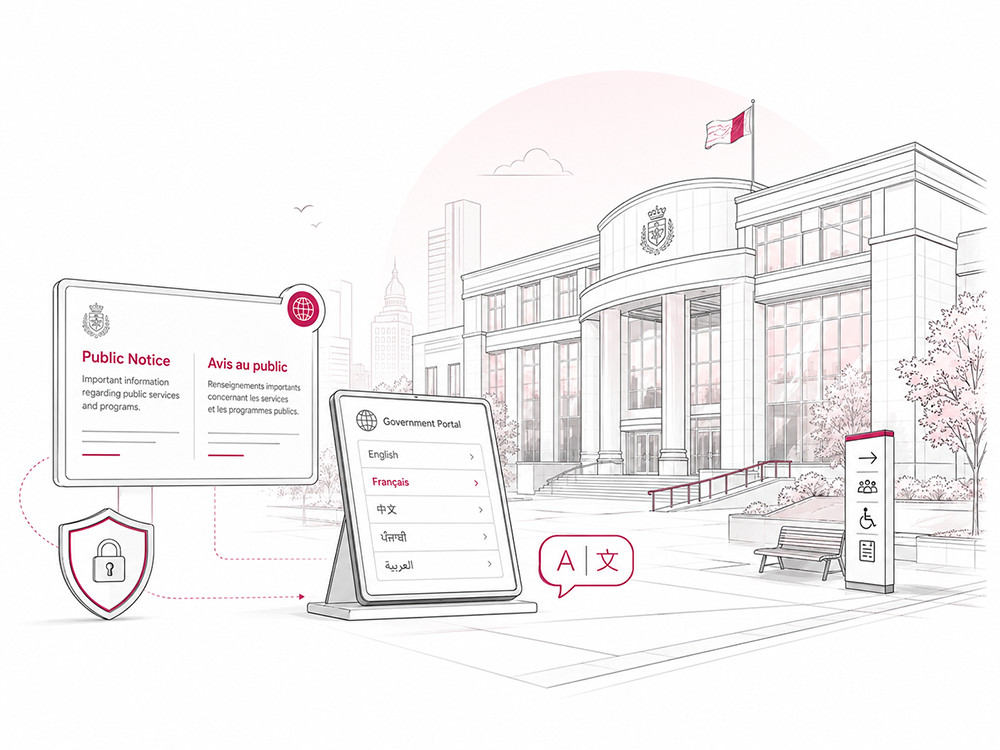
Make Public Information Easier to Understand and Use
Government communication has to do more than convey words accurately. It must help people understand what is happening, what is required, which services are available, and what action to take next.
Stepes connects official documents, digital services, multimedia, training, and live communication within coordinated multilingual workflows. Your teams gain consistent terminology, appropriate human review, controlled approvals, and visibility from intake through publication.
Public-Sector Coverage
Language Services at Every Level of Government
Stepes supports one-time government translation projects and ongoing multilingual communication programs across diverse public-sector environments.
Federal Agencies
Translate public information, program materials, reports, regulations, digital content, training, procurement documents, and agency operations content with workflows aligned to your subject matter, audience, and review requirements.
State Governments
Support statewide programs across health, labor, transportation, education, housing, public safety, licensing, environmental services, workforce development, and other resident-facing functions.
Cities, Counties, and Municipalities
Communicate clearly with multilingual communities through translated public notices, service information, forms, websites, meeting materials, emergency updates, and outreach content.
Tribal Governments and Public Authorities
Support multilingual and culturally informed communication for tribal governments, transportation authorities, utilities, housing authorities, school districts, courts, commissions, and other public bodies.
Government Contractors
Translate technical documentation, proposals, training content, program deliverables, user documentation, research, software, and public-facing materials produced in support of government contracts.
International Public Institutions
Manage multilingual communication for ministries, public agencies, development programs, public-health campaigns, international cooperation, and cross-border administrative activities.
Government Communication Use Cases
Public-sector language needs extend across programs, departments, and communication channels. Stepes applies the appropriate linguistic expertise, technology, and review model to each use case.
Public Information and Community Outreach
Make announcements, resident guides, program explanations, surveys, consultations, town-hall materials, social media, and FAQs understandable across languages while preserving a clear and respectful tone.
Examples: Public notices · Resident guides · Outreach campaigns
Health and Human Services
Support public-health departments, social-service agencies, benefits administrators, behavioral-health programs, aging services, disability programs, and related community resources.
Examples: Enrollment · Eligibility · Health education
Emergency and Public Safety
Translate alerts, evacuation information, severe-weather notices, public-health advisories, shelter instructions, preparedness campaigns, recovery resources, and frequently changing notices.
Examples: Emergency alerts · Safety procedures · Recovery resources
Transportation and Public Infrastructure
Localize transit information, service alerts, rider guides, public-meeting materials, construction notices, infrastructure reports, environmental documentation, and traveler content.
Examples: Transit content · Project notices · Public meetings
Housing, Employment, and Social Programs
Support clear program administration through multilingual applications, tenant communications, workforce resources, unemployment information, requirements, forms, and supporting digital content.
Examples: Housing · Workforce · Benefits
Legal, Regulatory, and Administrative Content
Translate policies, regulations, guidance, legal notices, procurement content, ordinances, licensing materials, inspection documents, and official correspondence with specialized review where appropriate.
Examples: Policies · Procurement · Administrative guidance
Education and Workforce Development
Translate instructional materials, eLearning, student and family communications, workforce-development programs, professional training, assessments, handbooks, and multimedia learning resources.
Examples: eLearning · Family communications · Training
International Development and Public Programs
Support program documentation, research, field resources, monitoring and evaluation, grants, procurement, impact reports, stakeholder engagement, and community-facing materials.
Examples: Program delivery · Field resources · Impact reporting
Government Documents and Content We Translate
Support the full range of content required for public communication, program delivery, digital government, and agency operations.
Public Information
- Public notices and advisories
- Resident and visitor guides
- Community announcements
- Public consultations and surveys
- Newsletters and email communications
- Social media and public-service campaigns
Programs and Services
- Applications and enrollment forms
- Eligibility and benefits information
- Letters, notices, and instructions
- Contact-center scripts
- Complaint and appeal information
- Community resource directories
Legal and Administrative
- Regulations, ordinances, and policies
- Contracts and agreements
- Procurement and RFP documents
- Licensing and permit materials
- Inspection and public records
- Court and hearing materials
Digital Government
- Government websites and portals
- Online forms and mobile applications
- Knowledge bases and help content
- Chatbot and virtual-assistant content
- Software interfaces and notifications
- Digital-service instructions
Reports and Research
- Annual and policy reports
- Research publications
- Economic and demographic studies
- Environmental reports
- Program evaluations
- Presentations and data-collection materials
Training and Multimedia
- Employee and community training
- eLearning modules
- Videos, animations, and webinars
- Subtitles, captions, and voice-over scripts
- Meeting transcripts
- Public briefings and presentations
One Language Partner for Documents, Digital Services, and Live Communication
Bring translation, localization, multilingual production, and interpreting into a connected service model instead of coordinating a different vendor for every content type.
Professional Government Translation
Qualified linguists are selected for the language, subject matter, audience, and document type. Fully human workflows are available for public-facing, legal, technical, health, safety, policy, and other high-consequence content.
Professional Translation ServicesAI Translation With Human Review
Use AI to accelerate appropriate content while preserving professional accountability through terminology controls, translation memory, automated QA, post-editing, and final human approval.
AI Translation ServicesGovernment Website Translation
Translate departmental websites, program portals, online guidance, knowledge bases, and frequently updated digital content through file-based, structured-content, API, or continuous-localization workflows.
Website Translation ServicesSoftware and Application Localization
Localize resident portals, public-service applications, agency systems, mobile apps, forms, notifications, and software interfaces with attention to context, usability, and interface constraints.
Software Translation ServicesMultilingual Desktop Publishing
Preserve visual integrity across Word, PowerPoint, Excel, InDesign, Illustrator, PDF, and other publishing formats while addressing text expansion, typography, tables, graphics, and right-to-left requirements.
Multilingual DTP ServicesMultimedia Localization
Localize public-service announcements, training programs, meetings, webinars, and digital learning content through transcription, translation, subtitling, captioning, voice-over, and multilingual production.
Multimedia Localization ServicesGovernment Interpreting Services
Support public meetings, interviews, hearings, training, community events, consultations, and appointments through remote, on-site, simultaneous, or consecutive interpreting based on project requirements.
Interpreting ServicesCertified Translation
Obtain certified translations for official records, administrative submissions, and supporting documentation. Certification, notarization, sworn translation, or jurisdiction-specific requirements are confirmed before work begins.
Certified Translation ServicesDigital Government
Accessible Multilingual Content Across the Complete User Journey
Translating visible page text is only part of making digital government content usable. Navigation, form instructions, validation messages, alternative text, captions, transcripts, metadata, and assistive-technology labels also shape the localized experience.
Stepes supports the translation and multilingual production of accessible content while coordinating with your accessibility, design, development, and publishing teams. Translation alone does not establish Section 508 conformance; accessible source design, technical implementation, remediation, and testing remain essential.
AI + Human Oversight
Match the Translation Workflow to the Content Risk
A high-volume administrative report does not carry the same risk as an emergency warning, legal notice, health instruction, benefits determination, or public-safety communication. Stepes helps agencies apply automation where it adds value and professional judgment where it is essential.
Professional Human Translation
For high-consequence, sensitive, legally significant, safety-related, highly visible, or linguistically complex content. Optional independent revision, subject-matter review, agency review, and final approval can be added.
AI-Assisted Translation With Human Review
For content that benefits from greater speed or scale but still requires professional quality. Linguists edit for accuracy, completeness, terminology, fluency, audience suitability, and context.
Governed AI Translation
For authorized use cases where rapid access matters more than publication-ready quality. Workflows can apply approved terminology, translation memory, QA checks, access controls, and required human approval.
Client-Provided Machine Translation Review
Send your source content and AI-generated translations to Stepes. Professional linguists compare them against the source, correct errors, apply terminology, identify omissions or unsupported additions, and prepare the content for its intended use.
Risk-Based Workflow Design
Define translation tiers around the factors that matter to your agency and audience.
Quality Framework
Quality That Protects Meaning
Government translation must remain faithful to the source while being clear, appropriate, consistent, and usable for the intended audience.
Qualified Linguists
Projects are assigned according to language pair, subject matter, content type, audience, and workflow requirements, including legal, medical, technical, financial, educational, and public-sector expertise.
Terminology Management
Centralize approved agency names, program terms, legal language, acronyms, recurring instructions, and community terminology for consistent use by linguists, reviewers, and AI workflows.
Translation Memory
Reuse approved translations to maintain consistency, reduce repeated work, accelerate updates, and preserve established language across recurring notices, forms, policies, and digital content.
Independent Review
Add second-linguist revision, subject-matter validation, legal review, program-owner approval, accessibility review, or community input according to the content’s purpose and risk.
Automated Quality Assurance
Identify possible omissions, number mismatches, terminology inconsistencies, untranslated text, punctuation issues, and formatting problems while preserving human linguistic judgment.
Plain-Language Translation
Carry clear, audience-appropriate communication into every target language and flag source ambiguity, difficult terminology, unexplained acronyms, or instructions that may be hard to use.
Regional and Community Review
Account for regional language requirements such as Brazilian and European Portuguese, Latin American and European Spanish, Simplified and Traditional Chinese, and Canadian and European French. Agency reviewers or community stakeholders can validate terminology, program names, tone, and local comprehension before publication.
Sensitive Content Governance
Controlled Workflows for Sensitive Government Content
Government translation may involve nonpublic records, personal information, program data, legal materials, procurement documents, unpublished policies, or other sensitive content. Stepes supports controlled project handling through access, workflow, confidentiality, and operational safeguards.
Role-Based Access
Limit project visibility and workflow actions according to the responsibilities of requesters, project managers, linguists, reviewers, program owners, procurement teams, and final approvers.
Controlled Linguist Assignment
Restrict sensitive projects to approved resources based on language, expertise, location, confidentiality requirements, or other agreed criteria.
Protected Project Workspaces
Keep files, instructions, discussions, translated content, review activity, and deliverables within a controlled project environment.
Retention and Handling Requirements
Define project-specific expectations for access, retention, archival, and deletion during onboarding or project planning.
Activity Visibility
Maintain visibility into project status, assigned resources, review activity, decisions, versions, and delivery milestones.
Enterprise Security Review Support
Support procurement and security assessments with relevant information about workflow controls, data handling, confidentiality, quality systems, and operational practices.
Requirements involving classified information, specific government authorization programs, data residency, background screening, citizenship restrictions, secure facilities, export controls, or cleared personnel must be evaluated and agreed to before content is submitted.
Enterprise Program Management
Coordinate Translation Across Agencies, Departments, and Programs
Replace fragmented email requests, separate vendor processes, and disconnected terminology files with a governed environment for multilingual requests, linguistic assets, participants, approvals, and reporting.
Centralized Request Intake
Give authorized teams a consistent way to submit content, languages, deadlines, service requirements, instructions, reference material, and approval needs.
Department and Program Workspaces
Organize translation activity by agency, department, program, region, content type, or funding source.
Configurable Approval Workflows
Route content through translation, linguistic review, subject-matter validation, legal review, program approval, and final release based on content type and risk.
Decision and Version History
Maintain records of comments, requested changes, approvals, source versions, translated versions, and release decisions.
Budget and Program Visibility
Track volume, languages, turnaround, costs, pending reviews, workflow bottlenecks, recurring content, and other operational indicators.
APIs and Content Integrations
Connect translation to websites, content-management systems, software repositories, structured content, and other government publishing environments.
Be Ready Before an Urgent Communication Is Needed
Emergency translation is faster and more reliable when the language program is prepared in advance. Stepes can help establish a multilingual readiness framework before an incident occurs.
During an active event, content can be prioritized by public impact, language, format, and release sequence. Parallel teams can support larger multilingual releases, while controlled updates help translators and reviewers work from the correct source version.
Emergency Communication Readiness
Prepare the language assets, people, and approvals needed for faster response.
- Priority languages
- Approved emergency terminology
- Reusable message templates
- Named requesters and approvers
- Linguist availability planning
- Escalation procedures
- Review requirements by content type
- Publishing formats and version control
Plan Languages Around the Audience and the Mission
The right language plan depends on the population, geography, program, communication channel, service risk, and purpose—not only the most widely spoken languages nationally.
Stepes helps agencies operationalize the language plan they establish through content inventories, workflow planning, cost modeling, terminology development, and scalable delivery. The agency remains responsible for determining its applicable legal and policy obligations.
Inputs for Language Prioritization
Combine public data with program-level evidence and the consequences of misunderstanding.
- Census and local demographic data
- Program enrollment and usage data
- Contact-center language requests
- School or health-system data
- Community and stakeholder input
- Geographic concentration
- Frequency and importance of interaction
- Consequences of misunderstanding
- Applicable policies, grants, and contracts
- Available budget and operational capacity
Global Public Institutions
Support for Programs That Cross Borders
Stepes supports ministries, embassies, public authorities, development organizations, government contractors, research institutions, and international programs that communicate with multilingual stakeholders.
International Cooperation
Translate agreements, policy exchanges, research, presentations, diplomatic support content, meeting materials, and institutional communications.
Public Health and Humanitarian Programs
Localize educational content, field resources, training, surveys, public-health information, program documentation, and community communications.
Economic Development and Trade
Translate investment information, trade documentation, infrastructure programs, business resources, economic reports, and international outreach content.
Monitoring, Evaluation, and Reporting
Support multilingual data collection, surveys, evaluation instruments, program reports, field documentation, and stakeholder feedback.
Global programs can be coordinated across major commercial languages, regional language varieties, and lower-resource languages, subject to linguist availability and project requirements.
A Clear Government Translation Process
Define the appropriate workflow once, then carry it consistently across languages, formats, departments, and recurring content.
Define the Requirements
Confirm the audience, content type, languages, format, purpose, timeline, review expectations, accessibility considerations, security needs, and required deliverables.
Assess Content and Risk
Evaluate subject matter, public visibility, consequences of error, volume, repetitions, digital requirements, and update frequency to select the right workflow.
Prepare Linguistic Assets
Collect existing translations, terminology, style guides, reference documents, program names, acronyms, and other approved language assets.
Translate and Localize
Assign qualified resources and localize documents, digital content, software, audiovisual materials, and structured content according to the approved workflow.
Review and Validate
Complete the required linguistic, automated, subject-matter, agency, legal, accessibility, or community review stages with comments tied to the correct version.
Deliver and Improve
Produce final files in the required formats, retain approved language assets as agreed, and use feedback and recurring issues to improve future workflows.
Why Government Organizations Choose Stepes
Combine specialized human expertise, AI-powered efficiency, digital content support, terminology consistency, and enterprise workflow visibility through one language partner.
Government and Subject-Matter Expertise
Linguists are selected for the language, content type, audience, and domain, including legal, healthcare, technical, financial, educational, and public-information content.
More Than 100 Languages
Support widely spoken languages, regional variants, and many lower-resource languages through one coordinated provider.
AI Efficiency With Human Accountability
Apply AI selectively while maintaining professional review and approval for public-facing and high-consequence content.
Documents, Digital Content, and Multimedia
Manage government documents, websites, software, forms, videos, training, and spoken communication through connected language services.
Centralized Terminology
Protect approved program names, agency terminology, defined terms, recurring instructions, acronyms, and public-service language across projects.
Enterprise Workflow Visibility
Manage requesters, reviewers, permissions, approvals, project status, language assets, and reporting within a coordinated multilingual environment.
ISO-Supported Quality Framework
Support procurement and supplier review through documented quality processes and relevant certification information.
Scalable Delivery
Use Stepes for one urgent document, a multilingual website, a recurring public-information program, or an agency-wide translation operation.
Procurement and Onboarding Support
Support vendor evaluations with relevant company information, quality documentation, security information, workflow descriptions, pricing models, sample projects, and supplier-review materials.
Government Translation Services FAQ
Answers to common questions about languages, workflows, AI, accessibility, security, interpreting, and ongoing public-sector translation programs.
Government translation services convert public-sector documents, digital content, multimedia, and official communications from one language into another. They may include document translation, website and software localization, multilingual desktop publishing, captioning, voice-over, interpreting, certified translation, terminology management, and ongoing language-program support.
Stepes supports federal, state, county, municipal, tribal, and international public-sector organizations, as well as government contractors, public authorities, education systems, courts, utilities, development programs, and other publicly funded institutions. The workflow is adapted to the organization, content, language, procurement structure, and intended audience.
Stepes translates public notices, policies, regulations, reports, forms, applications, benefits information, health and safety materials, procurement documents, legal content, websites, portals, training, software, presentations, emergency communications, videos, and many other government content types.
Stepes supports translation and localization in more than 100 languages and regional variants. Availability for specialized assignments depends on subject matter, required credentials, service type, location, deadline, and review requirements.
Agencies often evaluate local demographics, program data, audience needs, frequency of contact, service importance, public-safety consequences, geographic concentration, communication channels, and available resources. Requirements may also vary by jurisdiction, program, funding arrangement, contract, court order, and content type. In March 2025, Executive Order 14224 designated English as the official language of the United States and revoked Executive Order 13166, while allowing agencies to continue multilingual documents, products, and services as they consider necessary to fulfill their missions, consistent with applicable law. Agencies should consult their legal and policy teams when determining formal obligations. Stepes can help operationalize the languages, workflows, and service levels an agency selects but does not provide legal advice.
Yes. Stepes can use AI translation as part of a governed workflow when it is appropriate for the content and approved by the client. AI may be combined with professional post-editing, terminology management, translation memory, automated QA, subject-matter review, and named human approval. High-consequence content can remain within a fully professional human workflow.
Yes. Agencies can provide the source content and an existing translation produced by an agency AI tool, language model, or machine translation engine. Stepes linguists compare the translation against the source, correct errors, apply approved terminology, identify omissions or unsupported additions, improve fluency, and prepare the content for its intended audience and use.
Stepes supports controlled enterprise workflows through role-based access, limited project visibility, protected project workspaces, confidentiality requirements, activity visibility, and agreed retention and handling practices. Project-specific security, resource, data-residency, screening, classification, citizenship, secure-facility, or government-authorization requirements must be evaluated and agreed to before work begins.
Stepes can translate and localize the language components of accessible websites, documents, multimedia, and software, including headings, form labels, alternative text, captions, transcripts, and assistive-technology labels. Translation by itself does not guarantee Section 508 conformance; source design, technical implementation, document structure, remediation, and testing also matter. Stepes can coordinate with your accessibility and publishing teams as part of a complete multilingual workflow.
Yes. Stepes supports urgent public notices, safety information, emergency updates, health advisories, service interruptions, and other time-sensitive communications. Feasibility depends on the languages, volume, subject matter, file formats, required review, and deadline. Agencies with recurring urgent needs can establish terminology, templates, workflows, and resource plans in advance.
Stepes provides remote and on-site interpreting support for meetings, interviews, hearings, public events, training, appointments, and other spoken-language requirements. Service mode, location, schedule, subject matter, language, interpreter credentials, equipment, and recording requirements are confirmed during planning.
Yes. Stepes can provide a signed certification of translation accuracy for appropriate documents. Notarization, sworn translation, apostille support, or other formal requirements vary by jurisdiction and intended use and should be confirmed before translation begins.
Stepes uses approved glossaries, translation memories, style guides, reference content, automated terminology checks, and professional review. Resolved terminology decisions can be centralized and reused across departments, languages, document versions, AI workflows, websites, and recurring public communications.
Yes. Agency reviewers, program owners, legal teams, subject-matter experts, regional staff, and other authorized stakeholders can be incorporated into the review and approval process. Access can be limited by project, department, language, workflow stage, or responsibility.
Stepes supports many lower-resource and Indigenous languages, subject to linguist availability, language variety, content type, location, required credentials, and deadline. These projects often benefit from additional planning for orthography, terminology, community review, font support, voice recording, and publishing requirements.
Yes. Stepes supports recurring and enterprise government language programs with centralized intake, project management, terminology, translation memory, user roles, approval workflows, reporting, and integration options. Service-level expectations, pricing, staffing, security, quality requirements, and performance reporting can be defined during procurement and onboarding.
Provide source files or estimated volume, source and target languages, intended audience and use, required delivery date, desired translation and review workflow, file formats, existing translations or terminology, accessibility needs, certification or interpreting requirements, security and handling requirements, expected update frequency, and procurement instructions. Stepes can review the materials and recommend an appropriate workflow before pricing is finalized.
Make Every Public Message Clear Across Languages
Translate one government document, launch a multilingual public-service website, prepare urgent communications, or coordinate an agency-wide language program. Share your files, languages, and deadline to receive a workflow and quote tailored to your requirements.