
100+ Languages
Global, regional, and lower-resource language programs
Native-Language Reviewers
Professional linguistic and cultural judgment
AI + Human Workflows
Automation, validation, review, and adjudication
ISO-Certified Services
ISO 17100, ISO 9001, and ISO 13485
Global AI Performance
Build AI That Works Across Languages and Markets
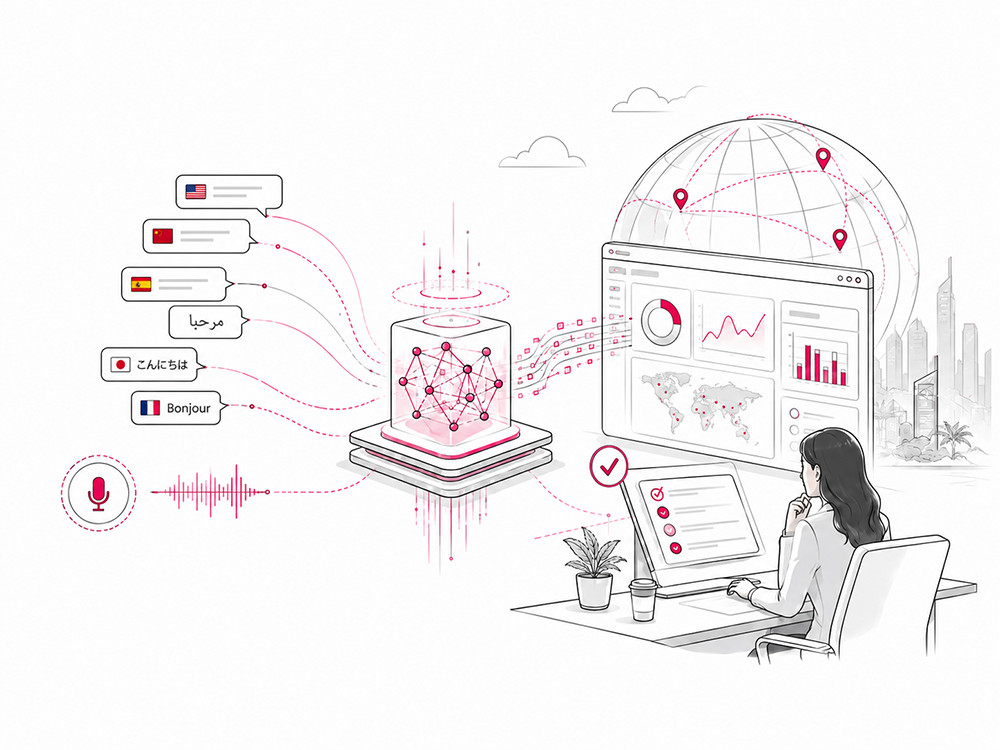
Strong English performance does not automatically translate into a strong global experience. Multilingual AI requires authentic local data, consistent evaluation, and professional language judgment throughout the product lifecycle.
Uneven performance. Model accuracy, fluency, and usefulness can vary significantly by language and locale.
Limited local data. Lower-resource languages and regional variants may lack representative training and evaluation content.
Unnatural translated data. Literal adaptation can miss authentic intent patterns, cultural context, and real-world phrasing.
Hidden market-specific risks. Hallucinations, omissions, inappropriate outputs, and terminology errors may appear only in certain languages.
Fragmented product experiences. The model, interface, prompts, documentation, and support content must work together in every market.
Complete AI Language Lifecycle
Support From Multilingual Data Strategy to Continuous Improvement
Stepes connects language data, human evaluation, product localization, and ongoing output review in one coordinated global program.
01
Plan
Define languages, locales, data types, contributor profiles, guidelines, and evaluation criteria.
02
Create
Build or adapt multilingual text, speech, conversational, and domain-specific datasets.
03
Annotate
Label, classify, enrich, and structure language data for training and evaluation.
04
Evaluate
Measure model quality across accuracy, relevance, fluency, culture, safety, and task performance.
05
Localize
Globalize interfaces, prompts, documentation, help content, and the surrounding product experience.
06
Improve
Review production outputs, compare model versions, and feed recurring issues into continuous improvement.
AI Language Services
Multilingual Services for AI Data, Models, and Products
Choose a focused capability or combine services into an end-to-end program designed around your model, data types, languages, and release goals.
Multilingual AI Data Services
Create and prepare text, speech, conversational, and domain-specific language data for training, fine-tuning, retrieval, evaluation, and continuous model improvement.
Explore ServiceMultilingual Text Annotation
Classify, label, segment, tag, and enrich multilingual text using your schemas, taxonomies, terminology, and quality requirements.
Explore ServiceVoice and Conversation Data Collection
Collect native-language speech, scripted recordings, spontaneous conversations, accents, dialects, and regional language variants.
Explore ServiceConversational AI Training Data
Develop realistic intents, utterances, dialogues, prompts, responses, and edge cases for chatbots, copilots, enterprise agents, and virtual assistants.
Explore ServiceMultilingual LLM Evaluation
Evaluate model responses for accuracy, relevance, fluency, instruction following, cultural fit, terminology, safety criteria, and completeness.
Explore ServiceMultilingual AI Output Review
Review, classify, correct, and improve AI-generated content during model development and after deployment across global markets.
Explore ServiceLooking for AI-enabled business translation? Stepes also provides AI-powered document and content translation with professional human review.
AI Translation ServicesGlobal AI Product Experience
Localize More Than the Model
A globally capable model still needs an interface, prompt system, documentation, support experience, and customer communications that feel clear and consistent in every market.
AI application interfaces
Chatbots, copilots, and agents
System prompts and prompt libraries
Response templates and notifications
Developer and API documentation
Model cards and technical content
Help centers and knowledge bases
Onboarding and customer training
Websites and product marketing
Safety, privacy, and legal content
Global AI Product Experience
Language QA CompleteProduct Interface
Localized Experience
AI Applications
Language Solutions for Every Type of AI Experience
Support global AI systems across text, voice, search, multimodal, customer experience, industrial, and specialized enterprise use cases.
Large Language Models
Prompt-response data, fine-tuning content, multilingual evaluation, output review, and product localization.
Conversational AI and Agents
Intent data, dialogue creation, terminology control, response evaluation, and deployment validation.
Voice AI, ASR, and TTS
Speech collection, transcription, pronunciation review, accent coverage, and localized voice experiences.
Search, NLU, and Recommendations
Query data, entity labeling, intent classification, relevance evaluation, and regional behavior review.
Customer Support AI
Knowledge-base localization, retrieval testing, answer verification, tone review, and multilingual optimization.
Computer Vision and Multimodal AI
Captions, metadata, visual question answering, multimodal prompts, and language-based output assessment.
Robotics, Automotive, and Physical AI
Voice commands, human-machine interfaces, operational terminology, and market-specific interaction data.
Domain-Specific Enterprise AI
Specialized language data and evaluation for healthcare, finance, legal, manufacturing, retail, and other industries.
Multilingual Data Strategy
Choose the Right Approach for Every Language and Use Case
Multilingual AI data does not always begin with translation. Stepes helps determine when to adapt existing content, create original native-language data, or combine both approaches.
Existing Data
Translate and Localize
Adapt established source-language datasets while preserving schemas, labels, relationships, and comparable meaning across markets.
- Terminology and taxonomy alignment
- Cultural and contextual adaptation
- Equivalent rather than literal meaning
- Structured field and schema preservation
Authentic Local Behavior
Create Natively
Generate original language data when natural phrasing, local intent, spontaneous speech, or market-specific behavior is essential.
- Native prompts and responses
- Regional search queries and intents
- Natural speech and conversations
- Market-specific scenarios and edge cases
Balanced Scale and Authenticity
Use a Hybrid Model
Start with translated seed content, then expand it with native-language variants, slang, accents, local scenarios, and culturally specific behavior.
- Consistent global foundations
- Local expansion and diversity
- Regional variants and code-switching
- Efficient coverage of priority markets
Human-in-the-Loop Evaluation
Professional Linguists for Multilingual Model Quality
Native-language and domain-qualified reviewers apply your evaluation criteria with the linguistic, cultural, and contextual judgment needed to identify issues automated metrics may miss.
Accuracy and factual consistency
Relevance and task completion
Fluency, grammar, and naturalness
Instruction following and completeness
Terminology and brand voice
Cultural appropriateness and local fit
Safety criteria and sensitive content
Preferred-response correction and error classification
Quality at Scale
Structured Quality From Pilot to Production
Every program is built around clear requirements, qualified reviewers, calibration, automated validation, human QA, adjudication, and traceable reporting.
Explore the Stepes Quality SystemRequirements and guideline review
Align languages, use cases, schemas, rubrics, deliverables, security expectations, and acceptance criteria.
Reviewer qualification and pilot
Select native-language and domain-qualified reviewers, then validate the workflow with a representative pilot.
Calibration and guideline refinement
Resolve edge cases, align scoring decisions, document examples, and improve reviewer consistency before scaling.
Multilingual production and QA
Combine human review with automated checks for schema, fields, tags, missing entries, duplicates, and terminology.
Adjudication and structured reporting
Escalate disputed cases, record corrections, categorize issues, and deliver traceable results for model teams.
Continuous feedback and improvement
Apply customer feedback, monitor recurring errors, and compare performance across languages and model versions.
Specialized AI
Domain Expertise for High-Stakes and Technical Applications
General fluency is not enough when models must understand regulated content, specialized terminology, professional workflows, or industry-specific user expectations.
Enterprise Governance
Controlled Workflows for Multilingual AI Data
Stepes supports enterprise programs with defined roles, secure exchange, documented requirements, version control, traceable corrections, and customer-specific handling procedures.
Access and Confidentiality Controls
Define project access, contributor roles, reviewer permissions, confidentiality requirements, and secure file or dataset exchange.
Data Handling Requirements
Apply customer-defined procedures for sensitive content, PII, contributor consent, retention, and approved delivery channels.
Traceability and Change Control
Maintain dataset versions, guideline updates, review decisions, issue escalation, corrections, and structured quality records.
Global Language Coverage
Beyond Standard Language Labels
Design multilingual AI programs around languages, countries, regional variants, dialects, accents, writing systems, registers, terminology, and real-world usage patterns.
Explore Supported LanguagesWhy Stepes
A Language-First Partner for Global AI
Bring multilingual data, model evaluation, product localization, and ongoing quality together through one scalable language-services partner.
Complete AI Language Lifecycle
One partner for data creation, annotation, evaluation, localization, output review, and continuous improvement.
Professional Native-Language Expertise
Linguists who understand natural expression, regional variation, terminology, context, and cultural expectations.
Domain-Specialized Review
Qualified reviewers for technical, medical, financial, legal, manufacturing, and other specialized AI applications.
Scalable Global Workflows
Support for pilots, multilingual production datasets, recurring model releases, and continuous evaluation programs.
AI-Enabled, Human-Governed Quality
Technology improves speed, validation, consistency, and reporting while people provide essential judgment.
Enterprise Program Management
Structured guidelines, calibration, access controls, issue resolution, quality records, and traceable delivery.
Frequently Asked Questions
AI & Machine Learning Language Services FAQs
Answers to common questions about multilingual data, model evaluation, localization, voice programs, and ongoing AI quality.
What types of multilingual data can Stepes create for AI models?
Should AI training data be translated or created natively?
Can Stepes evaluate multilingual LLM and generative AI outputs?
Does Stepes support speech, accents, dialects, and regional variants?
Can Stepes localize the full AI product as well as its training data?
How does Stepes maintain quality across multiple languages?
Can Stepes support ongoing evaluation after an AI product launches?
Global AI Language Programs
Build AI That Performs Globally
Tell us about your model, languages, data types, evaluation goals, or product roadmap. Stepes will help define a practical multilingual workflow for pilot, production, and continuous improvement.