
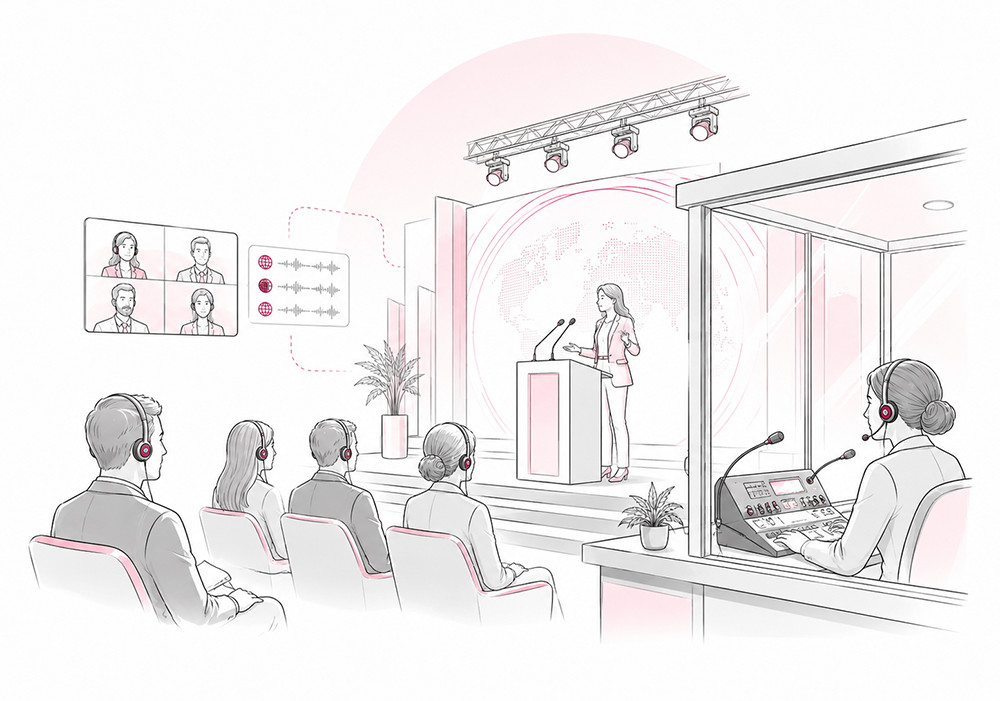
One Language Partner for Every Multilingual Event
Successful multilingual events require more than finding interpreters who speak the right languages. Event schedules, session formats, speaker materials, technology, audience access, terminology, and contingency planning must all work together.
Stepes provides a coordinated conference and event interpreting solution built around your program—from one executive meeting to a complex conference with several languages, rooms, speakers, and audience channels.
Professional Interpreters
Interpreters are matched by language combination, regional fluency, subject-matter knowledge, interpreting method, and event experience.
Event Coordination
Our team organizes interpreter schedules, session assignments, materials, language channels, and operating requirements across rooms, speakers, and time zones.
Technology Planning
Stepes helps define and coordinate interpreting equipment, audio setup, virtual platform features, participant access, and technical testing.
Multilingual Content Support
Presentations, programs, event websites, captions, recordings, learning materials, and attendee communications can be localized before and after the event.
Interpreting for In-Person, Virtual, and Hybrid Events
Every event is different. Stepes designs the interpreting solution around where participants are located, how sessions are structured, how audiences interact, and which technology is already in place.
In-Person Event Interpreting
Give attendees direct access to presentations, panels, workshops, and discussions in their preferred languages. Stepes supports simultaneous and consecutive interpreting, coordinates with venues and AV providers, and helps plan booths, portable systems, headsets, microphones, and language channels where needed.
Virtual Event Interpreting
Connect speakers and participants across countries and time zones through professional remote interpreters. We help coordinate interpreter access, language channels, speaker audio, moderator instructions, participant guidance, and technical checks for scheduled webinars, summits, and online conferences.
Hybrid Event Interpreting
Create one connected multilingual experience for attendees in the venue and those joining online. Interpreters may work on-site, remotely, or through a combined model while Stepes coordinates venue audio, online platforms, language routing, testing, and contingency planning.
For routine virtual conversations, scheduled calls, and on-demand language access, visit our Remote Interpreting Services page.
Choose the Right Interpreting Format for Every Session
The right method depends on audience size, number of languages, participation, available time, session length, subject matter, venue, and technical environment. Stepes reviews the complete program and recommends the format that supports both communication quality and the intended event experience.
Simultaneous Interpreting
Interpreters deliver the target language while the speaker continues, allowing audiences to follow through headsets, receivers, or online language channels with minimal delay.
Best suited to conferences, keynotes, congresses, panels, town halls, and tightly scheduled multilingual programs.
Consecutive Interpreting
The speaker pauses at planned intervals while the interpreter communicates each segment in the target language. This format often requires less specialized equipment.
Best suited to executive meetings, workshops, interviews, press engagements, discussions, and question-and-answer sessions.
Whispered Interpreting
An interpreter provides quiet, near-real-time interpretation for one person or a very small group during a brief session or meeting.
Best suited to limited language-access needs where a full simultaneous setup would be unnecessary or impractical.
Liaison and Discussion Interpreting
The interpreter supports shorter exchanges as conversations move between individuals or small groups in different languages.
Best suited to networking, site visits, hosted delegations, facility tours, breakout discussions, and exhibitor meetings.
Planning Longer or Multilingual Sessions?
Sustained simultaneous interpreting may require rotating interpreter teams, while events with several languages may use direct or relay configurations. Stepes designs the team around the schedule, language directions, subject matter, and technical setup.
Conference and Event Interpreting for Every Global Audience
Stepes adapts interpreter teams, technology, preparation, and live support to the purpose and requirements of your event.
International Conferences and Conventions
Keynotes, panels, breakout sessions, networking programs, and multilingual audiences across one or several event days.
Executive Summits and Leadership Meetings
Strategic presentations, discussions, announcements, and decision-making sessions involving international leaders.
Medical and Scientific Congresses
Clinical, scientific, pharmaceutical, medical-device, and healthcare presentations that require careful terminology preparation.
Investor and Financial Events
Investor meetings, stakeholder presentations, financial conferences, executive briefings, and high-visibility corporate communications.
Product Launches and Press Events
New products, technical demonstrations, announcements, and media programs for international customers, partners, and journalists.
Employee Town Halls and Company Meetings
Leadership updates, organizational changes, company announcements, and question-and-answer sessions for multilingual workforces.
Training and Certification Events
Instructor-led training, demonstrations, professional development, assessments, and certification programs for global audiences.
Trade Shows and Industry Forums
Presentations, exhibitor meetings, technical demonstrations, hosted buyers, and conversations with international partners.
Government and Public-Sector Events
International delegations, public meetings, policy forums, institutional conferences, and multilingual stakeholder programs.
Webinars and Virtual Conferences
Scheduled online programs supported through remote interpreters, coordinated language channels, and multilingual event content.
Professional Interpreters Matched by Language, Subject, and Event
Conference interpreters must do more than understand two languages. They listen, analyze, communicate clearly, manage specialized terminology, follow fast-moving speakers, and deliver the intended meaning in real time.
Language and Regional Fluency
We consider working languages, language directions, regional usage, audience expectations, pronunciation, and whether direct or relay interpreting may be required.
Conference Delivery Experience
Relevant experience may include booth interpreting, consecutive business interpreting, virtual and hybrid delivery, panels, question-and-answer sessions, technical presentations, executive communication, and recorded events.
Subject-Matter Knowledge
Specialized programs often include terminology, data, acronyms, product names, regulatory concepts, and technical explanations that require preparation and domain familiarity.
Team Configuration and Continuity
Longer simultaneous sessions, parallel rooms, connected sessions, breaks, schedule changes, and specialized tracks may require rotating teams, additional coverage, or a central language coordinator.
Subject-Matter Expertise for High-Stakes Communication
The more specialized the discussion, the more important it is to match interpreters with relevant professional knowledge and prepare them with the right event context.
Healthcare and Life Sciences
Medical congresses, investigator meetings, advisory boards, clinical training, scientific presentations, and medical-device events.
Medical Translation ServicesFinancial and Investor Communications
Investor meetings, financial conferences, leadership presentations, stakeholder discussions, and other time-sensitive corporate communications.
Financial Translation ServicesLegal and Compliance
Regulatory meetings, policy discussions, negotiations, legal conferences, investigations, and compliance training.
Legal Translation ServicesTechnology, Software, and AI
Developer conferences, user events, product launches, demonstrations, global team meetings, and technical training.
AI and Machine Learning TranslationManufacturing and Engineering
Technical conferences, supplier meetings, plant events, engineering presentations, training programs, and product demonstrations.
Manufacturing Translation ServicesGovernment and Public Sector
International delegations, public meetings, policy events, institutional conferences, and cross-border programs.
Government Translation ServicesInterpreting Technology Built Around Your Event
Clear audio and reliable language access are essential to successful conference interpreting. Stepes treats interpreters, sound, equipment, language channels, participant access, and technical readiness as one connected environment.
One Connected Language Experience
Technical planning connects the speaker feed, interpreter environment, and participant language channel before the event goes live.
Speaker & Floor Audio
Interpreter Environment
Audience Language Channels
Technology and Coordination May Include
- Interpreter booths and consoles
- Headsets, receivers, and portable systems
- Microphones and floor audio feeds
- Dedicated virtual language channels
- Venue, event platform, and AV coordination
- Multiple-room and parallel-track routing
- Technical rehearsals and language-channel validation
- Backup connections, equipment, and escalation contacts
Preparation That Protects Every Word
Professional interpreters bring language expertise and real-time communication skills. Your event materials give them the context needed to prepare for the speakers, terminology, organization, and objectives.
Advance preparation helps interpreters identify specialized terms, confirm names and pronunciations, anticipate session flow, and understand the intended audience.
A Coordinated Workflow from Planning to Live Delivery
A structured process keeps interpreter selection, event preparation, technology, rehearsals, and live delivery aligned from the beginning.
Define the Event
We review dates, location or platform, languages, audience, session structure, subject matter, accessibility needs, and communication goals.
Design the Interpreting Solution
Stepes recommends the delivery method, interpreter-team structure, language directions, equipment, channels, room coverage, and technical responsibilities.
Prepare the Language Team
We select interpreters by language, subject, event experience, and availability, then organize schedules, materials, terminology, and technical instructions.
Rehearse and Validate
Platform access, sound, equipment, language channels, speaker feeds, moderator instructions, backup plans, and escalation contacts are checked before the event.
Deliver and Follow Through
Interpreters provide live language support while Stepes coordinates updates, session transitions, issue escalation, and optional post-event localization.
Extend Your Event Across Every Language and Channel
A live event often begins long before the first session and continues after the final speaker. Stepes can support the complete multilingual content lifecycle so international participants receive a consistent experience.
Before the Event
- Presentation translation
- Agenda and program translation
- Speaker biographies
- Event website localization
- Registration and invitations
- Multilingual signage and sponsor materials
During the Event
- Live conference interpreting
- Multilingual captions
- Transcription support
- Language-channel coordination
- Updated presentation content
- Speaker and attendee communications
After the Event
- Recorded-session transcription
- Subtitle translation and captions
- Video localization and voice-over
- Multilingual summaries
- Training-content localization
- Post-event reports and publishing
Enterprise Reliability When the Event Is Live
Live events leave little room for fragmented responsibility. Stepes brings language planning, interpreter coordination, technical preparation, and multilingual content support together through one managed workflow.
Named Event Coordination
A Stepes contact helps coordinate languages, schedules, interpreters, materials, technical requirements, and communication among event stakeholders.
Confidential Handling
Presentations, financial information, scientific data, unreleased products, and participant information are handled through appropriate confidentiality practices.
Terminology Consistency
Approved terms, product names, acronyms, speaker names, and key messaging can be shared across interpreters and related translation work.
Schedule and Change Management
A structured update process helps the language team adapt to revised presentations, speaker changes, room moves, and agenda adjustments.
Contingency Planning
Potential disruptions involving equipment, audio, internet connections, rooms, platform access, or interpreter coverage are considered before the event.
Scalable Language Coverage
Stepes supports a focused meeting in one language pair or a multilingual program with multiple channels, rooms, speakers, and audience groups.
Professional Human Interpreting Supported by Intelligent Workflows
Professional interpreters remain at the center of high-stakes live communication. Stepes uses modern language technology and structured workflows to support interpreter matching, content organization, terminology preparation, scheduling, transcription, and related multilingual production—strengthening the process without replacing human judgment and adaptability.
Tell Us About Your Event
You do not need to know which interpreting method, equipment, or team structure your event requires. Share the information you already have, and Stepes will help recommend an appropriate solution.
We review the event as a connected program so the language experience supports your speakers, participants, schedule, venue, and technology.
Helpful Planning Details
Conference and Event Interpreting FAQs
Answers to common questions about event formats, interpreter teams, technology, preparation, scheduling, and pricing.
Conference interpreting is the live conversion of spoken communication from one language into another during conferences, meetings, presentations, panels, workshops, and other organized events. Unlike written translation, interpreting happens as people speak and requires real-time listening, analysis, subject preparation, and professional delivery.
In simultaneous interpreting, the interpreter delivers the target language while the speaker continues speaking, and attendees usually listen through headsets, receivers, or online language channels. In consecutive interpreting, the speaker pauses at intervals while the interpreter delivers each segment. Simultaneous interpreting preserves the pace of larger events, while consecutive interpreting often works well for smaller, more interactive sessions.
The right method depends on audience size, number of languages, session format, participation, available time, venue or platform, equipment, subject complexity, and event objectives. Stepes reviews the agenda and recommends an approach that supports communication quality and the intended participant experience.
Interpreter requirements depend on the languages, interpreting method, event duration, number of rooms, overlapping sessions, technical environment, and subject matter. Longer simultaneous sessions generally require coordinated interpreter teams, while additional coverage may be needed for parallel tracks, breaks, specialized sessions, or multiple language channels.
Begin planning as early as practical, especially when the event involves several languages, specialized terminology, multiple rooms, technical equipment, interpreter travel, or limited interpreter availability. Early planning also provides more time for materials, terminology, rehearsals, and coordination. Shorter timelines may still be possible depending on the event.
Stepes can help determine, arrange, or coordinate the interpreting technology required for the event. Depending on the location and format, this may include booths, consoles, microphones, transmitters, headsets, receivers, portable systems, or virtual language channels. We can also coordinate with the venue, AV provider, event producer, or your technical team.
Yes. Stepes supports scheduled virtual and hybrid events with professional remote interpreters and coordinated language-channel workflows. We help review interpreter access, speaker audio, participant language selection, platform requirements, technical testing, and the connection between in-person and remote audiences.
Useful preparation materials include agendas, presentations, scripts, speaker information, session descriptions, panel questions, product names, approved terminology, acronyms, participant lists, previous recordings, and relevant technical or regulatory documents. Providing materials early gives interpreters more time to prepare for the subject and speakers.
Yes. Stepes can organize multilingual events involving multiple language channels, rooms, tracks, speakers, and overlapping sessions. Planning may include interpreter assignments, room coverage, language routing, equipment requirements, relay configurations, session schedules, and coordination with event and technical teams.
Pricing depends on the language combinations, language directions, event duration, interpreting method, number of interpreters, rooms and sessions, equipment, venue location, travel, technical support, preparation needs, virtual platform requirements, and any recording or post-event services. Stepes reviews the complete event configuration before preparing a clear proposal.
Yes. Stepes can support presentation translation, agenda and event-website localization, registration content, multilingual captions, transcription, subtitle translation, voice-over, recorded-session localization, and multilingual publishing before and after the live event.
Conference and event interpreting is designed for planned programs that may require interpreter teams, technology, speaker preparation, multiple sessions, and broader event coordination. Remote interpreting connects participants and interpreters through phone or video for scheduled or on-demand conversations. On-site interpreting places an interpreter physically at a meeting, appointment, site visit, tour, or other in-person engagement.
Plan a Multilingual Event That Works for Every Audience
Bring professional interpreters, event technology, language preparation, and live coordination together through one global language partner.
Tell us about your languages, speakers, schedule, audience, venue, or virtual platform. Stepes will review your event and recommend a multilingual solution built around the experience you want to deliver.