
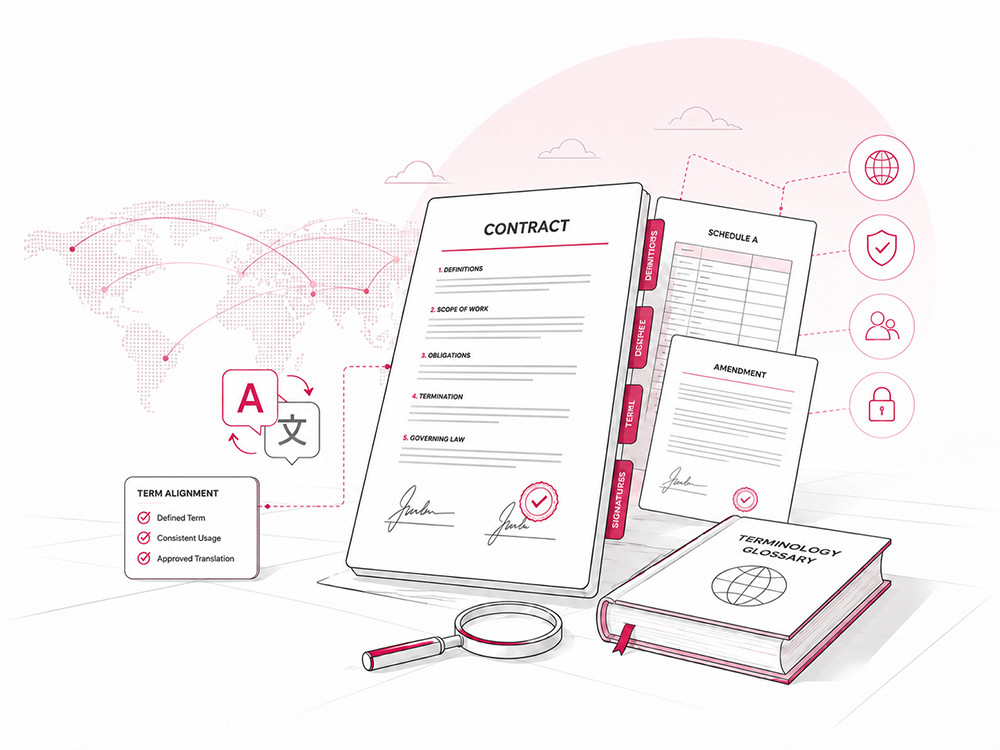
When Every Clause Carries Meaning
Contracts do more than communicate information. They define rights, obligations, responsibilities, limitations, exceptions, timelines, and commercial relationships.
In this context, a small change in wording can create a significant change in meaning. Contract translation therefore requires more than fluency in two languages. Translators must understand how contractual language works, how defined terms relate across clauses, how qualifications and exceptions modify obligations, and how the agreement will ultimately be reviewed or used.
Preserve the source meaning without adding interpretations that are not present in the original.
Keep definitions, qualifications, cross-references, schedules, and related provisions connected across the document.
Combine professional legal expertise with terminology resources, translation memory, structured review, and document-level QA.
Contracts and Agreements We Translate
Stepes translates contracts, commercial agreements, and supporting documents for corporate legal, procurement, finance, HR, commercial, and global operations teams.
Commercial & Sales Agreements
Translate the agreements that govern customer relationships, routes to market, and ongoing commercial engagements.
- Master service agreements (MSAs)
- Sales and customer agreements
- Distribution and reseller agreements
- Agency and franchise agreements
- Commercial terms and conditions
Procurement & Supply Chain
Support global sourcing, manufacturing, vendor management, and supplier relationships with consistent multilingual contract documentation.
- Supplier and vendor contracts
- Procurement and purchase agreements
- Manufacturing and supply agreements
- Logistics and transportation agreements
Technology & Intellectual Property
Maintain specialized legal and technical terminology across agreements governing software, data, technology, and intellectual property.
- SaaS and software licensing agreements
- Technology and IP licensing agreements
- Technology transfer agreements
- IP assignment agreements
- Development and collaboration agreements
Corporate & Transactional
Translate corporate and transaction-related documents where entity names, financial language, and document relationships require close control.
- Shareholder and partnership agreements
- Joint venture agreements
- Investment agreements
- M&A-related agreements
- Letters of intent and transaction documents
Employment & Professional Services
Support multilingual employment and professional relationships across countries and business units.
- Employment and executive agreements
- Consulting agreements
- Independent contractor agreements
- Separation agreements
- Confidentiality and restrictive covenant documents
Confidentiality & Data
Protect consistency across agreements involving sensitive commercial information, personal data, technology, and intellectual property.
- NDAs and confidentiality agreements
- Data processing agreements
- Data sharing agreements
- Information security agreements
Financial Agreements
Translate contractual documentation involving financing, payment obligations, guarantees, and other financial arrangements.
- Loan agreements
- Credit agreements
- Financing agreements
- Guarantees
- Letters of credit and related financial documents
Schedules, Exhibits & Contract Updates
A contract rarely ends with the signature page. Stepes translates the documents that extend, modify, and support the underlying agreement.
Defined Terms Must Stay Defined
Contracts create their own vocabulary. Once an agreement defines a term, that meaning may govern dozens of clauses throughout the document.
Translating the same defined term differently from one section to another can introduce uncertainty even when each individual translation sounds linguistically natural. Stepes helps control defined terms and recurring contractual language across the entire agreement.
Establish approved translations for defined terms, party names, legal concepts, product names, departments, and recurring language.
Reuse previously reviewed contractual language when identical or similar content appears again, preserving continuity while reducing unnecessary retranslation.
Use existing bilingual agreements, templates, prior contract translations, and counsel-approved wording as controlled reference material.
Combine automated and human QA with approved reviewer changes so future translations better reflect established preferences.
One Agreement Often Becomes a Document Family
A master service agreement may establish the relationship. SOWs define services. Schedules add requirements. Exhibits provide specifications. Amendments change provisions. Renewals extend the relationship.
These documents need to work together across languages just as they do in the source language. Stepes helps preserve multilingual continuity by applying existing terminology, approved translations, precedent clauses, translation memory, project instructions, and reviewer feedback to subsequent work.
Preserve the Contract, Not Just the Translation
A legally accurate sentence is not enough if the final document is difficult to review or its structure no longer matches the source.
Contracts depend on relationships between clauses, definitions, schedules, tables, references, and supporting documents. Stepes combines linguistic translation with document-level quality control to help preserve those relationships in the translated file.
Maintain clause and section numbering, cross-references, headings, defined-term capitalization, footnotes, schedules, exhibits, and signature blocks where applicable.
Translate pricing schedules, responsibility matrices, service levels, financial information, specifications, and other tabular contract content.
Support common contract formats including Microsoft Word, PDF, Excel schedules, and other business document formats, with document production incorporated where required.
Match the Translation Workflow to How the Contract Will Be Used
An agreement being reviewed internally has a different risk profile from a final agreement being negotiated across jurisdictions or submitted to an authority. Stepes helps clients select the appropriate combination of technology, professional translation, human review, and quality controls.
Internal Review & Understanding
For preliminary assessment, due diligence, procurement screening, and internal reference where speed and general understanding are the priority.
AI-assisted translation, translation memory reuse, and targeted professional validation may be suitable depending on the content and risk.
Negotiation & Business Review
For agreements actively reviewed by legal, procurement, sales, HR, finance, or external counterparties.
Professional legal translation, terminology control, translation memory, and structured QA provide stronger control over recurring contractual language.
Execution & High-Consequence Agreements
For material agreements, complex cross-border contracts, signature-ready documents, and other content where errors could have significant consequences.
Expert human translation, independent revision, subject-matter review, and additional document QA can be applied according to project requirements.
Certified or Official Use
For contracts or related documents submitted to courts, government bodies, registries, immigration authorities, financial institutions, or other receiving organizations.
Certification, sworn translation, notarization, or other formalities should be confirmed with the receiving authority before translation begins.
Certified Translation ServicesAI + Human Expertise for Contract Translation
Contracts often contain recurring clauses, established templates, defined terminology, and language that has already been reviewed and approved—creating strong opportunities for intelligent language reuse.
The opportunity is not to replace professional judgment with AI. It is to use technology intelligently around the work that requires judgment. Stepes combines AI, translation memory, terminology resources, professional legal linguists, and quality assurance within controlled contract translation workflows.
Secure Translation for Confidential Agreements
Contracts frequently contain commercial pricing, acquisition plans, supplier terms, employee information, product roadmaps, licensing arrangements, financial data, intellectual property, trade secrets, and personal information.
Translation security therefore involves more than protecting a file during upload. It requires appropriate controls throughout the multilingual workflow.
Translation Security and ConfidentialityControlled Project Access
Files, instructions, comments, and translations can be restricted to authorized project participants based on workflow requirements.
NDA-Covered Language Professionals
Professional translators and reviewers work under confidentiality obligations and project-specific access controls.
Secure Workflow Management
Translation, review, QA, and delivery are managed through controlled cloud-based workflows rather than unmanaged exchanges between disconnected participants.
Protected Language Assets
Contract glossaries, translation memories, reviewer comments, and approved multilingual language are treated as enterprise language assets requiring appropriate controls.
Secure File Handling
Source contracts, translated files, versions, reference documents, and deliverables are handled within managed project processes from intake through delivery.
Contract Translation Across 100+ Languages
Business agreements connect companies across countries, legal systems, supply chains, workforces, and markets. Stepes supports multilingual contract translation across major commercial languages and global regions.
Cross-Border Sales
Customer agreements, distribution contracts, terms and conditions, and related commercial documents.
Global Procurement
Supplier agreements, vendor contracts, procurement documents, and manufacturing relationships.
International Employment
Employment and consulting agreements for multinational teams and workforce programs.
Technology & Licensing
SaaS contracts, software licenses, IP agreements, and international technology partnerships.
Corporate Transactions
Joint ventures, investments, partnerships, acquisitions, and related transaction documentation.
Global Legal Operations
Recurring contract translation across business units, regions, language pairs, and outside stakeholders.
Built for Recurring Global Contract Programs
For enterprise organizations, contract translation is rarely a one-time requirement. Legal teams may manage agreements across customers, suppliers, employees, partners, subsidiaries, product lines, and markets.
Store validated translations so negotiated and reviewed language can be referenced on future projects.
Maintain approved defined terms, party names, product terminology, legal expressions, and other recurring language.
Incorporate approved feedback from internal counsel, outside counsel, procurement teams, and other stakeholders.
Apply established language to recurring contracts and focus professional review on material changes, new clauses, and higher-risk content.
Organize language assets and workflows by languages, regions, departments, contract types, or enterprise programs.
Quality Control for Professional Contract Translation
Contract translation quality should be built into the workflow rather than left to a final proofreading step. Stepes combines preparation, linguistic expertise, terminology management, automated quality checks, professional review, and document validation.
Contract Analysis
Review files, languages, complexity, intended use, formatting, references, confidentiality, timeline, and quality expectations.
Terminology & Reference Preparation
Prepare defined terms, client glossaries, prior translations, translation memories, precedent agreements, and preferred language.
Translation
Assign the appropriate professional, AI-assisted, or hybrid workflow based on project requirements and risk.
Linguistic Review & QA
Check meaning, terminology, omissions, names, numbers, dates, consistency, and other contract-sensitive content.
Document QA
Verify relevant clause numbering, tables, references, schedules, exhibits, formatting, and overall document usability.
Final Delivery
Prepare approved files in the required format with project-specific quality and delivery requirements addressed.
Secure Online Contract Translation Workflows
Digital translation should make contract translation easier to manage—not reduce control over the process.
Stepes provides secure online translation workflows that help organizations submit contract files, manage multilingual projects, track progress, centralize language assets, review translations, and receive completed documents through one connected environment.
For recurring enterprise programs, Stepes can support more structured workflows with centralized terminology, translation memory, project management, workflow automation, user roles, quality controls, and reporting.
Get an Online Translation QuoteContract Translation Is Part of the Larger Legal Lifecycle
Contracts rarely exist in isolation. They connect with corporate governance, compliance, intellectual property, due diligence, employment, regulatory matters, disputes, and other legal content.
Stepes supports multilingual legal content across the broader legal lifecycle with professional legal linguists, AI-enabled workflows, terminology governance, translation memory, quality assurance, and secure enterprise translation.
Explore Legal Translation ServicesContract Translation Services FAQs
Answers to common questions about professional contract translation, terminology consistency, AI-assisted workflows, confidentiality, certification, document formatting, and turnaround.
What is contract translation?
Contract translation is the professional translation of contracts, agreements, and related documents from one language into another. Unlike general business translation, it requires close attention to defined terms, obligations, rights, exceptions, recurring clauses, party names, numbers, dates, cross-references, schedules, exhibits, and other elements that can affect how the document is understood.
What types of contracts does Stepes translate?
Stepes translates master service agreements, NDAs, sales contracts, supplier agreements, vendor contracts, distribution agreements, licensing agreements, SaaS agreements, employment contracts, consulting agreements, joint venture agreements, shareholder agreements, investment agreements, procurement contracts, SOWs, SLAs, amendments, schedules, exhibits, and many other business and legal agreements.
How does Stepes keep defined terms consistent throughout a contract?
Stepes can use legal glossaries, terminology management, translation memory, prior approved translations, precedent agreements, and client reference materials to establish preferred translations for defined terms and recurring language. Automated QA and professional human review provide additional checks for consistency across clauses and related documents.
Can Stepes keep amendments and SOWs consistent with an agreement translated previously?
Yes. When previous translations and reference materials are available, Stepes can use translation memory, approved terminology, precedent language, and client feedback to help keep new SOWs, schedules, exhibits, amendments, renewals, and related agreements aligned with earlier translations.
Can Stepes translate redlined or revised contracts?
Stepes can support revised and versioned contract files, including documents containing tracked changes or other revision information, depending on the source format and required deliverable. Clients should provide the source files, prior translations where available, and instructions about how revisions should appear in the translated version.
Do contract translations need to be certified?
Not necessarily. Many contracts translated for negotiation, internal review, commercial use, procurement, or corporate reference require professional legal translation but not formal certification. Certification, notarization, sworn translation, or another formality may be required when a receiving organization specifies it. The receiving authority ultimately determines what it will accept.
Certified Translation ServicesCan AI be used to translate contracts?
Yes, when applied appropriately. Repeated clauses, standard templates, previously approved language, and controlled terminology can benefit from AI-assisted translation and translation memory reuse. Important legal content should not rely on uncontrolled raw machine translation alone. Stepes uses AI within governed workflows that can include terminology management, translation memory, professional legal-linguist review, automated QA, and final human validation.
Does Stepes preserve contract formatting?
Yes. Depending on the source file and project scope, Stepes can preserve or reproduce important contract structure including headings, clause numbering, tables, defined-term capitalization, footnotes, schedules, exhibits, signature blocks, and other formatting elements. Complex PDF reconstruction or specialized desktop publishing may require additional document production work.
How does Stepes protect confidential contracts?
Stepes uses secure enterprise translation workflows designed to protect sensitive multilingual content throughout intake, translation, review, QA, and delivery. Controls include managed file handling, authorized project access, confidentiality obligations for linguistic resources, protected language assets, and secure cloud-based workflow management.
Stepes SecurityHow long does it take to translate a contract?
Turnaround depends on the agreement's length and complexity, language pair, file format, number of target languages, required review level, formatting needs, and whether certification or other formalities are required. Translation memory and AI-assisted workflows can accelerate suitable projects, particularly when contracts contain repeated or previously translated content.
What languages does Stepes support for contract translation?
Stepes provides professional contract translation services in more than 100 languages, covering major commercial languages across Europe, Asia, the Americas, the Middle East, and other global markets. Organizations can manage individual language pairs or larger multilingual contract programs through one translation partner.
Translate Your Contracts With Confidence
Whether you need one agreement translated for an international transaction or ongoing multilingual support for a global contract portfolio, Stepes combines professional legal-linguistic expertise with terminology control, quality assurance, and secure enterprise workflows.