
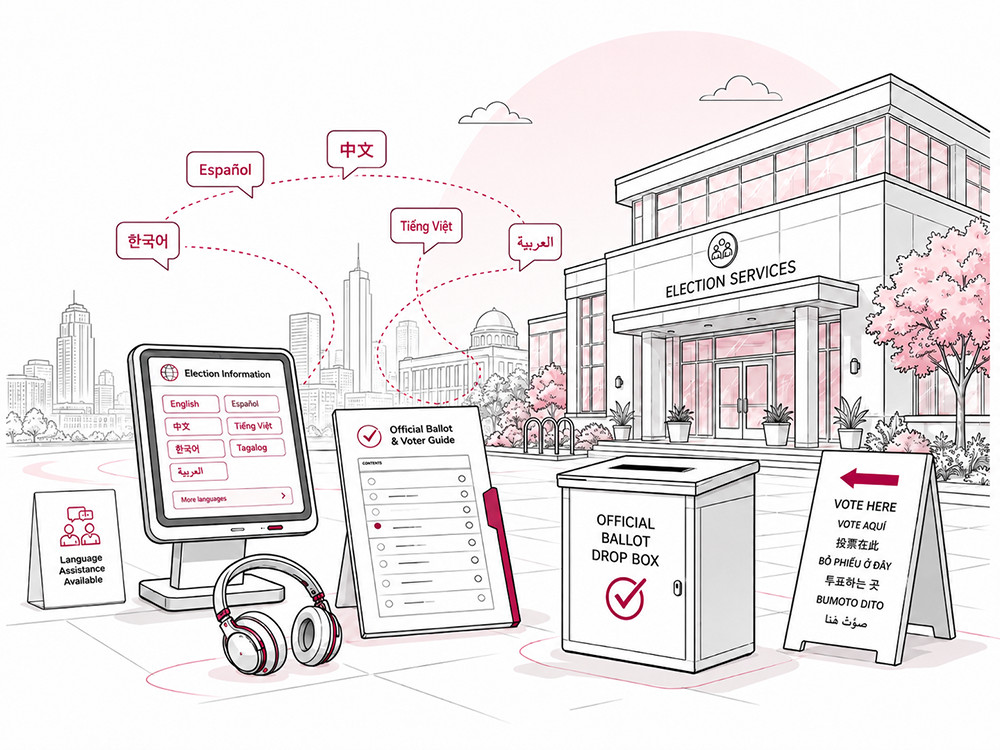
100+ Languages
Global and community language coverage
Human-Led Quality
Professional translation and independent review
Multilingual Production
Print, digital, web, and formatted deliverables
Controlled Workflows
Terminology, versions, approvals, and QA
Language Access Across Every Stage of an Election
Multilingual election communication extends far beyond the ballot. Stepes helps keep voter-facing content connected before registration, while voters prepare, at the point of voting, and throughout post-election communication.
Register
Registration information, eligibility requirements, forms, deadlines, notices, and voter assistance information.
Prepare
Voter guides, sample ballots, candidate information, ballot measures, election websites, polling details, and FAQs.
Vote
Official ballots, voting instructions, mail voting materials, provisional voting information, signage, and voter assistance.
Understand
Results information, certification notices, post-election FAQs, process explanations, reports, and public updates.
One election may generate hundreds of interconnected content assets. A coordinated language workflow helps approved terminology, instructions, names, dates, and recurring content remain aligned wherever voters encounter them.
Language Services Across the Election Ecosystem
Election communication involves government agencies, community organizations, campaigns, and other stakeholders. Stepes adapts each workflow to the content, audience, risk level, and publication requirements.
Election Authorities
Support official multilingual election communication at the state, county, municipal, and local level.
- State election agencies
- Secretaries of state
- County election offices
- Boards of elections
- Registrars and clerks
- Government contractors
Civic & Community Organizations
Expand access to voter education and public-interest information across multilingual communities.
- Voter education
- Community outreach
- Research and surveys
- Public information
- Events and multimedia
- Community resources
Campaigns & Political Organizations
Communicate approved campaign content accurately across languages and channels.
- Candidate statements
- Campaign websites
- Policy materials
- Mailers and advertising
- Social media
- Video and press content
Election Content in Every Format and Channel
Modern election programs publish information across documents, websites, portals, mobile channels, video, signage, and live voter services. Stepes supports the complete multilingual content environment.
Ballots & Voting Materials
Voter Information & Outreach
Digital Election Content
Administrative & Public-Sector Content
Support Multilingual Voter Access Across Jurisdictions
Election language access in the United States can involve federal, state, local, and jurisdiction-specific requirements.
Section 203 of the Voting Rights Act requires covered jurisdictions to provide applicable registration and voting notices, forms, instructions, assistance, ballots, and other election information in designated minority languages as well as English. Other federal provisions, state and local requirements, election policies, and community needs may also shape a language access program.
Stepes helps election organizations operationalize their defined requirements through professional translation, linguistic review, terminology management, multilingual production, digital localization, and interpreting.
Your Requirements
Languages, content, review, accessibility, formats, and deadlines.
Your Language Program
Approved terminology, references, previous translations, and publication standards.
Stepes Multilingual Workflow
Translate, review, produce, localize, QA, and deliver.
Voter-Facing Delivery
Ballots, guides, websites, notices, signage, outreach, and assistance.
Accuracy Where Every Word Matters
Ballots and official voting materials are not ordinary translation projects. Stepes supports high-consequence election content with professional human linguists, independent review options, controlled terminology, in-context validation, and final quality assurance.
Professional Translation
Qualified linguists translate with approved terminology, references, and available context.
Independent Linguistic Review
A second professional linguist can review accuracy, completeness, clarity, and consistency.
Terminology Validation
Names, office titles, ballot language, recurring instructions, and jurisdiction-specific phrases are checked.
Layout & In-Context Review
Translated content is evaluated in its final or near-final presentation for readability and context.
Final QA & Approval
Final checks support terminology, numbers, names, punctuation, formatting, completeness, and delivery readiness.
For official ballots, voting instructions, legal information, and other high-consequence election materials, Stepes can provide fully professional human translation and independent linguistic review workflows.
One Election Vocabulary Across Every Voter Touchpoint
Election terminology appears repeatedly across ballots, voter guides, registration materials, websites, signage, training, FAQs, and voter support channels. The words may be repeated. The translations should not be reinvented every time.
Stepes uses terminology management to centralize approved multilingual election vocabulary so linguists and reviewers can apply consistent language across projects, channels, and election cycles.
From Translation to Publication-Ready Election Materials
Election organizations rarely need translated text alone. They need finished voter guides, ballots, mailers, signs, PDFs, websites, and other materials that are ready to publish.
Stepes combines professional translation with multilingual desktop publishing and in-context QA to help preserve the intent of the source design while giving each language the space, typography, and formatting it needs.
Source Formats
Adobe InDesign, Illustrator, Word, PowerPoint, PDF, HTML, XML, and structured content.
Layout Adaptation
Text expansion, tables, page flow, multilingual typography, right-to-left languages, and translated artwork.
Final Delivery
Publication-ready source files and agreed print, web, digital, or PDF outputs.
When Election Content Changes, Every Language Has to Keep Up
Polling information may change. Source documents may be revised. Websites may receive new instructions. Stepes helps election organizations update multilingual content through controlled reuse and review instead of restarting every language from the beginning.
Source Update
A source file, page, notice, or election instruction changes.
Changed Content Identified
Previously approved content is separated from new or revised material.
Approved Translation Reused
Translation memory carries forward established multilingual content.
New Content Translated
Qualified linguists translate only the content that requires new work.
Review & QA
Terminology, linguistic review, formatting, and required approvals are applied.
Updated Release
Revised multilingual content is prepared for the required publication channel.
Translation Memory
Reuse previously approved multilingual content.
Terminology Control
Preserve established language across new and revised assets.
Parallel Languages
Coordinate translation, review, production, and QA simultaneously.
Version Visibility
Keep current files, reviewer status, and updated deliveries easier to track.
Make Digital Election Information Usable Across Languages
Voters increasingly interact with election information through websites, portals, mobile devices, email, social media, video, and other digital channels.
Election Websites
Public election information, voter resources, FAQs, polling details, voting options, deadlines, and results information.
Voter Portals & Online Forms
Interface text, field labels, instructions, validation messages, error messages, navigation, and help content.
Mobile, SMS & Email
Essential voter communication across mobile content, notifications, alerts, and digital outreach.
Multimedia
Subtitles, captions, transcripts, voice-over, on-screen text, and audio localization.
Multilingual Accessibility
Accessible digital documents, alternative text, captions, transcripts, form labels, screen-reader labels, navigation instructions, and status messages.
Translation is one part of creating an accessible multilingual experience. Technical accessibility requirements must also be addressed through the design, development, document, or publishing environment.
Language Support When Voters Need It in Real Time
Not every voter interaction happens through documents or websites. Stepes provides interpreting services for voter information lines, planned outreach, public meetings, and election-day language support across remote and in-person settings.
Over-the-Phone Interpreting
Voter information lines, help desks, scheduled services, and other voice interactions.
Video Remote Interpreting
Real-time video support when visual interaction improves communication or remote access is preferred.
On-Site Interpreting
Planned meetings, public sessions, voter education activities, and other in-person settings, subject to language, location, and availability.
Community & Voter Outreach
Support voter education sessions, community meetings, public presentations, training, and outreach events with planned language assistance.
Election-Day Support
Align interpreting resources with the election organization’s defined languages, service model, locations, schedules, and operational requirements.
Multilingual Campaign Translation Services
Campaigns communicate across websites, advertising, mail, social media, video, public appearances, and policy content. Stepes helps translate approved communications accurately and consistently for multilingual audiences.
Our role is to provide professional language services for your approved content—preserving the intended source message across languages and media without providing political strategy or targeting guidance.
Marketing Translation ServicesCampaign Websites
Candidate biographies, issue pages, event information, FAQs, and digital updates.
Candidate Statements & Policy Content
Candidate statements, policy positions, issue briefs, platforms, speeches, and public communications.
Advertising & Outreach
Digital and print advertising, flyers, direct mail, brochures, email, and SMS content.
Social Media
Approved social content localized while maintaining terminology, tone, and message consistency.
Video & Multimedia
Subtitles, captions, transcripts, voice-over, and translated on-screen text.
Press & Public Communications
Press releases, media materials, announcements, speeches, and event information.
Match the Translation Workflow to the Election Content
Not every piece of election content carries the same level of risk. Stepes helps organizations match human expertise, review, automation, and AI to the intended use instead of forcing every project through the same translation model.
Professional Human Translation + Independent Review
For official ballots, ballot measures, voting instructions, registration information, legal or procedural content, and other high-consequence voter communication.
- Professional linguists
- Independent linguistic review
- Terminology and translation memory
- Automated QA and controlled approvals
Human Translation With Translation Technology
For recurring or high-volume election content where professional linguists can work efficiently with reusable language assets and automation.
- Translation memory
- Approved terminology
- Automated quality checks
- Workflow and version management
AI-Assisted Translation With Human Review
For suitable lower-risk content, AI-assisted translation may be incorporated when approved by your organization and matched to the intended use.
- Human review
- Terminology and translation memory
- Project-specific controls
- Governed use by content risk
The goal is not to apply the newest technology everywhere. It is to use the right combination of human expertise and technology for each type of election content.
Quality, Review, and Visibility From Intake to Publication
Election translation programs often involve multiple files, languages, reviewers, deadlines, and publication formats. Stepes brings these elements into coordinated workflows that support consistency and control.
Qualified Linguists
Professional translators matched by language pair, subject matter, and content complexity.
Independent Linguistic Review
Second-linguist review options for content requiring additional linguistic assurance.
Translation Memory
Reuse previously approved translations instead of retranslating recurring election content.
Terminology Management
Keep approved names, terms, instructions, and jurisdiction-specific language consistent.
Automated QA
Identify potential issues involving numbers, omissions, terminology, punctuation, tags, and formatting.
Controlled Review & Approvals
Coordinate files, comments, reviewers, versions, status, and delivery in organized workflows.
A Clear Workflow for Multilingual Election Content
Every election program is different. Stepes builds the workflow around your languages, content, publication process, review requirements, deadlines, reviewers, and stakeholders.
Define Requirements
Confirm target languages, content types, source formats, program and jurisdiction requirements, accessibility considerations, review workflow, publication format, and schedule.
Prepare Language Assets
Collect previous translations, approved glossaries, election terminology, style guidance, translation memories, jurisdiction references, and other useful materials.
Translate
Qualified linguists translate the content using approved terminology, context, references, and the agreed quality workflow.
Review & Validate
Apply independent linguistic review, customer review, terminology validation, in-context review, linguistic QA, and automated QA as required.
Produce & Localize
Complete multilingual desktop publishing, website or portal localization, multimedia production, subtitling, captioning, or voice-over when included.
QA & Deliver
Complete final quality checks and provide the approved multilingual deliverables in the agreed formats.
For recurring programs, approved translations and terminology can become reusable language assets for future updates and election cycles.
Election Translation in 100+ Languages
The right election language program depends on the jurisdiction, community, audience, applicable requirements, and communication needs.
Stepes supports widely used global languages as well as many regional and community languages. Support for Indigenous, Native American, Alaska Native, historically oral, and other less commonly requested languages depends on the language, content type, location, available qualified resources, and required service model.
For less commonly written or historically oral languages, language-access programs may require specialized approaches that combine community knowledge, oral communication, interpreting, review, and other methods appropriate to the language and audience.
View All Translation LanguagesWhy Election Organizations Choose Stepes
Election translation requires more than multilingual word replacement. Organizations need a language partner that can coordinate quality, terminology, production, digital localization, updates, and live communication across languages.
Election & Government Expertise
Support official, legal, administrative, public-facing, digital, and community election content.
Human-Led Quality
Professional linguists and independent review for high-consequence content where linguistic accountability matters most.
Multilingual Production
Move from source content to publication-ready documents, websites, multimedia, and voter-facing deliverables.
Connected Language Assets
Use translation memory and terminology across ballots, guides, websites, forms, signage, training, and support.
Scalable Delivery
Coordinate multiple languages and content streams in parallel to support fixed schedules and time-sensitive updates.
Digital + Print + Live Support
Manage documents, publishing, websites, multimedia, and interpreting through one language-services partner.
Modern Translation Technology
Combine linguists with translation memory, terminology, QA automation, workflows, and governed AI-assisted models.
Enterprise Project Visibility
Centralize multilingual projects, reviews, language assets, status, and delivery across stakeholders.
Election Translation Services FAQ
Practical answers about ballots, Section 203 support, multilingual publishing, websites, urgent updates, interpreting, AI, and language coverage.
Election translation services convert voter information, ballots, registration materials, election websites, public notices, voting instructions, outreach content, and other election-related information into additional languages. A complete program can also include linguistic review, terminology management, multilingual desktop publishing, digital localization, multimedia localization, accessibility-related content translation, and interpreting.
Stepes translates official and sample ballots, ballot measures, voter guides, registration materials, polling-place information, voting instructions, vote-by-mail materials, election notices, election-worker training, websites, portals, public outreach, FAQs, campaign content, multimedia, and administrative materials.
Yes. Stepes provides professional ballot translation services for official ballots, sample ballots, ballot titles and summaries, ballot measures, referenda, candidate statements, voting instructions, and related materials. High-consequence workflows can include professional human translation, independent linguistic review, terminology validation, in-context review, and final QA.
Yes. Independent linguistic review can be added when a second professional linguist should verify accuracy, completeness, terminology, clarity, consistency, and overall linguistic quality. Customer reviewers and approved jurisdiction-specific terminology can also be incorporated.
Yes. Stepes can provide translation, linguistic review, terminology management, multilingual publishing, digital localization, and interpreting for election programs designed around Section 203 language-access requirements. Election authorities remain responsible for identifying the legal and policy requirements and covered languages applicable to their programs.
Yes. Stepes localizes public information pages, voter resources, FAQs, polling information, online forms, voter portals, help content, notifications, and other digital election experiences. Frequently updated environments can use repeatable workflows that reuse approved terminology and previous translations.
Yes. Multilingual desktop publishing can support voter guides, ballots, notices, brochures, mailers, signage, and other designed election materials in formats such as Adobe InDesign, Illustrator, Microsoft Word, PowerPoint, PDF, and web-ready content.
Yes, depending on the languages, volume, formats, review requirements, and deadline. Translation memory, terminology management, parallel language production, workflow automation, and centralized review can reduce repetitive work and help accelerate controlled updates.
Yes. Stepes provides over-the-phone, video remote, and on-site interpreting that can support voter assistance, public information, community outreach, meetings, help lines, and other election-related communication. Availability depends on language, modality, location, schedule, and project requirements.
Stepes matches translation technology to content risk and intended use. Professional human translation and independent linguistic review are available for official ballots, voting instructions, legal information, and other high-consequence content. Translation memory, terminology management, automated QA, and workflow automation can improve efficiency, while AI-assisted translation with human review may be used for suitable lower-risk content when approved by the customer.
Stepes provides professional translation services in 100+ languages, including Spanish, Chinese, Vietnamese, Korean, Tagalog / Filipino, Arabic, Haitian Creole, Hindi, Bengali, Punjabi, Japanese, Portuguese, Russian, and many others. Support for Indigenous, Native American, Alaska Native, historically oral, and other less commonly requested languages depends on the language, content, location, available resources, and service model.
Yes. Existing translations, glossaries, voter guides, ballot terminology, and other approved language assets can be reviewed and incorporated into translation memory and terminology resources to improve consistency and reduce unnecessary retranslation.
Yes. A single program can include voter guides, ballots, PDFs, websites, portals, email, SMS, video, signage, desktop publishing, and interpreting while using shared terminology and translation memory to improve consistency across channels.
Prepare Your Multilingual Election Content
From ballots and voter guides to election websites, multilingual publishing, rapid content updates, and live language support, Stepes helps election organizations build reliable workflows around their content, languages, deadlines, and review requirements.