
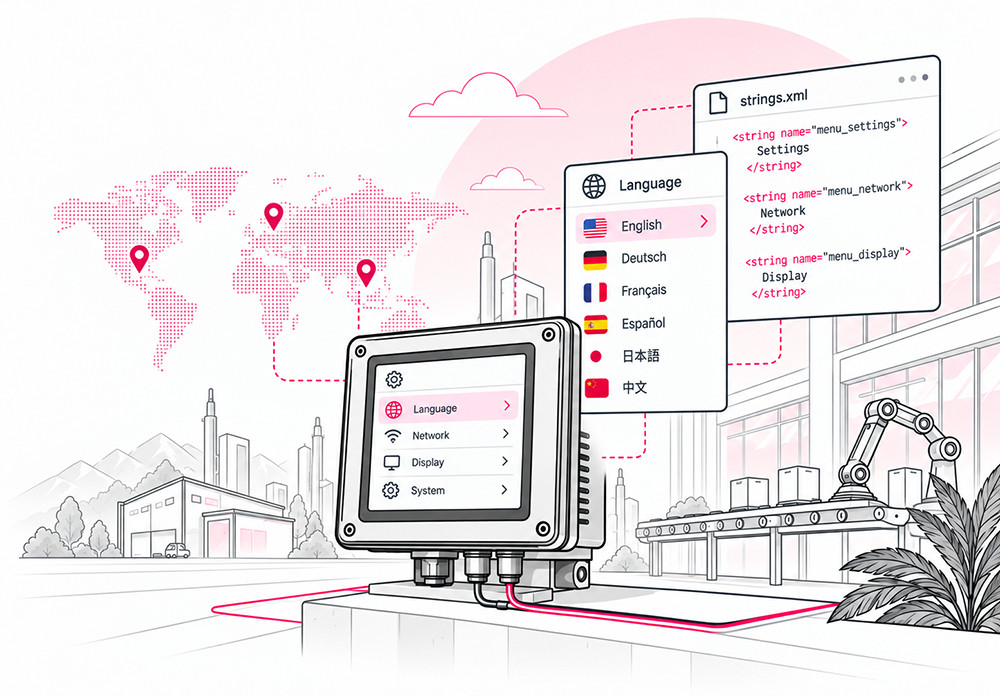
Localize the Software That Lives Inside the Product
Embedded software localization is different from translating a website, mobile app, or conventional business application. The language is part of a physical product. It appears on device displays, touchscreens, control panels, status screens, setup workflows, diagnostic interfaces, and other environments shaped by hardware, firmware, operating states, and limited screen space.
A short command such as Reset, Clear, Run, or Home may mean something very different depending on the device, user action, operating mode, or system state. The translation must therefore fit more than the source sentence. It must fit the product.
Stepes provides embedded software localization for electronics manufacturers, industrial technology companies, medical device developers, robotics companies, connected-product teams, and other organizations building software-enabled products for international markets.
Our workflows bring together linguistic accuracy, localization engineering, product context, terminology, and multilingual QA so localized interfaces remain clear, technically sound, and ready for integration into product releases.
Localize Every User-Facing Layer of Embedded Software
Modern devices communicate through many forms of embedded language. Stepes localizes the interface content customers, operators, technicians, and service teams depend on to configure, operate, monitor, troubleshoot, and maintain your products.
Firmware Interfaces
Menus, system prompts, operating modes, status messages, notifications, settings, software commands, update screens, and user preferences.
Embedded HMIs
Touchscreens, industrial HMIs, equipment displays, operator panels, graphical controls, and other interfaces where language and device behavior work together.
Control Panels & Device Menus
Navigation labels, physical controls, configuration options, mode selections, and software commands that need to remain clear across hardware and UI.
Alerts, Diagnostics & Error Messages
Alarms, warnings, fault descriptions, service notifications, troubleshooting prompts, and diagnostic information translated with appropriate technical precision.
Setup & Configuration
Installation flows, calibration, onboarding, pairing, network setup, regional settings, profiles, and other workflows that prepare devices for operation.
Embedded Voice & Audio
Spoken prompts, alerts, instructional audio, accessibility content, and other embedded audio experiences where supported by the product.
Built for Device Constraints, Not Just Software Screens
Embedded interfaces often operate within technical limits that do not exist in conventional digital products. A translation may be linguistically correct and still fail when it reaches the device.
Limited Interface Space
Translated text can expand or contract significantly. Fixed displays, buttons, status areas, menus, and tables need enough flexibility to avoid truncation, overlap, and unclear abbreviations.
Hardware and Software Must Agree
Physical buttons, labels, touchscreen controls, manuals, and support content should use recognizable terminology for the same feature or action.
Device State Changes Meaning
A short word such as “Open,” “Clear,” or “Reset” can represent different actions or states. Correct localization depends on function and context.
Product Architecture Matters
Strings may be tied to firmware branches, screen IDs, product variants, variables, supported character sets, and release-specific behavior that must remain intact.
Longer translations, supported glyphs, hardware labels, and device states all affect whether language works in the real interface.
Protect Code. Localize the Right Content. Return Build-Ready Resources.
Embedded localization requires careful separation of translatable language from the technical structures that make the software function. Stepes combines translation with localization engineering to protect non-translatable elements while preparing user-facing content for multilingual processing.
- Resource keys and identifiers
- Variables and placeholders
- Tags and markup
- Escape sequences
- Dynamic values
- Product codes
- Software commands
- Structured file relationships
Stepes supports common structured localization formats such as JSON, XML, XLIFF, PO, RESX, CSV, XLSX, and other customer-provided resources. We also work with customer-specific exports and proprietary workflows where embedded content is managed through specialized development environments.
{
  "device.mode.auto": "Automatic",
  "device.pressure": "{value} bar",
  "alarm.overheat": "High temperature",
  "system.reset": "Reset System"
}
One Device Vocabulary Across Every Customer Touchpoint
A product feature should not have one name on the physical device, another in the firmware, and a third in the user manual. Stepes helps product teams maintain a recognizable multilingual vocabulary across the complete device experience.
Button, label, switch, or printed device control.
Interface command aligned with the physical control.
Manual terminology that stays recognizable to users.
Operational guidance using the same product language.
Customer-facing help that connects back to the product.
Give Translators the Context a String File Cannot
Embedded software often contains exactly the language that is hardest to translate without context: short labels, isolated verbs, status terms, abbreviations, technical commands, and conditional messages.
A spreadsheet containing thousands of disconnected strings rarely tells the complete story. Stepes uses available product context to help linguists understand what users see, what the device is doing, and how each string functions within the interface.
Design Multilingual Interfaces for Every Script and Screen
International products must accommodate more than different words. Languages can change the length, direction, visual density, line-breaking behavior, and presentation requirements of an interface.
Translations can be substantially longer or shorter than the source, affecting buttons, tabs, status areas, menus, and tables.
Localized text can clip, overlap, wrap unexpectedly, or become difficult to understand on constrained displays.
Selected fonts must contain the characters required for each target language and render them clearly at device sizes.
Chinese, Japanese, and Korean interfaces can require careful attention to glyph support, line breaking, terminology, and text density.
Arabic and Hebrew interfaces may require review of alignment, navigation flow, directional UI elements, and mixed-direction content.
Variables, generated values, numbers, dates, times, units, and decimal conventions must remain clear in localized interface patterns.
Validate Localization Where Users Actually See It
A translation can pass linguistic review and still fail on the device. Stepes supports multiple layers of quality assurance so teams can identify problems in the language, resource structure, rendered interface, and product context.
From Strings to Screens
Review quality at the level where users experience it, with testing depth matched to the product and available customer environment.
Representative environments can include screenshots, prototypes, emulators, simulators, test builds, bench systems, or physical devices.
Validate accuracy, fluency, grammar, terminology, consistency, and contextual appropriateness for the intended users.
Check variables, placeholders, tags, formatting, resource structures, numbers, and other protected elements before delivery.
Review truncation, clipping, overlap, line breaks, font rendering, alignment, missing characters, and right-to-left behavior.
Where customer environments permit, review localized content in screenshots, prototypes, emulators, simulators, test builds, bench environments, or physical devices.
Keep Every Firmware Release Multilingual
Firmware updates add features, revise workflows, fix issues, introduce new configurations, and change device behavior. Global users need those changes in their languages without forcing localization teams to restart every release from the beginning.
Identify Changes
Separate new and modified strings from previously translated content where the available source structure supports it.
Reuse Approved Language
Apply translation memory, terminology, and validated interface content before translating from the beginning.
Localize the Release
Route new and modified content through the appropriate AI-assisted, professional translation, review, and QA workflow.
Validate in Context
Review changed content in the available interface or test environment and resolve linguistic, visual, or technical issues.
Strengthen the Baseline
Return approved translations to reusable language assets so the next firmware release starts from a stronger foundation.
Embedded Software Localization Across Industries and Devices
Embedded software shapes products across nearly every technology sector. Stepes supports multilingual interfaces and related product content across consumer, commercial, industrial, connected, and regulated environments.
Consumer Electronics
Smart appliances, wearables, home electronics, entertainment systems, personal devices, and connected accessories.
Electronics Translation ServicesIndustrial Equipment & Automation
Machine interfaces, operator panels, production equipment, test systems, controllers, monitoring platforms, and industrial technology.
Industrial Automation Translation ServicesRobotics
Robot controllers, teach pendants, setup workflows, operating modes, diagnostics, status displays, alarms, and configuration environments.
Robotics Translation ServicesAutomotive & Mobility
Vehicle HMIs, embedded controls, infotainment functions, charging interfaces, diagnostics, and other software-driven mobility experiences.
Automotive Translation ServicesMedical & Laboratory Devices
Monitoring systems, diagnostic instruments, analyzers, laboratory equipment, imaging systems, and other health technologies.
Medical Device Translation ServicesIoT & Edge Devices
Gateways, smart controllers, sensors, connected hardware, edge-computing products, and products that combine embedded software with connected services.
IoT Translation ServicesTest, Measurement & Control Equipment
Meters, analyzers, calibration equipment, test platforms, laboratory instruments, monitoring systems, and technical control products used by engineers, technicians, researchers, and operators worldwide.
Extra Control Where Device Language Carries Greater Risk
Not every embedded string has the same consequence. A preference label may require a different quality workflow from an emergency warning, critical device command, diagnostic result, or safety-related operating instruction.
Stepes configures localization workflows around the purpose, audience, complexity, and risk of the content rather than forcing every string through the same process.
Manufacturers remain responsible for determining applicable product, market-access, validation, and regulatory requirements. Stepes works within customer-defined requirements to provide the appropriate linguistic and localization controls.
May require professional translation, independent review, subject-matter expertise, terminology validation, in-context checks, or customer approval.
May use approved translation memory, terminology, AI-assisted translation, automated QA, and targeted professional review where appropriate.
Use AI Where It Adds Speed, Human Expertise Where Context Matters
AI can accelerate recurring embedded localization, but short commands, safety-sensitive messages, and highly contextual interfaces still require judgment. Stepes matches technology, professional expertise, review, and QA to the content and its intended use.
Automation Can Accelerate
- Recurring update volumes
- Approved translation reuse
- Terminology suggestions
- Consistency checks
- Automated QA
- Repetitive change sets
Human Expertise Matters Most For
- Ambiguous short commands
- New product terminology
- Operator actions
- Safety-sensitive messages
- Highly constrained interfaces
- Novel or complex technical content
Secure Localization for Products Still Under Development
Embedded localization often begins long before market launch. Source resources can expose unreleased features, product configurations, engineering terminology, future model names, diagnostic capabilities, or other proprietary information.
Confidential Engineering Content
Localize pre-release interfaces, firmware resources, specifications, technical references, and other restricted information through controlled project workflows.
Defined Access
Align project participation, file access, review responsibilities, and approval roles with customer requirements.
Confidentiality Requirements
Incorporate nondisclosure and project-specific confidentiality requirements into program setup where required.
Controlled Review & Delivery
Coordinate product owners, engineers, localization teams, regional stakeholders, and reviewers through defined approval processes.
Embedded Software Localization in 100+ Languages
A global device interface must work for the language as well as the market. Stepes supports international product launches, regional releases, installed product bases, and ongoing software updates across more than 100 languages.
Language expansion, fonts, character coverage, text direction, locale conventions, terminology, and available screen space can all affect the embedded experience. The goal is an interface designed to work in each language, not simply an interface containing translated words.
German, French, Italian, Spanish, Portuguese, Dutch, Polish, Czech, Danish, Swedish, Norwegian, Finnish, and more.
Simplified Chinese, Traditional Chinese, Japanese, Korean, Vietnamese, Thai, Indonesian, Malay, and more.
Arabic, Hebrew, Turkish, Persian, and other languages requiring appropriate attention to directionality and interface behavior.
Latin American and international Spanish, Brazilian Portuguese, Canadian French, and multilingual programs across the Americas.
Why Global Product Teams Choose Stepes
Embedded software localization sits at the intersection of language, software engineering, product design, technical documentation, and release management. Stepes connects these disciplines in one scalable multilingual workflow.
Firmware, HMIs, control panels, device menus, diagnostics, warnings, setup flows, and other hardware-linked software localized with product context.
Structured resources are processed while protecting keys, variables, placeholders, tags, and non-translatable technical content.
Screenshots, metadata, product states, terminology, engineering references, and interface context help resolve short and ambiguous strings.
Linguistic review, automated QA, technical validation, visual review, and in-context testing are combined according to project needs.
Approved language assets are reused across firmware versions, product models, new languages, and recurring software releases.
Support individual devices or complete product families across teams, markets, and more than 100 languages through repeatable workflows.
Embedded Software Localization FAQs
Answers to common questions about firmware localization, embedded interfaces, technical resource handling, multilingual QA, and recurring releases.
Embedded software localization adapts firmware, HMIs, device menus, control panels, prompts, alerts, configuration workflows, diagnostic interfaces, and other software integrated into physical products for different languages and markets. It can include translation, terminology management, resource-file engineering, locale adaptation, text-length management, font and character considerations, right-to-left behavior, technical QA, interface review, and in-context validation.
General software localization can cover websites, SaaS products, mobile applications, desktop software, enterprise systems, and other digital experiences. Embedded software localization focuses specifically on software that runs inside or directly controls physical products, adding considerations such as constrained displays, hardware controls, firmware architecture, device states, supported fonts, physical labels, and validation on representative product interfaces.
Yes. Stepes localizes firmware strings, device menus, operating controls, setup screens, notifications, warnings, status messages, diagnostic content, software commands, and related embedded interfaces. Services can also include terminology management, localization engineering, translation memory, technical QA, visual review, and recurring localization for new firmware versions.
Yes. Embedded localization workflows vary by product and development environment. Stepes can process common structured localization formats as well as customer-provided exports and proprietary workflows. During project setup, we review the source structure, identify translatable content, determine which elements must remain protected, and establish the appropriate translation and delivery process.
Localization engineering separates user-facing language from technical elements that should not be translated. Depending on the file type and workflow, Stepes can protect resource keys, placeholders, variables, tags, markup, escape sequences, identifiers, product codes, and other structured elements, with technical QA used to identify unexpected changes before delivery.
These issues are evaluated as part of the embedded localization environment. Stepes can review translation length, line wrapping, truncation, character rendering, font coverage, interface alignment, and bidirectional behavior using the product context and testing access available for the project. Right-to-left interfaces may also require review of alignment, navigation flow, directional controls, and mixed-direction content.
Yes, when the appropriate customer environment or access is available. In-context localization QA can use screenshots, prototypes, emulators, simulators, test builds, bench environments, or physical devices depending on the product and project setup. The goal is to identify issues that may not be visible in the translation resource itself.
Stepes uses translation memory, terminology management, approved translations, product context, and version-aware workflows to preserve language across recurring releases. The same terminology can also be coordinated across physical controls, embedded software, manuals, installation instructions, training, troubleshooting content, websites, and customer support.
Make Every Device Release Ready for Global Users
Whether you are launching a new embedded product, adding languages to an installed device platform, updating firmware across international markets, or building a continuous localization program for an entire product family, Stepes can connect translation, localization engineering, terminology, in-context QA, and recurring release support in one scalable workflow.