
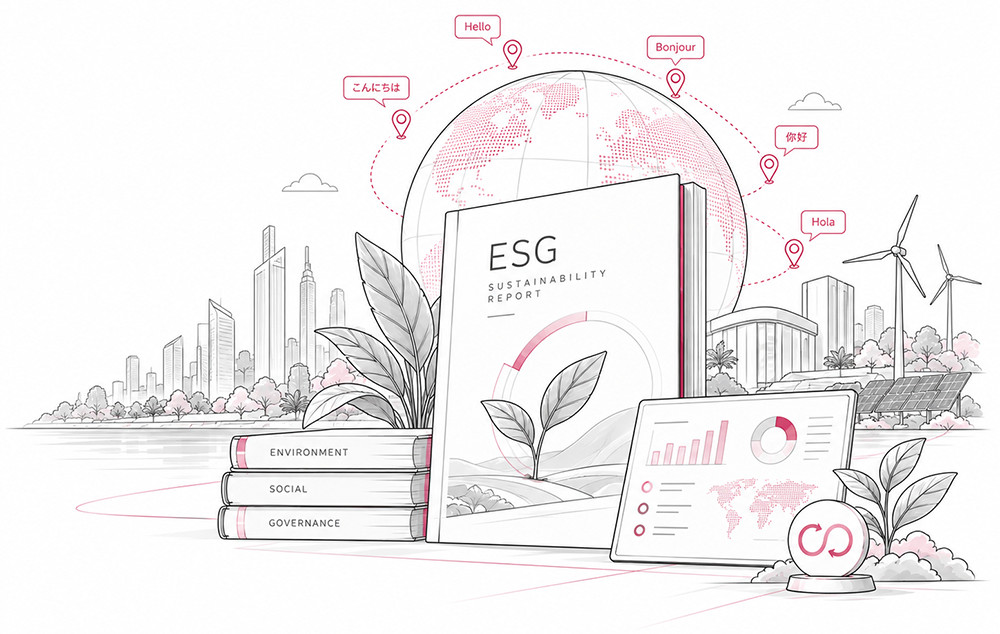
ESG Translation Goes Beyond Words
Sustainability content brings together environmental science, corporate reporting, finance, governance, regulation, data, and public communication. Reliable ESG translation must keep terminology, metrics, disclosures, and supporting content aligned across languages, formats, and reporting cycles.
ESG terminology must stay consistent
Defined sustainability concepts and KPI labels should not drift between sections, reports, markets, or reporting years.
Narrative and data must tell the same story
Reports combine prose with targets, metrics, dates, units, tables, charts, and footnotes that must remain aligned after translation.
Multiple stakeholders need one controlled workflow
Sustainability, finance, legal, compliance, audit, investor relations, communications, and regional reviewers need coordinated multilingual review.
Every reporting cycle should build on the last
Translation memory, approved terminology, style guidance, and reviewer decisions let teams reuse trusted language while focusing attention on new or changed content.
ESG and Sustainability Content We Translate
Stepes supports sustainability translation across reporting, regulatory, operational, investor, employee, supplier, and public-facing content—from individual documents to recurring global ESG programs.
Sustainability & ESG Reporting
- ESG and sustainability reports
- Integrated and annual reports
- Sustainability statements
- Corporate responsibility reports
- ESG performance updates
- Executive and management reporting
Regulatory & Disclosure Content
- CSRD and ESRS reporting content
- Materiality assessments
- Reporting methodologies
- Regulatory questionnaires
- Risk and opportunity disclosures
- Governance statements
Climate & Environmental Content
- Climate strategies and policies
- Scope 1, 2 and 3 content
- Transition plans
- Energy and resource reporting
- Water, waste and biodiversity
- Environmental impact information
Social & Workforce Content
- Human rights policies
- Workforce disclosures
- Labor standards
- Health and safety
- Modern slavery statements
- Community and social impact programs
Governance & Compliance Content
- Corporate governance policies
- Codes of conduct
- Anti-bribery and anti-corruption
- Risk and internal controls
- Whistleblower policies
- Compliance communications
Supply Chain & Stakeholder Content
- Supplier codes of conduct
- Responsible sourcing policies
- Supplier ESG questionnaires
- Due diligence documentation
- Investor communications
- Sustainability websites and presentations
Multilingual Sustainability Reporting Across Global Frameworks
Stepes supports translation and localization for sustainability content prepared under leading international and market-specific reporting environments while helping teams preserve approved terminology, disclosure meaning, KPI labels, and cross-language consistency.
CSRD & Revised ESRS
Translate sustainability statements, materiality content, narrative disclosures, KPI labels, tables, policies, methodologies, and supporting reporting content prepared for European sustainability reporting environments.
ISSB / IFRS S1 & S2
Support multilingual sustainability-related financial disclosures covering governance, strategy, risk management, metrics, targets, climate-related risks, and opportunities.
GRI Standards
Translate sustainability reporting content addressing organizational impacts on the economy, environment, and people while maintaining consistent terminology across global disclosures.
SASB & Industry Reporting
Support industry-focused sustainability content, metrics, investor communications, and related disclosures using sector-specific terminology and reporting conventions.
Stepes also supports multilingual content associated with the EU Taxonomy, climate disclosure programs, nature-related reporting, responsible investment, supply-chain sustainability, corporate governance, and market-specific ESG requirements. Stepes provides translation and localization services and does not provide legal, accounting, sustainability assurance, or regulatory advice.
CSRD & ESG Reporting GuideSpecialized Expertise Across Environmental, Social, and Governance Content
ESG spans diverse technical disciplines. Stepes matches language expertise to the subject matter, audience, document type, and intended use so specialized terminology remains accurate and appropriate across global markets.
Environmental
Translate content covering environmental impacts, risks, strategies, technologies, and operating practices that shape sustainability performance.
- Climate change
- Greenhouse gas emissions
- Energy and decarbonization
- Pollution and waste
- Water resources
- Biodiversity and ecosystems
- Circular economy
- Renewable energy
Social
Communicate workforce, human rights, community, and social-impact programs consistently across employees, suppliers, partners, and global stakeholders.
- Workforce policies
- Labor practices
- Health and safety
- Human rights
- Diversity and equal opportunity
- Supply-chain labor standards
- Modern slavery
- Community engagement
Governance
Translate policies, controls, procedures, and communications that support corporate oversight, accountability, ethics, and responsible business conduct.
- Board oversight
- Business ethics
- Anti-corruption
- Risk management
- Internal controls
- Whistleblower protection
- Corporate transparency
- Compliance programs
Built for Annual and Recurring ESG Reporting Cycles
Each reporting period introduces new disclosures, revised metrics, updated policies, stakeholder feedback, and changing source content while retaining substantial approved language. Stepes creates a repeatable multilingual workflow that connects new content with trusted language assets.
Prepare
Review files, languages, prior reports, glossaries, style guidance, stakeholder requirements, and publication formats.
Translate
Apply the right combination of professional linguists, approved AI-assisted workflows, and translation memory reuse.
Validate
Check terminology, numbers, units, KPI labels, defined terms, references, protected content, and project-specific requirements.
Review
Coordinate sustainability, finance, legal, regional, and other stakeholder review in a controlled multilingual process.
Publish
Validate tables, charts, footnotes, typography, pagination, and language-specific layout in the final publication format.
Reuse
Return approved translations, terminology decisions, and reviewer feedback to language assets for the next reporting cycle.
Keep ESG Terminology Consistent Across Languages
Sustainability reporting depends on concepts that must remain stable across narrative sections, data tables, policies, websites, presentations, and reporting years. Stepes helps organizations govern multilingual ESG terminology through centralized language assets that guide professional linguists, AI workflows, reviewers, and quality checks.
Protect ESG Metrics Across Every Language
Carbon emissions, targets, percentages, dates, energy values, water consumption, workforce statistics, financial amounts, ratios, units, and year-over-year comparisons must remain aligned with the source and with the translated narrative surrounding them.
AI-Powered ESG Translation With Human Accountability
AI can improve speed and efficiency across high-volume sustainability content, but not every disclosure, policy, claim, or data point carries the same level of risk. Stepes configures AI + human workflows so the level of automation, linguistic expertise, review, and accountability matches the content.
Suitable recurring content may benefit from translation memory, AI translation, terminology automation, automated QA, and streamlined professional validation.
Regulatory-facing, investor-facing, public, legally significant, or interpretation-sensitive content can be routed through stronger professional controls.
The goal is not to maximize automation. It is to use technology where it creates value while preserving appropriate human accountability where language carries greater business or reporting risk.
Turn Previous ESG Translations Into Reusable Language Assets
Governance structures, methodologies, reporting boundaries, policy descriptions, KPI definitions, company background, program descriptions, and established commitments may recur from year to year. Translation memory turns approved bilingual content into a reusable enterprise asset.
Build on approved language instead of starting over.
Each reporting cycle can add trusted bilingual content and reviewer decisions that strengthen future ESG communications.
Reuse Approved ESG Language
Identify previously approved translations when identical or similar content appears in a new report and reuse or adapt them in context.
Focus Review on What Changed
Let linguists and internal reviewers concentrate on new disclosures, changed data, updated policies, revised claims, and other fresh content.
Improve Consistency Across Reporting Cycles
Maintain continuity between annual reports, sustainability statements, investor communications, policies, and supporting documents.
Preserve Institutional Knowledge
Keep validated translations and reviewer decisions available even as internal teams, reporting systems, or external providers change.
Build Greater Value Over Time
Expand the organization's trusted bilingual language assets with every approved sustainability reporting cycle.
Publication-Ready Sustainability Reports
Sustainability reports combine narrative content with data, infographics, photography, tables, charts, sidebars, footnotes, icons, and multi-column layouts. Translation is only complete when the final publication works in every language.
One Multilingual Workflow Across ESG Stakeholders
Sustainability content crosses organizational boundaries. Stepes helps global teams manage shared terminology, content, review, and approval while allowing each function to apply its own expertise.
Sustainability & ESG Teams
Reports, disclosures, materiality assessments, climate strategies, ESG programs, policies, and stakeholder communications.
Finance & Corporate Reporting
Metrics, annual-report content, investor information, financially connected sustainability narratives, and disclosures.
Financial Translation ServicesLegal & Compliance
Governance policies, codes of conduct, ethics content, risk disclosures, due diligence, and other risk-sensitive materials.
Legal Translation ServicesInvestor Relations
ESG presentations, performance updates, shareholder communications, investor reports, web content, and related disclosures.
Procurement & Supply Chain
Supplier codes, responsible sourcing, ESG questionnaires, procurement standards, human-rights policies, and due diligence.
Corporate Communications
Sustainability websites, reports, employee programs, public campaigns, executive communications, and stakeholder content.
Secure Workflows for Sensitive Corporate Reporting
ESG and sustainability programs can involve confidential environmental performance data, workforce metrics, supply-chain information, governance decisions, financial information, corporate targets, and future commitments before publication.
Stepes supports enterprise translation workflows designed to keep sensitive multilingual content controlled throughout the project lifecycle.
Enterprise Translation ManagementCentralized Project Management
Coordinate source files, languages, project instructions, schedules, reviewers, status, and deliveries through a structured workflow.
Role-Based Review
Route translated content to the appropriate internal stakeholders while keeping review responsibilities and approvals organized.
Controlled Language Assets
Manage client-specific translation memories, glossaries, style guidance, and reference content as reusable enterprise resources.
Secure File Handling
Support controlled project access and enterprise workflows appropriate for confidential corporate content.
Why Global Organizations Choose Stepes for ESG Translation
Stepes combines sustainability subject-matter expertise with modern language technology and enterprise translation operations to support both individual ESG projects and recurring global reporting programs.
Specialized ESG Expertise
Linguists and reviewers are matched to the sustainability topic, document type, target language, audience, and subject-matter requirements.
100+ Languages
Coordinate sustainability communications across major global markets through one multilingual delivery model.
AI + Human Quality
Combine AI-assisted translation, professional linguists, translation memory, terminology, automated checks, and expert review based on content risk.
Terminology Governance
Keep sustainability terminology, KPI labels, policy names, defined concepts, and organization-specific language aligned across reporting cycles.
Numeric & Final-Format QA
Apply controls to language, numbers, units, references, tables, charts, formatting, and the final publication experience.
Reusable Language Assets
Preserve approved terminology and translations so each completed ESG project can strengthen future reporting and reduce repetitive work.
CSRD & ESG Reporting Across Languages
Build a Stronger Multilingual ESG Reporting Process
Multilingual sustainability reporting introduces risks that go beyond translation fluency. Our practical guide explores how global teams can improve terminology governance, numeric consistency, stakeholder review, version control, reporting workflows, and assurance readiness.
- Multilingual CSRD and ESG reporting risks
- Sustainability terminology governance
- Numeric and KPI validation
- Cross-functional review workflows
- Version and language-pack management
- Reporting-cycle reuse
ESG & Sustainability Translation FAQs
Answers to common questions about multilingual ESG reporting, sustainability documents, terminology, metrics, AI workflows, and publication-ready delivery.
ESG translation is the specialized translation of environmental, social, and governance content for audiences across different languages and markets. It can include sustainability reports, climate disclosures, corporate policies, governance materials, human-rights content, supplier documentation, investor communications, data tables, websites, and related content. Effective ESG translation must preserve subject-matter meaning, approved terminology, numerical information, and consistency across documents and reporting cycles.
Stepes translates sustainability reports, ESG reports, integrated reports, corporate responsibility reports, climate strategies, emissions content, materiality assessments, policies, codes of conduct, governance documentation, human-rights and workforce materials, supplier ESG content, investor communications, presentations, websites, and related corporate reporting in more than 100 languages.
Yes. Stepes supports multilingual sustainability and ESG reports from source-content translation through terminology management, stakeholder review, numeric and KPI QA, multilingual desktop publishing, and final-format validation. Workflows can be configured for individual reports or recurring annual reporting programs.
Yes. Stepes translates multilingual content prepared for CSRD and ESRS reporting environments, including sustainability statements, narrative disclosures, policies, materiality content, KPI labels, tables, methodologies, and supporting documentation. Stepes provides language services and does not determine an organization's legal or regulatory compliance obligations.
Yes. Stepes supports multilingual sustainability content prepared with reference to major reporting environments such as the ISSB's IFRS S1 and IFRS S2, GRI Standards, SASB-related industry terminology, and other international or market-specific sustainability frameworks.
Stepes can create or apply multilingual glossaries and termbases containing approved sustainability terms, definitions, KPI names, company terminology, policy names, abbreviations, preferred translations, and prohibited variants. Approved terminology can then be applied across professional translation, AI workflows, automated QA, and human review.
Stepes can apply structured quality controls to values, dates, percentages, units, signs, table labels, chart labels, totals, references, and narrative statements linked to data. Critical checks can also be repeated after multilingual layout so formatting changes do not introduce errors into the final report.
Yes. Stepes translation memory stores approved bilingual content so relevant language from previous reports, policies, methodologies, disclosures, and communications can be reused or adapted when it appears in future projects. This improves consistency and lets linguists and reviewers focus on new or changed material.
Yes, when it is appropriate for the content and quality requirements. Stepes supports AI-assisted, professional human, and hybrid translation workflows. Repetitive or lower-risk content may benefit from greater automation, while regulatory-facing, public, investor-facing, legally sensitive, or high-impact disclosures can receive stronger professional human controls.
Yes. Stepes provides multilingual desktop publishing and final-format QA for sustainability reports and related content in formats such as Adobe InDesign, Illustrator, Word, Excel, PowerPoint, and PDF. Our teams can adapt layouts, charts, tables, typography, and language-specific formatting to produce publication-ready multilingual files.
Stepes provides ESG and sustainability translation services in more than 100 languages, supporting major European, Asian, Latin American, Middle Eastern, and other global markets. Multilingual programs can be coordinated through one workflow with shared terminology, translation memory, project management, and quality controls.
Ready to Simplify Multilingual ESG Reporting?
From global sustainability reports and ESG disclosures to corporate policies, supplier communications, and recurring reporting programs, Stepes combines specialized professionals, governed terminology, reusable language assets, AI-powered efficiency, and human accountability.