
How Fast Do You Need Your Translation?
Deadlines vary. So should the translation workflow. Tell us when you need the finished files, and Stepes will determine the fastest professional delivery option based on your content, languages, volume, complexity, and quality requirements.
Same Day
For short, urgent documents and time-sensitive communications when qualified resources can be confirmed quickly.
24 Hours
For moderate volumes that need professional translation, coordinated review, and accelerated delivery.
Overnight / Weekend
For qualifying projects that extend beyond normal working hours and benefit from global time-zone coverage.
Custom Rush
For larger or complex projects with a fixed accelerated deadline and coordinated parallel workflows.
Professional Translation at Accelerated Speed
Fast translation is not simply a matter of asking translators to work faster. Professional rush translation requires removing unnecessary delays from the process while protecting linguistic quality, terminology consistency, formatting, and the usability of the finished content.
Stepes accelerates translation through technology-enabled project intake, rapid resource matching, translation memory, terminology management, parallel production, automated quality checks, and coordinated human review.
For straightforward content, the workflow can move extremely quickly. For legal, medical, technical, regulatory, or other specialized materials, Stepes assigns linguists with the appropriate subject-matter expertise and builds the fastest workflow that is responsible for the content.
Why Stepes Can Deliver Translations Faster
Stepes was built around an on-demand translation model that uses technology to reduce administrative delays and connect projects with qualified language resources more efficiently.
Traditional Translation Workflow
The Stepes Fast Translation Workflow
Speed through better workflow design. The goal is not to eliminate important quality steps. It is to eliminate unnecessary waiting between them.
From File Upload to Delivery Without Unnecessary Delays
Every urgent translation project begins with a clear understanding of what must be translated, how the translation will be used, and when it must be ready.
Upload & Analyze
Send your source files and target languages. We review word count, file type, subject matter, formatting, terminology, translation memory, and other requirements.
Confirm the Deadline
Tell us the exact date and time you need the translation. We evaluate feasibility based on scope, complexity, available resources, and required quality controls.
Match Qualified Linguists
Professional translators are selected based on language, subject expertise, project requirements, and availability for the requested schedule.
Translate & Review
Translation, terminology management, TM reuse, parallel workflows, automated QA, and human review work together according to the project needs.
Verify & Deliver
Completed files are checked for completeness, consistency, formatting, and agreed project requirements before delivery.
How Fast Can We Translate Your Content?
Translation turnaround depends on more than word count, but project size provides a useful starting point when planning urgent delivery.
Short documents
Same day in many casesShort documents with straightforward formatting and commonly supported language pairs are often strong candidates for same-day delivery.
Medium projects
Same day to 24 hoursModerate-volume projects may require additional translation, review, or specialist resources depending on the content.
Large projects
Custom accelerated scheduleLarger projects can often move faster through parallel translation, TM reuse, coordinated terminology, automated QA, and managed review.
AI Speed. Professional Human Accountability.
Modern translation technology can remove significant friction from urgent multilingual projects. Stepes uses automation where technology creates efficiency and professional linguists where language, context, subject knowledge, and judgment matter.
AI where it creates efficiency. Human expertise where judgment matters. Fast translation describes the turnaround requirement, not uncontrolled machine output.
Workflow Automation
Accelerates project intake, file analysis, routing, coordination, tracking, and delivery so less time is spent on repetitive administration.
Translation Memory
Reuses approved translations and repeated content when appropriate, reducing unnecessary retranslation while supporting consistency.
Terminology Management
Applies approved product, technical, legal, regulatory, and client-specific terminology across the project.
Automated Quality Checks
Helps identify potential issues involving numbers, missing content, terminology, punctuation, formatting, tags, and other measurable elements.
Professional Linguists
Human translators and reviewers provide the linguistic judgment required when meaning, tone, technical accuracy, or regulatory significance matters.
Fast Translation Without the Common Rush-Project Risks
Urgent translation introduces risks that do not always appear in projects with flexible schedules. The solution is to manage those risks from the beginning rather than remove the controls designed to catch them.
Translation memory, shared glossaries, approved terminology, and coordinated project resources help keep key terms aligned.
Shared linguistic assets, project instructions, terminology controls, and centralized review help parallel resources work as one team.
Automated QA and human review can work together to identify potential issues before delivery.
Formatting requirements are evaluated during intake so the delivery schedule reflects both linguistic and production needs.
Controlled file handling and clear handoffs help teams stay aligned on the current version and the timing impact of changes.
Feasibility is reviewed before production so the fastest responsible workflow can be confirmed upfront.
Fast Translation for Business-Critical Content
Stepes provides accelerated translation for a wide range of business, technical, legal, regulated, and customer-facing materials.
Business Documents
Reports, presentations, proposals, executive communications, policies, HR communications, and operational documents.
Document Translation ServicesLegal & Compliance
Contracts, litigation materials, investigations, regulatory correspondence, policies, disclosures, and court-related content.
Legal Translation ServicesTechnical Content
Manuals, specifications, procedures, product documentation, engineering materials, release notes, and technical updates.
Technical Translation ServicesMedical & Life Sciences
Clinical, medical, regulatory, safety, pharmaceutical, healthcare, and patient-facing communications.
Life Sciences Translation ServicesFinancial Content
Financial reports, transaction materials, disclosures, investor communications, policies, and other time-sensitive financial documents.
Financial Translation ServicesMarketing & Digital
Press releases, campaigns, product launches, web content, customer communications, and global announcements.
Marketing Translation ServicesFast Translation for Time-Critical Industries
Some industries face deadlines where multilingual content cannot simply wait for a standard production schedule. Stepes builds expedited workflows around the operational realities of these sectors.
Legal
Court dates, transaction deadlines, investigations, discovery, contracts, regulatory matters, and international proceedings.
Legal Translation ServicesLife Sciences & Healthcare
Clinical operations, safety communications, regulatory activity, medical documentation, product updates, and patient communications.
Life Sciences Translation ServicesFinancial Services
Global transactions, financial reporting, regulatory filings, disclosures, investor communications, and governance requirements.
Financial Translation ServicesTechnology
Product launches, release cycles, security updates, customer communications, UI content, and rapidly changing documentation.
Software Localization ServicesManufacturing
Production changes, supplier communications, safety information, technical updates, operating instructions, and supply-chain requirements.
Manufacturing Translation ServicesMarketing & Communications
Global campaigns, product announcements, media communications, customer messaging, and coordinated market launches.
Marketing Translation ServicesNeed More Than a Few Pages Translated Fast?
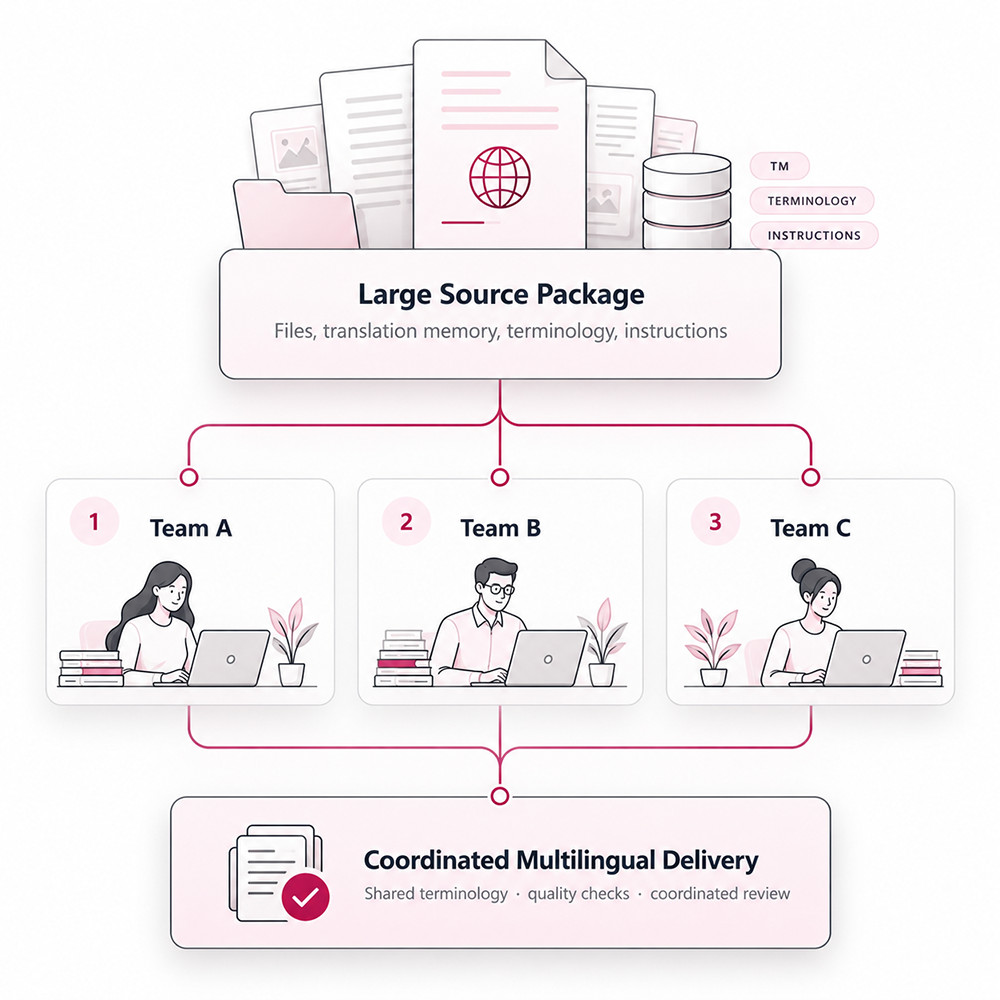
Large-volume urgent translation is a different challenge from translating a short document. It requires coordinated production rather than simply asking one translator to work faster.
Large files can be segmented among multiple qualified linguists so work progresses simultaneously rather than sequentially.
Previously translated and repeated content can be reused across the project to reduce unnecessary work and reinforce consistency.
Shared glossaries and project-specific terminology help multiple linguists use the same approved language.
Reviewers work from common project instructions and linguistic assets so feedback remains aligned across files.
Technology can identify measurable issues across large amounts of multilingual content efficiently.
Centralized project management coordinates resources, deadlines, queries, changes, and final delivery.
Need a Certified Translation Urgently?
Time-sensitive official documents sometimes require both rapid turnaround and formal certification. Rush certified translation may be available for qualifying documents depending on the language pair, source quality, formatting, and certification requirements.
Fast Translation Services in 100+ Languages
Stepes supports professional translation across more than 100 languages, helping organizations respond quickly to multilingual requirements across global markets.
Rush availability varies by language pair, specialization, project size, and required workflow. For recurring programs, established translators, translation memory, terminology resources, and previous project knowledge can further accelerate future turnaround.
View All LanguagesWhen an Unexpected Deadline Becomes a Translation Project
Urgent multilingual requirements are not always planned. The faster the deadline, the more important coordinated resources and quality controls become.
One Coordinated Path From Urgency to Delivery
A global organization needed customer-facing communications translated across multiple languages following an unexpected business update. The content had to be released quickly and consistently across markets.
Stepes reviewed the files, confirmed the project requirements and delivery feasibility, then coordinated translators and parallel workflows across the required languages.
The translated communications were completed according to the agreed schedule, allowing the organization to move forward with its international release without waiting for a conventional translation timeline.
How Much Does Fast Translation Cost?
There is no single rush-translation price that applies to every project. Pricing depends on the resources and workflow required to meet the requested deadline.
Larger projects require more translation capacity and may need multiple linguists working in parallel.
Qualified translator availability and market rates vary by language combination.
Legal, medical, financial, engineering, scientific, and other specialized content may require subject-matter expertise.
Shorter deadlines can require priority scheduling, additional resources, or accelerated review.
Editable files are generally faster to process than scanned PDFs, images, or files requiring extensive desktop publishing.
Independent review, certification, client review, or additional QA stages can affect schedule and pricing.
Translation Memory Can Reduce Time and Cost
If your files contain repeated content or text previously translated by Stepes, translation memory can identify reusable segments. This can reduce the amount of new translation required while helping maintain consistency with previous projects.
Upload Files for PricingHave a Deadline? Here’s What to Send Us.
Starting an urgent translation project should be simple. Providing complete project information upfront helps Stepes confirm feasibility and begin work faster.
Send the source documents that need translation.
Tell us the source language and each target language or locale required.
Include both the date and time whenever the deadline is fixed.
Provide terminology, references, previous translations, formatting instructions, certification needs, or other relevant information.
Stepes reviews the project and confirms the proposed workflow, pricing, and delivery schedule.
Once approved, the project moves into production according to the agreed plan.
Frequently Asked Questions
Practical answers about same-day, 24-hour, overnight, rush, urgent, and expedited professional translation.
Fast translation services are professional translation workflows designed for shorter-than-standard delivery schedules. They use priority resourcing, workflow automation, translation memory, terminology management, parallel production where appropriate, and coordinated quality controls to accelerate delivery. Fast translation may also be described as urgent, rush, expedited, express, or rapid translation.
These terms generally describe the same underlying requirement: professional translation completed on an accelerated schedule. Same-day and 24-hour translation are more specific because they describe an actual delivery window. Stepes evaluates the content and requested deadline and recommends the appropriate workflow.
Same-day translation is completed within the same business day and is best suited to shorter projects with clear requirements. A 24-hour schedule provides more time for coordination and review and can be a better fit for longer, more specialized, or more heavily formatted content. Stepes confirms the appropriate delivery window after reviewing the actual files and project requirements.
Short, straightforward documents can often be completed the same day. Moderate-volume projects may be completed within the same day or 24 hours, while larger projects generally require a custom accelerated schedule. Actual turnaround depends on language pair, word count, subject matter, file format, review requirements, and resource availability.
Yes. Same-day professional translation is available for many qualifying projects, particularly shorter documents in commonly supported language pairs. Send the source file and exact deadline so Stepes can confirm availability and feasibility.
Yes. Stepes supports 24-hour translation for qualifying projects across a broad range of business content and languages. Available turnaround depends on volume, complexity, formatting, subject expertise, and language resources.
Overnight and weekend delivery may be available for qualifying projects. Stepes’ global translator network and technology-enabled workflows can help coordinate translation across regions and time zones when appropriate. Availability should be confirmed before production begins.
There is no universal daily word-count limit because content complexity and workflow requirements vary significantly. For larger projects, Stepes can use multiple qualified translators working in parallel with shared translation memory and terminology to increase production capacity.
In many cases a project of this size may be feasible within an accelerated schedule, but the answer depends on language pair, subject matter, formatting, translation-memory leverage, review requirements, and available qualified resources. Upload the document and provide your deadline for a project-specific assessment.
Yes. Large projects can often be accelerated by dividing content across multiple qualified translators and coordinating their work through shared translation memory, terminology, project instructions, automated QA, and centralized review.
Stepes combines professional linguists with translation memory, terminology management, automated QA, project-specific instructions, coordinated review, and final file verification. The exact workflow is adapted to the content, deadline, audience, and required level of quality assurance.
No. Fast translation describes the turnaround requirement, not a single translation method. Stepes can use AI and automation to accelerate workflow tasks and support appropriate translation processes, while professional human translators and reviewers provide linguistic expertise for business-critical content.
Yes, subject to qualified specialist availability and a realistic production schedule. Specialized content may require translators with legal, medical, scientific, engineering, regulatory, or other subject-matter expertise, which is considered when Stepes confirms the deadline.
Yes. Rush certified translation may be available for qualifying official documents, including immigration, legal, academic, employment, government, and corporate records. Turnaround depends on the document, language pair, certification requirements, formatting, and project volume.
Yes. Stepes translates PDF documents as well as Word, PowerPoint, Excel, and many other common file formats. Editable files can generally be processed more efficiently. Scanned or highly formatted PDFs may require additional preparation or desktop publishing.
Stepes provides translation services across more than 100 languages. Rush availability depends on the specific language pair, subject matter, project volume, and deadline. Common business languages generally provide the broadest immediate resource availability.
Pricing depends on word count, language pair, subject matter, delivery deadline, file format, review level, and other project requirements. The most accurate approach is to upload the source files and specify the required deadline.
Provide the source files, source language, target language or locale, and exact delivery deadline. If available, also include previous translations, glossaries, style guides, formatting requirements, certification requirements, and other reference materials.
Yes. Stepes evaluates the project requirements and proposed turnaround before production begins. For urgent work, confirming feasibility upfront helps align resources, workflow, quality requirements, and delivery expectations.
Tell Us Your Deadline. We’ll Take It From There.
Upload your files, select your languages, and provide the required delivery date and time. Stepes will review the project and confirm the fastest available professional turnaround along with clear pricing before work begins.