
Connected Device Content
Specialized Translation for Every Part of the Medical Device Experience
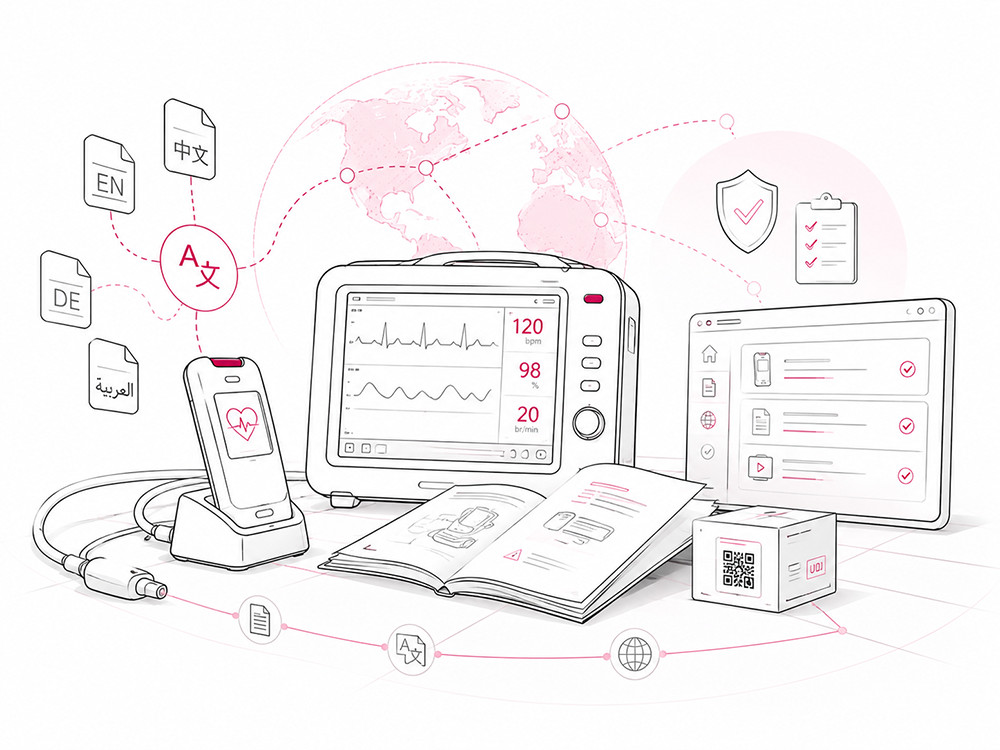
A medical device reaches its users through much more than the physical product. Instructions for use, labels, software screens, technical documentation, training, service content, and safety communications work together to explain how the device should be installed, operated, maintained, and updated.
Those materials must remain clear and consistent across languages. A component name used in the software should match the term in the IFU. A warning on the packaging should retain the same meaning in training and support materials. When a device or software function changes, the affected multilingual content must be identified, updated, reviewed, and released in alignment.
Protect Technical Meaning
Preserve the intended meaning of operating instructions, warnings, precautions, contraindications, specifications, and device functions.
Maintain Content Consistency
Coordinate terminology across IFUs, labels, embedded software, mobile applications, portals, technical manuals, and training.
Support Global Scale
Manage multiple languages, regional reviewers, file formats, product versions, and delivery requirements through one centralized process.
Medical Device Translation Requires More Than Language Fluency
Medical device content sits at the intersection of healthcare, engineering, software, usability, quality management, and technical communication.
Translators must understand not only the source language but also the device, its intended use, the people who operate it, and the practical context in which the content appears. Stepes assigns linguists and reviewers according to the language pair, subject matter, content type, intended audience, and target market.
- Surgeons and physicians
- Nurses and healthcare professionals
- Laboratory personnel
- Biomedical engineers
- Service and installation technicians
- Distributors and field teams
- Caregivers
- Patients and home users
Technical and Clinical Understanding
Device content can involve anatomy, diagnostics, materials science, electronics, software, mechanical engineering, sterilization, maintenance, and clinical procedures.
Safety-Critical Language
Warnings, precautions, contraindications, operating sequences, measurement instructions, error messages, and troubleshooting procedures require careful linguistic treatment.
Cross-Asset Consistency
A device component or software function should not receive one translation in the interface and another in the IFU, label, or training material.
Market-Specific Requirements
Language requirements differ by jurisdiction, device, intended user, and content type. Stepes helps clients implement the multilingual requirements defined by their regulatory strategy.
Medical Device Content Translation Across Documents, Software, and Media
Stepes supports individual projects and continuing multilingual programs spanning product families, business units, and global markets.
IFUs, Labels, and Packaging
Translate the content users rely on to identify, understand, and operate a device, including professional-use and patient-use instructions.
- IFUs and electronic IFUs
- Device labels and packaging
- Quick-start guides
- Warnings and precautions
- Symbol explanations
- Patient information
Technical and Product Documentation
Support engineering, installation, operation, maintenance, and field service with precise multilingual technical content.
- User and operator manuals
- Product specifications
- Installation instructions
- Service and maintenance manuals
- Calibration procedures
- Technical drawings
Regulatory and Quality Documentation
Translate documentation used by regulatory, quality, clinical, and product teams throughout the device lifecycle.
- Technical documentation
- Risk-management materials
- Clinical evaluation content
- Verification and validation records
- Quality procedures
- Audit documentation
Software and Digital Content
Localize the digital experiences through which healthcare professionals, technicians, and patients interact with connected devices.
- Embedded user interfaces
- Mobile applications
- Clinician dashboards
- Patient portals
- Online help
- Release notes
Training and Support Content
Prepare multilingual materials for product adoption, professional education, technical support, and field operations.
- Product training
- Clinical education
- eLearning courses
- Field-support documentation
- Knowledge bases
- Video and multimedia
Post-Market and Lifecycle Content
Keep global stakeholders informed as safety information, software, instructions, and product communications evolve after launch.
- Revised IFUs and labels
- Field safety communications
- Product update notices
- Complaint-related narratives
- Software update content
- Customer communications
Translation Expertise Across Medical Device Technologies
Medical devices range from relatively simple products to integrated systems combining hardware, software, sensors, cloud infrastructure, and clinical workflows.
Diagnostic and Imaging Systems
MRI, CT, ultrasound, X-ray, digital pathology, imaging workstations, and diagnostic software.
Surgical and Interventional Devices
Surgical instruments, robotic systems, catheters, endoscopy equipment, and navigation technologies.
Implantable and Therapeutic Devices
Orthopedic, cardiovascular, neuromodulation, infusion, respiratory, and rehabilitation devices.
Monitoring and Connected Devices
Patient monitoring, remote platforms, wearables, sensor-based devices, and home-use technologies.
Laboratory and IVD Systems
Laboratory analyzers, point-of-care systems, test kits, sample-processing equipment, and diagnostic software.
SaMD and AI-Enabled Devices
Clinical decision support, digital therapeutics, connected applications, cloud platforms, and AI-enabled software functions.
Multilingual Support Across the Medical Device Lifecycle
Medical device translation should not begin and end with a finished manual. Content is created, revised, reviewed, and reused from early product development through market launch and post-market operations.
Research and Development
Design inputs, specifications, usability research, prototype documentation, and technical collaboration.
Clinical and Regulatory Preparation
Clinical evaluation content, risk-management materials, technical files, and validation documentation.
Product Launch and Market Entry
IFUs, labeling, software, training, websites, distributor materials, and launch communications.
Commercialization and Adoption
Clinical education, product support, service documentation, patient information, and sales-enablement content.
Post-Market Operations
Product updates, revised safety information, field communications, complaint content, and recurring software releases.
By retaining approved terminology, translation memory, product references, and reviewer decisions, Stepes helps clients avoid restarting the translation process with every update while preserving continuity across versions.
IFU, eIFU, Labeling, and Packaging Translation
Instructions for use and device labeling connect the manufacturer’s technical knowledge with the people who install, operate, maintain, prescribe, or receive the device. Stepes supports professional-use, patient-use, and home-use products across digital and print formats.
- Professional and patient IFUs
- Electronic IFUs and structured content
- Quick-reference and setup guides
- Device labels and packaging
- Warnings, identifiers, numbers, and units
- Multilingual layout and final-format QA
Multilingual eIFU programs can coordinate responsive presentation, downloadable files, paper versions, product revisions, and approved terminology across languages. Labeling workflows can also address space constraints, text expansion, right-to-left layouts, multilingual artwork, and print-ready review.
Software, SaMD, and Connected Devices
Medical Device Software Localization for Evolving Digital Products
Modern medical devices increasingly combine physical hardware with embedded software, mobile applications, cloud platforms, web portals, and connected services.
Medical device software localization requires technical file handling, context management, terminology alignment, layout validation, and coordinated release support. Stepes localizes menus, controls, setup screens, status messages, warnings, measurement displays, dashboards, online help, notifications, documentation, and release notes.
- Embedded interfaces and controls
- Clinician dashboards and reports
- Patient applications and portals
- Software resource files
- Online help and onboarding
- Release notes and update communications
- In-context linguistic testing
- Recurring delta localization
In-context review helps identify truncation, text expansion, ambiguous strings, incorrect line breaks, character-rendering problems, untranslated content, and right-to-left display issues. For AI-enabled devices, controlled release workflows can keep software, IFUs, labels, help content, and training aligned as functionality changes.
Explore Software Localization ServicesMedical Device Translation for Market-Specific Requirements
Global medical device translation is not a one-size-fits-all process. Language and documentation requirements can depend on the market, device classification, intended user, distribution model, and type of information provided.
Stepes supports manufacturers with the multilingual execution needed to implement their regulatory and market-entry strategies while maintaining consistent terminology across documents, software, labels, training, and supporting systems.
European Union
Support MDR- and IVDR-regulated content across Member States, including IFUs, eIFUs, labels, software, technical documentation, and safety communications. Language requirements can vary by market, device, intended user, and content type.
United States
Translate medical device content used for professional education, patient support, clinical and research activities, commercial programs, and multilingual user communication within FDA-regulated environments.
Canada
Prepare English and French Canadian device content for labels, instructions, software, training, and market support with terminology adapted for Canadian users and requirements.
Asia-Pacific, Latin America, and the Middle East
Coordinate language programs for Japan, China, South Korea, Australia, Southeast Asia, Latin America, the Middle East, and other markets with locale-specific terminology and review workflows.
Language and documentation requirements vary by market, device, intended user, and content type. Manufacturers should confirm applicable requirements with their regulatory and legal teams. Stepes provides translation and localization services and does not replace regulatory, legal, clinical, or quality advisers.
Terminology and Change Management
Keep Medical Device Language Consistent Across Every Release
Terminology consistency is essential when the same device concepts appear across product models, documents, software interfaces, training, and support materials.
Stepes combines terminology management, translation memory, client references, screenshots, and reviewer feedback to create a governed multilingual language foundation. Termbases can record approved translations, definitions, context, usage guidance, prohibited variants, and locale-specific preferences.
When source content changes, version-aware workflows can identify affected segments, apply approved terminology, prevent obsolete translations from resurfacing, and coordinate review across languages. Regulatory, product, clinical, and regional reviewers can contribute decisions that remain available for future projects.
From Content Intake to Final Multilingual Delivery
Stepes configures each medical device translation workflow according to the content, languages, intended users, markets, risk profile, file requirements, and client review process.
Requirements Review
Confirm files, languages, markets, intended users, device category, content type, schedule, and review expectations.
File Preparation
Analyze source files, extract translatable content, protect variables and tags, and prepare documents or software resources.
Resource Assignment
Select linguists and reviewers by language, medical-device experience, specialty, audience, and target market.
Translation
Apply approved terminology, translation memory, style guidance, product references, screenshots, and client instructions.
Review and QA
Perform the agreed linguistic review, terminology validation, completeness checks, number and unit checks, and technical QA.
Client Review
Coordinate regulatory, product, clinical, or in-country feedback and preserve approved decisions for future releases.
Production and Delivery
Complete multilingual DTP, software-file generation, final-format QA, versioned delivery, and language-asset updates.
Apply AI Where It Helps—and Human Expertise Where It Matters Most
Medical device content does not have a single risk level or one appropriate translation method. Stepes configures workflows around content type, intended audience, linguistic assets, quality requirements, and client-approved use of AI.
Professional Human Translation
Qualified linguists translate specialized, novel, patient-facing, safety-related, or high-impact content with direct human control over meaning and terminology.
- Safety-critical instructions
- Patient-facing content
- Specialized technical material
AI-Assisted Human Translation
AI, translation memory, approved terminology, and automated QA help professional linguists work more efficiently while retaining human responsibility for final quality.
- Approved language assets
- Professional validation
- Documented quality checks
Machine Translation Post-Editing
Selected lower-risk or highly repetitive content can use machine translation with professional post-editing when the language pair, content, and client requirements support it.
- Content-specific suitability
- Terminology application
- Professional editing
Expert AI Translation Review
Stepes can review translations generated by a client’s AI or machine translation system for accuracy, completeness, terminology, locale fit, and context.
- Source and target review
- Multilingual file support
- Severity-based findings
A patient-facing warning, an internal knowledge article, an embedded software string, and an engineering reference document should not automatically receive the same workflow. Risk-sensitive program design directs professional review toward the content where linguistic judgment, technical knowledge, and user impact matter most.
Quality-Controlled Medical Device Translation
Stepes supports medical device translation with ISO-certified quality frameworks, qualified resources, controlled workflows, terminology management, review steps, secure content handling, and documented delivery processes.
ISO 13485 Quality Management
A medical-device quality framework supporting defined processes, qualified resources, documentation, issue handling, and continual improvement.
ISO 17100 Translation Workflows
Professional translation and review practices supported by defined resource competencies and process requirements.
ISO 9001 Process Discipline
Broader quality-management controls for process consistency, customer focus, performance monitoring, and improvement.
Qualified Linguists and Reviewers
Resources matched by language, medical-device experience, technical specialty, content type, target market, and review role.
Secure Content Handling
Controlled access, secure file exchange, project permissions, confidentiality procedures, and enterprise onboarding support.
Documented and Connected Workflows
Defined instructions, approved language assets, review records, issue resolution, controlled delivery, and recurring program visibility.
Medical Device Translation in 100+ Languages
Coordinate multilingual launches across European, Asian, Latin American, Middle Eastern, and African markets while accommodating regional terminology, complex scripts, right-to-left presentation, and local review requirements.
Stepes supports regional language variants, multilingual European programs, coordinated Asia-Pacific releases, Latin American Spanish, Canadian French, Brazilian Portuguese, and market-specific terminology.
Explore All Translation LanguagesBuild a More Consistent Global Medical Device Experience
A connected medical device translation program helps teams improve how multilingual content is created, reviewed, updated, and delivered.
Faster Multilingual Launch Preparation
Coordinate documents, software, languages, reviewers, and delivery requirements through one managed program.
Greater Terminology Consistency
Use approved device language across IFUs, labels, interfaces, training, technical documentation, and support.
Less Rework Across Updates
Reuse validated content and focus translation and review effort on new or changed material.
Clearer Reviewer Coordination
Give regulatory, product, clinical, and regional stakeholders a structured process for feedback and approvals.
More Scalable Global Operations
Retain language assets and workflows across products, business units, markets, and recurring release cycles.
Clearer User Experiences
Help healthcare professionals, technicians, caregivers, and patients understand how to operate and interact with the device.
Why Stepes
One Multilingual Partner Across the Device Lifecycle
Stepes combines ISO 13485-certified quality management, medical-device linguists, localization engineering, terminology governance, AI-assisted workflows, multilingual production, and enterprise technology. We support a single urgent document and structured programs spanning multiple device families, business units, regional reviewers, documentation systems, and software release schedules.
- Coordinated global product launches
- Multiple related device models
- Recurring IFU and labeling revisions
- Agile software localization
- Centralized terminology governance
- Regional reviewer coordination
- Program reporting and visibility
- System-connected translation workflows
- Consolidated multilingual operations
- Reusable translation memory
Medical Device Translation Services FAQ
Explore common questions about IFUs, labeling, software localization, regulatory content, terminology, AI, file formats, and continuing product updates.
What are medical device translation services?
Medical device translation services adapt the documents, software, labeling, training, and communications associated with a device for users in other languages and markets. Content may include IFUs, labels, packaging, technical manuals, software interfaces, mobile applications, regulatory documentation, training, service materials, and post-market communications.
Why do medical device translations require specialized linguists?
Medical device content can combine clinical concepts, engineering, software, manufacturing, usability, and safety-related instructions. Specialized linguists are better equipped to understand device context, preserve technical meaning, apply approved terminology, and adapt content for healthcare professionals, technicians, patients, or other intended users.
Does Stepes translate medical device IFUs and eIFUs?
Yes. Stepes translates professional-use and patient-use IFUs, electronic IFUs, quick-start guides, operator manuals, and supporting instructions. Services can include translation, linguistic review, terminology management, multilingual formatting, structured-content support, and final-format QA.
Can Stepes translate medical device labels and packaging?
Yes. Stepes translates device labels, packaging, inserts, warnings, precautions, storage information, symbol explanations, product identifiers, and related content. Workflows can address text expansion, space constraints, right-to-left languages, multilingual artwork, numbers, units, and print-layout requirements.
Does Stepes localize medical device software and SaMD?
Yes. Stepes localizes embedded device interfaces, desktop software, mobile applications, web portals, clinician dashboards, patient interfaces, resource files, online help, notifications, release notes, and software documentation. In-context linguistic testing can identify truncation, display, context, terminology, and character-rendering issues.
Can Stepes support EU MDR- and IVDR-related content?
Stepes translates documentation and user-facing content used in MDR- and IVDR-regulated environments, including IFUs, eIFUs, labels, software, technical documentation, safety communications, and training. Clients remain responsible for confirming the legal and regulatory requirements applicable to their products and markets.
How does Stepes maintain medical device terminology consistency?
Stepes uses approved termbases, translation memory, style guides, previous translations, product references, screenshots, and client-review feedback. Approved terminology can be applied across IFUs, software, labels, technical documentation, training, and future product updates.
Does Stepes use AI for medical device translation?
Stepes can use AI and machine translation as part of an appropriately configured workflow. The method depends on the content, intended audience, language pair, risk, available terminology, and client requirements. Higher-risk or highly specialized content receives greater professional human involvement and review.
Can Stepes review medical device translations produced by our own AI system?
Yes. Clients can provide source content together with AI- or machine-generated translations for expert review. Stepes can evaluate accuracy, completeness, terminology, context, consistency, readability, locale suitability, and formatting or software constraints.
What file formats can Stepes process?
Stepes supports common document, design, structured-content, software, web, eLearning, audio, and video formats. Examples include Microsoft Office, Adobe InDesign, XML, HTML, JSON, software resource files, PDFs, subtitle files, and structured documentation formats.
Can Stepes support recurring medical device updates?
Yes. Stepes supports ongoing translation for revised IFUs, labeling changes, software releases, product updates, training revisions, and post-market communications. Translation memory, terminology management, delta translation, and version-aware workflows help preserve continuity from one release to the next.
How do I request a medical device translation quote?
Submit your source files, target languages, required services, and preferred deadline through the Stepes online quote platform. Our team will review the materials and provide pricing and turnaround information.
Plan More Controlled Multilingual Device Programs
Use practical guidance to plan IFU translation, electronic publishing, software localization, quality review, terminology, and responsible AI workflows.
Medical Device IFU Translation Guide
Plan professional and patient-use IFU translation, review, terminology, layout, version control, and final-format quality assurance.
Read the IFU Translation GuideElectronic IFUs and Multilingual Version Control
Explore how to coordinate multilingual eIFU content across digital delivery, downloadable files, revisions, and paper versions.
Explore eIFU Version ControlMedical Device Software Localization Checklist
Review interface context, terminology, variables, text expansion, character rendering, right-to-left behavior, and linguistic testing.
Use the Software Localization ChecklistAI Translation for Medical Devices
Understand where AI can improve translation efficiency and where professional human validation remains essential.
Explore AI Translation GuidanceBring Your Medical Device Content to Global Markets With Confidence
Translate your IFUs, labeling, technical documentation, software, training, and lifecycle updates through one quality-controlled multilingual workflow. Tell us about your device, content, target languages, markets, and delivery requirements.