
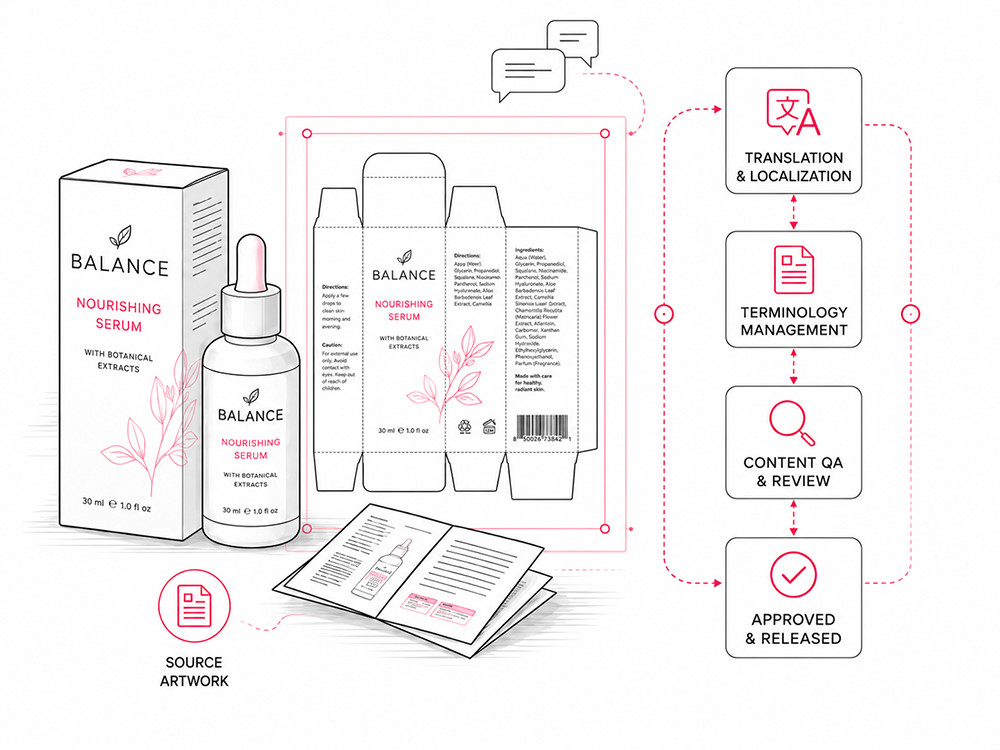
Your Packaging Carries More Than Marketing Copy
A package may look like one piece of content, but the language inside it can serve many different purposes. Product packaging brings together brand messaging, technical information, ingredients, instructions, safety content, consumer disclosures, and other information customers rely on to understand and use a product.
That makes packaging translation different from translating an ordinary document. A slogan may need creative adaptation. An ingredient needs precise terminology. A warning cannot lose its intended meaning. A measurement must remain correct. And every translation still has to fit inside the approved package design.
Stepes helps global companies translate these interconnected content types through packaging localization workflows designed around accuracy, consistency, artwork integrity, and market readiness.
Product & Brand Content
Product names, descriptions, claims, benefits, slogans, promotional language, and customer-facing messaging.
Ingredients & Product Information
Ingredients, materials, components, formulations, specifications, quantities, and structured product data.
Instructions & Directions
Preparation, use, dosage, assembly, operation, care, storage, handling, and maintenance information.
Safety & Warnings
Warnings, precautions, hazards, contraindications, safety statements, and other high-impact content.
Consumer & Regulatory Information
Required statements, manufacturer details, disclosures, certifications, country-of-origin information, recycling information, and market-specific content.
Connected Packaging Content
QR-linked information, digital product experiences, supporting instructions, websites, and other content that extends beyond the physical package.
Translate Every Part of the Package
Packaging translation often reaches far beyond the front panel. Stepes supports multilingual product content across primary packaging, secondary packaging, inserts, labels, graphics, and supporting materials so customers receive a consistent experience wherever product information appears.
Product Labels
Translate product names, descriptions, identifiers, specifications, benefits, quantities, and other essential information customers see on the product or container.
Ingredients & Composition
Maintain accurate multilingual terminology for ingredients, materials, formulations, components, and related product details.
Claims & Marketing Copy
Adapt product benefits, promotional statements, taglines, brand messaging, and other persuasive packaging content for local audiences while protecting brand intent.
Warnings & Safety Information
Translate warnings, precautions, handling instructions, hazards, storage requirements, and safety-critical information with workflows appropriate to the content risk.
Instructions & Directions
Localize usage, preparation, dosage, assembly, care, maintenance, installation, and operating instructions so customers can use products correctly.
Regulatory & Legal Content
Translate approved declarations, disclosures, manufacturer information, certifications, market-specific statements, and other controlled product content.
Inserts & Supporting Materials
Support package inserts, leaflets, instruction cards, quick-start guides, warranty information, product literature, and other materials supplied with the product.
Artwork & Graphics
Translate text inside illustrations, icons, diagrams, callouts, side panels, tables, labels, and graphical elements while preserving the surrounding design.
One Product. Many Packaging Components. Every Market.
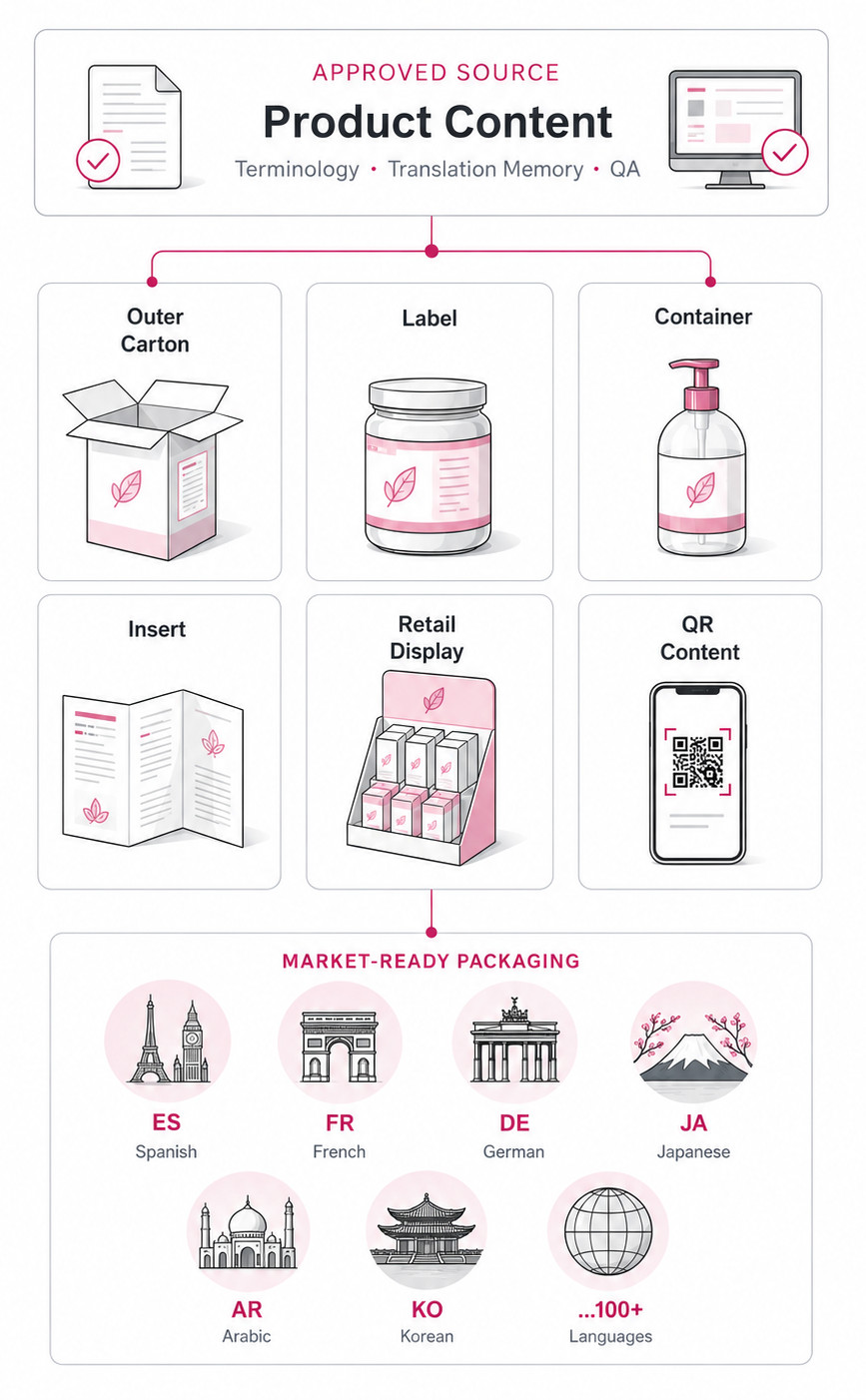
A single product may carry the same information across a carton, bottle, container, pouch, sleeve, insert, instruction card, retail display, and online product page. Multiply that by product variants, package sizes, languages, and destination markets, and packaging localization quickly becomes a connected content operation.
Stepes helps companies manage packaging language as a reusable product asset rather than translating every component in isolation.
Outer Cartons
Brand messaging, product information, instructions, warnings, specifications, and market-specific content.
Labels & Containers
High-density product information that must remain accurate and readable within limited space.
Pouches, Sleeves & Sachets
Compact packaging formats where text expansion and multilingual layout require careful production.
Inserts & Instruction Cards
Supporting information that expands on safe use, preparation, assembly, dosage, care, or product operation.
Retail & Display Packaging
Customer-facing packaging, shelf displays, promotional elements, and other materials designed for the point of sale.
Digital & QR-Connected Content
Multilingual information that continues the packaging experience through product pages, instructions, support content, or digital resources.
Shared terminology, translation memory, approved product language, and quality controls help keep the information behind these components aligned.
Protect the Artwork, Not Just the Words
A packaging translation is not finished when the target text is linguistically complete. It has to work inside the actual artwork.
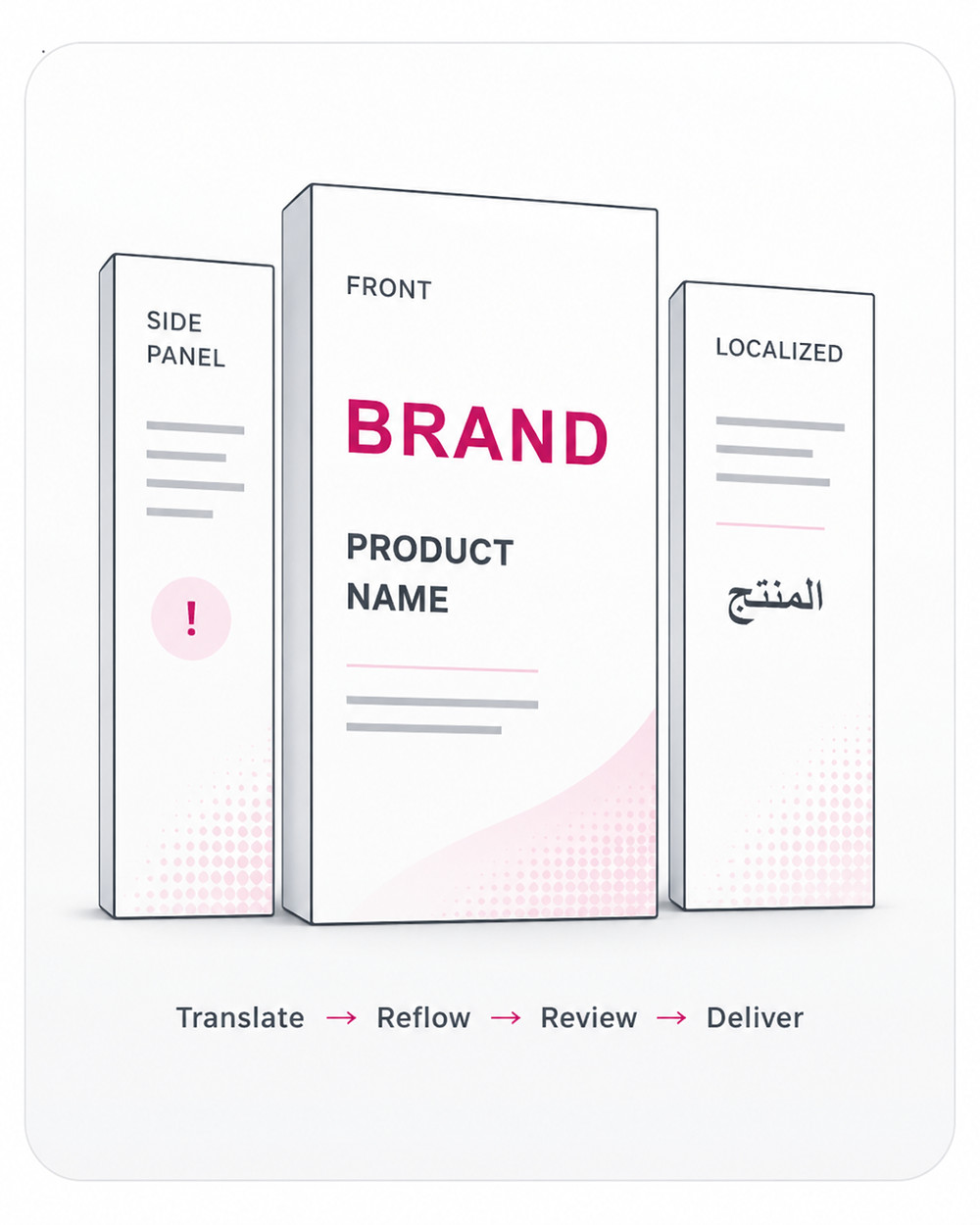
Translated copy can become longer or shorter. Fonts may not support the target script. Line breaks can change. Text may overflow a panel. Arabic and other right-to-left languages can require major layout adaptation. Product names, measurements, symbols, graphics, and non-translatable elements must remain protected throughout production.
Stepes combines professional packaging translation with multilingual desktop publishing to help move content from source artwork to professionally localized packaging.
Prepare the Source
Review editable artwork, linked assets, fonts, target languages, existing translations, terminology, and production requirements.
Translate the Content
Extract or prepare translatable text while protecting artwork structure, identifiers, numbers, product references, and non-translatable elements.
Localize the Layout
Reintegrate translated content and adapt text frames, typography, spacing, graphics, alignment, and language direction for each target language.
Review in Context
Check the translation inside the actual package layout to identify problems that may not be visible in a bilingual translation file.
Deliver Production-Ready Assets
Provide the agreed editable artwork, packaged design files, review PDFs, print-ready outputs, or other final deliverables.
From Adobe Illustrator and InDesign to PDFs and other design formats, Stepes helps preserve both the language and the visual integrity of global packaging.
Explore Multilingual Desktop PublishingTranslation Has to Fit the Package
Packaging gives language a hard physical boundary. A translation that is perfectly accurate in a text editor may no longer work when placed inside a narrow side panel, compact label, nutrition table, warning box, or multilingual carton. Different languages also behave differently in layout.
Stepes combines language expertise with multilingual production to address the practical constraints of packaging design.
Text Expansion
Translations may require more space than the English source. Layouts can be adjusted through text reflow, spacing, typography, and other production techniques without casually removing meaning just to make the copy fit.
Multilingual Typography
Target-language fonts must support the correct characters, accents, glyphs, punctuation, and script behavior while remaining consistent with the packaging design.
Complex Scripts
Chinese, Japanese, Korean, Indic, Southeast Asian, Cyrillic, and other writing systems have language-specific requirements for fonts, spacing, line breaking, punctuation, and visual balance.
Right-to-Left Packaging
Arabic, Hebrew, Persian, Urdu, and other RTL languages may require bidirectional text handling, changed alignment, repositioned graphics, mirrored structures, and target-language visual QA.
Constrained Panels
Labels, tables, callouts, small containers, and compact package panels require careful management of line breaks, text density, hierarchy, and readability.
In-Context Validation
Final packaging is reviewed in its intended layout so translation, typography, and visual presentation can be evaluated together.
Packaging Expertise Across Product Categories
Different products place different demands on packaging translation. Stepes combines multilingual production with subject-qualified language expertise to support packaging across consumer, technical, and regulated industries.
Food & Beverage
Translate product names, ingredients, allergen statements, nutrition information, preparation instructions, storage conditions, claims, warnings, quantities, and multilingual packaging artwork.
Explore Food & Beverage TranslationBeauty & Personal Care
Localize product benefits, ingredients, usage directions, precautions, shades, variants, claims, brand language, labels, cartons, and small-format packaging.
Pharmaceuticals
Support multilingual product labels, cartons, package inserts, medication information, dosage content, warnings, safety statements, and pharmaceutical artwork.
Explore Pharmaceutical TranslationMedical Devices
Translate device labels, packaging, safety information, symbols, instructions, product identification, and supporting regulated content.
Explore Medical Device TranslationConsumer Products
Localize packaging for electronics, household goods, apparel, lifestyle products, toys, appliances, health and wellness products, and other retail categories.
Explore Retail & E-commerce TranslationIndustrial & Technical Products
Translate technical labels, specifications, handling instructions, product warnings, safety information, installation content, and industrial packaging.
Explore Technical TranslationFood & Beverage Packaging Where Every Detail Matters
Food and beverage packaging combines language, structured product data, ingredients, quantities, claims, consumer information, and design in a limited amount of space.
Stepes helps food and beverage companies translate approved packaging content accurately and consistently while maintaining terminology across product families and markets.
Explore Food & Beverage Translation ServicesFood Packaging Content We Translate
- Product and common names
- Ingredient declarations
- Allergen statements
- Nutrition information
- Serving information
- Net quantity, weight, and volume
- Preparation and cooking instructions
- Storage conditions
- Date and shelf-life information
- Warnings and consumer notices
- Product claims
- Certifications
- Country-of-origin information
- Package descriptions
- Promotional packaging copy
- Multilingual artwork
Packaging Requirements Are Market-Specific
Product information requirements can differ by category, jurisdiction, destination market, and intended use. Language requirements, ingredients, allergens, nutrition information, claims, presentation, and consumer disclosures may also vary.
Stepes supports regulatory implementation by translating customer-approved product and regulatory content according to the terminology, source information, and market requirements defined for the project. Regulatory, legal, and product-compliance determinations remain with the appropriate customer or regulatory specialists.
Packaging Localization Controls
Preserve the intended meaning of approved product, safety, and regulatory information.
Use the appropriate target language, regional variant, locale conventions, and approved terminology for each market.
Apply approved product, ingredient, allergen, quality, and brand language consistently.
Integrate translated information into package layouts while maintaining hierarchy, readability, and design intent.
Reuse approved content as formulations, claims, packaging, or product information change.
Check accuracy, completeness, terminology, numbers, units, formatting, and final presentation.
High-Stakes Packaging Requires Specialized Translation
Pharmaceutical and medical device packaging can communicate information that directly affects product identification, use, dosage, handling, and safety.
Stepes supports regulated packaging translation with subject-qualified linguistic resources, controlled terminology, structured review, multilingual production, and quality workflows aligned to the project requirements.
Pharmaceutical Packaging
- Product labels
- Cartons
- Package inserts
- Medication guides
- Prescribing information
- Dosage and administration content
- Contraindications and precautions
- Safety statements
- Storage information
- Pharmaceutical artwork
Medical Device Packaging
- Device labels
- Product identification
- Packaging and cartons
- Warnings and precautions
- Symbols and callouts
- Instructions for use
- Handling and storage information
- Supporting product materials
- Multilingual artwork
Sensitive or regulated packaging content can be routed through specialist translation, independent revision, subject-matter review, client approval, and in-context validation according to the agreed workflow.
One Packaging Vocabulary Across Every Product and Market
Global packaging portfolios repeat far more language than they first appear to. A product family may reuse the same names, ingredients, warnings, claims, directions, materials, storage statements, manufacturer details, technical terms, and approved legal language across dozens or hundreds of SKUs.
Stepes helps turn this repeated language into reusable multilingual knowledge.
Terminology Management
Centralize approved product names, ingredient terminology, claims, warnings, technical language, brand terms, and preferred translations so linguists and reviewers work from the same multilingual vocabulary.
Translation Memory
Reuse previously translated and approved packaging content instead of retranslating identical or similar language from the beginning each time.
Product-Family Consistency
Carry validated terminology and translations across package sizes, flavors, formulations, models, variants, and related products.
Market Variants
Maintain the right regional terminology and approved differences when multiple markets use the same language.
Approved Content Reuse
Preserve validated language across cartons, labels, inserts, product pages, instructions, and other connected product materials.
Continuous Improvement
Feed approved corrections and reviewer decisions back into terminology and translation memory so future packaging benefits from previous work.
The result is greater multilingual consistency across products, languages, and release cycles—with less repetitive translation effort.
Update the Change, Not the Entire Package
Packaging rarely stays static. A formula changes. An ingredient is added. A warning is revised. A new product claim is approved. A package size changes. Artwork is refreshed. A new SKU launches. A product enters another market.
When only part of the source changes, the multilingual workflow should be able to recognize that.
Stepes uses translation memory, terminology, content comparison, and version-aware workflows to help identify existing approved language and focus new translation and review on the content that actually changed.
Identify New and Modified Content
Separate new or revised source language from previously translated material.
Reuse Approved Translations
Apply validated translations where the underlying source remains unchanged and reuse is appropriate.
Focus Review on Change
Direct linguistic attention toward revised ingredients, claims, instructions, warnings, specifications, or other affected content.
Update the Artwork
Apply approved language to the new packaging revision while maintaining the required layout and production specifications.
Validate the New Version
Check the localized revision against the updated source and approved multilingual content.
Preserve the Knowledge
Update terminology and translation memory so the latest approved language is ready for the next release.
This approach can reduce repetitive work while improving consistency across recurring packaging updates.
From Master Artwork to Market-Ready Packaging
Stepes coordinates the linguistic and production stages required to move packaging from approved source content to multilingual deliverables.
Analyze
Review source artwork, file types, target languages, product category, existing translations, terminology, linked assets, formatting requirements, and final deliverables.
Prepare
Organize translatable content while protecting product identifiers, numbers, artwork elements, variables, approved names, and non-translatable information.
Translate
Apply professional linguists, translation memory, terminology, AI-enabled technology, and subject-matter expertise according to the content and project requirements.
Review
Verify meaning, terminology, completeness, product information, numbers, claims, warnings, and other critical language through the defined review workflow.
Reintegrate
Return translated content to Illustrator, InDesign, or other source artwork and adapt typography, text frames, graphics, spacing, alignment, and language direction.
Validate
Perform the required linguistic, visual, numerical, terminology, and in-context QA against the source and approved translation.
Deliver & Maintain
Provide the agreed editable files, packaged assets, review copies, print-ready PDFs, or other outputs and retain approved language assets for future packaging updates.
One coordinated workflow helps reduce handoffs between translation, artwork, review, and multilingual production.
Quality Matched to Packaging Risk
Not every sentence on a package carries the same consequences. Stepes helps organizations configure AI, professional translation, specialist review, and quality controls according to the purpose, audience, visibility, and risk of the content.
Brand & Promotional Copy
Customer-facing slogans, benefits, claims, and promotional messaging may require localization or transcreation to preserve intent while sounding natural in the target market.
General Product Information
Descriptions, materials, features, specifications, and other product content require clear translation and consistent terminology across packaging and channels.
Technical Instructions
Assembly, installation, preparation, care, handling, and operating information benefit from subject-qualified translators and structured QA.
Safety & Regulated Content
Warnings, precautions, dosage information, safety statements, and other high-impact content can require specialist translation, additional review, and controlled approval.
Final Packaging Artwork
All content must ultimately work in its finished visual environment.
AI and workflow automation can accelerate appropriate stages such as file preparation, terminology application, repeated-content processing, content comparison, routing, and quality checks. Professional human expertise remains central wherever meaning, safety, regulatory sensitivity, brand judgment, or complex artwork decisions require it.
Explore Translation Quality AssurancePackaging QA Before Production
Packaging quality assurance needs to look beyond grammar. Stepes can combine automated checks, professional linguistic review, subject-matter validation, multilingual production review, and in-context QA according to the project scope.
Linguistic Quality
Confirm that the translation communicates the intended source meaning.
Identify missing, untranslated, added, duplicated, or hidden content.
Check product names, ingredients, materials, warnings, technical terminology, and other approved language.
Maintain consistent wording across panels, package components, products, and languages.
Review grammar, spelling, punctuation, fluency, style, and locale conventions.
Product Data Quality
Check quantities, dimensions, percentages, dates, product references, and other numerical content.
Verify translated content has not introduced missing, changed, or inconsistent measurements.
Protect approved names, model numbers, SKUs, trademarks, codes, and other identifiers.
Check high-density terminology against approved language resources and the source.
Review critical information for completeness, accuracy, and consistency.
Artwork Quality
Identify copy that no longer fits its intended frame or panel.
Check font compatibility, missing glyphs, accents, special characters, and script rendering.
Review inappropriate wrapping, disconnected phrases, misplaced content, and visual hierarchy.
Confirm translated labels, diagrams, callouts, and text embedded in images are present and correctly positioned.
Verify writing direction, alignment, typography, graphic placement, and mixed-language presentation.
Cross-Market Quality
Confirm the intended language and regional variant are used for the destination market.
Apply the right market-specific product, brand, technical, and regulatory terminology.
Confirm the localized package matches the intended source revision and market deliverable.
Check that the correct product content and identifiers are associated with the intended market.
Quality controls can be configured according to product category, language, market, content type, and project risk rather than forcing every packaging project into one universal review model.
Work Directly With Your Packaging Artwork
Native source files allow multilingual packaging to be translated and produced with greater control over text, layers, typography, graphics, and future revisions.
Stepes supports common design, publishing, document, and graphics formats used in packaging workflows.
Whenever possible, provide editable native artwork together with linked images, fonts, and a reference PDF. Complete source packages improve editability, multilingual production, version management, and final visual QA.
Adobe Illustrator
AI · EPS · SVGLocalize editable product labels, packaging graphics, callouts, diagrams, icons, and artwork while preserving surrounding visual elements.
Adobe InDesign
INDD · IDML · INX · INDB · ICMLTranslate cartons, inserts, labels, brochures, instruction materials, and other designed product content with multilingual typesetting and visual QA.
Adobe Photoshop
PSDLocalize layered graphics and image-based packaging assets when editable content is available.
Translate text-based or supplied packaging PDFs and determine the most appropriate workflow for translation, reconstruction, review, or final production.
Microsoft Office
DOCX · XLSX · PPTXSupport copy decks, label tables, product data, review files, regulatory text, and other source materials used alongside packaging artwork.
Structured & Additional Formats
XML · DATA EXPORTS · TEMPLATESEvaluate structured content, data exports, customer-specific templates, and other files used to generate or manage packaging content.
Scale Packaging Translation Across Products and Markets
Packaging translation may begin with one label and grow into an ongoing multilingual program involving product families, regional variants, artwork revisions, multiple departments, and frequent launches.
Stepes helps enterprises scale without rebuilding the localization process for every project.
Whether you are launching one product into a new market or managing recurring packaging localization across a global portfolio, Stepes provides the language technology and professional expertise to support continued growth.
Multiple SKUs
Maintain terminology and approved language across flavors, sizes, models, formulations, configurations, and product families.
Multiple Languages
Coordinate packaging localization across 100+ languages and regional variants through shared processes and language assets.
Multiple Markets
Manage market-specific language, terminology, content variants, review requirements, and deliverables.
Multiple Revisions
Leverage approved translations and focus effort on new and changed content as packaging evolves.
Centralized Language Assets
Use shared terminology, translation memory, reference content, and quality rules to improve consistency across the portfolio.
Flexible Workflows
Apply different combinations of AI, professional translation, specialist review, client approval, and in-context QA according to content risk.
Connected Content
Carry approved language across packaging, product information, e-commerce, instructions, marketing, support, and other product touchpoints.
Quality Standards You Can Build On
Stepes supports multilingual packaging through established quality systems for professional, enterprise, and regulated translation workflows.
Translation Services
Structured requirements for professional translation processes, qualified linguistic resources, and defined translation workflows.
Quality Management
Quality-management practices designed to support consistent processes, customer requirements, corrective action, and continuous improvement.
Medical Device Quality Management
Quality processes relevant to multilingual medical device and regulated life sciences content.
The standards, review steps, and quality controls appropriate to a packaging project depend on its product category, content, market, intended use, and customer requirements.
Why Global Brands Choose Stepes for Packaging Translation
Packaging sits at the intersection of product information, brand communication, technical content, artwork, and customer experience. Stepes brings the language and production capabilities behind these elements into one multilingual workflow.
Packaging + Language Expertise
Translate labels, cartons, inserts, warnings, ingredients, instructions, claims, specifications, and product content across diverse industries.
Artwork-Ready Workflows
Move beyond translated text with multilingual typesetting, graphic localization, in-context review, and final artwork QA.
Specialized Linguists
Match professional translators and reviewers to the target language, subject matter, product category, and content requirements.
Terminology at Scale
Protect approved product, brand, ingredient, technical, and regulated terminology across SKUs and markets.
Translation Memory & Content Reuse
Build on previously approved packaging translations to improve consistency and reduce repetitive work across revisions.
Flexible AI + Human Translation
Use AI and automation where they improve efficiency while applying professional human judgment where accuracy, safety, brand voice, or complexity demands it.
Risk-Based Quality
Configure review and QA around what the content does and what the consequences of an error could be.
100+ Languages
Support global packaging programs across major European, Asian, Middle Eastern, African, and Latin American languages and regional variants.
Packaging Translation Services FAQ
Practical answers about product label translation, packaging artwork, multilingual DTP, language reuse, quality assurance, and global packaging workflows.
Packaging translation is the translation and localization of language that appears on product labels, cartons, containers, pouches, sleeves, inserts, instruction cards, retail packaging, and related artwork.
Professional packaging localization can include linguistic translation, terminology management, translation memory, multilingual typesetting, graphic localization, right-to-left adaptation, in-context review, artwork QA, and delivery of localized design files.
The goal is not simply to translate the words. It is to make the multilingual content work accurately and effectively in the package customers will actually see and use.
Stepes translates product names and descriptions, labels, ingredients, materials, specifications, claims, warnings, safety information, usage instructions, preparation directions, storage information, quantities, measurements, manufacturer information, regulatory statements, package inserts, promotional copy, sustainability information, graphic callouts, and other multilingual packaging content. We support both individual packaging projects and ongoing localization programs across multiple products, languages, revisions, and markets.
Yes. Stepes provides product label translation services for consumer products, food and beverage, beauty and personal care, pharmaceuticals, medical devices, industrial products, electronics, household goods, and other categories. Label translation can include professional translation, terminology management, multilingual formatting, artwork localization, in-context review, and quality assurance according to the project requirements.
Yes. Stepes supports multilingual packaging workflows in Adobe Illustrator, Adobe InDesign, and other common design and publishing formats. When editable source files are available, translated text can be reintegrated into the artwork and the target layout adjusted for text expansion, typography, fonts, line breaks, writing direction, and other language-specific requirements.
Explore Multilingual Desktop PublishingTranslated text may take more or less space than the source language. Stepes multilingual production specialists can adapt text frames, line breaks, typography, spacing, and layout to accommodate the target language while preserving readability and design intent. If substantive copy changes or shortening would affect meaning, brand language, approved claims, or regulated content, those changes should follow the appropriate linguistic and customer approval process rather than being made only to fit the artwork.
Yes. Stepes translates product names, ingredients, allergen statements, nutrition information, serving information, weights and volumes, preparation instructions, storage conditions, warnings, claims, package descriptions, promotional copy, and multilingual food packaging artwork.
Because food labeling requirements differ by product and market, Stepes translates approved source information according to the market requirements and terminology defined for the project. Legal and regulatory determinations remain with the appropriate customer specialists.
Explore Food & Beverage Translation ServicesYes. Stepes supports translation of pharmaceutical labels, cartons, package inserts, medication information, dosage and administration content, warnings, safety statements, storage information, and related packaging artwork.
Workflows can include specialist linguists, controlled terminology, independent revision, subject-matter review, client approval, and multilingual artwork QA according to project requirements.
Explore Pharmaceutical Translation ServicesYes. Stepes translates medical device labels, cartons, product identification, warnings, symbols, handling information, storage instructions, IFUs, and supporting product content. Our medical device translation workflows can combine qualified linguistic resources, terminology control, multilingual DTP, structured quality review, and ISO-aligned quality processes.
Explore Medical Device Translation ServicesStepes uses approved terminology, translation memory, reference content, style guidance, and quality controls to maintain consistent language across related products. Previously approved language can be reused across different package sizes, flavors, models, formulations, or product variants where the source content and translation remain applicable.
Yes. Stepes can analyze revised content, leverage previously approved translations, identify new or changed language, and focus translation and review on affected content. This is particularly useful for new packaging revisions, formulation changes, updated warnings, new claims, artwork refreshes, additional package sizes, and related SKU launches.
Packaging QA can include linguistic accuracy, completeness, terminology, grammar, spelling, numbers, measurements, units, product names, ingredients, warnings, fonts, special characters, text overflow, line breaks, graphics, RTL presentation, and source-to-target artwork comparison. The exact QA process is configured according to the product, content type, languages, intended use, and agreed project scope.
Explore Translation Quality AssuranceYes. Stepes supports Arabic, Hebrew, Persian, Urdu, and other right-to-left languages. RTL packaging production may require more than changing text direction. Depending on the artwork, the layout may also require mirrored structures, changed alignment, repositioned graphics, script-compatible fonts, bidirectional text handling, and final visual QA.
Stepes supports common packaging and design formats including Adobe Illustrator, Adobe InDesign, Adobe Photoshop, PDF, SVG, EPS, Microsoft Word, Excel, and other design, publishing, structured-content, and document formats. Editable native files are recommended whenever available because they generally provide greater control over text extraction, layout adaptation, typography, graphics, and final production.
View Translation File Format SupportStepes uses AI and automation as part of flexible translation workflows where they can improve speed, reuse, consistency, or process efficiency. The appropriate workflow depends on the content. High-volume or repetitive product language may benefit from AI-assisted processes, translation memory, terminology automation, and automated QA. Brand-sensitive, technical, safety-related, medical, or regulated content can receive professional human translation and additional specialist validation. The objective is not to apply one translation method to every packaging project, but to match technology and human expertise to the content and its risk.
Stepes supports packaging translation in more than 100 languages, including major European, Asian, Middle Eastern, African, and Latin American languages as well as many regional language variants. Multilingual production is available for Latin, Cyrillic, Chinese, Japanese, Korean, Arabic and other right-to-left scripts, Indic languages, Southeast Asian languages, and other complex writing systems.
Yes. Stepes supports both individual packaging projects and recurring enterprise programs involving multiple SKUs, languages, markets, package types, and release cycles. Shared terminology, translation memories, workflow rules, review processes, multilingual artwork expertise, and centralized language assets allow approved packaging language to scale across an expanding product portfolio.
Ready to Take Your Packaging Global?
Whether you are translating one product label or managing multilingual packaging across an entire portfolio, Stepes helps connect professional translation, terminology control, content reuse, multilingual artwork, and quality assurance in one scalable workflow.
Bring us your labels, cartons, package inserts, design files, existing translations, or next product launch. We’ll help turn approved product content into packaging that is ready for customers around the world.