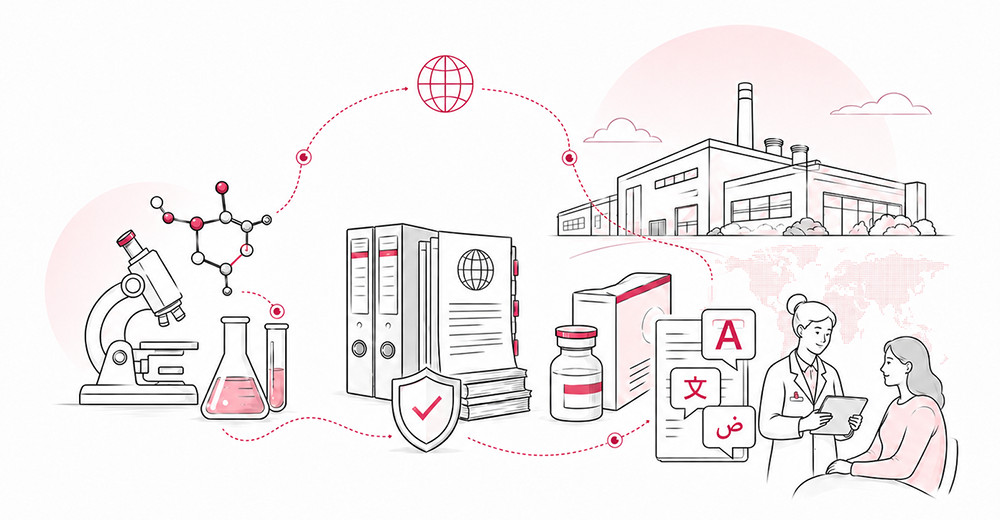
Pharmaceutical Content Is Connected Across the Drug Lifecycle
A clinical protocol informs investigator and site materials. Study results become part of regulatory submissions. Regulatory decisions influence product labeling. Approved terminology carries into safety, manufacturing, medical affairs, and patient communication.
Stepes helps pharmaceutical teams manage these connections as one multilingual content lifecycle, combining specialized linguists, approved terminology, translation memory, professional review, automated QA, multilingual publishing, and reusable language assets.
Research & Development
Scientific documentation and terminology establish the foundation for downstream multilingual content.
Clinical Development
Protocols, ICFs, site materials, COAs, reports, and participant communications move across study markets.
Regulatory & CMC
Submission content requires controlled terminology, consistency across modules, and careful document handling.
Labeling & Launch
Approved regulatory language flows into labels, packaging, product information, and launch materials.
Pharmacovigilance & Safety
Safety cases, periodic reports, risk plans, and new findings require accurate, time-sensitive multilingual handling.
Manufacturing & Quality
SOPs, batch records, validation, training, and quality documentation support consistent global operations.
Medical Affairs & Commercial
Scientific, HCP, patient, market-access, and commercial content extends approved product meaning to global audiences.
Lifecycle Management
Variations, labeling revisions, safety updates, and product changes propagate across related multilingual assets.
Translation Across the Pharmaceutical Lifecycle
Stepes supports scientific, clinical, regulatory, safety, operational, and market-facing pharmaceutical content with workflows matched to the content's purpose, audience, and level of risk.
Research & Drug Development
Translate scientific information across international research teams while maintaining continuity as content progresses toward clinical development and regulatory documentation.
- Preclinical documentation
- Drug discovery materials
- Scientific reports
- Study plans
- Pharmacology and toxicology
- Chemistry and analytical documentation
Clinical Development
Support global studies with specialized translation for sponsor, CRO, investigator, site, ethics, regulator, patient, and caregiver content.
- Protocols and amendments
- Investigator's Brochures
- Informed Consent Forms
- Case Report Forms
- Clinical Study Reports
- COA and eCOA content
- Patient materials
- Site documentation
Regulatory & CMC
Maintain precision and terminology consistency across structured regulatory and technical documentation used to communicate quality, safety, efficacy, and manufacturing information.
- CTD and eCTD content
- CMC documentation
- Regulatory dossiers
- Marketing authorization content
- Health authority responses
- Variations and amendments
Pharmaceutical Labeling & Packaging
Protect approved meaning while adapting labels and packaging for different languages, markets, formats, typographic requirements, and space constraints.
- Prescribing information
- SmPCs and PILs
- Medication guides
- Product labels
- Package inserts
- Cartons and packaging
- Safety statements
- Artwork
Pharmacovigilance & Drug Safety
Process recurring safety content with pharmaceutical expertise, controlled terminology, reusable language assets, professional review, and dependable multilingual workflows.
- ICSRs
- Adverse event narratives
- CIOMS forms
- DSURs
- PSURs and PBRERs
- Risk Management Plans
- Safety communications
- Regulatory correspondence
Manufacturing, Quality & GMP
Preserve procedural meaning, terminology, units, references, and document structure so multilingual teams can execute controlled manufacturing and quality processes consistently.
- SOPs
- Manufacturing instructions
- Batch records
- Validation documentation
- CAPA content
- Deviation reports
- Quality manuals
- Training materials
Medical Affairs & Scientific Communications
Combine scientific subject expertise with natural professional communication for healthcare professionals, researchers, advisory groups, and global medical teams.
- Publications and manuscripts
- Abstracts and posters
- Congress materials
- HCP education
- Medical information
- Advisory board content
- Scientific presentations
Commercial, Market Access & Patient Communications
Preserve approved product meaning while adapting communication naturally for local HCP, patient, payer, and commercial audiences.
- HCP marketing
- Patient education
- Product websites
- Market access content
- Value communication
- Product launch materials
- Training
- Multimedia
Terminology & Language Assets
One Pharmaceutical Vocabulary Across Every Product and Market
A pharmaceutical product can generate hundreds or thousands of multilingual assets. Critical terminology should not drift from a protocol to a submission, label, safety report, manufacturing procedure, or patient communication.
Stepes combines client-approved terminology, translation memory, reference content, style guidance, and automated terminology checks to create reusable multilingual knowledge that grows with your program.
- Product and brand names
- Active ingredients
- Indications and mechanisms
- Dose, strength, and administration
- Clinical and study terminology
- Adverse events and safety language
- Regulatory terminology
- Manufacturing and quality terms
Terminology
Terminology databases + translation memory + approved language + automated QA
Version & Change Management
Every Pharmaceutical Revision Has Downstream Impact
A change to a dosage, indication, contraindication, formulation, safety statement, claim, or manufacturing process may require coordinated updates across multiple documents and languages.
Stepes helps teams identify what changed, reuse approved language where appropriate, focus linguistic review on affected content, and carry validated terminology forward into future releases.
Identify new and modified content
Reuse approved translations
Focus expert review on changes
Maintain cross-document consistency
Risk-Appropriate Workflows
The Right Translation Workflow for Every Pharmaceutical Content Type
A regulatory submission, patient recruitment flyer, safety narrative, manufacturing SOP, scientific presentation, and commercial website should not automatically move through the same translation process.
Assess Content
Confirm audience, intended use, complexity, regulatory importance, confidentiality, volume, and timing.
Prepare Language Assets
Apply terminology, translation memory, references, prior approvals, and style guidance.
Match the Workflow
Select human, AI-assisted, review, validation, and publishing steps appropriate to the content.
Translate & Review
Route content to pharmaceutical linguists and reviewers with the right subject and audience experience.
QA, Deliver & Reuse
Complete linguistic and final-format QA, then retain approved language for future updates.
High-Impact Regulated Content
Clinical, regulatory, safety, labeling, and patient-facing content may require specialist human translation, independent review, terminology controls, structured QA, and client-defined validation.
Controlled Operational Content
Manufacturing, SOP, validation, and quality documentation requires procedural accuracy, technical terminology, document consistency, and careful file handling.
High-Volume & Commercial Content
Depending on risk and intended use, AI-assisted translation or professional post-editing can accelerate production while retaining appropriate human oversight.
AI-Powered Pharmaceutical Translation With Expert Human Oversight
AI can make pharmaceutical translation workflows faster and more efficient when it is used selectively, governed by language assets, and matched to the content's risk and intended use.
Stepes uses DomainAI-assisted automation to reduce repetitive manual work and direct linguistic attention toward content that needs professional judgment, scientific interpretation, regulatory awareness, or patient-facing clarity.
Final workflow depth is configured for the document type, audience, intended use, and client requirements.
Specialized Pharmaceutical Linguists for Specialized Content
The word “pharmaceutical” covers many scientific disciplines and content types. Stepes matches linguists to language pair, subject area, document type, target audience, market, and client requirements.
For recurring programs, preferred linguist and reviewer teams can build familiarity with your products, terminology, style, approved language, and review expectations over time.
Stepes' myTranslator service helps you retain preferred subject-matter linguists across ongoing programs, reducing repeated onboarding and strengthening consistency as product knowledge accumulates.
Explore myTranslatorPharmaceutical Quality Built Into Every Step
Quality starts with content assessment, terminology, resource selection, workflow design, references, and review criteria—not with proofreading alone after translation is complete.
Linguistic Quality
- Accuracy and completeness
- Meaning and fluency
- Grammar and style
- Readability
- Internal consistency
- Audience appropriateness
Pharmaceutical Terminology
- Product names and active ingredients
- Dosage forms and strengths
- Units and concentrations
- Routes of administration
- Clinical and safety terminology
- Manufacturing terminology
Structured Content
- Numbers and dates
- Tables and figures
- Captions and footnotes
- Cross-references
- Section numbering
- References and callouts
Final-File QA
- Layout and text expansion
- Fonts and line breaks
- Tables and graphics
- Language typography
- Artwork placement
- Output validation
Multilingual Production
Preserve the Pharmaceutical Deliverable, Not Just the Translation
Regulatory dossiers contain complex structures. Clinical documents use tables, forms, and controlled numbering. Manufacturing procedures include diagrams and callouts. Labels must fit defined artwork. Medical affairs teams work in presentations.
Stepes combines translation with multilingual file engineering, desktop publishing, artwork support, and final-format QA so translated content remains practical for review, submission, publishing, training, or the next production stage.
Pharmaceutical Translation in 100+ Languages
Stepes supports major pharmaceutical markets with native-language professionals, subject-matter expertise, client terminology, reference materials, and market-appropriate review workflows.
European Languages
French, German, Spanish, Italian, Portuguese, Dutch, Swedish, Danish, Norwegian, Finnish, Polish, Czech, Romanian, Greek, Hungarian, and more.
Asia-Pacific Languages
Simplified Chinese, Traditional Chinese, Japanese, Korean, Vietnamese, Thai, Indonesian, Malay, Hindi, and additional Asia-Pacific languages.
Middle Eastern & African Languages
Arabic, Hebrew, Turkish, Afrikaans, and additional languages for pharmaceutical programs across the Middle East and Africa.
Regional Market Variants
Brazilian Portuguese, Canadian French, Latin American Spanish, and other market-specific variants aligned to the intended audience and regulatory context.
Language coverage alone is not enough for pharmaceutical content. The translation workflow must also reflect subject matter, target-market conventions, intended use, terminology requirements, and the level of professional review the content needs.
Scale From One Pharmaceutical Document to a Global Program
Translation needs can begin with a single file and grow into a recurring multilingual operation. Stepes supports pharmaceutical organizations at each level while carrying terminology, language assets, and program knowledge forward.
Individual Projects
Translate a protocol, regulatory document, SOP, safety report, label, presentation, or other standalone pharmaceutical asset.
Clinical or Product Programs
Coordinate related content, terminology, translation memory, language teams, and review around one study, compound, therapy, or product.
Multimarket Launches
Manage simultaneous multilingual production across many languages and deliverables for major milestones or product launches.
Ongoing Global Operations
Support continuous clinical, regulatory, safety, manufacturing, medical affairs, commercial, and lifecycle content.
Who We Support
Pharmaceutical Translation for Global Life Sciences Organizations
Stepes supports organizations and teams throughout the pharmaceutical ecosystem with connected multilingual workflows across content types, markets, and product lifecycles.
Pharmaceutical Companies
Clinical development, regulatory affairs, safety, manufacturing, medical affairs, commercialization, and post-approval lifecycle content.
Biopharmaceutical & Biotechnology Companies
Innovative medicines, biologics, vaccines, advanced therapies, scientific research, regulatory documentation, and biomanufacturing.
Contract Research Organizations
Multilingual clinical content coordinated across sponsors, countries, sites, investigators, and participants.
CDMOs & Manufacturing Partners
Manufacturing, quality, validation, technical, training, and operational documentation for international production environments.
Regulatory & Safety Teams
Submissions, labeling, pharmacovigilance, health authority communication, safety content, and recurring product updates.
Medical Affairs, Market Access & Commercial Teams
Scientific communication, HCP and patient content, market access, product launches, training, digital assets, and international commercialization.
Why Pharmaceutical Teams Choose Stepes
A strong pharmaceutical translation program combines the right people, language assets, technology, quality controls, file production, and program management—without forcing every content type through the same process.
Pharmaceutical Subject Expertise
Specialized linguists are matched to pharmaceutical subject matter, document type, target language, market, audience, and program requirements.
Connected Language Assets
Terminology, translation memory, approved translations, references, and reviewer feedback help keep related content aligned across releases.
Risk-Appropriate Workflows
Human translation, independent review, AI-assisted workflows, post-editing, QA, and validation are configured around content purpose and risk.
AI-Powered Enterprise Technology
DomainAI-assisted analysis, terminology tools, translation memory, workflow automation, and automated QA help reduce repetitive manual work.
Quality + Deliverable Integrity
ISO-supported processes, structured review, DTP, file engineering, artwork support, and final-format QA protect both meaning and output.
Global Program Scale
100+ languages, preferred language teams, centralized management, and reusable assets support growth from a single document to ongoing global operations.
Pharmaceutical Translation Services FAQ
Answers to common questions about pharmaceutical documents, terminology consistency, review workflows, regulatory translation, revisions, AI, and global language coverage.
What are pharmaceutical translation services?
Pharmaceutical translation services provide specialized translation and localization for content created throughout drug research, development, clinical trials, regulatory approval, manufacturing, pharmacovigilance, labeling, medical affairs, commercialization, and post-approval lifecycle management. The workflow should reflect the subject matter, audience, intended use, and risk associated with each content type.
What pharmaceutical documents can Stepes translate?
Stepes translates protocols, Investigator's Brochures, Informed Consent Forms, Clinical Study Reports, regulatory submissions, CTD/eCTD and CMC content, product labeling, SmPCs, PILs, package inserts, pharmacovigilance documents, ICSRs, DSURs, PBRERs, Risk Management Plans, SOPs, batch records, validation documentation, scientific publications, HCP content, patient materials, websites, training, and commercial communications.
How is pharmaceutical translation different from medical translation?
Medical translation is broader and can include healthcare, patient, medical device, pharmaceutical, clinical, and scientific content. Pharmaceutical translation focuses more specifically on the information created throughout the lifecycle of medicines, including drug development, clinical research, regulatory submissions, CMC, pharmacovigilance, manufacturing, labeling, medical affairs, commercialization, and product updates.
How does Stepes maintain pharmaceutical terminology consistency?
Stepes combines terminology management, translation memory, approved client references, style guidance, preferred language teams, and automated quality checks. This helps maintain continuity across product names, active ingredients, indications, dosage forms, administration routes, clinical terminology, safety language, manufacturing processes, and other client-specific vocabulary.
Does pharmaceutical translation require independent review?
The appropriate review process depends on the content, audience, intended use, client quality procedures, and project requirements. High-impact clinical, regulatory, safety, labeling, or patient-facing content may require specialist translation followed by independent review and additional client-defined validation or approval steps. Other content may appropriately use a different combination of professional translation, AI assistance, post-editing, or QA.
Can Stepes translate pharmaceutical regulatory submissions and labeling?
Yes. Stepes supports regulatory translation for CTD/eCTD content, CMC documentation, dossiers, health authority correspondence, variations, and related submission content. We also translate pharmaceutical labeling such as prescribing information, SmPCs, PILs, medication guides, package inserts, product labels, packaging, dosage information, warnings, and related artwork.
How does Stepes manage pharmaceutical document revisions?
Stepes uses translation memory, terminology resources, file analysis, and language technology to identify previously translated content and support targeted processing of new or changed text. Approved translations can be reused where appropriate while linguists focus on revised content and verify consistency in context.
Can AI be used for pharmaceutical translation?
Yes, when it is appropriate for the content and applied within a controlled workflow. AI can assist with file analysis, terminology extraction, translation memory matching, change detection, repeated-content identification, first-pass translation, and QA. Clinical, regulatory, safety, patient-facing, and other high-impact materials may require pharmaceutical linguists and reviewers to provide professional judgment and subject expertise.
What languages does Stepes support for pharmaceutical translation?
Stepes provides pharmaceutical translation in more than 100 languages and regional variants across Europe, Asia, the Americas, the Middle East, and Africa. Major languages include Spanish, French, German, Italian, Portuguese, Dutch, Chinese, Japanese, Korean, Arabic, Polish, Czech, Swedish, Danish, Norwegian, Vietnamese, Thai, and many others.
Translate Pharmaceutical Content With Confidence Across Global Markets
From a clinical protocol or regulatory submission to a safety report, manufacturing SOP, pharmaceutical label, scientific presentation, or global product launch, Stepes brings specialized language expertise, AI-powered workflows, terminology control, translation memory, structured QA, and 100+ language support into one scalable multilingual program.