
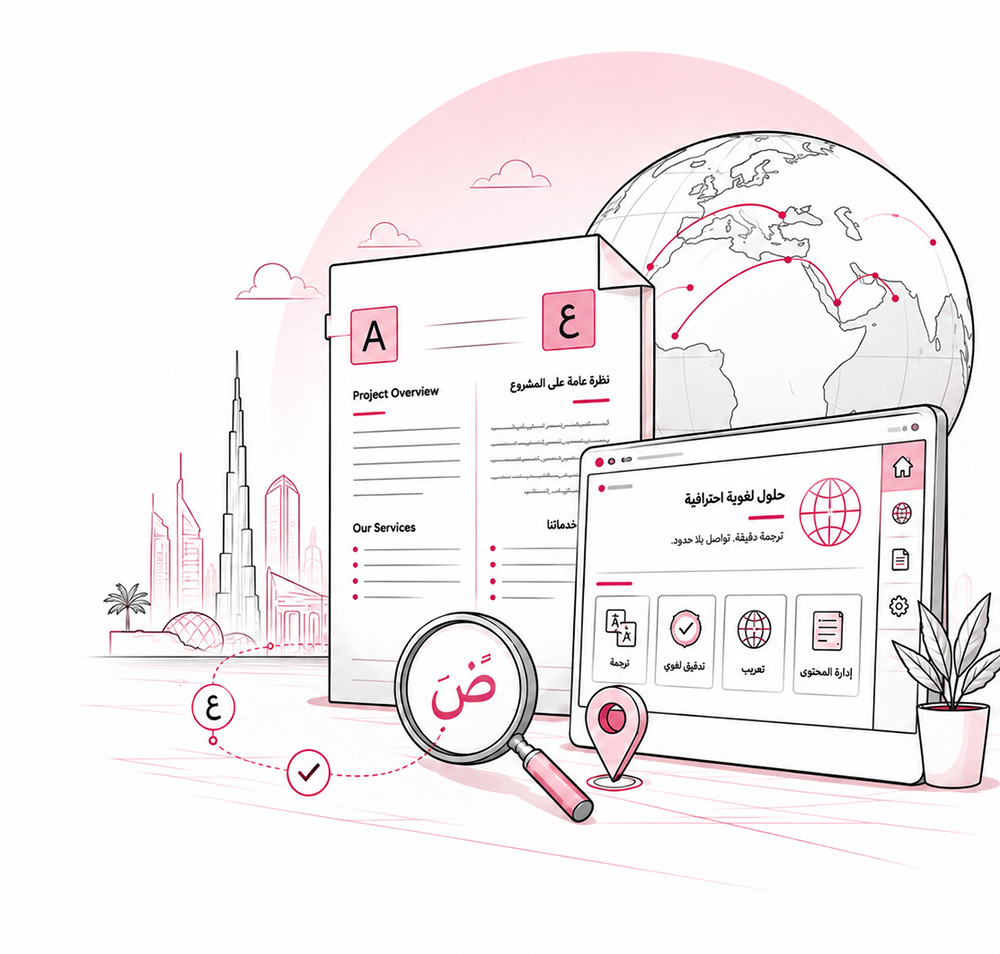
Professional Arabic Translation for Global Business
Arabic connects organizations with major markets across the Middle East and North Africa while also serving significant Arabic-speaking communities throughout the United States and other international markets. Effective Arabic communication can support product launches, customer engagement, healthcare access, regulatory programs, software adoption, workforce communications, infrastructure projects, and digital growth.
Yet professional Arabic translation requires more than selecting “Arabic” from a language list. A business may need Modern Standard Arabic that works across multiple countries, Arabic adapted for Saudi Arabia or the United Arab Emirates, conversational language for multimedia, or a specific spoken variety for voice and interpreting.
Digital products introduce another layer: right-to-left layouts, bidirectional Arabic and English text, locale-specific formatting, typography, interface behavior, and functional testing.
Stepes brings these linguistic and technical requirements together in one enterprise solution. Our Arabic linguists work with project managers, localization engineers, reviewers, and subject-matter specialists to produce content that is accurate in meaning, natural for the intended audience, consistent with approved terminology, and ready for its final format.
Modern Standard Arabic or Regional Arabic?
The right Arabic strategy depends on what you are translating, where it will be used, who will read or hear it, and what action you want the audience to take. Not every project needs a separate Arabic version for every country.
Modern Standard Arabic
MSA is the standardized form widely used for formal written communication and cross-market content. It is often the best scalable choice when one Arabic version must serve audiences across several countries.
- Corporate and business communications
- Technical and regulatory documentation
- Healthcare and medical content
- Training, policies, and public information
- Cross-market websites and product content
Country-Specific Arabic Localization
Market adaptation can improve relevance where terminology, tone, consumer language, local conventions, regulatory references, or brand messaging differ.
- Market-preferred terminology and consumer language
- Tone and level of formality
- Dates, currencies, units, and local conventions
- Regulatory references and product language
- Brand messaging and calls to action
Spoken Arabic & Dialect Localization
Spoken Arabic varies more significantly across regions and becomes important when content is conversational rather than formal documentation.
- Voiceover and audio
- Conversational AI and virtual assistants
- Advertising and social media
- Customer support and market research
- Gulf, Egyptian, Levantine, and North African varieties
English-to-Arabic and Arabic-to-English Translation
Professional translation in both directions for business, technical, digital, regulated, and specialized content.
Bring Products and Content to Arabic-Speaking Markets
Stepes translates English content into Arabic for product launches, customer experiences, regulated programs, and ongoing business operations.
- Technical documentation and product information
- Websites, software, and mobile apps
- Medical, regulatory, financial, and legal materials
- Marketing, training, and customer communications
Translate Arabic Content for International Use
Our Arabic-to-English services support international business, regulatory, legal, research, technical, and corporate requirements.
- Contracts and corporate records
- Technical and regulatory documents
- Research, reports, and financial materials
- Government communications and certificates
Arabic Translation and Localization Services
Different content types create different language, engineering, formatting, and review requirements. Stepes supports Arabic across documents, digital experiences, audiovisual content, and recurring enterprise programs.
Arabic Document Translation
Reports, policies, presentations, manuals, correspondence, contracts, forms, specifications, procedures, training materials, product documentation, and other corporate content.
Arabic Technical Translation
Engineering documentation, operating procedures, specifications, safety content, manufacturing materials, equipment manuals, maintenance instructions, and technical drawings.
Arabic Legal & Regulatory Translation
Agreements, policies, compliance documentation, corporate records, regulatory materials, filings, notices, certificates, procurement content, and legal communications.
Arabic Marketing & Transcreation
Campaigns, brochures, product messaging, presentations, advertising, social content, corporate communications, and brand materials adapted for Arabic-speaking audiences.
Arabic Website & Ecommerce Localization
Page copy, navigation, landing pages, product catalogs, forms, metadata, images containing text, help content, CMS updates, and ecommerce experiences.
Arabic Software & App Localization
UI strings, SaaS platforms, web and mobile applications, notifications, help content, software documentation, placeholders, variables, and RTL behavior.
Arabic Multimedia & Voice Localization
Subtitles, captions, scripts, voiceover, training videos, product demonstrations, eLearning, and multimedia using MSA or an appropriate spoken variety.
Certified Arabic Translation
Official and business documents requiring formal translation certification, with service scope aligned to the receiving institution or jurisdiction.
Arabic Translation Expertise Across Industries
A patient-facing medical document, industrial operating procedure, banking application, and consumer campaign require different terminology, quality controls, and review strategies.
Healthcare & Life Sciences
Medical devices, pharmaceuticals, diagnostics, clinical content, patient communications, IFUs, labeling, healthcare software, regulatory and quality documentation.
Energy & Infrastructure
Oil and gas, renewables, utilities, engineering, construction, operating procedures, safety materials, specifications, training, tender and procurement content.
Defense & Aerospace
Technical manuals, aerospace systems, engineering content, maintenance documentation, training, procurement materials, and operational communications.
Government & Public Sector
Public information, policies, programs, digital government services, forms, training, public notices, procurement content, websites, and community communications.
Banking, Financial Services & Fintech
Financial reports, banking products, digital interfaces, insurance, investment content, disclosures, policies, fintech applications, and corporate communications.
Technology, Software & Cybersecurity
SaaS, cloud products, cybersecurity platforms, AI applications, mobile products, documentation, knowledge bases, support content, onboarding, and product updates.
Retail & Ecommerce
Product descriptions, catalogs, marketplaces, mobile commerce, marketing, promotions, checkout experiences, notifications, customer service, and product information.
Arabic RTL Localization That Works Beyond the Words
Arabic localization is not complete when the translated sentences are accurate. Documents and digital interfaces must manage right-to-left Arabic alongside left-to-right numbers, URLs, model numbers, product names, code, and other embedded elements.
Right-to-Left Layout
Reading order, navigation, page structure, menus, forms, tables, controls, icons, headers, footers, and appropriate interface mirroring.
Bidirectional Arabic + English
Product names, model numbers, SKUs, URLs, email addresses, phone numbers, measurements, acronyms, trademarks, and technical terminology.
Arabic Typography & Rendering
Arabic-compatible fonts, character shaping, line breaks, text expansion, punctuation, spacing, alignment, mixed-script text, and readability.
Numbers, Dates & Currencies
Locale-specific conventions for numbers, dates, calendars, currencies, and regional formatting rather than a single blanket rule.
Tables, Charts & Complex Documents
Financial and technical tables, forms, charts, diagrams, captions, footnotes, infographics, presentations, and multi-column layouts.
Arabic Desktop Publishing
Professional formatting in Adobe InDesign, Illustrator, Microsoft Word, PowerPoint, and PDF workflows for business-ready delivery.
Arabic Digital Experience Localization
Arabic websites and applications should feel designed for Arabic users—not simply translated after the product was built.
Arabic Website Localization
Localize visible copy, navigation, forms, metadata, CMS content, ecommerce, help content, structured content, imagery, locale formatting, and RTL layouts. Recurring workflows can support continuously updated websites.
Website Translation ServicesArabic Software Localization
Support SaaS, cloud platforms, enterprise applications, dashboards, customer portals, help systems, notifications, error messages, and product documentation with consistent terminology and contextual review.
Software Localization ServicesArabic Mobile App Localization
Localize iOS, Android, and cross-platform applications across UI strings, onboarding, forms, in-app content, notifications, help, app-store descriptions, and product updates.
App Localization ServicesRTL Localization Testing
Linguistically correct Arabic can still fail after implementation. In-context review helps identify visual, functional, and bidirectional issues before release.
- Incorrect RTL alignment
- Reversed navigation behavior
- Text truncation and overlap
- Broken line wrapping
- Mixed-direction errors
- Incorrect icon orientation
- Untranslated strings
- Placeholder and variable issues
- Font problems
- Layout overflow and form behavior
Arabic SEO and Digital Content Localization
Translating English keywords directly into Arabic does not necessarily reproduce how Arabic-speaking customers search. Search localization should reflect natural Arabic, market terminology, page purpose, and local search intent.
AI-Powered Arabic Translation with Professional Human Review
The strongest enterprise workflow is not necessarily the one that automates the most translation. It is the one that applies the right combination of technology, professional expertise, quality control, and human review to each content type.
AI Translation + Quality Controls
Useful for selected large-volume, informational, internal, temporary, or time-sensitive content where rapid multilingual availability is the primary objective.
AI Translation + Human Review
Professional Arabic linguists validate meaning, fluency, terminology, tone, market suitability, and context for customer-facing and business content.
Professional Human Translation
A human-led workflow for nuanced marketing, specialized communications, sensitive materials, creative content, and complex technical documentation.
Translation + Independent Review + QA
Higher-impact, regulated, legal, safety-related, and mission-critical content can add independent revision, specialist review, automated QA, and in-context validation.
Consistent Arabic Terminology Across Markets and Content
As Arabic content expands across departments, products, markets, and channels, terminology and approved translation assets become essential to consistency.
Approved terminology can define product names, features, technical and medical terminology, regulatory language, brand language, preferred and prohibited translations, abbreviations, acronyms, and transliteration rules.
Translation memory stores previously translated and approved content so organizations can preserve language, reduce repetitive translation, accelerate recurring updates, and maintain continuity across product releases and document families.
A scalable program can maintain a shared MSA foundation while documenting selected Saudi, UAE, Egyptian, or other market preferences where differences matter.
Arabic Translation for Global Markets
Stepes supports Arabic translation and localization across the Middle East, North Africa, the United States, and international markets, using MSA, market adaptation, or an appropriate spoken variety according to the project.
Saudi Arabia · ar-SA
Healthcare, technology, ecommerce, finance, energy, infrastructure, government, industrial, and consumer content with Saudi locale handling where required.
United Arab Emirates · ar-AE
Business, technology, ecommerce, finance, healthcare, government, and customer-facing content with UAE-market adaptation where appropriate.
Qatar, Kuwait, Bahrain & Oman
Corporate, energy, infrastructure, government, finance, technology, healthcare, and other business applications across Gulf markets.
Egypt · ar-EG
Formal Arabic plus Egyptian-market adaptation for consumer content, multimedia, marketing, and applications where local language adds value.
Jordan, Lebanon, Iraq & the Levant
Formal Arabic translation and market localization across the Levant, with appropriate regional spoken varieties when required.
Morocco, Algeria, Tunisia & North Africa
MSA for formal applications plus market-specific strategies where everyday spoken language and local context require additional adaptation.
Scale Without Duplicating Every Translation
For enterprises operating across several Arabic-speaking countries, Stepes can establish a shared language foundation while maintaining the market rules and terminology that genuinely need local control.
Arabic Translation for U.S. Audiences
Stepes helps U.S. companies, healthcare organizations, government agencies, financial institutions, educators, and service providers communicate important information in Arabic.
Healthcare
Patient information, healthcare communications, instructions, education, forms, digital experiences, and medical materials.
Government & Public Information
Notices, public programs, digital content, forms, policies, community information, and public-facing communications.
Financial & Customer Services
Customer documents, service communications, digital banking, support content, policies, and online experiences.
Education & Training
Learning materials, institutional information, training, onboarding, and educational communications.
Business & Workforce
Product information, employee communications, training, policies, customer support, and other business content.
A Scalable Arabic Translation Workflow
Arabic workflows can be configured around content type, target market, project risk, language assets, deadline, and approval requirements.
Analyze
Review content, audience, countries, language direction, subject matter, file formats, intended use, and quality requirements.
Prepare
Apply translation memory, terminology, style guides, references, protected product names, and project instructions.
Translate
Route content to the appropriate AI-supported, professional human, or hybrid workflow with qualified Arabic linguists.
Review
Evaluate meaning, terminology, fluency, grammar, style, and contextual suitability, adding independent or specialist review where needed.
Quality Assurance
Check omissions, numbers, units, terminology, formatting, tags, placeholders, variables, protected text, and RTL presentation.
Validate
Review software, websites, documents, or other content in context and incorporate required stakeholder validation.
Deliver & Improve
Return approved corrections and terminology decisions to translation memory and other language assets for future projects.
Enterprise Quality for Arabic Translation
Arabic translation quality depends on more than proofreading the final file. Stepes combines qualified resources, defined processes, reusable language assets, automated checks, structured review, and appropriate specialist oversight.
Qualified Arabic Linguists
Translators and reviewers are selected according to source and target language, intended market, content type, subject matter, technical complexity, quality requirements, and project risk.
ISO-Aligned Quality Processes
Stepes supports professional translation through ISO 9001 quality management, ISO 17100 translation-service processes, and ISO 13485 requirements for applicable medical-device quality workflows.
Automated QA + Linguistic Validation
Automated checks identify objective issues such as omissions, terminology, numbers, tags, placeholders, and formatting, while human reviewers evaluate meaning, nuance, tone, market suitability, and context.
Secure Enterprise Workflows
Managed workflows, controlled access, defined roles, and enterprise processes support confidential product information, regulated documentation, unreleased software, corporate records, legal materials, and sensitive communications.
Continuous Quality Improvement
Reviewer feedback and approved changes can strengthen terminology, translation memory, project instructions, style guidance, and future workflows so quality improves across the program.
Why Global Companies Choose Stepes for Arabic Translation
A complete Arabic program connects language strategy, subject expertise, RTL engineering, technology, quality, and reusable enterprise language assets.
Arabic Language Strategy
Choose MSA for broad formal communication, market-specific adaptation where local relevance matters, and spoken varieties for conversational experiences.
Industry Expertise
Professional Arabic linguists are matched with subject matter across healthcare, finance, software, energy, engineering, government, ecommerce, and more.
RTL Localization Engineering
Address the complete Arabic experience across documents, websites, software, apps, tables, presentations, bidirectional content, and complex formats.
AI + Human Workflows
Choose the level of automation, professional translation, review, and validation appropriate to each content stream and business risk.
Translation Memory & Terminology
Reuse approved translations and govern Arabic terminology across projects, products, departments, channels, and markets.
Integrated Quality Assurance
Combine automated checks with professional linguistic judgment, independent revision, specialist review, and in-context validation where required.
Arabic Translation Services FAQs
Practical answers about Arabic language strategy, regional localization, RTL implementation, AI workflows, software localization, certification, and terminology.
What is the difference between Modern Standard Arabic and regional Arabic?
Should my company use Modern Standard Arabic or country-specific Arabic?
Can one Arabic translation be used across the Middle East?
Does Stepes provide Arabic translation for Saudi Arabia and the UAE?
Do you translate both English to Arabic and Arabic to English?
How does right-to-left localization affect websites and software?
Can Stepes localize Arabic mobile apps and software?
Do you provide certified Arabic translations?
Can AI be used for professional Arabic translation?
How does Stepes maintain consistent Arabic terminology?
Does Arabic content need special desktop publishing?
Can you support several Arabic countries within one translation program?
Translate and Localize for Arabic-Speaking Markets with Confidence
Whether you need a business-critical document, a Saudi product launch, a UAE ecommerce experience, regulated healthcare content, a complete RTL application, or an ongoing localization program, Stepes can build the right Arabic workflow for your market, content, and business requirements.