
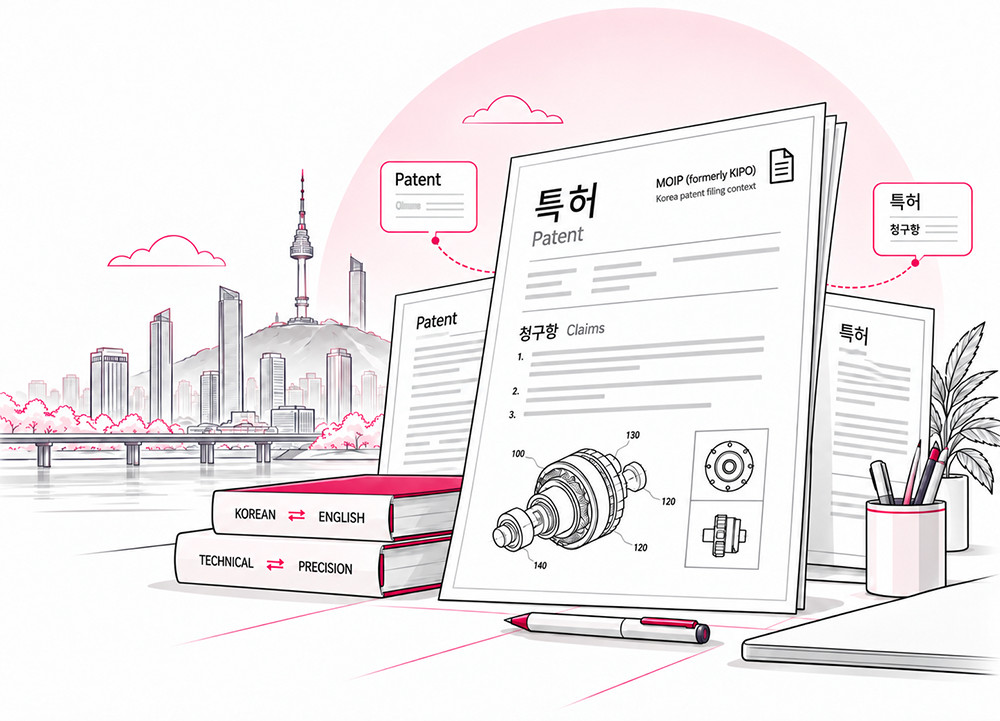
Korean Patent Translation for Filing, Research, and IP Strategy
Korean patent translation serves different purposes depending on the direction of translation and how the translated content will be used.
As part of Stepes’ broader Patent Translation Services, our Korean patent specialists support both directions with workflows matched to the intended use, technical field, and level of review.
For Korean Filing and Prosecution
Translate patent content for Korea-related filing workflows while preserving technical relationships, defined terminology, claim structure, and consistency across the application.
- Patent applications and specifications
- Independent and dependent claims
- Abstracts and drawing text
- Amendments and revised claims
- Patent prosecution materials
- PCT national-phase content
For Research, Analysis, and IP Strategy
Make Korean patent publications accessible to international legal, research, and technology teams without translating more content than the intended use requires.
- Prior-art research
- Patentability analysis
- Freedom-to-operate research
- Invalidity investigations
- Litigation and IP disputes
- Portfolio and technology reviews
Korean Patent Translation for MOIP and PCT National-Phase Work
Korea’s intellectual property authority is the Ministry of Intellectual Property (MOIP), which replaced the former Korean Intellectual Property Office (KIPO). Stepes supports law firms, patent teams, corporations, and filing partners with Korean patent translation for MOIP-related workflows and PCT national-phase entry.
Translation requirements vary by application and filing circumstances. Stepes prepares translated patent content for attorney, patent-agent, or filing-team review while qualified patent professionals remain responsible for jurisdiction-specific filing requirements, deadlines, and legal strategy.
Patent Specifications
Technical descriptions, reference numbers, units, conditions, and process sequences.
Patent Claims
Defined terms, claim relationships, and consistency across the full claim set.
Abstracts & Drawing Text
Concise technical language aligned with the underlying application.
Amendments & Prosecution
Established patent terminology carried into evolving application content.
Related Patent Families
Reference to prior filings and approved terminology where appropriate.
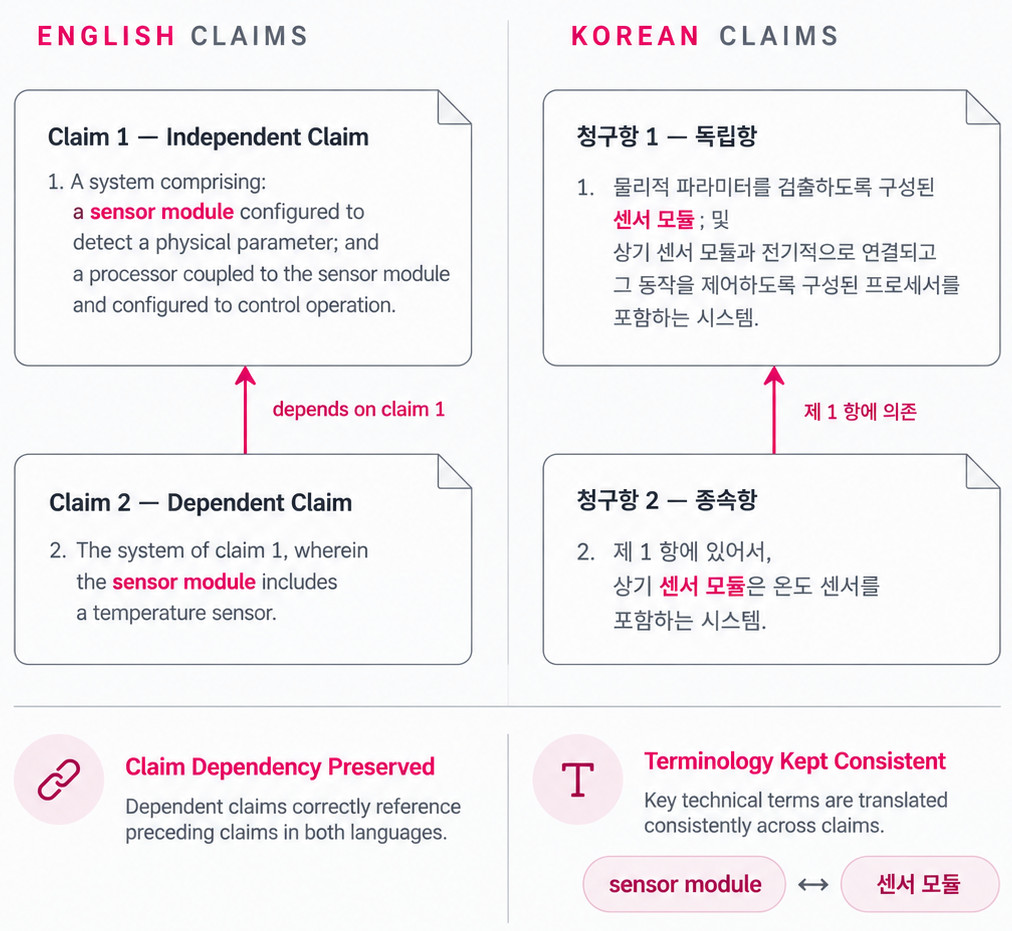
Korean Patent Claims Require More Than Literal Translation
Patent claims compress complex technical and legal concepts into highly structured language. A translation can read naturally and still create problems if a component is renamed, a functional relationship changes, or a defined term varies across related claims.
Claim Structure
Preserve dependencies, references to preceding claims, and relationships among claimed elements.
Defined Terminology
Maintain invention-specific terms consistently across claims and the detailed description.
Technical Relationships
Protect modifiers, conditions, sequences, ranges, and functional relationships across English and Korean syntax.
Cross-Document Consistency
Align claim language with the specification, drawings, amendments, and related patent-family documents.
Korean-to-English Patent Translation for Prior Art and Research
Korean patent literature can contain important technical and competitive information. Stepes helps patent attorneys, IP teams, researchers, and technology companies evaluate that information with translation depth matched to the importance of each document.
Screen
Identify Korean-language documents that may warrant closer attention.
Summarize
Capture the key technical concepts, claims, embodiments, or relevant findings.
Selected Passages
Translate claims, abstracts, examples, figures, or other material sections.
Full Translation
Translate the complete Korean patent when comprehensive English access is required.
Verified Translation
Add further linguistic or technical review for higher-stakes use.
Korean Patent Prosecution and IP Dispute Translation
Patent language continues to evolve after filing. Stepes helps keep Korean and English terminology aligned as applications move through prosecution, analysis, and IP disputes.
Office Actions and Examiner Communications
Translate patent-office correspondence so international counsel, inventors, and in-house IP teams can understand Korea-related prosecution developments.
Amendments and Responses
Maintain continuity with terminology used in the underlying application and prior claims as patent language changes during prosecution.
Claim Charts and Technical Analyses
Translate structured comparisons, technical references, and supporting materials used in infringement, validity, licensing, and portfolio analysis.
Expert and Evidentiary Materials
Support Korean-English translation of technical reports, exhibits, declarations, supporting documentation, and other IP dispute materials.
Korean Patent Translation Across Advanced Technologies
Accurate patent translation depends on understanding the technology well enough to recognize how terminology, components, processes, and technical relationships function within the invention.
Semiconductors & Electronics
Semiconductor fabrication, integrated circuits, displays, sensors, memory systems, packaging, and electronic components.
Automotive & Mobility
Electric vehicles, vehicle electronics, autonomous systems, sensors, powertrains, and advanced mobility technologies.
Batteries & Energy Storage
Battery chemistry, electrode materials, cell architecture, charging technologies, energy storage, and battery management.
Telecommunications
Wireless communications, RF technologies, networking, mobile devices, signal processing, and emerging 5G/6G systems.
AI & Software
Machine learning, computer vision, data processing, software architecture, cybersecurity, and computer-implemented inventions.
Biotechnology & Pharmaceuticals
Biologics, therapeutics, formulations, molecular technologies, diagnostics, bioprocessing, and pharmaceutical development.
Medical Devices
Diagnostic systems, imaging, surgical devices, monitoring equipment, digital health, and other medical innovations.
Advanced Manufacturing
Robotics, industrial automation, materials engineering, mechanical systems, production equipment, and precision manufacturing.
Keep Korean Patent-Family Terminology Consistent
One invention may appear in a PCT application and later in Korean, U.S., European, Chinese, Japanese, and other filings. It may also generate amendments, prosecution documents, divisional applications, and years of related correspondence.
Stepes helps clients maintain terminology across Korean and English patent families by using available reference material and language assets throughout the translation lifecycle.
Reuse Approved Patent Terminology
Use validated translations for recurring technical expressions, claim elements, and invention-specific terms.
Build Korean-English Terminology Resources
Capture preferred equivalents in bilingual glossaries for future related work.
Reference Related Family Members
Review earlier filings and translations when they provide useful context for recurring concepts.
Apply Translation Memory Intelligently
Reuse validated language while evaluating whether it remains appropriate in the new context.
Flag Meaningful Differences
Reflect substantive source changes rather than forcing artificial consistency across family members.
A Korean Patent Translation Workflow Matched to Intended Use
A patent translation for filing should not automatically follow the same workflow as a translation used to screen prior art. Stepes begins with the purpose of the translation and builds the workflow around it.
Define the Intended Use
Confirm whether the translation supports filing, prosecution, prior art, research, litigation, portfolio analysis, or another IP workflow.
Match Korean + Technical Expertise
Select resources according to the language direction, patent content, subject matter, and required review level.
Establish Patent-Family Terminology
Review prior translations, related filings, client glossaries, claims, and other available reference material.
Translate, Review, and QA
Combine translation technology and professional linguistic review with terminology, technical, and document-level quality controls.
Quality Controls for Korean Patent Language
Patent translation quality depends on whether important relationships survive across the entire document, not simply whether individual sentences appear correct.
Claims Consistency
Check recurring claim terminology, references among claims, defined components, and relationships between independent and dependent claims.
Bilingual Terminology
Review key Korean and English technical terms across specifications, claims, drawings, amendments, and related documents.
Technical Accuracy
Verify technical expressions, units, process conditions, numerical information, and specialized terminology in the context of the invention.
Document Integrity
Check reference numbers, symbols, headings, tables, drawing references, cross-references, numbering, and other structural elements.
Secure Translation for Unpublished Korean Patent Content
Patent documents can contain some of an organization’s most valuable technical information long before the underlying invention becomes public. Stepes supports secure Korean patent translation for sensitive intellectual property and pre-publication materials.
Explore Stepes SecurityWorkflow safeguards can include
- Controlled access
- Secure file handling
- Confidentiality procedures
- NDA-based workflows
- Restricted linguistic resource access
From One Korean Patent to Ongoing IP Programs
Korean patent translation needs can range from a single document to a recurring stream of applications, prosecution materials, research documents, and international patent-family content.
Single Patent
Translate one Korean or English patent application, publication, specification, claim set, or other IP document.
Patent Family
Coordinate terminology and translation across related Korean and international patent-family documents.
Prior-Art Review
Scale Korean-to-English translation from initial screening and selected passages to complete translations.
Ongoing Patent Portfolio
Support recurring Korean filing, prosecution, research, and portfolio translation with reusable terminology resources.
For ongoing programs, centralized terminology, translation memory, workflow automation, and repeatable quality controls can improve consistency while reducing unnecessary rework.
Korean Patent Translation FAQs
Common questions about English-Korean patent translation, MOIP, PCT national-phase work, prior art, prosecution, terminology, certification, and confidentiality.
Yes. Stepes provides English-to-Korean patent translation for applications, specifications, claims, abstracts, drawing text, amendments, prosecution materials, PCT national-phase content, and related technical documents. The workflow can be adapted to the technical field, intended use, existing patent-family terminology, and required review level.
Yes. We translate Korean patents and related IP documents into English for prior-art research, patentability analysis, freedom-to-operate research, litigation, invalidity investigations, competitive intelligence, technology landscaping, portfolio review, and other IP purposes. Projects can range from selected claims or passages to complete patent translations.
Yes. Stepes supports Korean translation of PCT application content for clients and patent professionals managing national-phase work in Korea. Depending on the matter and filing instructions, translated content may include the description, claims, abstract, drawing text, amendments, and other relevant application materials. Applicants should confirm current filing requirements, deadlines, and procedural questions with qualified patent counsel or the appropriate filing professional.
MOIP is Korea’s Ministry of Intellectual Property, the current national authority responsible for intellectual property administration. It replaced the former Korean Intellectual Property Office (KIPO). Because KIPO was the established name for many years, it continues to appear in older patent records, corporate documentation, search systems, and industry terminology.
Yes. Stepes translates complete patent specifications as well as independent and dependent claims. For Korean patent claims, we pay particular attention to defined terminology, dependencies, technical relationships, numerical information, repeated claim elements, and alignment between the claims and detailed description.
Yes. Korean-to-English patent translation can support patentability searches, freedom-to-operate analysis, invalidity research, competitor monitoring, technology landscaping, and litigation preparation. Depending on your research requirements, Stepes can support screening, summaries, selected-passage translation, full patent translation, or additional review for higher-stakes use.
Yes. When appropriate reference materials are available, Stepes can use prior translations, client terminology, related applications, approved claims, bilingual glossaries, and translation memory to improve consistency across Korean and English patent-family documents. We also distinguish between terminology variation that should be harmonized and substantive source changes that need to remain visible in translation.
Yes. We translate Korean and English office actions, amendments, responses, examiner correspondence, claim revisions, technical supporting materials, and other prosecution-related content. When these documents relate to an existing patent application, we can reference previously established terminology to improve continuity across the matter.
Stepes can support certified translation requirements when certification is requested for a particular project or use. Certification requirements vary by document, jurisdiction, receiving organization, and intended purpose, so clients should confirm the specific requirement with their attorney, filing professional, court, government authority, or other requesting party before translation begins.
Stepes supports secure workflows for unpublished patent applications, invention disclosures, R&D documentation, patent strategy, litigation materials, and other sensitive intellectual property. Depending on project requirements, safeguards can include controlled access, secure file handling, confidentiality procedures, NDA-based workflows, and restricted linguistic resource access.
Translate Korean Patent Content With Confidence
Translate English-Korean patent applications, PCT national-phase content, prior art, prosecution documents, and patent families with technical expertise and controlled terminology. Stepes scales from one patent to ongoing IP programs.