
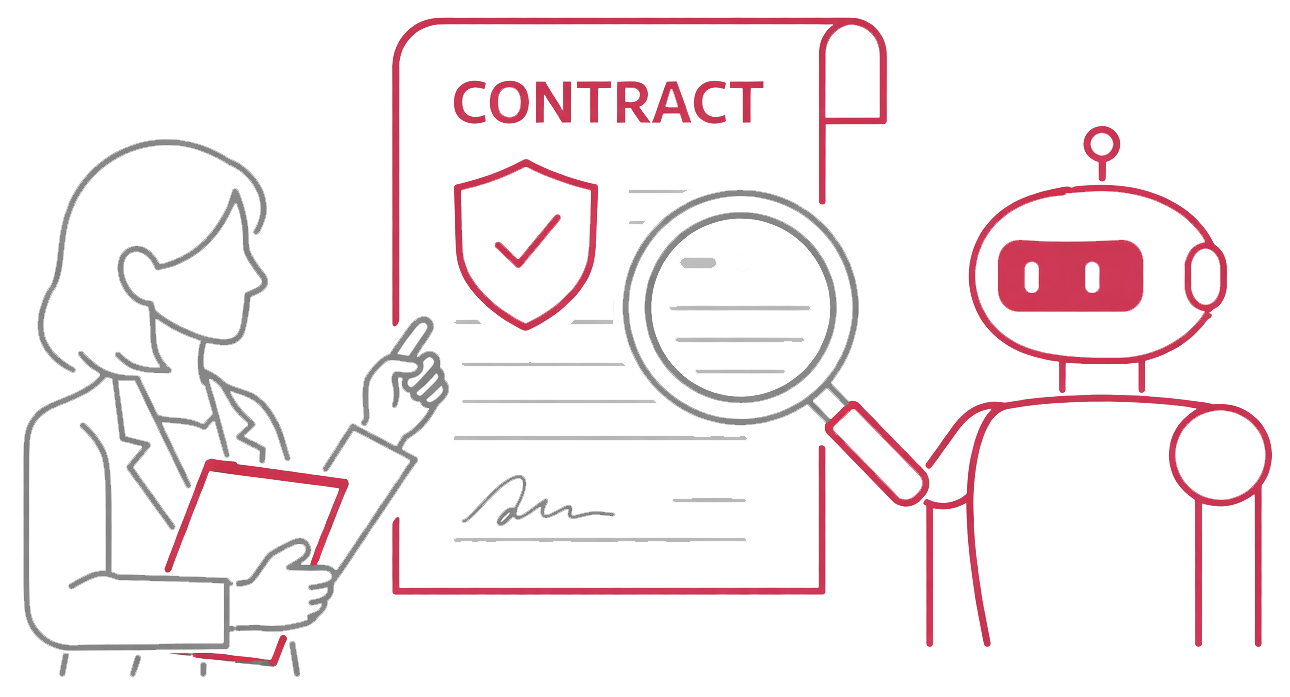
AI Legal Translation Review for Contracts, Litigation & Compliance
Structured human validation of AI-generated legal translations to reduce contractual ambiguity, jurisdictional risk, and compliance exposure.
AI tools can accelerate legal document drafting, but enforceable legal language requires precision. Stepes provides expert human review of AI-translated contracts, NDAs, litigation materials, and regulatory filings to strengthen clarity, consistency, and defensibility.
What Is AI Legal Translation Review?
AI legal translation review is a structured human validation process applied to AI-generated legal translations. Instead of translating a document from scratch, professional legal linguists review and correct a machine-produced draft to strengthen accuracy, consistency, and enforceability.
In many organizations, AI tools generate an initial translation of contracts, NDAs, compliance documents, or litigation materials. While these systems can accelerate multilingual workflows, legal language requires precision at the clause level. Even small errors in terminology, defined terms, cross-references, or jurisdictional phrasing can create contractual ambiguity or compliance exposure.
Legal document MTPE, or machine translation post-editing in the legal domain, goes beyond surface corrections. It involves:
- Reviewing clause structure and legal intent
- Verifying defined-term consistency
- Checking governing law and jurisdictional terminology
- Correcting cross-references and numbering
- Aligning terminology with regulatory requirements
Human review of AI legal translation ensures that the final document reflects the same legal meaning and enforceability as the source text. The goal is not simply to polish language, but to reduce legal risk and strengthen defensibility across jurisdictions.
AI legal translation review is most appropriate when organizations are using AI to accelerate document production but still require expert legal oversight before execution, submission, or distribution.

Why AI-Generated Legal Translations Require Expert Validation
AI systems can produce fluent multilingual drafts, but legal documents are not ordinary content. Contracts, court filings, regulatory submissions, and compliance materials carry binding obligations and legal consequences. Even subtle inaccuracies can alter meaning, shift liability, or weaken enforceability.
Without expert validation, AI-generated legal translations may introduce risks such as:
Legal clauses depend on precise wording. Minor shifts in modality, conditionals, or obligation language can change whether a clause is mandatory, discretionary, or unenforceable. Professional review ensures the legal intent remains intact.
Legal terminology varies across jurisdictions. A term that appears equivalent in another language may carry different legal implications under local law. We verify that terminology aligns with the specific legal framework of the target market.
AI systems may translate the same defined term differently across sections. In contracts and regulatory filings, defined-term consistency is critical to clarity and enforceability throughout the document.
Legal documents often rely on internal references to clauses, exhibits, or appendices. AI-generated drafts may misalign numbering or reference the wrong provision. Our review validates the integrity of all internal document references.
Compliance documents must align with jurisdiction-specific legal language. Inaccurate terminology can result in submission delays or formal rejection by authorities. We ensure alignment with local regulatory standards.
Ambiguous or incorrectly translated language may become a point of dispute in arbitration or court proceedings. Structured legal review minimizes these risks by ensuring linguistic and legal precision.
Improper handling of sensitive legal content or inconsistent confidentiality clauses can create compliance and reputational risk. We maintain strict security protocols to protect all sensitive legal materials.
Legal Documents We Review and Validate
Stepes provides AI legal translation review across a wide range of high-risk legal and regulatory documents. Our legal-domain linguists validate AI-generated drafts to preserve contractual meaning, regulatory alignment, and jurisdictional accuracy.
We regularly review and validate:
We review AI-translated commercial agreements, including MSAs, supplier agreements, and licensing contracts. Our focus is on confirming clause intent, liability provisions, and maintaining strict defined-term consistency across the document.
Non-disclosure agreements require precise obligation language. Our review ensures that confidentiality scope, term limits, and disclosure exceptions are accurately preserved to protect sensitive corporate information.
Share purchase agreements (SPA), merger agreements, and governance structures require careful terminology control. We validate voting rights, dividend provisions, and exit mechanisms to avoid ambiguity among stakeholders.
We support executive agreements, non-compete clauses, and procedural litigation materials such as pleadings and affidavits. Accuracy is critical to maintain procedural integrity and align with local employment law terminology.
Statements of claim, defense submissions, and compliance filings must align with jurisdiction-specific standards. We review procedural orders and supporting exhibits to preserve legal argumentation and cross-references.
Internal policies, codes of conduct, and anti-corruption frameworks (FCPA/UKBA) require absolute terminology consistency across languages to support enterprise-wide risk management programs.
We validate online terms of service and data processing agreements (DPA). Our review ensures precise interpretation of regulatory language like GDPR and territorial rights in cross-border distribution agreements.
AI legal translation review is particularly valuable when organizations use machine translation to accelerate document preparation but require expert legal oversight before execution, filing, or publication.
Whether you need to review AI translated contracts, validate an NDA drafted using AI tools, or conduct structured legal document MTPE across multilingual agreements, our team provides risk-focused human validation tailored to legal environments.
Our AI Legal Translation Validation Process
AI-generated drafts can accelerate multilingual legal workflows, but enforceability depends on expert review. Stepes applies a structured AI legal translation review process designed specifically for contracts, litigation materials, and compliance documentation.
Our approach combines legal domain linguists, clause-level validation, and compliance-focused QA to reduce risk before execution or submission.
We begin by reviewing the AI-generated translation alongside the source document. Our team assesses document type, governing law, and jurisdiction to determine the appropriate level of validation. High-value contracts and litigation materials receive enhanced scrutiny.
Legal terminology is verified against established bilingual glossaries and jurisdiction-specific standards. This step corrects inconsistencies introduced by AI and aligns the translation with recognized legal usage.
Legal terms often lack direct equivalents across legal systems. Our legal linguists evaluate terminology to confirm that the translated language reflects the correct legal concept under the applicable governing law (e.g., Common Law vs. Civil Law).
Each clause is reviewed to confirm that obligations, warranties, and indemnities accurately reflect the source meaning. We pay close attention to modality (shall/may) and conditional structures to preserve the original risk allocation.
We verify the consistency of capitalized terms and defined expressions throughout the document. This prevents the ambiguity that often arises when AI systems render the same term differently across sections.
Legal documents rely on internal references to sections and annexes. We confirm that all cross-references, clause numbering, and structural elements are accurate and perfectly aligned with the source text.
A final quality check verifies formatting and structural accuracy. Upon request, we provide a formal review attestation confirming that the AI-generated translation has undergone structured professional human validation.
AI Legal Translation Review vs Full Human Legal Translation
AI legal translation review and full human legal translation serve different purposes. While both involve legal expertise, the primary distinction lies in who leads the translation process and how risk is managed.
AI legal translation review begins with an AI-generated draft that is then validated by legal linguists.
Full human legal translation is led by professional legal translators from the outset, with AI-assisted tools used in a controlled, supportive capacity.
In 2026, most high-performing legal translation workflows incorporate advanced tools such as terminology databases, translation memory, and AI-assisted consistency checks. The difference is not whether AI is used, but how it is used.
The table below provides general guidance:
| Use Case | AI Legal Translation Review (AI-Led Draft + Human Validation) | Full Human Legal Translation (Human-Led + AI-Assisted Tools) |
| Internal draft contracts | Suitable | Optional |
| High-value commercial contracts | Case-by-case | Recommended |
| Court filings | Limited | Strongly Recommended |
| Public regulatory submissions | Risk-sensitive | Recommended |
| Patent filings | Limited | Recommended |
In this model, AI generates the initial draft, followed by structured human validation. This approach is typically appropriate when:
- The document is intended for internal reference only.
- Speed and rapid turnaround are the primary priorities.
- Secondary legal review will occur before final execution.
- The organization has a defined risk tolerance for the specific content.
Note: This model improves efficiency but remains dependent on the initial AI output quality.
A professional legal linguist translates directly from the source. While AI tools may assist with terminology, the translator controls the entire drafting process. This is preferred when:
- The document carries significant financial or legal exposure.
- It will be executed without further revision.
- It must be submitted to a court or regulatory authority.
- The matter involves litigation, arbitration, or enforcement.
- Absolute precision in legal drafting is critical to the outcome.
AI legal translation review is not positioned as a replacement for full human legal translation. It is a risk-managed option for organizations that use AI to accelerate workflows but still require professional validation before execution, filing, or publication.
For high-risk legal environments, human-led translation remains the most defensible approach. For organizations requiring full human-led legal drafting from the outset, explore our comprehensive Legal Translation Services.

Who Uses AI Legal Translation Review?
AI legal translation review is used by organizations that are adopting AI tools to accelerate multilingual workflows but still require professional legal oversight before execution, filing, or publication.
As AI translation for law firms and corporate legal teams becomes more common, structured human validation provides a necessary layer of risk control.
Many law firms are experimenting with AI translation platforms to improve efficiency in cross-border matters. While AI can generate draft translations quickly, firms rely on expert legal linguists to validate terminology, preserve legal intent, and protect client interests before documents are finalized. AI legal translation review allows firms to balance innovation with professional responsibility.
In-house legal teams often manage high volumes of contracts, NDAs, vendor agreements, and compliance documentation across multiple jurisdictions. When AI-generated drafts are used internally, structured legal document MTPE ensures that the final version maintains enforceability and consistency.
Compliance officers handling regulatory disclosures, internal policies, and governance documentation require precise terminology alignment. Human review of AI legal translation helps reduce regulatory risk and prevent submission delays.
Legal technology providers integrating multilingual capabilities into contract lifecycle management or document automation systems often require expert validation workflows. AI legal translation review strengthens accuracy before content is delivered to end users.
Global organizations frequently operate with dual-language contracts. AI-generated drafts can accelerate internal review, but structured validation ensures that both language versions reflect the same legal meaning and obligation.
During mergers and acquisitions, translated agreements, shareholder documentation, and due diligence materials require precision. AI-assisted drafting may improve speed, but expert validation reduces ambiguity and transactional risk.
AI legal translation review is particularly valuable in environments where efficiency and risk management must coexist. Organizations adopting AI translation for law firms or corporate legal departments still require human oversight to safeguard enforceability and compliance.
By combining AI-enabled workflows with legal-domain expertise, Stepes supports modern legal teams navigating cross-border complexity.
AI-Enabled Legal Workflows with DomainAI
For organizations seeking a more structured, end-to-end solution, Stepes also offers DomainAI, our domain-tuned AI environment designed for regulated legal and compliance content.
DomainAI supports controlled AI-assisted drafting, terminology alignment, and semantic validation within a governed workflow. This allows AI acceleration and professional legal oversight to operate together under defined review protocols.
Organizations may:
- Submit externally generated AI drafts for structured legal validation
- Use DomainAI within a controlled, human-validated legal translation workflow
All final deliverables undergo clause-level human review before execution, filing, or publication.
By combining AI-enabled efficiency with legal-domain expertise, Stepes helps law firms and corporate legal departments modernize multilingual workflows without compromising enforceability or compliance standards.
AI legal translation review must balance efficiency with risk control. By combining structured human validation with enterprise-level confidentiality practices, Stepes helps law firms and corporate legal teams adopt AI-enabled workflows without compromising legal security.

Confidentiality and Secure Handling of Legal AI Content
Legal documents often contain privileged, sensitive, or commercially confidential information. When AI tools are involved in the workflow, security expectations are even higher. Stepes applies structured safeguards to protect legal content throughout the AI legal translation review process.
Each client engagement is handled within a controlled project environment. Legal documents are not commingled across accounts, and access is restricted to authorized personnel assigned to the specific matter. This reduces cross-project exposure and strengthens information governance.
Human review of AI legal translation is performed by vetted legal-domain linguists operating under strict access controls. Permissions are role-based and limited to the scope of the assignment. Access is revoked upon project completion.
All reviewers and project managers operate under confidentiality obligations. For law firms and corporate legal departments, additional non-disclosure agreements can be executed to align with internal compliance requirements.
We recognize that legal documents may be subject to attorney-client privilege, regulatory oversight, or litigation sensitivity. Our workflows are designed to support those obligations.
Client documents are not used to retrain or improve public AI models. AI-generated drafts submitted for legal document MTPE remain confidential and are not incorporated into external training datasets. This policy protects intellectual property, legal strategy, and confidential contractual terms.
We support secure file transfer protocols and controlled document exchange methods appropriate for sensitive legal content. Upon request, additional safeguards can be implemented to align with client security policies.
AI legal translation review must balance efficiency with risk control. By combining structured human validation with enterprise-level confidentiality practices, Stepes helps law firms and corporate legal teams adopt AI-enabled workflows without compromising legal security.
Frequently Asked Questions
AI legal translation review is a structured human validation process applied to AI-generated legal translations. Legal linguists review and correct the machine-produced draft to preserve clause meaning, defined-term consistency, jurisdictional accuracy, and enforceability. It combines AI efficiency with professional legal oversight.
AI translation can produce useful drafts, but contracts require precise legal wording. Without expert validation, AI-generated translations may introduce ambiguity or inconsistency. AI legal translation review reduces risk by applying clause-level human correction before execution.
An NDA can be legally binding if properly drafted and executed. However, AI-generated translations should undergo human legal review to confirm confidentiality scope, obligations, and jurisdiction-specific terminology before being relied upon.
Legal MTPE, or legal machine translation post-editing, refers to human review and correction of machine-translated legal documents. Unlike basic editing, legal document MTPE involves clause-level validation, defined-term consistency checks, and regulatory terminology alignment.
AI translation should be avoided or supplemented with full human translation when documents involve litigation, court filings, regulatory submissions, high-value commercial agreements, or significant legal exposure. In these cases, human-led legal translation provides greater drafting control.
Stepes supports legal AI translation review across major global languages, including European, Asian, and Middle Eastern jurisdictions. Multilingual validation is performed by legal-domain linguists familiar with jurisdiction-specific terminology.
Legal documents are handled within segregated project environments with controlled reviewer access. Client content is not used to retrain AI models, and secure document transfer workflows are implemented to support confidentiality and compliance requirements.
Reduce Legal Risk in AI-Generated Translations
AI tools can accelerate multilingual legal workflows, but legal enforceability depends on precision. Stepes provides structured human validation of AI-generated legal translations to protect contractual clarity, regulatory alignment, and cross-border accuracy before execution or filing.