
Point-of-Work Clarity
Work Instructions That Work in Every Language
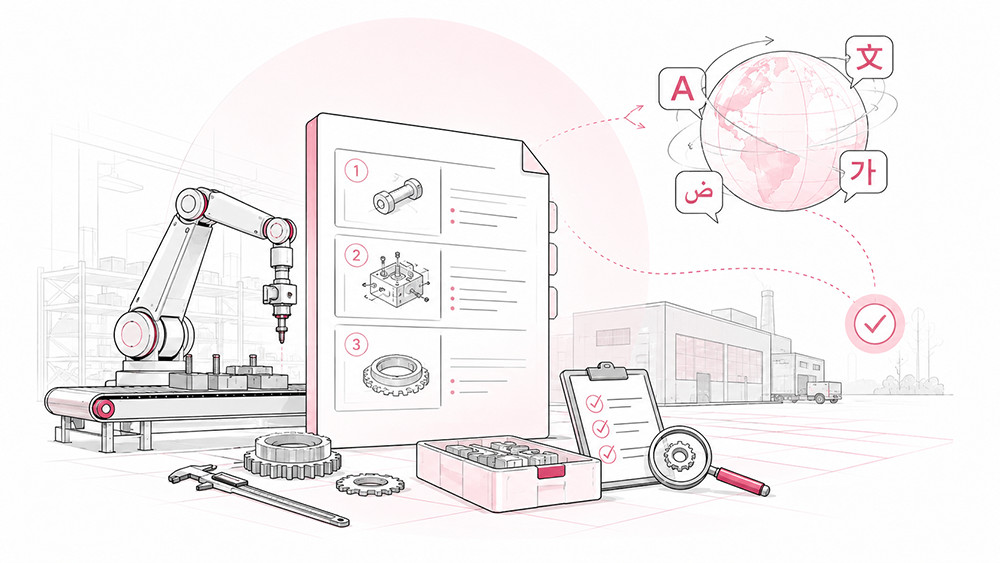
Work instructions sit close to the actual work. They tell operators, technicians, inspectors, maintenance teams, laboratory personnel, warehouse employees, and other frontline teams how to complete a specific task accurately and consistently.
A work instruction may specify an exact operating sequence, machine setting, measurement, tool, material, inspection criterion, warning, diagram, photograph, or acceptance threshold. Translation therefore has to preserve more than the words—it has to preserve the logic of the task.
The goal is simple: employees working in different languages should receive the same clear guidance for performing the same task.
Document Hierarchy
SOPs and Work Instructions: Different Levels of Operational Detail
Organizations often use both together: SOPs establish the required process, while work instructions provide the detailed guidance employees need to carry it out correctly.
Define the Process
Standard operating procedures typically describe the broader process that must be followed.
- What must happen
- Roles and responsibilities
- Required procedures
- Quality requirements
- Governance and controls
Explain the Task
Work instructions go deeper into the activity performed at a workstation, machine, inspection point, laboratory, or facility.
- Exact steps and sequence
- Tools and materials
- Machine settings
- Measurements and visual references
- Inspection and acceptance criteria
An SOP may require torque verification before final assembly. The related work instruction can identify the torque wrench, specify the required setting and fastening sequence, show the relevant component, and explain how the result is recorded.
Work Instructions for Every Stage of Operations
Stepes supports manufacturing work instruction translation across production, quality, engineering, maintenance, logistics, laboratory, and other operational functions.
Assembly Work Instructions
Detailed instructions for component assembly, fastening, fitting, wiring, joining, soldering, installation, subassembly, and final production operations.
Machine Setup and Operation
Equipment preparation, startup, shutdown, tooling, fixture setup, calibration, parameter settings, operating sequences, and production changeovers.
Inspection and Quality Instructions
Inspection methods, measurements, sampling requirements, defect classifications, acceptance criteria, and quality checkpoints.
Maintenance Work Instructions
Preventive and corrective maintenance covering inspection, lubrication, cleaning, adjustment, parts replacement, servicing, and repair.
Testing Instructions
Laboratory, production, functional, verification, electrical, mechanical, and other testing procedures, including setup and result criteria.
Packaging and Labeling Instructions
Packing sequences, labeling requirements, product identification, serialization, handling, palletization, storage, and shipment preparation.
Cleaning and Sanitation Instructions
Equipment cleaning, sanitation, disinfection, contamination control, line clearance, facility cleaning, and hygiene-related tasks.
Warehouse and Material Handling
Receiving, inventory, picking, packing, storage, loading, equipment use, material movement, and distribution-center operations.
Safety-Related Work Instructions
Task-specific precautions, PPE requirements, hazard controls, equipment warnings, isolation steps, and safe operating instructions.
Troubleshooting and Corrective Instructions
Diagnostic sequences, error conditions, corrective actions, repair steps, equipment resets, and escalation requirements.
Work Instruction Translation for Global Manufacturing
A process designed in one location may need to be performed consistently across plants, suppliers, contract manufacturers, departments, and languages.
One manufacturing organization may maintain hundreds or thousands of work instructions across production cells, engineering teams, quality departments, maintenance groups, laboratories, warehouses, and global facilities. Those instructions continue to evolve as products, equipment, materials, quality requirements, and processes change.
Automotive Manufacturing
Assembly, machining, inspection, testing, quality, maintenance, supplier, battery-production, and production-line work instructions.
Automotive Translation ServicesElectronics Manufacturing
Assembly, testing, repair, ESD handling, inspection, component, packaging, and production instructions for electronics and technology manufacturing.
Electronics Translation ServicesIndustrial Equipment and Machinery
Equipment operation, fabrication, machining, assembly, inspection, maintenance, installation, and plant work instructions.
Medical Devices
Manufacturing, inspection, testing, cleaning, packaging, quality-control, and other controlled work instructions used across medical device operations.
Pharmaceutical and Life Sciences
Production, laboratory, cleaning, packaging, quality, material-handling, and controlled operational instructions.
Chemicals and Materials
Batch operations, laboratory procedures, production instructions, equipment use, material handling, quality testing, and packaging.
Aerospace and Advanced Manufacturing
Assembly, inspection, tooling, maintenance, fabrication, production-control, and quality work instructions with specialized technical terminology.
Logistics and Warehousing
Receiving, storage, inventory management, material handling, picking, packing, fulfillment, equipment use, and shipping operations.
Clear Work Instructions for Multilingual Workforces
Global operations increasingly depend on teams that work across languages, countries, facilities, suppliers, and cultural backgrounds. Translating task-level instructions into the languages employees use can strengthen comprehension, training, quality, safety communication, and consistent execution.
Support Spanish, Chinese, Vietnamese, Polish, Portuguese, French, German, Japanese, Korean, Thai, Czech, Romanian, and many other languages.
Explore 100+ Translation LanguagesGive employees detailed instructions they can readily understand and apply.
Reduce the chance that different facilities or language groups interpret the same procedure differently.
Reinforce onboarding and hands-on training with clear instructions employees can reference while working.
Keep process steps, measurements, inspection criteria, and acceptance requirements aligned across teams.
Make task-specific precautions, warnings, and safe operating instructions easier to understand and follow.
Deploy common processes across plants while giving local teams instructions in the appropriate languages.
Visual + Digital Content
Translate the Instruction Without Losing the Workflow
Work instructions increasingly combine text, images, diagrams, structured steps, and digital interfaces. Stepes supports both document-based and connected work instruction content.
Visual Work Instruction Translation
Keep translated text aligned with photographs, diagrams, arrows, callouts, screenshots, part labels, tables, symbols, numbered steps, and embedded graphics.
Stepes supports Word, Excel, PowerPoint, PDF, Adobe InDesign, Illustrator, XML, HTML, and other document and structured content formats.
Digital Work Instruction Translation
Support electronic work instruction systems, operator tablets, manufacturing applications, connected-worker tools, quality platforms, portals, and structured content repositories.
Digital workflows can include reusable steps, linked visuals, product-specific content, and frequent updates—making terminology, translation memory, and structured delivery especially valuable.
AI-Powered Work Instruction Translation With Human Quality Control
High-volume work instruction programs are well suited to intelligent automation, but production content also requires control. Stepes applies an appropriate combination of AI translation, translation memory, approved terminology, professional review, and automated quality checks based on content requirements and business risk.
Accelerate large and recurring multilingual work instruction programs.
Use translation memory and terminology to anchor recurring content in trusted language.
Apply linguistic and subject-aware judgment where accuracy, context, and risk require it.
Recurring Translation Operations
Keep Terminology, Translations, and Revisions Aligned
Work instructions change as products, equipment, quality requirements, and processes evolve. Reusable language assets help every new revision move faster without losing consistency.
One Term. One Meaning.
Standardize approved translations for components, tools, equipment, materials, process steps, defect classifications, safety terminology, product names, and internal abbreviations across documents and languages.
Terminology ManagementTranslate Updates Without Starting Over
Translation memory identifies previously approved content so unchanged language can be reused where appropriate while linguists focus on the new or modified material in each revision.
Translation MemoryKeep Every Language on the Latest Revision
Support recurring updates triggered by engineering changes, process improvements, equipment updates, corrective actions, quality findings, and new product introductions.
Enterprise Translation ManagementTypical Revision Flow
Task-Critical Quality
Quality Checks Beyond Translation
A sentence can be grammatically correct and still be wrong for the task. Work instruction QA therefore needs to examine the technical, procedural, and visual context of the translated content.
Confirm that steps, warnings, requirements, and important source information are accurately represented without omissions.
Check terminology against approved glossaries, product language, and project-specific requirements.
Review quantities, units, tolerances, dimensions, ranges, settings, and other task-critical values.
Preserve numbered operations, dependencies, and procedural relationships across the translated instruction.
Maintain part numbers, product codes, model numbers, trademarks, variables, and other content that should remain unchanged.
Check tables, callouts, labels, diagrams, page structure, and the relationship between text and supporting visuals.
Review accuracy, grammar, fluency, clarity, consistency, and target-language usability.
Apply approved translation memory and terminology so recurring content remains aligned across documents and revisions.
Built for Controlled Work Instruction Environments
Work instructions frequently form part of a larger quality or controlled-document environment. Stepes supports translation workflows designed to preserve important document structure and metadata while maintaining clear stages for source content, translation, review, approval, and final delivery.
Stepes complements your document-control process by helping multilingual content move through translation, review, quality assurance, and recurring updates systematically.
From One Work Instruction to an Entire Global Plant Network
Stepes supports one-time translation needs and recurring enterprise programs that grow across departments, facilities, countries, and languages.
Translate a specific procedure, assembly instruction, inspection method, maintenance task, or test instruction.
Standardize multilingual instructions across manufacturing cells, quality groups, maintenance teams, laboratories, or warehouses.
Translate large collections of operational content for a multilingual plant, production site, or distribution center.
Maintain recurring instructions across multi-site manufacturing networks, suppliers, contract manufacturers, and languages.
As volume grows, approved terminology and translation memory become increasingly valuable because trusted language can be carried forward instead of recreated project by project.
A Smarter Work Instruction Translation Workflow
A structured process connects content analysis, language assets, the right translation method, professional review, QA, and future reuse.
Analyze
Review files, languages, formats, terminology, repeated content, visual elements, quality requirements, and delivery needs.
Prepare
Apply existing glossaries, translation memories, reference materials, approved translations, and project instructions.
Translate
Route content through the appropriate professional, AI-assisted, or hybrid translation workflow based on complexity, risk, and scale.
Review
Professional linguists review meaning, clarity, terminology, context, and consistency, with additional technical or customer review where required.
Assure Quality
Use automated and human checks to identify omissions, terminology issues, numerical inconsistencies, and formatting problems.
Deliver and Reuse
Deliver final multilingual work instructions and retain approved language assets for future revisions and related content.
Why Global Manufacturers Choose Stepes
Combine language expertise, manufacturing context, AI-powered translation technology, reusable language assets, and enterprise quality controls in one scalable operating model.
Manufacturing and Technical Expertise
Support for technical and manufacturing content across engineering, automotive, electronics, industrial, medical device, life sciences, and other specialized sectors.
AI + Human Translation
Modern AI-powered workflows combined with professional linguistic expertise and human validation according to quality, scale, and risk requirements.
Translation Memory
Reuse approved multilingual content across recurring instructions and future revisions instead of retranslating identical material.
Terminology Control
Standardize product, component, process, equipment, quality, and safety terminology across languages and documents.
Visual and Digital Content Support
Translate traditional documents together with visual, structured, and digital work instruction content.
Enterprise Quality Assurance
Connect linguistic review with terminology controls, translation memory, automated checks, approvals, and final-format QA.
Work Instruction Translation FAQs
Answers to common questions about task-level manufacturing translation, visual and digital instructions, revisions, terminology, quality, and enterprise scale.
Work instruction translation is the translation of detailed, task-specific instructions used to perform manufacturing, inspection, maintenance, testing, cleaning, packaging, warehouse, laboratory, and other operational activities. Because these documents frequently contain technical terminology, measurements, numbered steps, warnings, visual references, equipment settings, and acceptance criteria, the translation must preserve both linguistic meaning and operational clarity.
An SOP generally defines a broader process, including what needs to happen, who is responsible, and which requirements or controls apply. A work instruction typically provides more detailed guidance for performing an individual task, including exact steps, tools, settings, measurements, visuals, and checkpoints. Organizations often use SOPs and work instructions together.
Stepes translates assembly instructions, machine operating instructions, inspection procedures, maintenance instructions, testing methods, cleaning instructions, packaging procedures, warehouse instructions, troubleshooting procedures, safety-related instructions, laboratory instructions, and many other forms of task-level operational documentation.
Yes. Stepes supports work instructions containing photographs, diagrams, screenshots, tables, arrows, callouts, part labels, inspection images, safety symbols, and other visual elements. Translation and formatting workflows help keep localized text connected to the correct visual reference.
Yes. Stepes supports multilingual content for digital work instruction systems, manufacturing applications, operator terminals, tablets, portals, connected-worker environments, quality systems, and structured content platforms. Depending on the system and project requirements, workflows can use files, structured exports, APIs, or other localization methods.
Stepes uses terminology management and translation memory to maintain approved multilingual language across recurring documents. Terminology resources define preferred translations for important components, tools, equipment, materials, processes, quality terms, and product names, while translation memory preserves previously approved bilingual content for appropriate reuse.
Translation memory can identify exact and similar content from previously translated versions so linguists can focus on new or modified material rather than retranslating all unchanged content. The workflow depends on the source format, revision method, translation memory availability, and project requirements.
Stepes supports professional translation across more than 100 languages and regional variants, including Spanish, Chinese, Vietnamese, Portuguese, Polish, French, German, Japanese, Korean, Thai, Romanian, Czech, Arabic, and many others used across global manufacturing and operations.
Yes. Stepes supports enterprise translation programs involving large file volumes, multiple languages, recurring revisions, distributed teams, translation memory, terminology management, AI-assisted workflows, professional human review, and centralized project management. Programs can begin with a pilot and scale to plants, multi-site manufacturing networks, or ongoing global content operations.
Work instruction quality workflows can include checks for numbers, measurements, units, tolerances, part numbers, protected content, machine settings, terminology, missing content, and formatting. Professional reviewers also evaluate translated meaning and context according to project requirements.
Yes. AI can be valuable for high-volume, repetitive, and frequently updated manufacturing content. Stepes combines AI translation with approved terminology, translation memory, automated QA, and professional human review according to content complexity and risk. For task-critical instructions, human validation helps confirm that steps, terminology, warnings, measurements, and technical meaning remain appropriate for their intended use.
Make Every Work Instruction Clear in Every Language
Whether you are translating one production procedure or maintaining thousands of multilingual work instructions across global manufacturing sites, Stepes provides the language expertise, AI-powered technology, terminology control, translation memory, and scalable quality workflows to keep operational content clear and consistent.