
Five practices that make PCT translation easier to plan and control.
Use these recommendations as the operating framework for the guide, then verify the requirements that apply to each actual national or regional phase filing.
Confirm the filing plan before translation starts
Work from the target jurisdictions, accepted languages, and deadlines confirmed by patent counsel or the filing representative.
Lock the controlling source and amendment history
Identify the application version, claim set, Article 19 amendments, Article 34 amendments, and other materials that apply to each target office.
Treat claims and terminology as controlled content
Preserve claim relationships, defined terms, numbers, units, figure references, and patent-family terminology across every target language.
Coordinate related national phases as one program
Centralized source control, terminology, QA, and reviewer coordination can reduce divergence when one PCT application enters several markets.
Verify office-specific requirements at the point of filing
Use current WIPO and patent-office guidance rather than relying on a universal deadline or document checklist.
PCT National Phase Translation at a Glance
A single PCT application can lead to multiple national or regional patent applications, each governed by the requirements of the relevant patent office. Translation planning should therefore begin with the target jurisdictions, accepted languages, current application version, applicable amendments, and filing instructions provided by patent counsel or a filing representative.
When Translation Is Needed
A national or regional office may require a translation when the international application is not in a language accepted for that national or regional phase.
What May Need Translation
Depending on the office and the application, translated content may include the description, claims, abstract, text in drawings, request, Article 19 amendments, Article 34 amendments, and other office-specific materials.
When Translation Is Due
Many national and regional phase deadlines fall around 30 or 31 months from the priority date, but the applicable deadline is not universal.
Why Translation Planning Matters
National-phase projects can involve overlapping deadlines, several target languages, amended claim sets, patent-family terminology, specialized technical content, and filing-specific review requirements.
Patent-office requirements and filing deadlines vary by jurisdiction and can change. Stepes provides patent translation and multilingual workflow support, not patent filing or legal advice. Applicants should confirm current requirements and deadlines with WIPO, the relevant patent office, and their patent counsel or filing representative.
How PCT Patent Translation Fits Into the International Filing Process
The PCT provides a unified international filing framework before applicants proceed into national or regional phases. Translation becomes particularly important when the application moves into patent offices with their own accepted languages and procedural requirements.
The International Phase
A PCT application may move through international search, international publication, possible Article 19 amendments to the claims, optional international preliminary examination, possible Article 34 amendments, and issuance of international search or preliminary examination materials. Not every application follows exactly the same path, and the translation scope later depends in part on which documents and amendments exist when the applicant proceeds into selected national and regional phases.
The National and Regional Phases
During the national or regional phase, the application proceeds before individual designated or elected patent offices. Those offices apply their own requirements concerning accepted filing languages, translation content, fees, forms, representation, examination, and other procedural matters.
Where Translation Enters the Workflow
Depending on the filing route and office requirements, the translation package can involve several parts of the international application and its amendment history.
- Description or specification
- Claims
- Abstract
- Text matter appearing in drawings
- Article 19 and Article 34 amendments
- Statements, request-related information, and other materials identified by patent counsel or the filing representative
When Does a PCT Application Need Translation for National Phase Entry?
Translation requirements generally arise when the international application is not in a language accepted by the office where national or regional phase protection is being pursued. For example, an English-language PCT application entering China generally requires Chinese translation, while the same English-language application may not require translation simply because it enters the United States.
The requirement therefore depends on both sides of the equation:
The Same PCT Application Can Create Different Translation Requirements
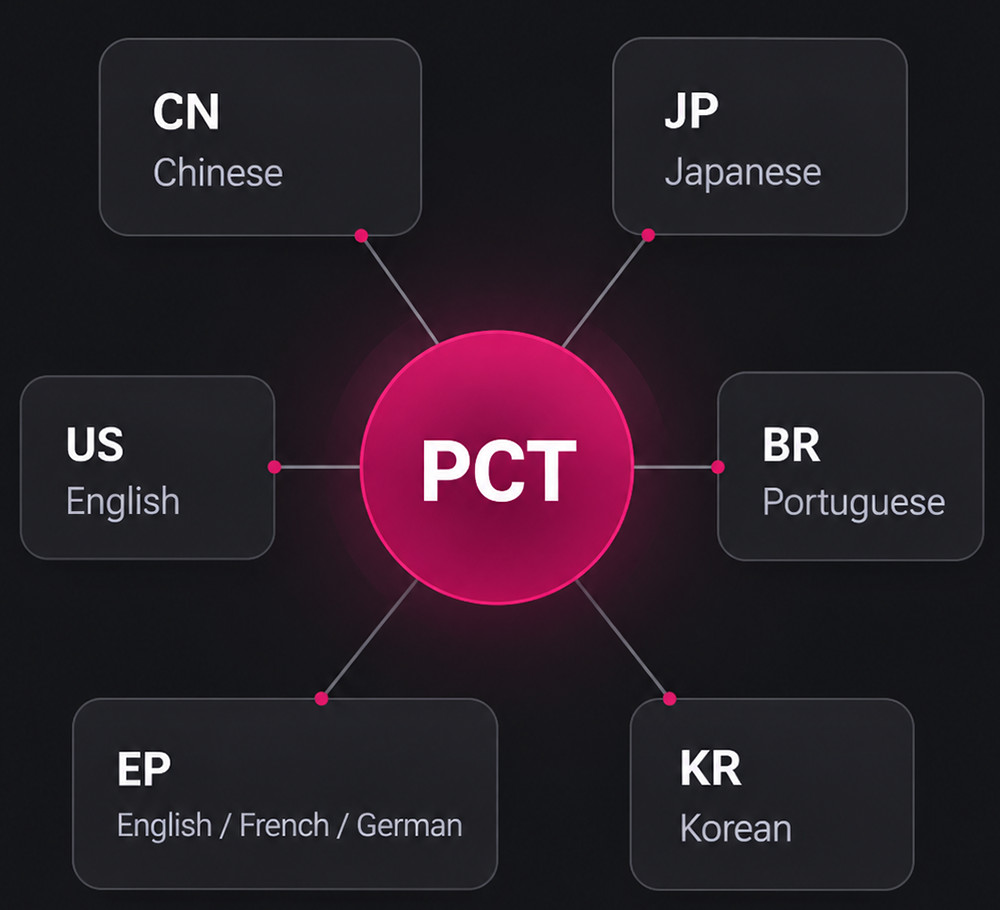
An English-language PCT application may require Chinese for China, Japanese for Japan, Korean for the Republic of Korea, Portuguese for Brazil, German for a German national-phase filing, or an English, French, or German translation for the European phase when required.
Shared terminology, source files, amendment histories, related patents, and reviewer instructions can be managed centrally while each target-language translation is prepared according to its own requirements.
What Parts of a PCT Application May Need Translation?
The precise translation scope depends on the patent office, application language, amendments, and filing instructions. Common components include the following.
Description or Specification
Technical background, embodiments, examples, operating principles, and other detailed implementation information.
Claims
Independent and dependent claims, dependencies, antecedent references, defined terms, limitations, ranges, units, and component relationships.
Abstract
Short but terminology-sensitive content that should remain aligned with the claims and description.
Text Matter in Drawings
Labels, legends, flowchart text, graph labels, callouts, and other language-dependent content.
Request or National-Phase Information
Request-related content may be treated differently by office and filing form.
Article 19 and Article 34 Amendments
Amended claims, description, drawings, replacement pages, statements, and related materials where applicable.
PCT National Phase Deadlines and Translation Planning
Many PCT national and regional phase deadlines are calculated at 30 or 31 months from the priority date, but those periods are not universal. Translation providers should work from deadlines supplied or confirmed by the applicant's patent counsel or filing representative rather than independently calculating filing deadlines.
A common national-phase reference point in several major markets.
Another common timetable used by several national and regional offices.
Always confirm the office-specific deadline and any available remedies using current official guidance.
Check WIPO time limitsWhy Translation Should Start Before the Filing Deadline
Technical subject-matter assignment
Select translators and reviewers with the appropriate patent, technical, and language expertise.
Terminology preparation
Review patent-family documents, approved terminology, previous translations, product documentation, and technical references.
Amendment reconciliation
Determine which claim sets and amendments are current and which versions require translation.
Professional translation
Preserve technical meaning, patent structure, references, numbers, units, formulas, drawings, and recurring terminology.
Independent review
Review accuracy, completeness, claim relationships, terminology, and project instructions.
Automated and final-file QA
Check numbers, references, claim numbering, formatting, missing content, terminology variation, and file integrity.
Client or counsel review
Support technical or legal review by the client's patent professionals when the project requires it.
PCT Translation Requirements in Major National and Regional Filing Markets
The overview below illustrates why national-phase patent translation should be planned office by office rather than through one universal checklist.
This information supports translation planning, not filing strategy or legal compliance. Patent-office requirements can change and may depend on the specific application and filing route. Always verify current requirements with WIPO, the relevant patent office, and your patent counsel or filing representative.
| Office / Market | National-Phase Timing* | Translation Language | Translation Scope at a Glance | Official Source |
|---|---|---|---|---|
| China / CNIPA | 30 months | Chinese | May include the request, description, claims, drawing text, abstract, and relevant amendments. | WIPO National Chapter |
| Japan / JPO | 30 months | Japanese | Description, claims, drawing text, abstract, and applicable amendments. | WIPO National Chapter |
| Republic of Korea / MOIP | 31 months | Korean | Application content, description, claims, drawing text, abstract, and applicable amendments; national-phase form use can affect request translation requirements. | WIPO National Chapter |
| European Patent Office / EPO | 31 months | English, French, or German | Translation into an EPO official language when required, including application content and applicable amendments. | WIPO National Chapter |
| United States / USPTO | 30 months | English | English translation required when applicable; amendments can require corresponding translated material. | WIPO National Chapter |
| Germany / DPMA | 31 months | German | Description, claims, drawing text, abstract, and applicable amendments. | WIPO National Chapter |
| India / Indian Patent Office | 31 months | English | Description, claims, drawing text, abstract, and applicable amendments when translation is required. | WIPO National Chapter |
| Brazil / INPI | 30 months | Portuguese | Portuguese translation requirements can include description, claims, drawing text, abstract, and relevant amendments. | WIPO National Chapter |
*Months are measured from the priority date under the current WIPO National Chapters referenced for this guide. Requirements and available remedies can change.
China / CNIPA
30 months- Translation language
- Chinese
- Scope at a glance
- May include the request, description, claims, drawing text, abstract, and relevant amendments.
Japan / JPO
30 months- Translation language
- Japanese
- Scope at a glance
- Description, claims, drawing text, abstract, and applicable amendments.
Republic of Korea / MOIP
31 months- Translation language
- Korean
- Scope at a glance
- Application content, description, claims, drawing text, abstract, and applicable amendments; national-phase form use can affect request translation requirements.
European Patent Office / EPO
31 months- Translation language
- English, French, or German
- Scope at a glance
- Translation into an EPO official language when required, including application content and applicable amendments.
United States / USPTO
30 months- Translation language
- English
- Scope at a glance
- English translation required when applicable; amendments can require corresponding translated material.
Germany / DPMA
31 months- Translation language
- German
- Scope at a glance
- Description, claims, drawing text, abstract, and applicable amendments.
India / Indian Patent Office
31 months- Translation language
- English
- Scope at a glance
- Description, claims, drawing text, abstract, and applicable amendments when translation is required.
Brazil / INPI
30 months- Translation language
- Portuguese
- Scope at a glance
- Portuguese translation requirements can include description, claims, drawing text, abstract, and relevant amendments.
China / CNIPA
China currently uses a 30-month national-phase timetable and requires Chinese translation where applicable. Current WIPO guidance identifies the request, description, claims, text matter in drawings, and abstract as relevant translated content, with additional treatment for Article 19-amended claims when those amendments are to form the basis of proceedings.
Explore Chinese Patent TranslationJapan / JPO
Japan currently uses a 30-month national-phase timetable and requires Japanese translation where applicable. Current WIPO guidance identifies the description, claims, text matter of drawings, and abstract, with specific rules for translated amendments.
Explore Japanese Patent TranslationRepublic of Korea / MOIP
The Republic of Korea currently uses a 31-month national-phase timetable and requires Korean translation where applicable. The WIPO National Chapter identifies the office as the Ministry of Intellectual Property of the Republic of Korea (MOIP), and use of the designated national-phase form can affect whether the request itself requires translation.
Explore Korean Patent TranslationEuropean Patent Office / EPO
The EPO currently uses a 31-month period for entry into the European phase. Its official languages are English, French, and German. Where the international application was not published in an EPO official language, an appropriate translation into an EPO official language may be required.
United States / USPTO
The United States currently uses a 30-month national-phase timetable and requires an English translation where the international application is not already available in English as required. Amendment translations can also affect whether amended material remains part of the national-phase application.
Germany / DPMA
Germany currently uses a 31-month national-phase timetable and requires German translation where applicable. Current WIPO guidance identifies the description, claims, drawing text, abstract, and relevant treatment of amended claims and other amendments.
Explore German Patent TranslationIndia / Indian Patent Office
India currently uses a 31-month national-phase timetable and requires English translation where applicable. Current WIPO guidance identifies the description, claims, text matter in drawings, abstract, and relevant amendments under the applicable circumstances.
Brazil / INPI
Brazil currently uses a 30-month national-phase timetable and requires Portuguese translation where applicable. Current WIPO guidance includes particular rules concerning when translations must be furnished and how missing translated portions may subsequently be addressed.
Claims, Article 19 Amendments, and Article 34 Amendments
Amendments are one of the areas where national-phase patent translation becomes substantially more complex than straightforward document translation. Clear version instructions are essential before translation begins.
Original and Amended Claim Sets
A project may include claims as originally filed, Article 19-amended claims, later Article 34 amendments, replacement pages, accompanying statements, international preliminary examination annexes, and further attorney-created versions prepared for national phase entry.
Establish the complete source baseline.
Identify amended claims and accompanying statements.
Reconcile later amendments and preliminary-examination materials.
Translate the version specified for each target office.
Article 19 Amendments
Article 19 amendments concern the claims during the international phase. One jurisdiction may require both original and amended versions under certain circumstances, another may permit a particular choice, and another may disregard an amendment when its required translation is not furnished. Office-specific instructions are therefore essential.
Article 34 Amendments
Article 34 amendments can arise during international preliminary examination and may affect the description, claims, drawings, or other application content. Where such amendments exist, provide the originally filed application, all relevant amendment pages, international preliminary report materials when applicable, clear identification of the version to be translated, and instructions concerning whether original, amended, or both versions are required.
Why Version Control Matters
- Translating an obsolete claim set
- Omitting a relevant amendment
- Translating the same amendment twice
- Mixing original and amended language
- Creating inconsistent terminology between versions
- Mismatching claim numbers
- Delivering the wrong version to a filing team
A controlled PCT translation workflow should therefore treat version identification as a quality requirement, not merely a project-management task.
Patent Claims Translation Quality ChecklistPriority Documents and Other Office-Specific Translation Requirements
Priority documents are another area where applicants should avoid assuming that one rule applies everywhere. A certified priority document, translation of a priority document, declaration, or related supporting material may be required in particular circumstances, but such requirements vary by office and application.
Other translation support may also be needed for declarations, assignments, inventor-related documentation, certificates, amendments, sequence-related language-dependent content, attorney or applicant statements, office correspondence, and national-phase supporting documentation.
Stepes prepares these translations according to the requirements and instructions supplied for the project. Patent counsel and filing representatives remain responsible for determining which documents are legally required.
One PCT Application, Multiple Languages and Filing Markets
A PCT application entering several national and regional phases should not have to become several disconnected translation projects. A centralized multilingual workflow can help maintain consistency across the patent family while still supporting the different requirements of each target jurisdiction.
How to Prepare a PCT Application for National Phase Translation
Good preparation can improve both translation quality and production efficiency.
Identify the target jurisdictions
Provide the countries and regional offices where translation support is needed. This helps determine the target languages, appropriate translators, project scale, and delivery schedule.
Confirm applicable deadlines with counsel
Provide the filing deadlines confirmed by patent counsel or the filing representative, including jurisdiction-specific delivery dates when they differ.
Confirm the target languages
Do not assume the target language solely from the country name. Regional offices can accept multiple official languages and filing routes may differ.
Establish the controlling source application
Identify the exact application version that should serve as the translation source and provide clean editable files when available.
Collect Article 19 and Article 34 amendments
Include all applicable amendments and clearly identify which jurisdictions require which versions.
Provide patent-family reference materials
Related applications, granted patents, earlier translations, priority applications, technical disclosures, and approved family terminology can help translators maintain context and consistency.
Identify drawings containing text
Provide editable artwork where possible and explain whether translated drawing text must be recreated, supplied separately, or handled another way.
Supply approved terminology
Client glossaries, product terminology, technical nomenclature, inventor preferences, and attorney-approved translations can be incorporated into the workflow.
Confirm required file formats
Identify whether final files are needed in Word, PDF, structured XML, editable drawing formats, bilingual review files, or another format.
Define the review process
Identify who will review or approve the translations and whether feedback should be incorporated across related languages or patent-family materials.
A Filing-Oriented PCT Patent Translation Quality Checklist
Patent translation quality is not determined by fluency alone. Filing-oriented work requires systematic checks across language, technology, document structure, and file integrity.
Completeness
- Every required source section is translated
- Paragraphs and claims are complete
- Drawing text is accounted for
- Applicable amendments are included
- The correct source version was used
Claims
- Claim numbering and dependencies
- Independent/dependent relationships
- Antecedent references
- Defined and repeated terminology
- Alternatives, limitations, ranges, units, and figure references
Technical Content
- Scientific and engineering terminology
- Chemical and biological terminology
- Mathematical notation and variables
- Units, values, ranges, symbols, and abbreviations
- Technical relationships
Drawings and References
- Figure numbers and drawing labels
- Reference numerals
- Figure citations in the description
- Translated callouts and flowchart text
- Tables and legends
Terminology Consistency
- Claims and specification
- Abstract and drawings
- Amendments
- Related family documents
- Context-sensitive review of TM and glossary reuse
File Integrity
- Section order and headings
- Paragraph and claim numbering
- Cross-references
- Tracked changes when applicable
- Tables, formulas, special characters, and required formatting
Maintain Patent Terminology Across Languages and Patent Families
Patent terminology may recur across priority filings, PCT applications, national-phase applications, continuation filings, prosecution documents, related patents, product documentation, technical publications, licensing materials, and litigation records.
Claims and Defined Terms
Record defined terms together with enough context for translators and reviewers to understand how they function across independent claims, dependent claims, specifications, figures, and amendments.
Patent-Family Reference Translations
Use previous translations as references rather than automatically accepting them as correct. Review their approval status, filing purpose, claim changes, terminology history, and jurisdiction.
Multilingual Patent Glossaries
Capture source terms, approved target terms, definitions, context, patent-family references, technical disciplines, preferred abbreviations, prohibited variants, and reviewer comments.
Translation Memory and Approved Language
Translation memory can identify repeated or similar content across related patents, but high-context claims and amendments should be reviewed carefully before previous wording is reused.
Where AI and Translation Technology Fit Into PCT Patent Translation
Modern patent translation workflows increasingly combine professional linguists with translation memory, terminology management, automated QA, and controlled artificial intelligence. The objective is to use technology according to the purpose, confidentiality, complexity, and risk of the content.
Technology Can Help With
- Terminology extractionIdentify recurring technical and patent terms before translation begins.
- Translation-memory matchingSurface previously translated content from related applications and patent families.
- Version comparisonHelp identify changes between original and amended application versions.
- Repetitive-content analysisRecognize shared material across related patents.
- Automated QAFlag numbers, units, missing text, terminology variation, references, and formatting issues.
- Workflow routingCoordinate multilingual projects and direct higher-risk content to appropriate human review.
Human Expertise Remains Critical For
- Filing-grade claimsClaim structure, dependencies, technical limitations, and defined terminology require careful professional interpretation.
- Specifications and descriptionsTechnical meaning must remain consistent across large, highly structured documents.
- Novel subject matterNew technologies often contain terminology that cannot be resolved through simple database matching.
- Ambiguous source languageHuman judgment is needed when technical or linguistic ambiguity could materially affect meaning.
- AmendmentsReviewers need to understand how new language relates to original content.
- Final validationHigh-consequence patent translations should receive the professional review appropriate to their intended use.
AI can be valuable for patent research, terminology analysis, source comparison, repetitive content, and quality automation. For filing-grade PCT applications, AI should operate within a controlled workflow that maintains professional human expertise where technical and legal precision are most consequential. Sensitive unpublished inventions also require appropriate information-security controls.
PCT National Phase Translation Planning Checklist
Before starting translation, assemble a complete project package so each language team works from the right source, amendments, terminology, requirements, and review instructions.
Application
- PCT application or publication number
- Current international application
- Source language
- Priority information
- Clean editable source files when available
Filing Markets
- National and regional offices
- Target languages
- Counsel-confirmed deadlines
- Filing instructions for each jurisdiction
- Required certification or supporting documentation, where applicable
Versions and Amendments
- Original claim set
- Article 19 amendments
- Article 19 statement, where applicable
- Article 34 amendments
- International preliminary examination materials, where relevant
- Version required for each jurisdiction
Reference Materials
- Priority application
- Related patent-family documents
- Earlier approved translations
- Client glossaries
- Product terminology
- Technical documentation
- Inventor or subject-matter references
Drawings and Specialized Content
- Drawings containing text
- Editable artwork where available
- Tables and formulas
- Chemical or biological content
- Sequence-related material
- Specialized formatting instructions
Production Requirements
- Target file formats
- Required layout or formatting
- Delivery schedule
- Phased-delivery requirements
- Certification instructions
- Secure file-transfer requirements
Review and Approval
- Technical reviewer
- Patent counsel or filing reviewer
- Client terminology approver
- Instructions for incorporating reviewer feedback
- Final approval process
Have a PCT application entering several national or regional phases?
Stepes can help coordinate the languages, files, terminology, amendments, and translation workflow through one managed project.
PCT Patent Translation FAQs
PCT patent translation refers to translating an international patent application and related materials for use in national or regional phases, international-phase processing, attorney review, or other PCT-related requirements. For national-phase entry, translation may be required when the international application is not in a language accepted by the relevant patent office.
Translation may be required when the language of the international application is not accepted by the national or regional office where protection is being pursued. Requirements vary by office, so applicants should confirm the accepted language, translated content, deadline, and other requirements for each filing.
Depending on the office and filing circumstances, translations may include the description, claims, abstract, text matter in drawings, request, Article 19 amendments, Article 34 amendments, and other application materials. Not every office requires exactly the same content.
No. Many national and regional phase deadlines are 30 or 31 months from the priority date, but WIPO's current time-limit information includes other timetables as well. Applicants should verify the deadline applicable to the particular office and filing route rather than applying a universal 30-month rule.
They may. The requirement and consequences of not supplying an Article 19 amendment translation vary by national or regional office and by how the applicant wishes the amended claims to be treated. Provide all Article 19 materials to your translation and filing teams and follow the instructions of patent counsel for each jurisdiction.
Translations of Article 34 amendments or related international preliminary examination annexes may be required depending on the national or regional office and the application. The translation team should receive both the original application and relevant amended materials so that the correct versions can be prepared.
Not in every national-phase filing. Priority-document translation requirements vary by jurisdiction and circumstance. Patent counsel or the filing representative should determine whether a priority document or translation is required for the particular application.
Sometimes, but reuse should be controlled. An approved translation may provide valuable terminology or reusable content for related applications, but different jurisdictions, amendments, claim versions, filing languages, or legal requirements can affect whether previous translated text remains appropriate. Translation memory and patent-family references are most effective when paired with professional review.
There is no single lead time appropriate for every application. The schedule depends on document length, technical complexity, target languages, number of jurisdictions, amendments, source-file condition, required review level, translator availability, and client or counsel review. Starting early provides more time for terminology preparation, amendment reconciliation, professional review, questions, and final QA.
Verify Current National Phase Requirements
PCT procedures and national patent-office requirements change over time. WIPO notes that its PCT Applicant's Guide is updated virtually every week based on information received from PCT Contracting States and Offices. The Applicant's Guide and office-specific National Chapters should therefore be treated as primary current references when confirming national and regional phase requirements.
International-phase and national-phase guidance, including National Chapters for individual countries and regional offices.
Open official guideCurrent time-limit reference by designated or elected office.
Open time-limit tableOffice-specific language requirements, translation content, amendments, special requirements, and procedural information.
Open national-phase guideWhere necessary, review current instructions published directly by the relevant patent office. Patent counsel or the filing representative should determine how those requirements apply to the specific application.
Plan National Phase Patent Translations With Confidence
Coordinate PCT applications, claims, amendments, terminology, and multiple target languages through a secure translation workflow aligned with the requirements and instructions supplied by your IP team and filing counsel.
Stepes provides translation and multilingual workflow support. Patent counsel and filing representatives remain responsible for jurisdiction-specific legal interpretation, filing deadlines, claim strategy, national-phase requirements, and final submission decisions.