
Quick Takeaways
Review Meaning, Structure, and File Integrity Together
A fluent target claim can still contain a structural, terminology, numerical, or cross-reference problem.
Compare authoritative source and target claims side by side rather than reviewing the target in isolation.
Verify claim structure and dependencies before polishing style or fluency.
Treat terminology, numbers, ranges, reference signs, and technical relationships as dedicated QA categories.
Route linguistic, technical, source-ambiguity, and jurisdiction-specific questions to the appropriate reviewer.
In This Guide
Patent Claims Require More Than a General Translation Review
Patent claims compress complex technical and legal relationships into highly structured language. Translation therefore involves more than producing accurate, fluent sentences.
Reviewers must also preserve the relationships among claim elements, dependencies, defined terms, limitations, numerical values, alternatives, references, and supporting technical content. A translated claim can read naturally and still contain a structural problem: a parent-claim reference can change, a repeated component can receive a different translation, a numerical boundary can shift, or a modifier can attach to the wrong element.
Patent claim translation quality assurance should therefore compare the target directly with the authoritative source rather than evaluate the target language in isolation. This checklist provides a systematic framework for that comparison and complements broader Patent Translation Services by focusing specifically on claim-level linguistic and technical QA.
What the Patent Claims Translation Checklist Covers
A thorough patent claim translation review should address twelve dimensions.
Claims, clauses, limitations, and required source content
Claim numbering, order, and independent/dependent status
Parent claims, dependency chains, and multiple references
Defined terms, technical concepts, and controlled repetition
Introduced elements, antecedents, and referential clarity
Modifiers, conditions, negation, and logical relationships
Values, ranges, operators, units, formulas, and notation
Enumerations, lists, conjunctions, and grouped options
Reference signs, figures, labels, and component alignment
Terminology and technical consistency across sections
Subject-matter terminology and technical relationships
Version, formatting, numbering, symbols, and delivery integrity
How to Review Translated Patent Claims
Start with objective source-to-target structure, then move into terminology, technical meaning, and appropriate escalation.
Review the authoritative source claim and translated claim together. For amended applications, confirm which source version is authoritative before QA begins.
Check claim numbers, dependencies, omissions, additions, numbers, and reference relationships before refining linguistic fluency.
Distinguish confirmed translation issues from terminology questions, technical questions, source ambiguities, and patent or filing questions.
Linguistic, technical, and jurisdiction-specific questions may require different reviewers, including translators, technical subject-matter experts, in-house IP teams, patent agents, or counsel.
Patent Claims Translation Quality Checklist
Use each category to verify the translated claims against the authoritative source and applicable reference materials.
Work through the twelve categories systematically. Record questions that require linguistic, technical, source, or patent-professional review instead of resolving uncertain points by assumption.
Verify Claim Completeness
A claim translation should account for all source content before stylistic refinement begins.
Long claims can look complete as sentences while still losing a short phrase, modifier, alternative, or subordinate relationship. Compare claims element by element rather than only claim by claim.
Check Claim Numbering and Structure
Claim numbering supports the relationships among claims and should be verified separately from linguistic accuracy.
Verify Every Claim Dependency
Dependent claims inherit subject matter through their relationship with earlier claims. The translated dependency structure should be checked explicitly.
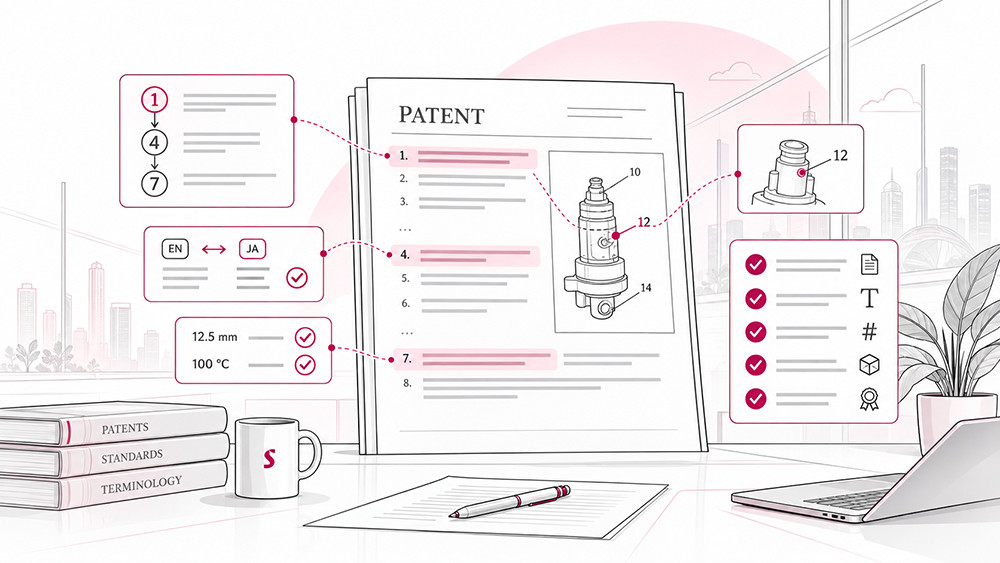
Source: Claim 1 → Claim 4 → Claim 7
Verify that Claim 7 still depends through Claim 4, not directly on Claim 1.
Maintain Defined Terms and Patent Terminology Consistently
Patent claims frequently repeat the same technical term intentionally. Synonym variation should not be introduced simply to make the target sound more stylistically varied.
Repeated terminology may help maintain clear relationships among elements, limitations, dependent claims, the specification, and drawings. The objective is controlled terminology that preserves the distinctions in the source.
Check How Claim Elements Are Introduced and Referenced
Translation should preserve enough information for the reader to understand which previously introduced element is being referenced.
a first sensor … a second sensor … the first sensor
Verify that the later target reference still identifies the first sensor unambiguously.
Preserve Claim Limitations and Logical Relationships
A patent claim is built from relationships as well as terminology. Small connecting words and modifiers can carry important meaning.
The reviewer should verify fidelity to the source. Jurisdiction-specific interpretation of claim language belongs with the appropriate patent professional.
Verify Every Number, Range, Unit, and Formula
Digits may remain visually unchanged while the translated relationship around them changes.
A value of 20 can survive perfectly while ‘at least 20’ becomes ‘less than 20.’ Compare the surrounding operator, boundary language, and unit, not only the digits.
Preserve Alternatives, Enumerations, and Lists
Long technical claims may contain sets of alternatives, nested lists, or grouped combinations that need structural comparison.
Cross-Check Reference Signs, Figures, and Drawings
Reference signs and drawings can provide important cross-document context and should be reviewed as part of multilingual QA.
Compare Claims with the Specification
Claims deserve dedicated review, but important terminology and technical relationships should also be compared with the specification when that context is available.
The goal is to identify unexplained inconsistencies or interpretation problems, not to rewrite claims so they sound like specification prose.
Confirm Technical Meaning and Subject-Matter Accuracy
A linguistically plausible translation may still be technically wrong. Specialized terminology and technical relationships need appropriate subject-matter context.
Perform a Final File and Version Check
Translation quality can be compromised after linguistic review through file handling, formatting, version control, or delivery errors.
A Practical QA Matrix for Patent Claim Review
Not every finding should be routed the same way. Use the issue type to determine what to compare and who may need to review it.
| QA Check | What to Compare | Typical Finding | Possible Review Route |
|---|---|---|---|
| Completeness | Source claim vs. target claim | Missing limitation or clause | Translator / linguistic reviewer |
| Claim numbering | Source vs. target sequence | Incorrect claim number | Linguistic QA |
| Claim dependency | Source vs. target references | Wrong parent claim | Patent-specialist reviewer |
| Terminology | Repeated source and target terms | Inconsistent equivalent | Translator / terminology reviewer |
| Antecedent relationship | Introduced vs. referenced elements | Ambiguous referent | Linguistic / patent-specialist reviewer |
| Logical relationship | Conditions, alternatives, modifiers | Changed relationship | Linguistic / technical reviewer |
| Numbers and ranges | Values, operators, boundaries | Changed numerical limitation | Linguistic / technical reviewer |
| Reference signs | Claims, specification, drawings | Wrong component number | Linguistic / technical QA |
| Technical meaning | Source, target, supporting context | Misinterpreted technical relationship | Technical subject-matter expert |
| Source ambiguity | Source claim and specification | Meaning cannot be resolved confidently | Client IP team / patent professional |
| Jurisdiction question | Translation vs. filing requirements | Claim-form or procedural question | Patent counsel / filing representative |
| Final file | Approved target vs. delivery file | Version or formatting mismatch | Final-format QA |
- Compare
- Source claim vs. target claim
- Typical finding
- Missing limitation or clause
- Review route
- Translator / linguistic reviewer
- Compare
- Source vs. target sequence
- Typical finding
- Incorrect claim number
- Review route
- Linguistic QA
- Compare
- Source vs. target references
- Typical finding
- Wrong parent claim
- Review route
- Patent-specialist reviewer
- Compare
- Repeated source and target terms
- Typical finding
- Inconsistent equivalent
- Review route
- Translator / terminology reviewer
- Compare
- Introduced vs. referenced elements
- Typical finding
- Ambiguous referent
- Review route
- Linguistic / patent-specialist reviewer
- Compare
- Conditions, alternatives, modifiers
- Typical finding
- Changed relationship
- Review route
- Linguistic / technical reviewer
- Compare
- Values, operators, boundaries
- Typical finding
- Changed numerical limitation
- Review route
- Linguistic / technical reviewer
- Compare
- Claims, specification, drawings
- Typical finding
- Wrong component number
- Review route
- Linguistic / technical QA
- Compare
- Source, target, supporting context
- Typical finding
- Misinterpreted technical relationship
- Review route
- Technical subject-matter expert
- Compare
- Source claim and specification
- Typical finding
- Meaning cannot be resolved confidently
- Review route
- Client IP team / patent professional
- Compare
- Translation vs. filing requirements
- Typical finding
- Claim-form or procedural question
- Review route
- Patent counsel / filing representative
- Compare
- Approved target vs. delivery file
- Typical finding
- Version or formatting mismatch
- Review route
- Final-format QA
The goal is not simply to find more issues. It is to route each meaningful finding to someone qualified to resolve it.
Patent Translation Findings That Deserve a Second Look
Some findings merit additional review before they are normalized as stylistic changes.
Wrong Claim Dependency
A dependent claim refers to a different parent claim than the source, or part of a multiple dependency disappears.
Review: Compare the complete dependency chain and source version.
Missing Limitation
A word, clause, condition, modifier, or technical feature from the source has no corresponding target content.
Review: Determine whether the content was omitted, merged elsewhere, or intentionally handled under project instructions.
Terminology Drift
The same defined concept receives multiple target translations without a contextual reason.
Review: Check approved terminology, specification context, related claims, and patent-family references.
Altered Numerical Relationship
Digits may match while a comparator, unit, range boundary, ratio, or mathematical operator differs.
Review: Compare the complete expression, not only the numerical value.
Ambiguous Reference
A target reference could point to more than one previously introduced element.
Review: Trace the element through the claim and supporting context.
Changed Logical Connector
A conjunction, alternative, negative expression, or conditional relationship differs from the source.
Review: Compare the full grammatical relationship and surrounding limitations.
Reference-Sign Mismatch
The target claim connects an element to the wrong reference number or drawing.
Review: Cross-check claims, specification, and figures.
Source Ambiguity
The source itself does not clearly resolve the intended relationship.
Review: Do not silently guess. Flag the issue for the appropriate client, technical reviewer, or patent professional.
What Automated QA Can Catch, and Where Human Review Still Matters
Automated translation quality assurance can provide valuable coverage for patent claims, especially when checks are configured around the structure of the content. It is strongest at surfacing objective differences and patterns for review.
Good Candidates for Automated QA
- Missing or duplicated claims
- Claim-number mismatches
- Source and target number differences
- Inconsistent repeated terminology
- Missing units or reference signs
- Segment, formatting, or version anomalies
Checks That Often Need Human Judgment
- Whether a technical relationship is preserved
- Whether terminology is correct in context
- Whether an antecedent remains unambiguous
- Whether a modifier attaches to the intended element
- Whether an apparent inconsistency is intentional
- Whether a source ambiguity was interpreted appropriately
The strongest workflow uses automation to increase review coverage and surface potential issues, while qualified human reviewers make context-sensitive linguistic and technical decisions. Recent patent-claim translation research has also identified domain-specific errors and limitations that are not captured reliably by a single automated quality score. See the 2025 patent claims translation shared task and 2025 large language model patent claim translation study.
Translation QA, Technical Review, and Patent Review Serve Different Purposes
A reliable patent translation workflow distinguishes among different types of review rather than treating every issue as a language problem.
Translation Quality Review
Does the target accurately and completely represent the source?
- Completeness
- Terminology
- Numbers and units
- Dependencies and references
- Target-language accuracy
Technical Review
Has the specialized technical meaning been understood and expressed correctly?
- Domain terminology
- Scientific relationships
- Formulas and notation
- Component functions
- Technical distinctions
Patent and Filing Review
Does the material meet legal, procedural, drafting, and filing requirements for its intended use?
- Patent counsel
- Patent agents
- Authorized filing professionals
- Responsible in-house IP teams
Final Five Checks Before Translated Claims Move Forward
Confirm source-to-target completeness, including subordinate clauses, alternatives, and conditions.
Trace dependent claims through the complete claim set rather than checking numbering visually.
Confirm that intentionally repeated concepts remain identifiable across claims, specification content, drawings, and related materials.
Treat objective data and relational language as dedicated QA categories.
Determine whether the project requires linguistic, technical, client, certification, or patent-professional review.
Download or Print the Patent Claims Translation Quality Checklist
Create a working PDF copy for translator self-review, independent linguistic QA, technical review, in-house IP review, or final pre-delivery verification. The complete checklist also remains available on this page for online reference.
Patent Claims Translation Quality FAQ
Sources and References
Authoritative patent-office guidance and recent patent-translation research informed the claim-structure, reference, jurisdiction, and automation guidance in this checklist.
Use the Checklist as a Review Framework, Not a Substitute for Professional Judgment
Strong patent claims translation QA combines systematic source-to-target comparison with the right level of linguistic, technical, and patent-professional review for the intended use. The checklist helps teams make those checks visible, repeatable, and easier to route across multilingual patent workflows.
For broader filing, prosecution, prior-art, portfolio, and multilingual patent support, explore Stepes Patent Translation Services.
Patent Translation Support
Need Help Reviewing Multilingual Patent Claims?
Stepes provides professional patent translation and multilingual quality review across complex technical fields, with workflows that can combine professional linguists, subject-matter expertise, terminology management, translation memory, automated quality checks, independent human review, and final-format QA.
This guide provides general translation-quality guidance and is not legal advice. Patent requirements and filing practices vary by jurisdiction and circumstance. Consult qualified patent counsel or the appropriate filing professional regarding legal, drafting, procedural, and jurisdiction-specific requirements.