
Component-Level Precision
Precision Translation for the Components Behind Modern Electronics
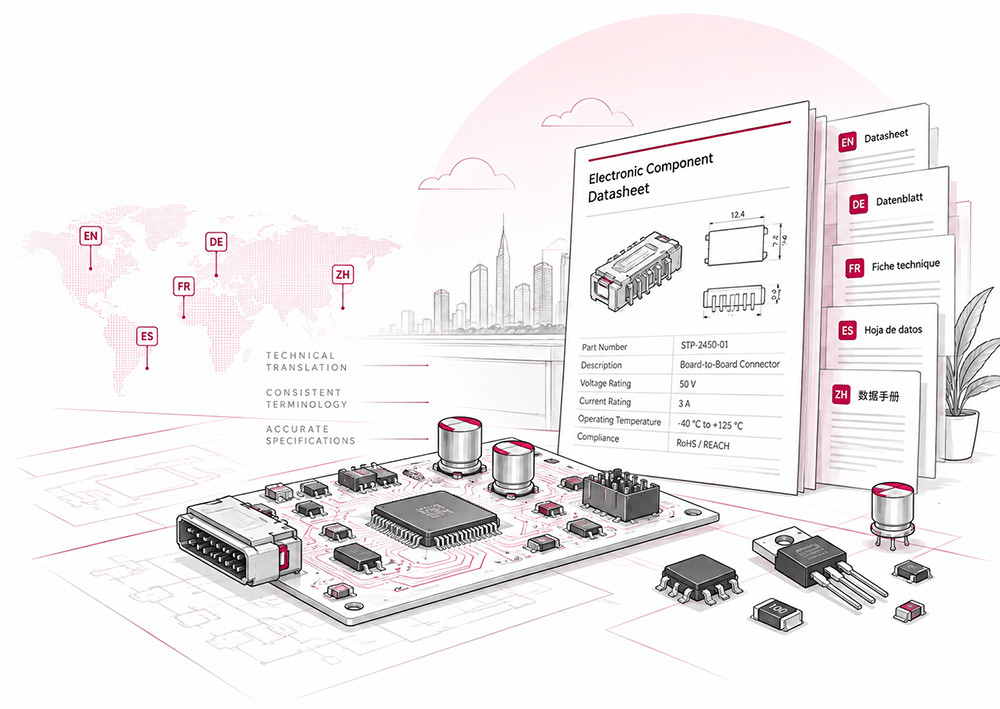
Electronic components carry enormous amounts of technical information in compact formats. A single datasheet may combine electrical characteristics, operating limits, tolerances, dimensions, materials, environmental conditions, package data, graphs, application guidance, and qualification information.
Stepes provides professional electronic components translation services for manufacturers, suppliers, distributors, PCB companies, engineering teams, sourcing organizations, and global OEMs. We translate the information used to select, specify, qualify, integrate, procure, test, and support electronic components across international markets.
Our workflows are designed around the details that matter in component documentation: terminology, numbers, units, symbols, product identifiers, structured data, tables, technical relationships, and recurring product revisions.
Explore Electronics Translation ServicesComponent Coverage
Translation Expertise Across Electronic Component Categories
Different component families use different terminology, parameters, documentation structures, and engineering conventions. Stepes adapts translation and QA workflows to the content involved.
Passive Components
Resistors, capacitors, inductors, transformers, filters, potentiometers, and related passive devices.
Connectors and Interconnects
Connectors, terminals, sockets, cable assemblies, and board-to-board connectivity products.
Sensors and Transducers
Temperature, pressure, position, motion, optical, environmental, and measurement technologies.
Electromechanical Components
Relays, switches, encoders, motors, actuators, fans, and electrical-mechanical devices.
Power and Energy Components
Power supplies, converters, regulators, modules, protection components, and battery-related electronics.
RF and Communications Components
Antennas, RF modules, filters, connectors, signal-processing, and communications components.
Optoelectronic Components
LEDs, photodiodes, optical sensors, displays, emitters, receivers, and optical modules.
Printed Circuit Boards
PCB specifications, board-level technical content, testing documentation, drawings, and revisions.
Translate Component Datasheets Without Losing Technical Meaning
A component datasheet is more than a collection of words. Technical meaning often depends on the relationship between a parameter, its value, its unit, and the conditions under which that value applies.
Electrical characteristics and operating conditions
Mechanical, environmental, and package information
Pin descriptions, tables, graphs, and technical footnotes
Application guidance, ordering information, and product notes
Engineering Content
Technical Translation for Component Engineering and Design-In
Engineers need more than a datasheet to select a component and integrate it successfully into a product.
Application Notes
Translate detailed guidance explaining how components can be configured, integrated, optimized, or applied in specific designs.
Technical Specifications
Maintain precise product requirements, performance characteristics, tolerances, materials, dimensions, interfaces, and operating conditions.
Design and Reference Guides
Give international engineering teams clear access to product-selection criteria, implementation guidance, reference designs, and technical recommendations.
Technical Drawings and Diagrams
Translate language-bearing annotations, legends, notes, callouts, and related explanatory content while preserving technical structure.
Test and Performance Documentation
Support technical evaluation with multilingual test descriptions, methodologies, results, performance comparisons, and engineering information.
Product Briefs and Technical White Papers
Communicate component capabilities, technologies, engineering advantages, and application possibilities to technical audiences worldwide.
Information Lifecycle
Component Documentation Across Engineering, Sourcing, and Quality
Keep multilingual information consistent as components move through evaluation, procurement, qualification, and product support.
Engineering
Specifications, drawings, design references, test content, application documentation, and engineering notes.
Sourcing & Procurement
Supplier specifications, component descriptions, procurement requirements, sourcing documentation, and technical correspondence.
Quality & Qualification
Qualification materials, reliability information, inspection documentation, test requirements, certificates, and supplier quality content.
Product & Market Support
Technical catalogs, selection guides, distributor materials, product pages, references, and supporting documentation.
BOM, Component Data, and PCB Documentation
Keep multilingual component information accurate across structured bills of materials and board-level engineering documentation.
Multilingual BOM and Component Data Translation
Translate component names, descriptions, product categories, manufacturer information, technical attributes, sourcing notes, procurement information, and supporting specification text while protecting identifiers that should remain unchanged.
Part numbers, model identifiers, reference designators, codes, and other protected values can remain nontranslatable according to project rules.
PCB and Board-Level Technical Translation
Support PCB manufacturers, suppliers, engineering organizations, and international fabrication and assembly partners with multilingual board-level technical information.
PCB specifications and fabrication requirements
Board descriptions and component placement information
Inspection criteria and testing documentation
Drawings, technical notes, and engineering revisions
Technical QA
Protect Numbers, Units, Symbols, and Product Identifiers
In component documentation, a small textual difference can represent a large technical difference. Stepes combines professional review with automated controls for nonlinguistic elements that carry engineering meaning.
Numbers, decimals, positive and negative signs
Measurement units and unit symbols
Voltage, current, frequency, resistance, and capacitance
Temperature ranges, dimensions, and tolerances
Manufacturer part numbers, SKUs, and model numbers
Package codes, reference designators, variables, and revision IDs
Tables, tags, cross-references, and structured elements
Terminology Governance
One Component Vocabulary Across Every Document and Market
A component should not have one name in a datasheet, another in a distributor catalog, and a third in an application note. Stepes helps electronics companies maintain controlled multilingual terminology across product families and content systems.
Approved Component Terminology
Glossaries, product naming rules, approved abbreviations, and translation memory create one governed vocabulary for recurring technical content.
Scale Multilingual Component Catalogs and Product Data
Component manufacturers and distributors may manage thousands of products and highly repetitive technical records. Translating this content document by document is difficult to scale.
Online and technical product catalogs
Distributor product content and e-commerce data
Parametric product information and technical attributes
PIM exports, spreadsheets, and structured repositories
Stepes combines translation memory, terminology, AI-powered translation, workflow automation, structured-content handling, automated QA, and targeted human review to support large multilingual component portfolios efficiently.
Translate Product Changes Without Breaking Continuity
Specifications change. Materials are updated. Packages are revised. Products mature or are discontinued. Stepes helps maintain continuity across recurring component updates.
Translation memory and change-based workflows can reuse approved content, focus effort on what changed, and help keep multilingual product information aligned as component portfolios evolve.
Localization Engineering
Structured Content Built for Translation and Reintegration
Component information frequently lives in systems and structured files rather than conventional documents.
Stepes can support multilingual workflows involving Microsoft Excel, CSV, XML, DITA, JSON and structured resources, product database exports, PIM content, PDF, Adobe InDesign, drawings, graphics, and other technical files.
Localization engineering helps distinguish human-readable text from variables, identifiers, product codes, numerical values, tags, markup, technical syntax, and other nontranslatable data.
Identify translatable fields, document structure, tags, and content relationships.
Lock identifiers, variables, values, codes, markup, and other nontranslatable elements.
Apply terminology, translation memory, AI assistance, and professional review according to content risk.
Return localized content to the target format and verify structure, completeness, and file integrity.
AI + Human Workflows
Match the Translation Workflow to the Content Risk
A complex specification used for engineering decisions has different quality requirements from thousands of repetitive catalog records. Stepes applies the right mix of AI, translation memory, professional linguists, technical review, and quality automation.
Expert-Led Technical Translation
Best suited to novel, high-visibility, or technically critical content such as detailed specifications, complex datasheets, application instructions, qualification documents, and engineering requirements.
AI-Assisted Translation With Human Review
Well suited to large documentation sets, recurring product-family content, distributor information, and technical catalogs where automation can increase throughput while professional review preserves context and terminology.
Highly Automated Structured Translation
Suitable for selected repetitive, lower-risk fields such as recurring product attributes or controlled database content when the customer's quality model supports a higher level of automation.
Translation Workflow
From Source Component Data to Multilingual Release
A structured workflow keeps language assets, technical controls, and release requirements connected across recurring component programs.
Review source files, languages, technical complexity, structured data, protected content, and deliverables.
Apply glossaries, translation memory, product terminology, abbreviations, and identifier rules.
Use the appropriate combination of professional translation, AI assistance, and localization engineering.
Validate meaning, terminology, readability, and engineering context according to content risk.
Check terminology, completeness, numbers, units, tags, variables, and formatting.
Verify final files, structure, presentation, and reintegrated content before release.
Reuse approved language assets across revised specifications, new products, and lifecycle changes.
Multilingual Component Information for Global Engineering and Supply Chains
A component may be designed in one country, produced in another, distributed through regional partners, incorporated by an OEM elsewhere, and supported across dozens of markets.
Component Manufacturers
Support customers with multilingual specifications, datasheets, catalogs, technical literature, and product updates.
Engineering & Product Teams
Give international engineers accurate component information for evaluation, integration, testing, and technical decisions.
Procurement & Sourcing
Translate the information needed to compare products, coordinate suppliers, clarify requirements, and manage sourcing.
Distributors
Scale multilingual product information across catalogs, e-commerce platforms, selection tools, and customer-facing technical content.
PCB & Electronics Suppliers
Support collaboration across board-level engineering, component information, testing, quality, and technical documentation.
Global OEMs
Maintain consistent component terminology across suppliers, regions, product teams, and manufacturing partners.
Electronic Component Translation Across High-Tech Industries
Accurate component information matters anywhere electronic systems must be designed, sourced, manufactured, maintained, or supported internationally.
Automotive Electronics
Vehicle electronics, connectivity, power systems, sensing, control, and advanced automotive technologies.
Medical Technology
Medical devices, diagnostic systems, monitoring technologies, laboratory equipment, and healthcare electronics.
Industrial Automation & Robotics
Sensors, controls, connectivity, motion systems, power electronics, and industrial components.
Telecommunications
Communications hardware, RF systems, connectivity equipment, and network infrastructure.
Aerospace & Defense
Technically demanding components used across avionics, communications, sensing, and mission-critical systems.
Energy & Power Electronics
Power conversion, energy management, renewable energy, storage, control, and supporting electronics.
Computing & Data Infrastructure
Components used in computing hardware, servers, storage systems, networking, and data centers.
Consumer Electronics
Components supporting connected devices, appliances, wearables, audio/video products, and smart-home systems.
Why Global Electronics Companies Choose Stepes
Electronic component translation combines technical language, structured data, large content volumes, frequent revisions, and demanding quality requirements. Stepes brings these elements together through one scalable multilingual workflow.
Electronics Subject-Matter Expertise
Professional linguists selected for relevant electronics, engineering, manufacturing, and technical subject matter.
Technical Data Integrity
Quality controls for the numbers, units, symbols, identifiers, terminology, and structured elements that carry technical meaning.
Terminology Governance
Consistent component vocabulary across product families, documentation, catalogs, suppliers, and recurring releases.
AI + Human Quality Models
Automation where it improves scale, with professional judgment where technical context and quality requirements demand it.
Technical File Engineering
Structured product information, technical documents, tables, graphics, and specialized files handled with protected nontranslatable content.
Continuous Product Updates
Reusable terminology and translation memory across revised datasheets, new products, engineering changes, and lifecycle communications.
Electronic Component Translation in Practice
Launching a New Component Family Worldwide
A component manufacturer releases a new product family across multiple markets. Shared terminology and translation memory keep datasheets, application notes, selection guides, web product data, and future product documentation aligned.
Localizing a Large Distributor Catalog
A distributor manages thousands of structured descriptions and technical attributes. Translation memory, terminology, AI-powered translation, structured-content processing, QA, and risk-based review provide a more scalable multilingual model.
Supporting a Global OEM Supply Chain
Engineering and sourcing teams need consistent multilingual specifications, BOM descriptions, qualification information, correspondence, and change notices across regions and suppliers.
Electronic Components Translation Services FAQs
What are electronic components translation services?
What types of electronic components does Stepes support?
Can Stepes translate electronic component datasheets?
How does Stepes protect numbers and measurement units during translation?
Can Stepes translate bills of materials?
Does Stepes provide PCB translation services?
How do you keep terminology consistent across large component portfolios?
Can Stepes translate large electronic component catalogs?
Can Stepes support Product Change Notifications and recurring component updates?
Translate Electronic Component Content With Engineering Precision
From a single component datasheet to a global multilingual product catalog, Stepes helps electronics companies translate complex technical information with the accuracy, consistency, scalability, and workflow control modern engineering organizations require.