
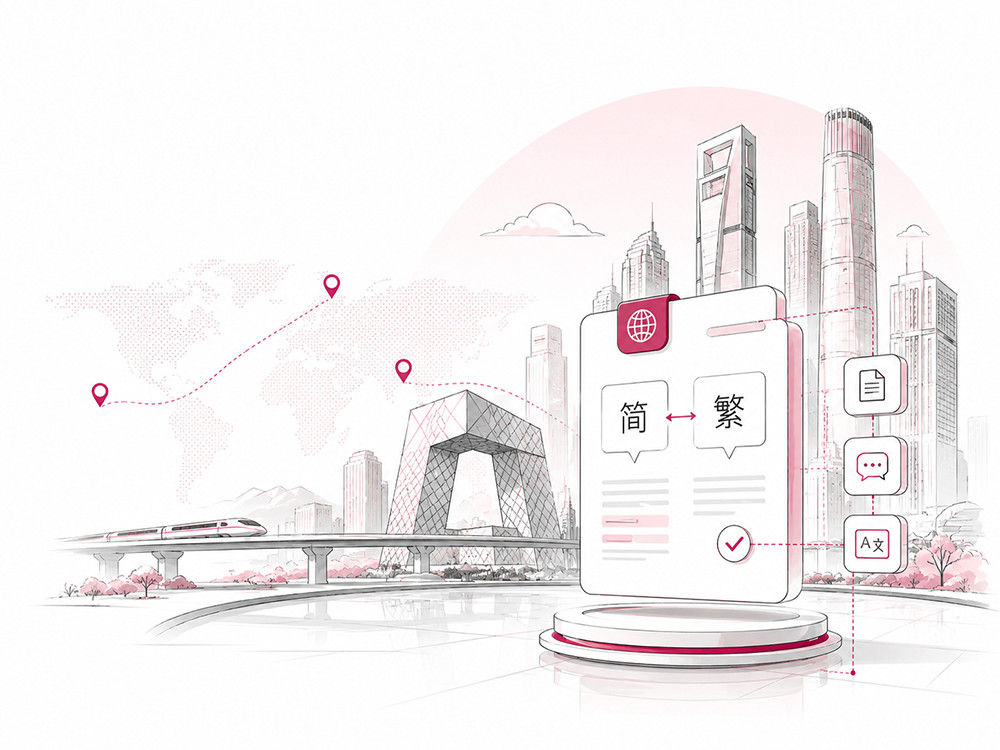
MULTI-MARKET EXPERTISE
Chinese Translation for Multiple Markets, Audiences and Industries
Chinese is not one uniform language requirement. The right solution depends on the written locale, spoken language, market, audience, industry, communication channel and intended use.
Stepes helps enterprises manage three major demand areas: market-specific Chinese translation for international business, Chinese language access for U.S. communities, and Chinese-to-English translation for cross-border regulatory, legal, scientific, financial and technical content.
Explore All Translation LanguagesInternational Markets
Product labeling, registration, technical content, software, ecommerce and corporate communication for Mainland China, Taiwan, Hong Kong and Singapore.
U.S. Language Access
Healthcare, insurance, legal, financial, government and customer-facing communication for diverse Chinese-speaking communities.
Chinese-to-English Content
Regulatory records, clinical documents, patents, contracts, supplier materials, technical specifications and corporate information.
U.S. language-access context: In the 2018–2022 American Community Survey, Chinese languages collectively were the second-most common non-English language group spoken at home. More than half of Chinese speakers did not report speaking English “very well.”
CHINESE VARIANT GUIDE
Choose the Right Chinese Variant for Every Market
Simplified and Traditional Chinese are written forms. Mandarin and Cantonese are spoken language varieties. They are related decisions, but they are not interchangeable.
Simplified Chinese + Mandarin
Use locally accepted terminology and conventions for product labeling, regulatory materials, medical content, technical manuals, software, ecommerce and customer communication. Product-specific requirements should be reviewed for the applicable sector and intended use.
Traditional Chinese + Mandarin
Taiwan uses its own technical, medical, legal, institutional and consumer terminology. A Taiwan version should be localized by qualified Taiwan Chinese linguists rather than created through simple character conversion.
Traditional Chinese + Cantonese
Formal written content normally uses Hong Kong Traditional Chinese. Interpretation, voice, interviews and conversational content often require Cantonese, with distinct vocabulary and usage considerations.
Audience-Led Localization
Singapore commonly uses Simplified Chinese in a multilingual environment. U.S. programs may need Simplified, Traditional or both, along with separate Mandarin and Cantonese support.
Script Conversion Is Not Complete Localization
Automated conversion can change many characters, but it does not reliably resolve regional terminology, product names, legal and medical language, institutional vocabulary, tone, search terminology or local usage. Stepes combines language technology with review by qualified target-market linguists.
WRITTEN CHINESE
Simplified and Traditional Chinese Translation Services
Stepes assigns linguists according to the target market—not only the script—so terminology, style and local expectations remain appropriate for each audience.
Localized for Mainland China, Singapore and Selected Global Audiences
Professional Simplified Chinese translation for regulated documents, product information, technical materials, websites, software, ecommerce, corporate communication and U.S. language-access programs.
- Mainland- and Singapore-specific terminology
- Medical, legal, technical and digital expertise
- Terminology management and market review
Distinct Localization for Taiwan, Hong Kong and Overseas Audiences
Professional Traditional Chinese translation for regulatory, legal, medical, financial, technical, software, public-information and customer-facing content.
- Separate Taiwan and Hong Kong locales
- Regional terminology and institutional language
- Cantonese considerations for spoken content
English-to-Chinese and Chinese-to-English Translation
Stepes helps global organizations communicate with Chinese-speaking audiences while enabling Chinese-origin content to reach regulators, courts, partners, researchers and customers around the world.
English-to-Chinese Translation
Market-specific localization for product labeling, medical-device instructions, clinical and patient materials, manuals, software, websites, legal and financial content, marketing and multimedia.
- Separate market versions when required
- Consistent product and brand terminology
- Human review matched to content risk
Chinese-to-English Translation
Precise professional English for regulatory submissions, clinical and scientific records, patents, litigation, financial due diligence, supplier documentation, engineering specifications and quality records.
- Clear interpretation of compressed source phrasing
- Subject-matter and document-type matching
- Fit-for-purpose legal, regulatory and technical review
Chinese Translation for Regulated and High-Risk Content
High-impact materials require qualified linguists, controlled terminology, independent review, traceable workflows, secure handling and delivery matched to the content’s purpose.
Medical, Pharmaceutical and Life Sciences
Clinical, regulatory and patient-facing Chinese translation supported by therapeutic-area expertise, controlled terminology, independent review and fit-for-purpose validation.
- Clinical trial and COA content
- Medical-device IFUs and labeling
- Safety, quality and regulatory documents
Healthcare and Patient Communication
Accessible Chinese-language communication for patients, members and communities across print, portals, mobile experiences, recorded media and interpretation.
- Patient forms and instructions
- Benefits and member communications
- Mandarin and Cantonese interpretation
Legal, Patent and Compliance Content
Precise Chinese translation for documents where jurisdiction, defined terms, evidence handling and secure workflow management are essential.
- Contracts, litigation and arbitration
- Patents and intellectual property
- Compliance and regulatory investigations
Financial Services and Insurance
Market-specific Chinese terminology for banking, insurance, investment, risk and compliance communications across Hong Kong, Mainland China, Taiwan, Singapore and U.S. audiences.
- Financial and investor communications
- Policies, claims and member notices
- Audit and due-diligence materials
Chinese Technical and Manufacturing Translation
Chinese translation supports global product development, manufacturing, supply chains, installation, operation, maintenance and quality management in both directions.
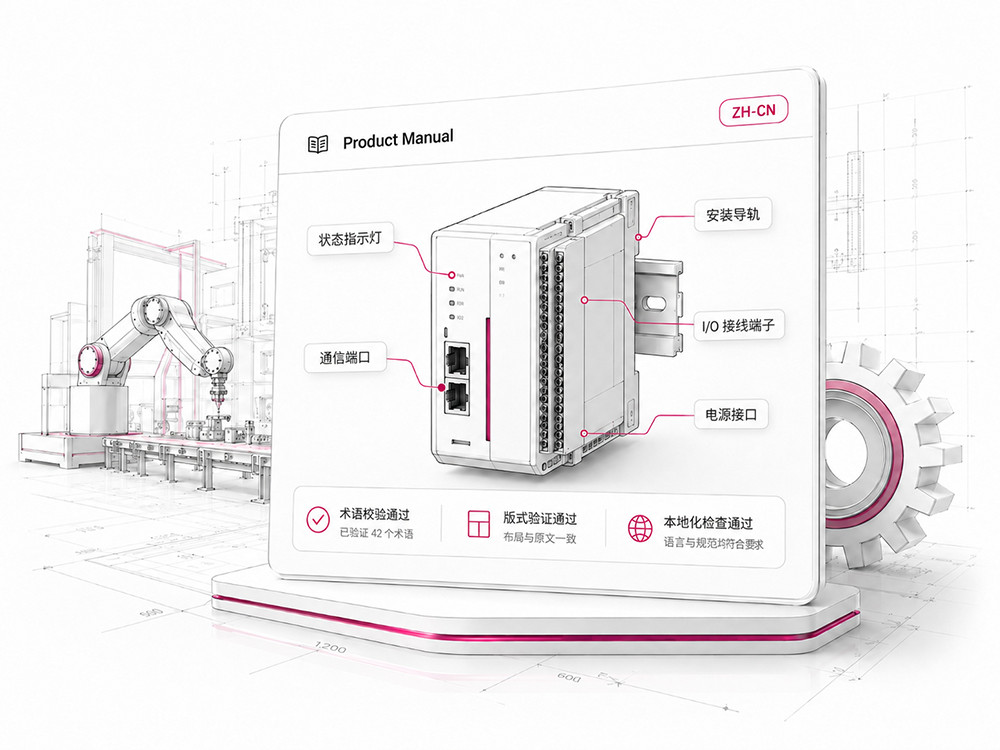
Stepes translates user manuals, engineering specifications, work instructions, safety content, quality records, supplier documentation, technical drawings, software documentation, automotive materials, electronics content and industrial-equipment information.
- Product terminology and part-name control
- Numbers, units, warnings and cross-references
- Structured files, tags and repeated content
- Linguistic and visual production QA
Chinese Website, Software and Ecommerce Localization
Chinese users need to navigate, understand, search, register, purchase and obtain support naturally in their preferred market version—not simply see English replaced with Chinese characters.
Website Localization
Market-specific navigation, calls to action, search terms, forms, user journeys, metadata, images, downloads and legal or regulatory content.
Website Translation ServicesSoftware and App Localization
User interfaces, mobile apps, SaaS, embedded systems, error messages, onboarding, accessibility labels, resource files and in-context testing.
Software Localization ServicesEcommerce Localization
Product names, descriptions, attributes, catalogs, checkout, customer service, marketplace listings, returns, warranties and automated messages.
Retail and Ecommerce Translationof people who spoke Chinese at home did not report speaking English “very well” in the 2018–2022 ACS.
Source: U.S. Census BureauChinese Language Access for U.S. Communities
Chinese-speaking communities in the United States include people with different regional, linguistic, cultural and generational backgrounds. Some audiences prefer Simplified Chinese, others Traditional Chinese, and many programs need both.
Stepes helps healthcare providers, government agencies, insurers, financial institutions, law firms, educational organizations and customer-service teams support vital documents, portals, mobile applications, notices, recorded messages, accessible media and Mandarin or Cantonese interpretation.
Language-access requirements vary by organization, program, jurisdiction, audience and applicable policy. Stepes helps build practical workflows aligned with your communication needs and operating requirements.
Mandarin and Cantonese Interpretation, Voice and Multimedia
Mandarin and Cantonese are distinct spoken varieties. The right choice depends on the participants, market, community and communication setting.
Mandarin Language Services
Remote and on-site interpretation, business meetings, conferences, clinical interviews, market research, customer service, voice-over, narration, transcription, subtitling and eLearning.
Mandarin Language ServicesCantonese Language Services
Hong Kong business communication, U.S. healthcare and community programs, legal and financial meetings, interpretation, voice-over, transcription, subtitling and conversational content.
Cantonese Language Services產品安全與操作指南
本指南說明設備的安裝、操作與維護要求。
DOCUMENT PRODUCTION
Chinese Document Translation and Multilingual Publishing
Chinese text can affect page composition, tables, diagrams, callouts, interface labels, font behavior and visual hierarchy.
Stepes supports Word, PowerPoint, Excel, PDF, InDesign, Illustrator, FrameMaker, XML, DITA, structured content, scanned documents, forms and technical drawings.
- Chinese font selection and embedding
- Line breaks, punctuation and character spacing
- Tables, graphics, screenshots and cross-references
- Print, digital and final PDF quality assurance
AI-Powered Chinese Translation with Professional Human Review
Enterprise AI translation works best when technology, terminology, human expertise and quality controls are matched to the content’s purpose and risk.
Stepes evaluates the subject matter, audience, market, volume, repetition, regulatory or legal importance, existing translation assets, deadline, security requirements and required quality level before selecting the workflow.
A Quality-Controlled Chinese Translation Process
Every project begins with the audience and intended use, then applies the appropriate language resources, technology, review and production controls.
Define the Audience and Locale
Confirm the target market, written Chinese locale, spoken-language needs, audience, intended use and delivery channel.
Assess Content and Risk
Evaluate subject matter, regulatory or legal importance, volume, format, repetition, publishing requirements and review level.
Assign Qualified Linguists
Select translators and reviewers by native locale, language direction, industry expertise, document type and required qualifications.
Prepare Language Assets
Centralize approved glossaries, style guides, translation memories, product names, references and previously validated content.
Translate and Review
Apply the appropriate combination of professional translation, AI assistance, post-editing, independent review and subject-matter validation.
Complete Final QA
Verify terminology, numbers, names, warnings, tags, links, fonts, visual layout and file integrity before delivery.
CHINESE-SPECIFIC QA
Common Quality Checks
Our review can identify linguistic, locale, technical and production issues that generic bilingual review may miss.
PROGRAM GOVERNANCE
Enterprise Chinese Translation at Scale
A mature Chinese translation program may include multiple markets, business units, content systems, reviewers and release schedules.
Stepes coordinates these requirements within one managed program while preserving the linguistic distinctions each audience needs.
Talk to Our Enterprise TeamMarket-specific teams
Separate linguistic resources for Mainland China, Taiwan, Hong Kong, Singapore, U.S. audiences and Chinese-to-English translation.
Centralized language assets
Shared translation memories, approved terminology and market-specific style guides across products, departments and releases.
Connected workflows
API, CMS and software localization support for recurring content, agile releases and continuous localization.
Governed collaboration
Role-based review, client approvals, secure file exchange and coordinated multi-department delivery.
Operational visibility
Project dashboards, reporting, quality tracking and cost analysis for enterprise language programs.
Why Enterprises Choose Stepes for Chinese Translation
Stepes combines regional language expertise, specialized linguists, translation technology and end-to-end production in one scalable enterprise solution.
Market-Specific Chinese Expertise
Simplified and Traditional Chinese, Mainland China, Taiwan, Hong Kong, Singapore, U.S. audiences, Mandarin, Cantonese and translation in both directions.
Specialized Linguists
Subject-matter expertise for medical, legal, financial, manufacturing, software, ecommerce, government and customer communication.
AI-Powered Translation Technology
Translation memory, terminology management, AI-assisted translation, automated QA, workflow automation, APIs and reporting.
Enterprise Quality Management
Qualified resources, independent review, controlled terminology, in-context validation and final linguistic and production QA.
End-to-End Language Services
Translation, localization, interpretation, multimedia, desktop publishing, software testing and production-ready delivery.
PROJECT PLANNING
What to Provide for an Accurate Chinese Translation Quote
These details help our team recommend the right locale, linguists, workflow, quality level and production approach.
Tell us where the content will be used, who needs to understand it, and whether it will be read, heard or both. We can recommend the appropriate written locale and spoken-language service.
Chinese Translation Services FAQs
Clear answers to the questions enterprises most often ask about Chinese variants, markets, workflows and language services.
What is the difference between Simplified and Traditional Chinese?
Simplified and Traditional Chinese are different written forms. Simplified Chinese is primarily used in Mainland China and Singapore. Traditional Chinese is used in Taiwan, Hong Kong and many overseas Chinese communities. The difference extends beyond character appearance: terminology, product names, institutional language, writing conventions and style also vary by market. Professional translation should therefore be localized for the target audience rather than produced through character conversion alone.
Is Mandarin the same as Simplified Chinese?
No. Mandarin is a spoken Chinese variety, while Simplified Chinese is a writing system. Mandarin-speaking audiences may read Simplified or Traditional Chinese depending on the market. Mainland China generally uses Simplified Chinese, while Taiwan generally uses Traditional Chinese, even though Mandarin is widely spoken in both places.
Is Cantonese the same as Traditional Chinese?
No. Cantonese is a spoken Chinese variety, while Traditional Chinese is a writing system. Hong Kong audiences commonly speak Cantonese and use Traditional Chinese for formal written communication. Taiwan also uses Traditional Chinese, but Mandarin is the predominant spoken language. This distinction is important for interpretation, voice-over, subtitles, interviews and conversational content.
Which Chinese version should I use for Mainland China?
Most content intended for Mainland China should use Simplified Chinese localized for Mainland terminology and conventions. Mandarin, or Putonghua, is generally appropriate for interpretation, narration and other spoken content. Regulated materials, product labeling, technical documentation, software and ecommerce content may also require market-specific terminology and compliance review.
What type of Chinese is used in Taiwan?
Taiwan uses Traditional Chinese with Taiwan-specific terminology and writing conventions. Mandarin is the primary spoken language for most professional and public communication. Taiwan content should not be created solely by converting Mainland Simplified Chinese because medical, legal, financial, technical, software and consumer terminology can differ significantly.
What type of Chinese is used in Hong Kong?
Hong Kong normally uses Traditional Chinese for formal written content. Cantonese is the primary spoken language for most residents and is often required for interpretation, voice-over, interviews, customer service and conversational media. Hong Kong terminology can differ from both Taiwan and Mainland China, especially in legal, financial, healthcare and government content.
Do I need a separate Chinese translation for Singapore?
A Singapore-specific version may be appropriate when the content is customer-facing, institutional, regulated or highly market-specific. Singapore commonly uses Simplified Chinese, but terminology, bilingual context, tone, public-sector language and consumer expectations can differ from Mainland China. Stepes can assess whether full localization, targeted adaptation or local linguistic review is the most efficient approach.
Should U.S. organizations use Simplified or Traditional Chinese?
The right choice depends on the audience. Some U.S. communities primarily use Simplified Chinese, while others prefer Traditional Chinese. National healthcare, insurance, government, financial or customer-service programs may need both. Spoken-language services may also require separate Mandarin and Cantonese support. Audience demographics, location, channel and existing community preferences should guide the decision.
Can Simplified Chinese be automatically converted to Traditional Chinese?
Automated conversion can be useful as an initial technical step, but it does not create a fully localized translation. Some character mappings depend on context, and terminology differs among Mainland China, Taiwan and Hong Kong. Conversion does not reliably resolve product names, legal terms, medical vocabulary, institutional language, tone, search behavior or market conventions. A qualified target-market linguist should review and localize the content.
Does Stepes translate Chinese documents into English?
Yes. Stepes provides Chinese-to-English translation for regulatory, legal, medical, scientific, technical, financial, manufacturing and corporate content. Common projects include patents, contracts, clinical reports, regulatory correspondence, supplier documentation, engineering specifications, financial statements, due-diligence files, quality records and litigation materials.
How does Stepes translate regulated Chinese content?
We begin by identifying the market, audience, content type, intended use and level of risk. Stepes then assigns appropriate subject-matter linguists, prepares approved terminology, selects the required translation workflow and applies independent review and quality assurance. Projects may also include client review, certification statements, desktop publishing and final production checks.
Can AI be used for Chinese translation?
Yes, when the workflow is appropriate for the content and risk level. AI-assisted translation can improve speed and scalability for repetitive or frequently updated content, especially when grounded in approved terminology and translation memory. Regulated, legal, patient-facing, safety-critical or brand-sensitive content generally requires greater human involvement. Stepes matches AI, professional translation, review and validation to the project’s purpose.
Does Stepes provide Mandarin and Cantonese interpretation?
Yes. Stepes provides Mandarin and Cantonese interpretation for business meetings, healthcare communication, legal matters, conferences, interviews, training, customer service and other professional settings. Services can include remote, telephone, video and on-site interpretation depending on the engagement.
Does Stepes provide Chinese typesetting and desktop publishing?
Yes. Stepes provides Chinese desktop publishing for Word, PowerPoint, PDF, InDesign, Illustrator, FrameMaker and technical documentation. Our teams manage fonts, line breaks, punctuation, tables, graphics, screenshots, bookmarks, cross-references and final output. Finished files can receive both linguistic and visual QA.
Translate Chinese Content with Confidence
Whether you are translating regulated documents for Mainland China, localizing software for Taiwan, preparing financial communications for Hong Kong, supporting Chinese-speaking communities in the United States, or translating Chinese technical records into English, Stepes can build the right solution.