
Make Multilingual eDiscovery Easier to Review, Prioritize, and Act On
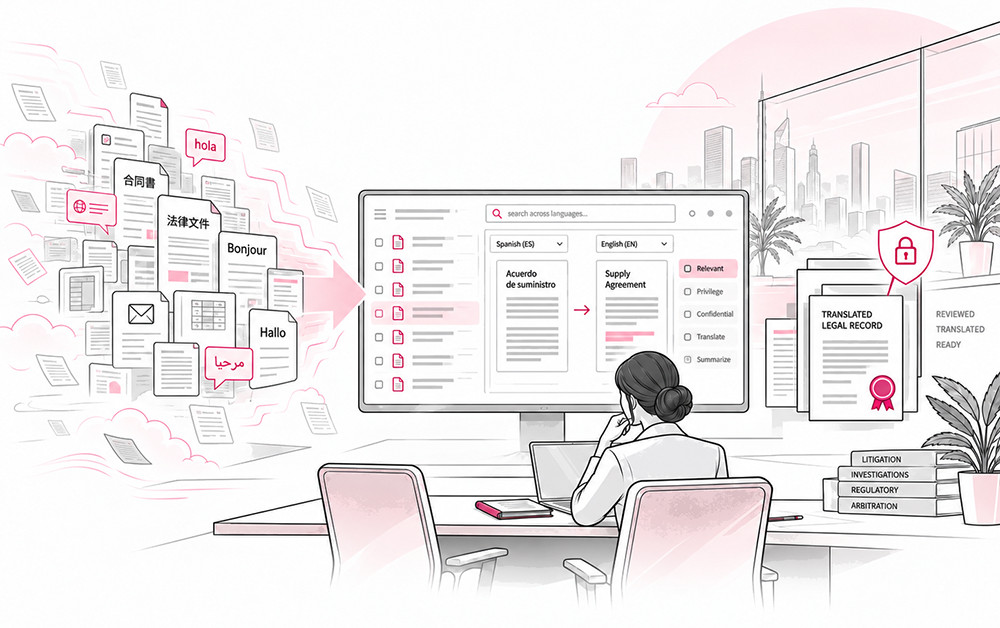
Electronic discovery can bring together enormous volumes of information from different business functions, custodians, systems, countries, and languages. When potentially relevant content is written in languages the review team does not understand, determining what matters can become slower, more expensive, and more difficult to manage.
Stepes provides specialized eDiscovery translation services that help law firms, corporate legal departments, investigation teams, and legal service providers work efficiently with foreign-language ESI. We support multilingual content across email, contracts, spreadsheets, presentations, technical records, financial documents, messaging platforms, scanned files, transcripts, investigation materials, and other electronically stored information.
The objective is not necessarily to translate every document in full. Stepes helps legal teams apply the appropriate language workflow according to each document's relevance, intended use, time sensitivity, and potential consequence.
Use rapid multilingual understanding to identify what deserves closer attention.
Move potentially relevant records to summary translation, professional validation, or full legal translation.
Apply independent review or certification to material evidence when the intended use requires it.
Specialized Language Support Without Replacing Your eDiscovery Platform
Stepes provides the specialized language layer within modern eDiscovery and document review workflows.
Keep the eDiscovery environment your team already uses. Stepes works alongside your eDiscovery platform, outside counsel, review teams, and litigation support providers to add multilingual capability where language becomes a barrier.
Your existing systems can continue to manage collection, hosting, search, review, and production while Stepes supports the language work needed to understand, prioritize, translate, and validate selected foreign-language content.
Risk-Based eDiscovery Translation
Match Translation Effort to the Importance of the Evidence
Not every foreign-language record requires the same translation process. Stepes supports a graduated model that increases human expertise and quality controls as document importance rises.
Multilingual Triage
Understand large document collections quickly.
AI-assisted translation can help review teams gain rapid visibility into foreign-language content, understand general meaning, identify potentially relevant records, and determine which documents need closer attention.
- Initial document assessment
- Relevance screening
- Foreign-language review support
- Early issue identification
- Large-scale internal investigation review
- Identification of documents requiring human translation
Summary Translation
Understand key information without translating every word.
When a document appears potentially relevant but does not yet justify complete translation, Stepes can provide focused summary translation to support review and escalation decisions.
- Principal subject matter
- Key statements or communications
- Important names and organizations
- Dates and events
- Financial or commercial information
- Potentially significant passages
Professional Legal Translation
Translate selected documents for substantive legal review.
Qualified professional translators are assigned according to language pair, legal subject matter, document type, and technical complexity, with controlled terminology and structured QA.
- Source meaning and legal terminology
- Defined terms and entity information
- Dates, numbers, qualifications, and exceptions
- Technical terminology
- Document structure and cross-references
- Matter-specific glossaries and translation memory
Independent Review or Formal Translation
Add higher controls for high-consequence evidence.
Documents intended for substantial legal reliance can receive independent bilingual revision and additional delivery controls before final use.
- Independent professional revision
- Terminology verification
- Numerical and factual QA
- Document integrity review
- Formatting checks
- Certification when requested or required
Multilingual Workflow
Language Support Across the eDiscovery Lifecycle
Modern eDiscovery is iterative. New custodians, documents, issues, languages, and priorities can emerge as a matter develops, requiring legal teams to reassess information throughout the review process.
Determine where foreign-language content appears and where multilingual review support may be required.
Use appropriate translation technology and linguistic expertise to understand the nature of the records.
Separate routine content from records that warrant closer review, summary, or complete translation.
Provide focused multilingual understanding when full translation is not yet necessary.
Assign professional legal linguists to records selected for substantive analysis or other defined use.
Add independent revision, integrity checks, and higher quality controls where risk is greater.
Deliver translated material in the agreed format with certification or formalities when appropriate.
Because the eDiscovery process can change over time, Stepes can support rolling translation requests as review priorities develop.
Use AI for Scale and Human Expertise for Legal Precision
AI-assisted translation can accelerate multilingual review, but the appropriate method depends on how the resulting text will be used.
AI-Assisted Review
For many internal-review scenarios, AI-assisted translation can provide the speed needed to understand general meaning, identify themes, and prioritize documents without waiting for every file to be professionally translated.
Accelerate review of large foreign-language document sets for initial comprehension or relevance assessment.
Professional linguists can review selected AI-assisted translations, verify terminology, and resolve ambiguous language.
Expert Human Control
AI output can contain terminology errors, omissions, inconsistent names, altered qualifications, mistranslated negation, or wording that appears plausible without reflecting the source accurately enough for higher-risk legal use.
Qualified human legal translators provide closer linguistic control for documents selected for substantive analysis or other consequential use.
Independent revision and additional QA can be added where the translation may be relied upon more formally.
Multilingual Support for Modern Electronically Stored Information
eDiscovery increasingly involves far more than traditional office documents. Stepes supports language workflows across the diverse content types legal teams encounter during disputes, investigations, and regulatory matters.
Email and Attachments
Translate individual messages, threaded emails, notices, and attachments while preserving the context needed for legal review.
Messaging and Collaboration Content
Support multilingual review of text messages, exported chats, collaboration-platform content, and other conversational records.
Contracts and Legal Documents
Translate agreements, amendments, notices, policies, correspondence, and transaction records with controlled legal terminology.
Business and Financial Records
Support reports, invoices, accounting records, spreadsheets, forecasts, presentations, and commercial correspondence.
Technical and Product Information
Translate specifications, engineering records, research materials, quality records, and other specialized evidence using subject-matter linguists.
Scanned and Image-Based Records
Process multilingual content contained in scanned PDFs, image-based documents, archived records, or files requiring text extraction.
Audio and Video Content
Support recordings through transcription, translation, subtitle, or transcript workflows when spoken content is relevant to the matter.
Investigation Materials
Translate employee communications, interview materials, compliance records, internal reports, policies, and related evidence.
Mixed-Language Documents
Handle files containing multiple languages, embedded comments, tables, quotations, handwritten content, or bilingual correspondence.
Scale Multilingual Review Across Large Document Collections
Large-scale translation creates a different challenge from translating a single legal document. Multiple linguists may be required, new terminology may emerge, review priorities can change daily, and related records can arrive in separate productions.
Stepes combines scalable multilingual resources with centralized language management to support changing requirements while maintaining linguistic control as the matter grows.
Scalable Professional Teams
Expand translation and review resources according to volume, language combination, technical complexity, and delivery schedule.
Rolling Translation
Move priority files through translation as they are identified rather than waiting for an entire document population to be finalized.
Centralized Project Coordination
Coordinate instructions, terminology, references, feedback, deadlines, and delivery requirements across the multilingual team.
Translation Memory
Reuse previously validated language where appropriate across repeated or related content to improve consistency and reduce duplicate work.
Matter-Specific Glossaries
Standardize important names, legal concepts, technical terminology, defined terms, product names, and recurring expressions.
Structured Quality Assurance
Use linguistic and automated checks to identify omissions, numerical inconsistencies, terminology issues, formatting problems, and other errors.
Terminology Control
Keep Names, Legal Concepts, and Technical Terms Consistent
When recurring language is translated differently from document to document, legal teams can lose consistency at exactly the point where they need it most.
Matter-Specific Legal Glossaries
Create controlled translations for defined terms, entity names, legal concepts, business terminology, and recurring language.
Translation Memory
Reuse approved translated content where appropriate across related records, agreements, templates, correspondence, and later phases.
Approved Reference Material
Use existing bilingual contracts, prior translations, corporate terminology, product references, and counsel-approved language.
Reviewer Feedback
Capture approved corrections and preferences so future translations reflect decisions already made by legal or subject-matter reviewers.
Approved terminology and language assets can continue into depositions, exhibits, expert materials, filings, and other later phases of the dispute.
Explore Litigation Translation ServicesSecure by Design
Protect Sensitive Information Throughout the Translation Workflow
eDiscovery materials can contain some of an organization's most sensitive information, including privileged communications, trade secrets, intellectual property, employee data, financial records, investigation materials, and confidential business information.
Stepes supports controlled handling of sensitive legal content throughout the translation lifecycle. If your matter has specific privacy, privilege, data-location, vendor-management, access-control, or retention requirements, share them during project setup so the workflow can be reviewed and configured appropriately.
Controlled Access
Restricted project access, role-based workflow controls, and controlled access to translation memories and glossaries.
Qualified Project Teams
Qualified linguist and reviewer assignment with confidentiality requirements for project participants.
Secure File Exchange
Secure file transfer and final delivery with client-specific file-handling procedures.
Governed Project Communication
Controlled project intake and centralized project communication throughout the translation workflow.
Retention and Client Requirements
Configurable retention requirements and project-specific handling controls can be reviewed before launch.
Apply Higher Quality Controls as Documents Become More Important
A record that begins as a relevance-screening item may later become important to witness preparation, negotiations, regulatory review, or litigation strategy. Stepes can increase translation controls as downstream reliance increases.
Internal Review
Rapid understanding and relevance assessment.
AI-assisted translation or professional triage.
Substantive Legal Analysis
Counsel needs dependable understanding of selected records.
Summary translation, linguist validation, or complete professional translation.
Material Evidence
The document may affect strategy, factual analysis, witness preparation, expert review, or a significant legal decision.
Expert human translation with enhanced terminology and QA controls.
Formal or High-Consequence Use
The translation may be submitted, presented, certified, or otherwise formally relied upon.
Professional translation plus independent revision and any required certification or delivery formalities.
Requirements for courts, regulators, agencies, arbitration bodies, and other receiving institutions can vary. Qualified counsel remains responsible for determining what form of translation is appropriate for the matter and jurisdiction.
Multilingual eDiscovery Across Complex Legal Matters
Stepes supports foreign-language evidence and document review across a broad range of disputes, investigations, and legal matters.
Commercial Litigation
Translate contracts, business correspondence, financial records, transaction documents, internal communications, and supporting evidence in cross-border disputes.
Internal Investigations
Help investigation teams understand multilingual employee communications, reports, interviews, policies, business records, and other potentially relevant information.
Regulatory and Government Investigations
Support review of foreign-language information examined in regulatory inquiries, enforcement matters, audits, and related proceedings.
Antitrust and Competition Matters
Manage multilingual business records, communications, contracts, market information, and large document collections across jurisdictions.
Intellectual Property Litigation
Combine legal and technical language expertise for patents, engineering records, product information, R&D materials, and IP-related communications.
Explore Patent Translation ServicesEmployment and Workplace Disputes
Translate employee correspondence, HR records, workplace investigations, policies, agreements, complaints, and related documentation.
Cross-Border Arbitration
Support multilingual review of commercial agreements, correspondence, financial records, technical evidence, witness materials, and other arbitration documentation.
Translation Support Beyond Document Review
eDiscovery is one part of a broader litigation and dispute workflow. Once relevant foreign-language records have been identified, legal teams may need multilingual support throughout the life of the matter.
- Pleadings and court filings
- Deposition materials
- Witness statements
- Interview records
- Expert reports
- Exhibits
- Legal correspondence
- Arbitration materials
- Hearing documents
- Judgments and orders
- Settlement and negotiation materials
- Technical evidence
- Financial evidence
- Certified legal documents
eDiscovery Translation in More Than 100 Languages
Stepes supports professional eDiscovery translation in more than 100 languages and regional variants, allowing legal teams to coordinate multilingual review through one language-services workflow.
Why Stepes for Multilingual eDiscovery?
Foreign-language discovery requires more than translating words from one language into another. The workflow has to match the scale of the document population, the purpose of the review, the subject matter involved, and the consequences of relying on the translated content.
Purpose-Based Translation
Use different levels of translation for triage, relevance assessment, substantive legal analysis, and high-consequence evidence.
AI + Human Flexibility
Combine AI-assisted translation for scalable understanding with professional validation and expert human translation where higher accuracy is required.
Legal and Subject-Matter Expertise
Assign linguists by language pair and by the legal, financial, technical, life sciences, manufacturing, or other expertise relevant to the evidence.
Large-Volume Scalability
Support changing document volumes, multiple languages, rolling review, urgent priority files, and parallel translation workflows.
Terminology Governance
Maintain approved names, defined terms, technical language, legal concepts, and recurring expressions across the matter.
Structured Quality Control
Add professional revision, terminology checks, automated QA, document integrity review, and certification according to intended use.
Secure Enterprise Workflows
Support confidential legal content with controlled access, restricted assignments, secure delivery, and configurable project requirements.
Global Language Coverage
Coordinate multilingual eDiscovery across more than 100 languages through one professional translation partner.
eDiscovery Translation FAQs
Answers to common questions about multilingual ESI, AI-assisted review, security, translation levels, certification, and large-volume discovery workflows.
eDiscovery translation helps legal teams understand, assess, summarize, translate, and validate foreign-language electronically stored information during document review, investigations, litigation, arbitration, and related legal matters. The work can range from rapid AI-assisted translation for internal relevance assessment to professional human translation and independent revision of material evidence. Stepes focuses on the language component of eDiscovery rather than replacing the technology used to collect, host, search, review, or produce electronic data.
No. Translating every foreign-language document through a full professional human workflow is often unnecessary. Large-volume document sets can first be screened using AI-assisted translation or other rapid linguistic workflows. Documents that appear potentially relevant can then receive summary translation or professional validation. Full expert translation can be reserved for material records requiring substantive legal review, with independent revision added for higher-consequence use.
Yes. AI-assisted translation can be useful for high-volume document triage, internal understanding, and relevance assessment. The appropriate workflow depends on how the translation will be used. Automated output may be sufficient to help reviewers understand general meaning, while material documents may require professional linguistic validation or complete human translation.
Stepes supports multilingual translation across emails, attachments, chat and messaging records, contracts, spreadsheets, presentations, financial records, technical documents, scanned files, investigation materials, transcripts, business correspondence, and other electronically stored information. Audio and video materials can also be supported through transcription and translation workflows when spoken content is relevant to the matter.
Yes. Stepes is designed to provide the language-services component of a broader eDiscovery workflow. Legal teams can continue using their preferred eDiscovery platforms, litigation support providers, review teams, and outside counsel while Stepes provides translation, linguistic validation, terminology management, professional review, and related multilingual services for selected content.
Stepes supports sensitive legal content through controlled file access, confidentiality requirements, restricted project assignments, secure file transfer and delivery, centralized project communication, and client-specific workflow controls. Clients should identify special privilege, privacy, data-location, retention, vendor-management, or security requirements before project launch so the workflow can be reviewed appropriately.
Yes. Stepes supports high-volume multilingual projects using scalable linguist teams, AI-enabled workflows, translation memory, terminology management, centralized project coordination, structured QA, and rolling delivery. Documents can be prioritized according to urgency and relevance so critical files move forward without waiting for the entire document population to be translated.
Independent revision is most useful when translated content carries greater consequence or will be relied upon more extensively. Examples can include material evidence, critical contractual language, important witness or investigation records, formal submissions, regulatory matters, or documents intended for court or arbitration use. The appropriate review level depends on purpose, complexity, jurisdiction, client requirements, and guidance from qualified counsel.
No. Certification requirements depend on the document's intended use and the requirements of the receiving institution or proceeding. Translations prepared only for internal document review generally do not require certification. Documents submitted to a court, regulator, agency, or other authority may have specific requirements.
eDiscovery translation focuses specifically on multilingual electronically stored information during discovery and document review, including foreign-language content assessment, triage, summary translation, professional translation of selected records, and quality escalation for material evidence. Litigation translation is broader and supports documents and communications throughout the dispute lifecycle, including pleadings, depositions, witness materials, expert reports, exhibits, arbitration records, court filings, and hearing or trial materials.
Yes. Stepes can create and maintain matter-specific legal glossaries, translation memories, approved names, entity lists, defined terms, technical terminology, and client or counsel preferences. These language assets help improve consistency across document collections and can continue to support later litigation, arbitration, regulatory, or court translation work.
Turnaround depends on document volume, language combination, file format, subject matter, translation method, review level, and deadline. Urgent records can often be prioritized and delivered separately while larger document sets continue through review. For high-volume matters, Stepes can propose rolling deliveries, parallel multilingual teams, and different translation workflows according to document priority.
Where available, provide the source files or representative samples, source and target languages, approximate document volume, file formats, intended use, deadlines, review priorities, required security controls, and any existing terminology or reference material. For large collections where final volume is not yet known, Stepes can discuss a scalable workflow based on the available information and refine the scope as documents are identified.
Turn Multilingual Discovery Into Actionable Legal Information
Whether your matter involves a few critical foreign-language records or a large multilingual document collection, Stepes can help build a translation workflow around document volume, risk, deadlines, subject matter, and intended use.
Use AI-assisted translation where scale matters. Add professional legal linguists where judgment matters. Apply independent review and formal controls where the consequences are higher.