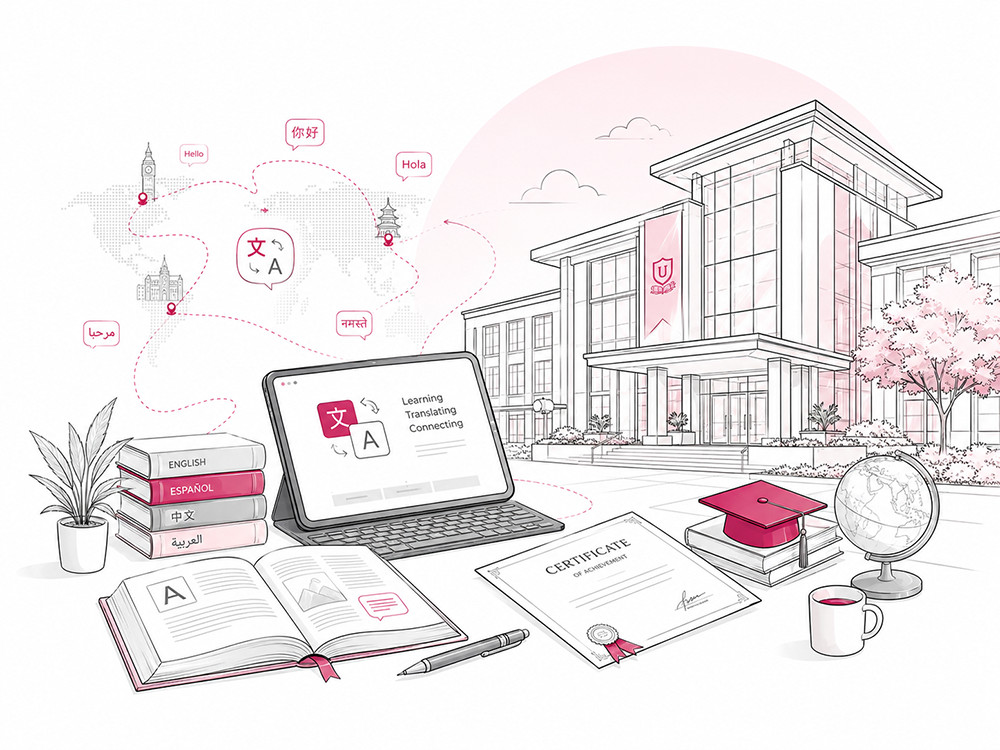
Multilingual Education Is a Connected Experience
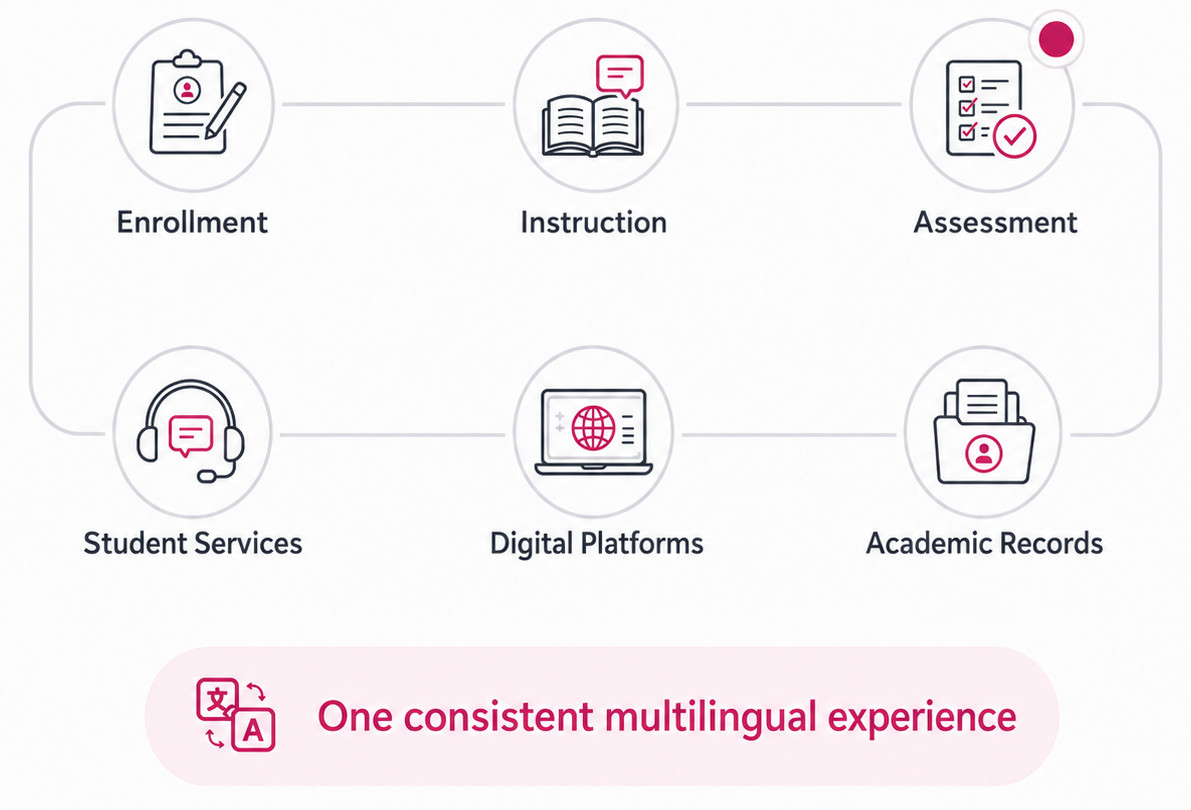
Education translation goes far beyond converting a document from one language into another. Students, families, educators, and administrators interact across websites, applications, classrooms, learning platforms, assessments, academic records, student services, and real-time conversations.
Stepes helps education organizations connect these experiences across languages while preserving terminology, instructional meaning, accessibility considerations, and the needs of each audience. The goal is not simply translated content—it is an education experience that works across languages.
Translation Expertise Across the Education Ecosystem
Different education organizations communicate with different audiences, use different technologies, and manage different types of multilingual content. Stepes brings the right linguistic, subject-matter, technical, and production expertise to each environment.
K–12 Schools & Districts
Support multilingual students and families across enrollment, student services, curriculum, special education, family communications, school policies, digital content, and community engagement.
Colleges & Universities
Translate the student journey from international recruitment and admissions to academics, research, campus services, institutional communications, global programs, and alumni engagement.
EdTech Companies
Localize educational software, learning applications, student portals, classroom technology, assessment systems, digital curricula, and connected learning products for global users.
Education Publishers & Learning Organizations
Translate textbooks, curriculum, assessments, digital courseware, educational multimedia, professional education, instructional resources, and other learning content for multilingual audiences.
Trusted by Leading Education Organizations
Stepes has supported universities and education organizations with multilingual content for global students, educators, researchers, and learning communities.


























Language Access for Students, Families, and Schools
K–12 communication often involves much more than the student in the classroom. Schools also need to communicate accurately with parents and guardians about enrollment, academic progress, student services, policies, special education, safety, and everyday school life. Stepes supports these multilingual touchpoints with professional translation and interpreting.
Enrollment & Registration
- Enrollment and registration forms
- School and program information
- Registration instructions
- Eligibility and transportation information
- Orientation content and student portals
Parent & Family Communications
- Parent notices and letters
- Newsletters and announcements
- Report-card communications
- Parent portal content
- Consent forms, surveys, and event information
Policies & Student Services
- Student handbooks
- Attendance and conduct policies
- Counseling and student-support resources
- Health and wellness information
- Emergency and district communications
Special Education Translation
- IEP-related materials
- Evaluations and assessment documentation
- Meeting notices and summaries
- Consent materials
- Special education and family communications
Curriculum & Classroom Content
- Curricula and lesson materials
- Worksheets and presentations
- Assessments and study guides
- Digital resources
- Classroom communications
Language Access Beyond Documents
- Parent-teacher conferences
- Enrollment conversations
- Special education meetings
- Orientations
- Student-services and community meetings
Readability, consistent terminology, audience-appropriate language, timely delivery, and access to professional interpreting all contribute to clear communication with multilingual school communities.
Multilingual Communication Across the University Experience
Universities communicate with prospective students, enrolled students, families, faculty, researchers, international partners, alumni, and communities across an expanding number of languages and digital channels.
Recruitment & Admissions
Programs, campaigns, applications, requirements, acceptance and orientation.
Student Services
Housing, health, financial aid, campus safety and international student resources.
Academics
Course information, syllabi, learning materials, assessments and departmental content.
Research
Research reports, abstracts, study materials, presentations and scholarly communication.
Global Programs
Study abroad, student exchange, partnerships, mobility and institutional agreements.
Institutional Communication
Administration, policies, HR, alumni, advancement and global marketing.
Localize Digital Learning for Global Users
EdTech localization requires more than translating educational text. Learners and educators experience language throughout software interfaces, lessons, assessments, instructions, notifications, multimedia, support content, and recurring product updates.
Learning management platforms, student portals, classroom software, teacher dashboards, apps, digital courseware, assessment platforms, and virtual learning environments.
Navigation, buttons, labels, forms, fields, instructions, tooltips, system messages, notifications, dashboards, and account content.
Digital lessons, curriculum content, questions and answers, interactive exercises, learner feedback, teacher resources, and certification content.
Terminology management, translation memory, structured files, contextual review, linguistic QA, multilingual build testing, and recurring releases.
Aprendizaje global
Contenido, interfaz y evaluación alineados en el mismo idioma.
Translate Every Type of Educational Content
Education organizations create an unusually broad mix of content. Stepes combines professional translation, localization technology, multilingual production, and subject expertise to support both individual projects and large multilingual programs.
Student & Family Communications
School notices · Parent communications · Consent forms · Student handbooks · Newsletters · Policies · Student-services content
Academic & Instructional Materials
Curricula · Course materials · Syllabi · Lessons · Presentations · Textbooks · Workbooks · Assessments
Admissions & Academic Records
Applications · Transcripts · Diplomas · Certificates · Academic records · Credential materials · Admissions documentation
Digital Learning
Online courses · Courseware · Learner interfaces · LMS content · Assessments · Training modules · Interactive learning content
Research & Institutional Content
Research materials · Academic communications · Institutional reports · Policies · Presentations · Administrative documentation
Marketing & Recruitment
Education websites · International campaigns · Program brochures · Recruitment materials · Digital marketing · Student communications
Subject Expertise Matters as Much as Language Expertise
Educational translation has to preserve what is being taught—not simply the words used to teach it. Stepes matches professional linguists to both the language pair and the subject matter of the content.
Medicine & Life Sciences
Medical education, healthcare curricula, life sciences, pharmaceutical sciences, public health, clinical disciplines, and scientific learning content.
Life Sciences TranslationEngineering & Technology
Mechanical, electrical, civil, industrial, chemical, software, and other engineering and technology disciplines.
Engineering TranslationLaw & Public Policy
Legal education, public policy, government, regulatory studies, international affairs, and related academic content.
Legal TranslationBusiness & Economics
Finance, accounting, economics, management, marketing, entrepreneurship, and business administration.
Science & Research
Biology, chemistry, physics, environmental science, mathematics, and multidisciplinary research content.
Computer Science & AI
Computer science, software engineering, data science, artificial intelligence, machine learning, and emerging technologies.
Humanities & Social Sciences
History, literature, languages, psychology, sociology, education, communications, and related disciplines.
Make Digital Learning Work in Every Language
Digital education brings together text, narration, video, graphics, assessments, interactions, learning-platform technology, and learner tracking. Localizing the words without localizing the complete experience can leave multilingual courses incomplete or difficult to use.
Build skills in every language
Localized narration, captions, interactions and assessments.
Written and Spoken Language Access
Some education communication happens in documents and digital platforms. Other communication happens in real time. Stepes brings translation and interpreting together to support multilingual education communities.
Education Translation
Professional translation supports student and family communications, academic content, policies and forms, learning resources, websites and applications, academic records, digital courseware, and institutional communications.
Professional Translation ServicesEducation Interpreting
Professional interpreters can support parent-teacher conferences, enrollment discussions, special education meetings, student-services conversations, orientations, campus programs, education events, and administrative communication.
Remote, telephone, and on-site interpreting options can be configured according to program requirements and availability.
Explore Interpretation ServicesThe Right Translation Workflow for Every Education Use Case
A school policy, university campaign, digital curriculum, student record, learning-platform update, and internal communication do not carry the same audience, complexity, risk, or quality requirements. They should not automatically receive the same translation workflow.
Professional Translation
For sensitive, complex, highly visible, or subject-intensive educational content where human linguistic judgment is central.
AI + Professional Review
For scalable programs that benefit from AI-assisted production with professional linguistic validation and controlled terminology.
AI Translation
For appropriate lower-risk or high-volume content where audience, quality expectations, and intended use support greater automation.
Projects involving special education, academic records, public-facing policies, assessments, complex academic subjects, or other consequential content may require additional professional review, terminology controls, or validation. The goal is to apply the right level of professional expertise and automation to the content being translated.
One Education Vocabulary Across Every Touchpoint
Program names, degree terminology, curriculum concepts, institutional language, and learning terminology often appear across websites, applications, policies, course materials, assessments, and student communications. Centralized language assets help every channel stay aligned.
Maintain approved translations for programs, departments, credentials, curriculum concepts, product terms, and branded language.
Reuse previously translated and approved content to improve consistency across recurring and updated materials.
Define tone, formality, capitalization, formatting conventions, audience requirements, and language preferences.
Capture approved customer changes so established language decisions can inform future work.
Terminology
Secure Translation for Sensitive Education Content
Educational translation can involve student records, academic documentation, evaluations, admissions materials, research content, employee information, confidential institutional documents, and unreleased digital products. Stepes can configure workflows around customer-specific security, confidentiality, access, review, and delivery requirements.
Controlled Project Access
Limit participation, file access, review responsibilities, and project permissions according to project requirements.
Confidential Content Handling
Support confidentiality requirements and NDAs for sensitive, student-related, research, and unreleased content.
Defined Review & Approval
Establish clear roles for linguists, reviewers, project stakeholders, subject-matter experts, and customer approvers.
Documented Quality Processes
Use structured translation, review, issue management, and quality workflows when additional control and traceability are required.
Accessible Learning Across Languages
Language accessibility and digital accessibility increasingly intersect. A course may be translated accurately but still become difficult to use if captions are missing, layouts break after text expansion, a document loses structure, or multilingual content is not properly integrated into the digital experience.
- Closed captions
- Subtitles
- Transcripts
- Multimedia content
- Accessible documents
- Multilingual web content
- Alternative text translation
- Digital course materials
- Learning-platform content
- User-interface text
Localization teams can account for language-specific issues such as text expansion, reading direction, font support, document structure, captions and transcripts, visual layouts, language attributes, interface behavior, and multimedia synchronization.
Accessibility requirements vary by content, technology, jurisdiction, and implementation environment. Stepes works with education teams to support multilingual content within their defined accessibility requirements while keeping linguistic quality and usability connected.
Explore Multimedia LocalizationA Controlled Workflow From Source Content to Global Learners
Every education localization program is different. Stepes configures the workflow around the content, audience, languages, technology, quality requirements, customer review process, and delivery schedule.
Understand
Audience, languages, subject matter, use, technology, quality, and delivery requirements.
Prepare
Source files, terminology, references, translation memory, style guidance, and technical requirements.
Translate
Professional linguists and the appropriate translation workflow for content and risk.
Review
Linguistic, subject-matter, customer, or additional validation according to scope.
Localize
Formatting, software, multimedia, courseware, and digital implementation when required.
Validate
Linguistic QA, formatting checks, in-context review, and functional testing as appropriate.
Maintain
Approved terminology, translation memory, style decisions, and reviewer feedback for future updates.
Built for Education Content That Never Stops Changing
New semesters begin. Curriculum changes. Admissions cycles restart. Policies are revised. Courses are updated. Software releases introduce new features. Assessment content evolves. Websites change daily. Stepes helps organizations turn individual translations into reusable multilingual programs.
Translate New and Changed Content
Focus localization resources on content that has actually changed instead of repeatedly translating material that is already approved.
Reuse Approved Language Assets
Translation memory, terminology, style guidance, and review decisions provide a stronger starting point for every update.
Maintain Cross-Channel Consistency
Keep language aligned as concepts move between websites, documents, applications, courses, assessments, and communications.
Support Continuous Releases
Configure localization around publication cycles, software releases, curriculum updates, or ongoing multilingual content operations.
Global Education in 100+ Languages
Support major global markets, regional language variants, right-to-left languages, CJK languages, and complex writing systems—while accounting for text expansion, fonts, character encoding, writing direction, dates, numbers, terminology, pronunciation, and interface layouts.
View Translation LanguagesWhy Education Organizations Choose Stepes
Education translation requires language expertise, subject knowledge, technology, and a clear understanding of how translated content will actually be used.
Education Domain Expertise
Multilingual communication across K–12, higher education, EdTech, academic content, and digital learning.
Subject-Matter Linguists
Professional translators matched to academic disciplines and educational content types—not language fluency alone.
AI + Professional Expertise
Workflow choices matched to audience, content, risk, scale, and required quality level.
Digital Localization Expertise
Software, eLearning, multimedia, websites, structured content, and multilingual QA.
Enterprise Terminology
Approved terminology, translation memory, style guidance, and reviewer decisions across recurring content.
Quality From Words to Experience
Review language in the context in which students, families, educators, and learners will actually encounter it.
Questions About Multilingual Education
Practical answers for schools, universities, EdTech companies, and learning organizations planning multilingual content and localization programs.
What types of educational content can Stepes translate?
Stepes translates educational content across K–12, higher education, EdTech, academic publishing, and digital learning. Projects can include curriculum, course materials, student and family communications, admissions content, academic records, assessments, special education materials, research content, websites, educational software, eLearning courses, multimedia, and institutional communications. Stepes supports both individual projects and ongoing multilingual education programs.
Does Stepes provide translation services for K–12 schools and school districts?
Yes. Stepes supports schools, districts, education agencies, and organizations serving students and families with translation for enrollment materials, parent communications, handbooks, school policies, report-card communications, special education materials, curriculum, assessments, digital resources, websites, and student-services information. Professional interpreting can also support real-time educational communication.
Can Stepes translate IEP and special education materials?
Yes. Stepes supports translation of IEP-related materials, evaluations, notices, meeting documentation, consent materials, and other special education communications. Projects can be assigned to professional linguists familiar with education terminology, with additional review and terminology controls configured according to project requirements.
Does Stepes provide higher education and university translation services?
Yes. Stepes supports colleges and universities across international recruitment, admissions, student services, academic departments, research, international programs, institutional communications, campus content, websites, and global marketing. Academic and instructional content can be matched with linguists who understand the relevant subject area.
Can Stepes localize EdTech software and learning platforms?
Yes. Stepes combines education translation with software localization for EdTech applications, learning platforms, assessment systems, student portals, classroom software, digital curriculum, teacher dashboards, and other educational products. Localization can include UI translation, structured resource files, terminology management, linguistic QA, in-context review, and multilingual product testing.
What is the difference between education translation and eLearning localization?
Education translation covers the broader multilingual education ecosystem, including K–12 communication, university content, academic materials, student records, EdTech, research, curriculum, and institutional communication. eLearning localization focuses specifically on digital learning experiences such as course text, narration, video, subtitles, assessments, interactions, Storyline or Captivate engineering, SCORM packages, LMS delivery, and functional testing.
How does Stepes maintain consistent terminology across educational content?
Stepes uses multilingual terminology databases, translation memory, style guidance, reference materials, and customer reviewer feedback to maintain approved language across recurring content. This is especially valuable when the same program names, academic concepts, interface terms, or institutional terminology appear across multiple channels.
Does Stepes provide education interpreting services?
Yes. Professional interpreting can support parent-teacher conferences, student and family meetings, enrollment discussions, orientations, special education meetings, student services, campus events, and other educational communication. Delivery can be configured around customer requirements using available remote, telephone, or on-site options.
How does Stepes use AI for education translation?
Stepes uses AI within a broader translation technology and professional expertise model. The appropriate workflow depends on content, audience, risk, complexity, volume, turnaround requirements, and desired quality. Some content requires professional human translation and detailed review, while other content can benefit from AI-assisted production with professional linguistic validation or greater automation for suitable lower-risk use cases.
How does Stepes handle sensitive student and institutional content?
Educational projects can include academic records, student information, evaluations, admissions materials, research, confidential institutional content, and unreleased digital products. Stepes can configure access, confidentiality, review responsibilities, file handling, quality controls, and delivery requirements around the customer's specific security and privacy requirements.
Can Stepes localize accessible education and multimedia content?
Yes. Stepes supports multilingual captions, subtitles, transcripts, multimedia, documents, websites, learning-platform content, alternative text, and other content used within accessible digital experiences. Localization teams can account for issues such as text expansion, writing direction, font support, layouts, captions, and multimedia synchronization.
Make Education Accessible in Every Language
Whether you are communicating with families across a school district, recruiting students around the world, translating academic programs, launching a multilingual learning platform, or scaling digital education into new markets, Stepes brings language expertise, technology, and production together in one coordinated localization program.