
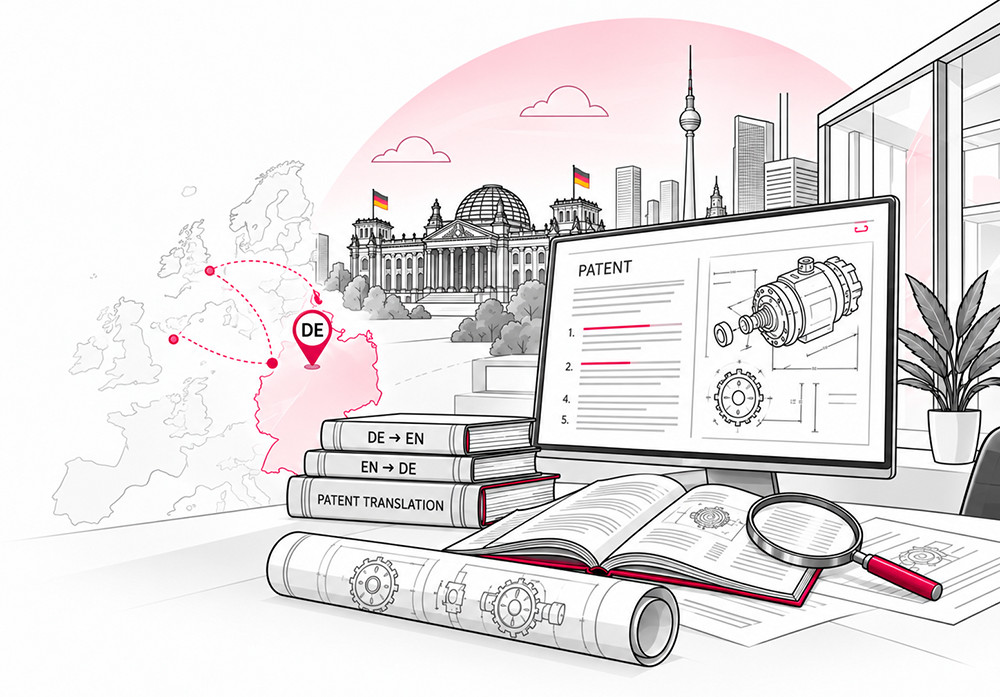
German Patent Translation for Germany and International IP Programs
German patent content appears across many stages of the intellectual property lifecycle. A company may need an English patent application translated into German for a German filing, a German patent translated into English for prior-art research, or consistent German terminology maintained across an international patent family.
These projects do not all require the same translation workflow. A patent translation intended for attorney review or official filing may require controlled human translation, independent review, terminology validation, and final document QA. A German patent identified during an early prior-art search may instead require fast screening, a technical summary, or translation of selected claims and passages before a full translation is commissioned.
Stepes aligns the translation approach with the document's purpose, technical field, language direction, risk level, and delivery requirements.
English-to-German and German-to-English Patent Translation
German patent translation is a two-way discipline. Filing teams may need highly controlled English-to-German translation, while attorneys, researchers, and global IP teams frequently need German-to-English translation to understand prior art, patent families, technical disclosures, and competitor portfolios.
English-to-German Patent Translation
English-to-German patent translation can support German patent applications, claims and descriptions, prosecution materials, amendments, patent-family documentation, technical exhibits, and other intellectual property content.
Defined terms, component names, process steps, numerical relationships, claim dependencies, figure references, and technical limitations should remain controlled throughout the document rather than translated sentence by sentence in isolation. German compound technical terminology also requires the translator to understand how individual components relate to the invention as a system.
- German patent applications and claims
- Descriptions, figures, and amendments
- German-language prosecution materials
- Related patent-family content
German-to-English Patent Translation
German-to-English patent translation supports international teams that need reliable access to German patents and technical publications for research, portfolio evaluation, litigation, R&D, and business decisions.
German patents may surface during patentability searches, freedom-to-operate analysis, invalidity research, competitor monitoring, due diligence, or patent-family analysis. Stepes supports everything from targeted translation of claims and selected passages to complete professional translation of full patents and supporting documents.
- German prior art and technical disclosures
- Patent-family and competitor review
- FTO, patentability, and invalidity research
- Dispute and due-diligence materials
German Patent Translation for DPMA Proceedings
The German Patent and Trade Mark Office administers national patent applications in Germany. When application materials originate in another language, the source language can materially affect the German translation timeline and project planning.
German Filing Translation Requirements
Patent application documents handled by the DPMA ultimately need to be available in German. Applications initially filed in English or French generally receive a longer period for supplying the German translation than applications filed in other foreign languages.
Stepes can support patent claims, descriptions and specifications, abstracts, drawing text, amendments, prosecution correspondence, supporting technical documentation, and related patent-family content. Existing priority documents, terminology lists, related patents, and approved translations can be incorporated into the workflow to improve consistency.
German Patent Ordinance §14 also sets formal requirements for German translations of foreign-language documents: they must be certified by a lawyer or patent attorney or prepared by a publicly appointed translator. Timing rules differ by document category, so applicants should confirm the exact filing arrangement with patent counsel or their filing representative.
German Patent Translation for EPO and European Patent Work
German is one of the European Patent Office's three official languages, together with English and French. Its role in a European patent matter depends on the language of proceedings, the documents involved, and the jurisdictions in which translation is actually required.
A European patent application may also initially be filed in another language, subject to the applicable requirement to provide a translation into an EPO official language. The official language in which the application is filed or into which it is translated generally becomes the language of the proceedings.
Stepes supports German-language applications and claims, German EPO documents translated into English for international teams, prosecution and examination materials, opposition-related content, technical exhibits, patent-family comparisons, and attorney or inventor review materials.
It is important not to assume that every European patent requires a German translation simply because protection is sought in Germany. Under the current framework, Germany generally does not require a separate Article 65(1) translation solely for post-grant validation of a European patent in Germany.
PCT and German National-Phase Translation Support
International patent applications can create German translation requirements as an application moves from the PCT international phase into national or regional patent systems.
PCT Patent Translation and National Phase GuideCoordinate German Translation Within the Patent Family
For national or regional phase entry, the relevant patent office may require a complete translation when the international application is not already in an accepted official language. Stepes can support German national-phase content, claims and amended claims, descriptions, abstracts, priority and supporting documents, patent-family materials, and subsequent prosecution content.
For complex international programs, terminology and translation memory can be coordinated across related PCT, EP, German, US, and other national family members. Filing routes and applicable translation requirements should be determined by the applicant's patent counsel or filing representative.
German Patent Documents We Translate
Stepes supports German patent translation across the intellectual property lifecycle, from application and prosecution materials to prior-art research, portfolio review, and dispute-related documentation.
Patent Applications
- Patent claims
- Descriptions and specifications
- Abstracts
- Drawing and figure text
- Amendments and revised application content
Prosecution and Examination
- Office communications
- Search and examination materials
- Responses and amendments
- Opposition-related documents
- Attorney and inventor review content
Patent Research
- German patents and published applications
- Prior-art documents
- Technical literature
- Patent-search materials
- Selected claims and technical passages
IP and Dispute Materials
- Claim charts
- Technical expert materials
- Exhibits
- Patent-family comparisons
- Licensing and other IP documentation
Precision for German Patent Claims and Specifications
Patent claims require unusually disciplined translation because individual words, dependencies, and technical relationships can carry significance throughout an application. Stepes approaches German patent claims as structured technical content rather than isolated sentences.
Preserve Defined Terminology
A component or concept introduced in an independent claim may appear repeatedly throughout dependent claims, the description, figures, and later amendments. Approved terminology should remain controlled across those references.
Maintain Claim Relationships
Translation must follow independent and dependent claim relationships, antecedent references, repeated technical limitations, alternatives, component relationships, and process sequences without flattening the structure of the invention.
Control German Technical Terminology
German engineering and scientific language frequently uses compound terms that encode relationships among components, materials, functions, and processes. The translator needs to understand those relationships before selecting consistent English or German terminology.
Verify Numbers, Figures, and References
Patent QA can cover numerical ranges, units, formulas, symbols, claim numbering, figure and drawing references, component reference numbers, tables, and structured content in addition to the translated text.
Keep Claims and Descriptions Aligned
Where corresponding concepts appear in the claims and description, terminology should remain consistent where appropriate. Related patent-family documents and previously approved translations can also be used as reference materials.
German Patent Terminology and Claim Consistency
The challenge is not simply finding an English equivalent for a German patent term. The larger task is choosing terminology that fits the document, jurisdiction, and technical context, then keeping that terminology consistent across claims, descriptions, prosecution documents, and related family members.
The examples shown here illustrate common patent terminology. The appropriate English rendering can vary based on context, document type, procedural setting, your terminology preferences, and existing patent-family terminology.
German Prior Art Translation for Patent Research
A German patent does not have to be part of a German filing to become important to an international IP team. German-language patents, published applications, scientific materials, and technical disclosures can surface during patentability, novelty, freedom-to-operate, invalidity, competitive intelligence, technology landscaping, and portfolio due diligence.
Screening
AI-assisted or rapid translation can help research teams triage larger collections of German patent documents and identify potentially relevant materials.
Technical Summary
A concise English summary can give attorneys or technical teams a clearer understanding of the invention, claims, and relevant passages.
Selected-Passage Translation
Translate individual claims, embodiments, examples, descriptions, or paragraphs that are directly relevant to the research question.
Complete Professional Translation
Translate the full German patent or technical document when the material warrants comprehensive analysis.
Human Verification
When a particular claim or passage will influence a legal, commercial, or technical decision, professional human review can be added to the workflow.
German Patent Prosecution, Opposition, and Dispute Translation
Patent language continues to evolve after the initial application. Stepes supports German and English translation for prosecution, opposition, and dispute-related patent content, with the review standard matched to how the material will be used.
Content translated for internal comprehension may require a different workflow from material prepared for attorney analysis, negotiation, formal submission, or evidentiary use. For complex matters, Stepes can work from attorney-provided terminology, matter-specific instructions, existing patent translations, and related technical documentation to maintain consistency across the record.
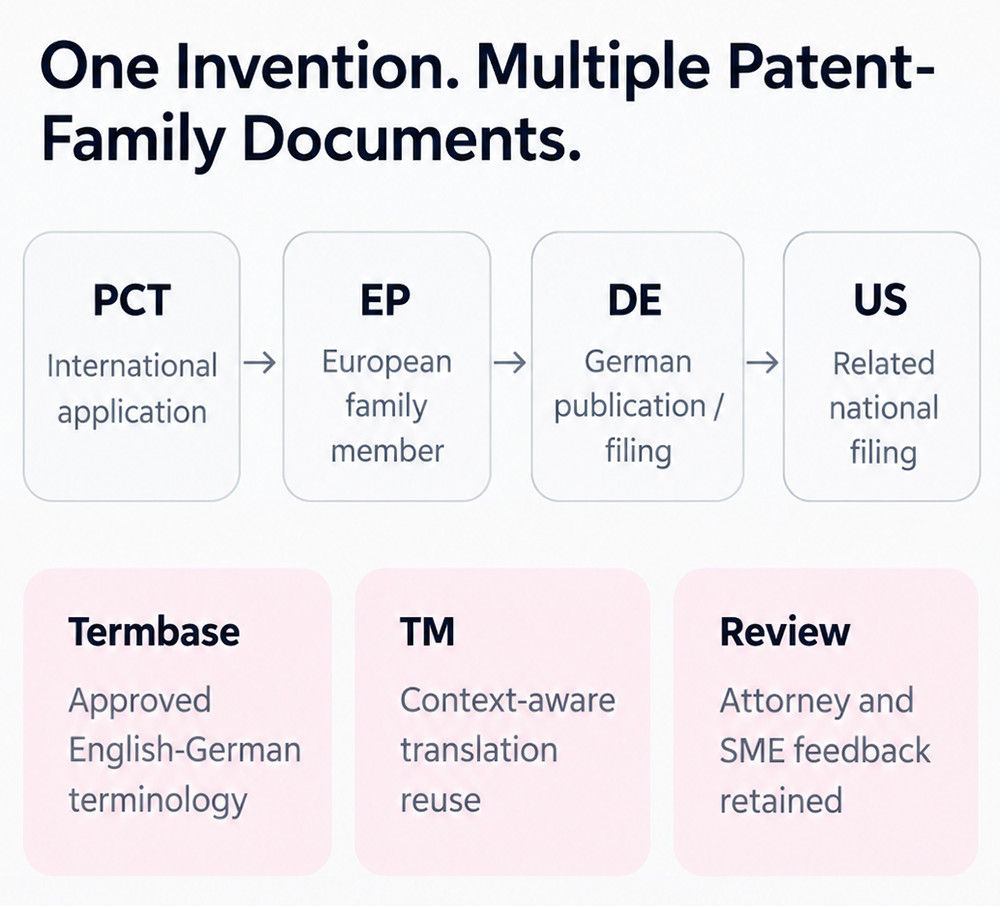
Consistent English-German Terminology Across Patent Families
A single invention can generate years of related patent content. As PCT, EP, German, US, divisional, continuation, amendment, and prosecution materials evolve, terminology can gradually drift across documents and languages.
Stepes helps organizations manage English-German patent terminology through reusable language assets and controlled review. Approved translations for defined terms, component names, processes, chemical or biological terminology, abbreviations, and other recurring concepts can be recorded and referenced across projects.
Translation memory can identify matching or similar content across related applications, recurring background descriptions, abstracts, amendments, and portfolio documentation. Previous translations are not reused blindly: claim context, technical meaning, amendments, and jurisdiction-specific wording still need to be evaluated.
Feedback from your patent counsel, engineers, inventors, and reviewers can also be incorporated into subsequent projects so established terminology decisions do not have to be rediscovered with every filing.
Technical Expertise for German Patents
Patent translation often requires the translator to understand the invention before the language can be translated precisely. Stepes matches German patent content with linguists and subject-matter resources appropriate to the technical field.
Automotive & Mobility
Powertrain systems, electric vehicles, batteries, autonomous driving, sensors, vehicle electronics, manufacturing technologies, and mobility platforms.
Mechanical & Industrial Engineering
Machinery, automation, robotics, manufacturing processes, industrial equipment, materials, mechanical assemblies, and control systems.
Electronics & Semiconductors
Circuits, semiconductor technologies, sensors, displays, embedded systems, electronic components, power electronics, and communications hardware.
Software, AI & Telecommunications
Software systems, computing architectures, artificial intelligence, machine learning, networking, communications protocols, cloud technologies, and digital platforms.
Chemicals & Materials
Chemical compounds, formulations, polymers, industrial chemistry, materials science, coatings, processes, and specialty materials.
Life Sciences & Medical Technology
Biotechnology, pharmaceuticals, diagnostics, medical devices, laboratory technologies, biologics, and healthcare innovations.
AI-Assisted German Patent Translation With Human Expert Control
AI translation can improve speed and scalability for some patent workflows, but the appropriate level of human involvement depends on the purpose and risk of the content. The goal is to apply the right combination of technology, technical expertise, and professional review to each document.
AI Patent Translation GuideAppropriate AI-Supported Uses
- German prior-art screening
- Large-document triage
- Terminology extraction
- Patent-family comparison
- Repetitive portfolio content
- Automated quality checks
Human-Centered Higher-Risk Uses
- Filing-grade claims and specifications
- Prosecution documents
- Certified translations
- Opposition and dispute materials
- Decision-critical prior art
- Sensitive unpublished inventions
A German Patent Translation Workflow Built Around Intended Use
Stepes structures German patent translation around the actual project rather than applying the same process to every patent document.
Intended-Use and Jurisdiction Review
We identify the language direction, document type, technical field, intended use, relevant DPMA, EPO, PCT, research, prosecution, portfolio, or dispute context, deadline, review requirements, and requested deliverables.
Patent-Family and Terminology Preparation
Related patents, previous translations, approved terminology, glossaries, translation memories, counsel instructions, and technical reference materials can be reviewed before translation begins.
Technical Linguist Assignment
The project is matched to language professionals with the required German and English skills and appropriate subject-matter expertise.
Translation and Appropriate Human Review
Translation and review depth are aligned with risk. Research screening does not automatically receive the same workflow as filing-grade patent claims.
Final QA and Delivery
Applicable quality checks can cover terminology, completeness, claim relationships, numbers, references, figures, formatting, and requested file outputs before secure delivery.
Secure Handling of Unpublished German Patent Content
Patent translation may involve unpublished inventions, confidential R&D, competitive product information, pending legal matters, and other sensitive intellectual property. Stepes supports controlled project access, confidentiality practices, secure file handling, and centralized workflow management for enterprise and professional IP content.
What Determines German Patent Translation Cost and Turnaround?
German patent translation is scoped according to the actual document and its intended use rather than a single fixed rate or standard turnaround.
German Patent Translation FAQs
Patent Translation Guidance
German Patent Translation Within a Global IP Program
German patent translation is often one part of a larger international intellectual property strategy. Explore broader patent services and practical guidance for international filing, claims, prior art, AI-assisted research, and German-language content.
Patent Translation Services
Professional patent translation for international filings, prosecution, prior art, litigation, and patent portfolios.
Explore Patent Translation ServicesPCT Patent Translation and National Phase Guide
Plan multilingual content for international applications, national-phase entry, amendments, and coordinated patent families.
Explore the PCT guidePatent Claims Translation Quality Checklist
Review terminology, defined terms, dependencies, references, numbers, units, drawings, and final-file consistency.
View the claims checklistPrior Art Translation for Patentability, FTO, and Invalidity
Choose the appropriate level of translation for screening, research, analysis, and decision-critical patent content.
Explore prior art translationAI Patent Translation: Research Use vs. Filing-Grade Translation
Understand where AI-assisted translation adds efficiency and where professional human translation and review remain essential.
Explore AI patent translationGerman Translation Services
Translate additional German business, technical, legal, and enterprise content beyond patents.
Explore German Translation ServicesTranslate German Patent Content With Technical Precision
Whether you need an English patent translated into German for an IP filing, a German patent translated into English for prior-art research, or consistent terminology maintained across an international patent family, Stepes can build a translation workflow around your technical field, intended use, and delivery requirements.