
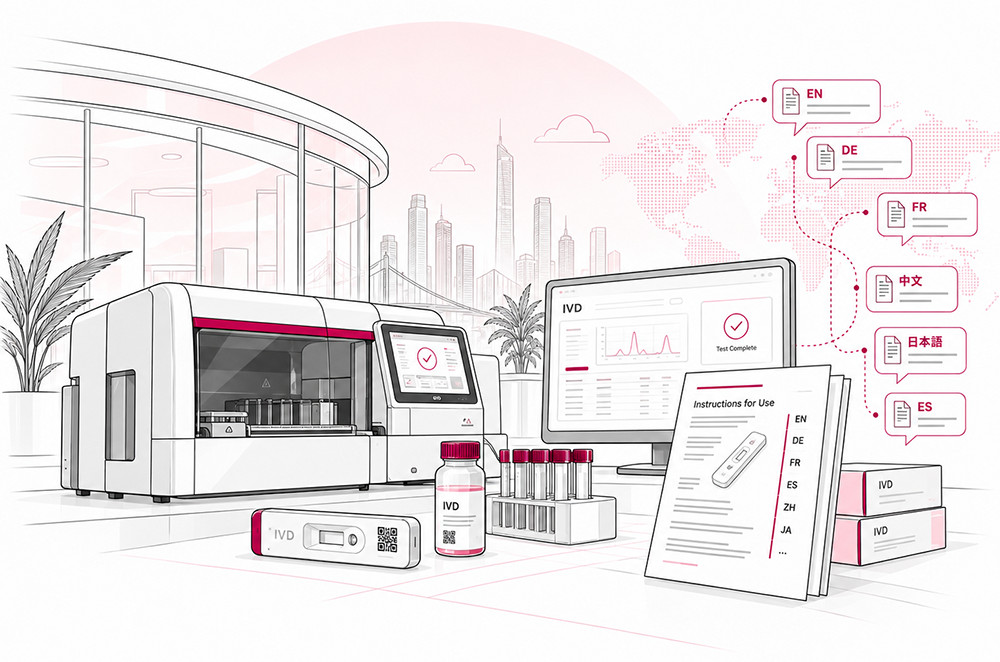
Specialized Translation for the IVD Product Ecosystem
In vitro diagnostics bring together science, regulated product information, laboratory workflows, physical devices, software, and increasingly connected digital experiences.
Translating this content requires more than language fluency. It requires an understanding of how information moves across an IVD product and how a terminology or numerical error in one place can affect many others.
Stepes provides specialized IVD translation services for diagnostic manufacturers, laboratories, medical technology companies, and life sciences organizations. Our professional linguists combine medical and scientific subject-matter expertise with translation memory, controlled terminology, automated quality assurance, and configurable human review.
Scientific Precision
Translate analytes, biomarkers, reagents, specimens, controls, calibrators, testing methodologies, and diagnostic performance with appropriate subject-matter expertise.
Regulated Product Content
Manage multilingual labeling, IFUs, technical documentation, regulatory materials, quality content, and supporting product information through controlled workflows.
Laboratory and User Workflows
Preserve the meaning of specimen collection, sample preparation, testing procedures, instrument operation, calibration, quality control, troubleshooting, and result interpretation.
Instruments and Digital Systems
Localize analyzer interfaces, diagnostic applications, instrument software, result displays, middleware, alerts, help content, and connected laboratory experiences.
Terminology Continuity
Keep approved IVD terminology aligned across labels, IFUs, instruments, software, training, regulatory documentation, websites, and support materials.
Lifecycle Control
Reuse validated language intelligently as assays, labels, software, documentation, and market requirements evolve across product releases.
IVD Content We Translate
IVD products generate complex multilingual content throughout development, regulatory preparation, commercialization, and post-market updates. Stepes connects these content streams so teams can maintain quality without managing each document or system in isolation.
Regulatory and Technical Documentation
Support global regulatory and quality programs with accurate, controlled translations of technical and scientific documentation.
- Technical documentation
- Regulatory submissions and supporting documents
- Performance evaluation documentation
- Analytical and clinical performance materials
- Scientific validity documentation
- Declarations and certificates
- SOPs and quality documentation
- Verification and validation materials
- Manufacturing and technical procedures
- Post-market and field communications
IVD Labeling and Product Instructions
Translate the information users rely on to identify, handle, store, prepare, operate, and use diagnostic products correctly.
- Instructions for Use (IFUs)
- Package inserts
- Kit, reagent, and instrument labels
- Packaging content
- Warnings and precautions
- Quick-reference guides
- Operator instructions
- Storage and handling instructions
- Symbols and accompanying text
Assay and Laboratory Content
Support laboratories and diagnostic workflows with linguists who understand the terminology and procedures behind IVD testing.
- Assay protocols
- Reagent documentation
- Specimen collection instructions
- Sample preparation procedures
- Laboratory procedures
- Calibration and quality-control documentation
- Reference materials
- Laboratory training
- Troubleshooting and service content
Instruments, Software, and Digital Content
Keep the physical and digital sides of the diagnostic experience aligned across languages.
- Analyzer interfaces
- Instrument software
- Diagnostic applications
- Result displays and dashboards
- Middleware
- Embedded help
- Alerts and error messages
- Setup and installation workflows
- Software release documentation
Training and Commercial Content
Extend the same terminology and product knowledge into the materials that educate customers, support users, and bring IVD products to market.
- Product training
- eLearning courses
- Service and maintenance training
- Scientific presentations
- Product brochures
- Websites
- Sales enablement
- Launch content
- Customer-support materials
- Multimedia content
Multilingual IVD Content for Global Regulatory Markets
IVD language requirements can vary by market, intended user, device type, content, and delivery format. A scalable translation program starts by defining where the product will be distributed, who will use it, which information must be localized, and how translated content will be reviewed and released.
Stepes supports IVD manufacturers with multilingual regulatory and product documentation across Europe, North America, Asia-Pacific, Latin America, the Middle East, and other international markets. We combine life sciences linguists, terminology management, translation memory, quality controls, and multilingual production to keep complex market releases organized.
Medical Device Translation ServicesEU IVDR Language Support
For IVD products under Regulation (EU) 2017/746, applicable language requirements are defined by the markets where a device is made available. Stepes helps manufacturers execute the approved multilingual scope across content such as:
- Labels and Instructions for Use
- Self-testing and near-patient instructions
- Product and safety information
- Technical and regulatory documentation
- Declarations and supporting materials
- Software and graphic user interface content where localization is required
- Market-specific product communications
Translate IVD Labels and Instructions Without Losing Critical Meaning
IVD labels and IFUs contain dense scientific, technical, and operational information. Product names, intended use, warnings, reagent information, specimen requirements, storage conditions, calibration procedures, test limitations, and result information must remain accurate while also being understandable to the intended user.
Protect Scientific and Operational Meaning
Treat Numbers as Critical Content
Stepes quality workflows can check numbers, measurements, percentages, temperatures, times, concentrations, dates, product references, and other structured content for unexpected differences between source and target. Human reviewers then evaluate whether terminology, context, and meaning remain appropriate for the product and intended user.
Validate the Final Deliverable
Stepes supports multilingual desktop publishing and final-format QA for labels, package inserts, PDFs, diagrams, tables, and other production files to identify issues such as text expansion, misplaced content, formatting errors, or bidirectional-language problems before release.
Medical Device IFU Translation Guide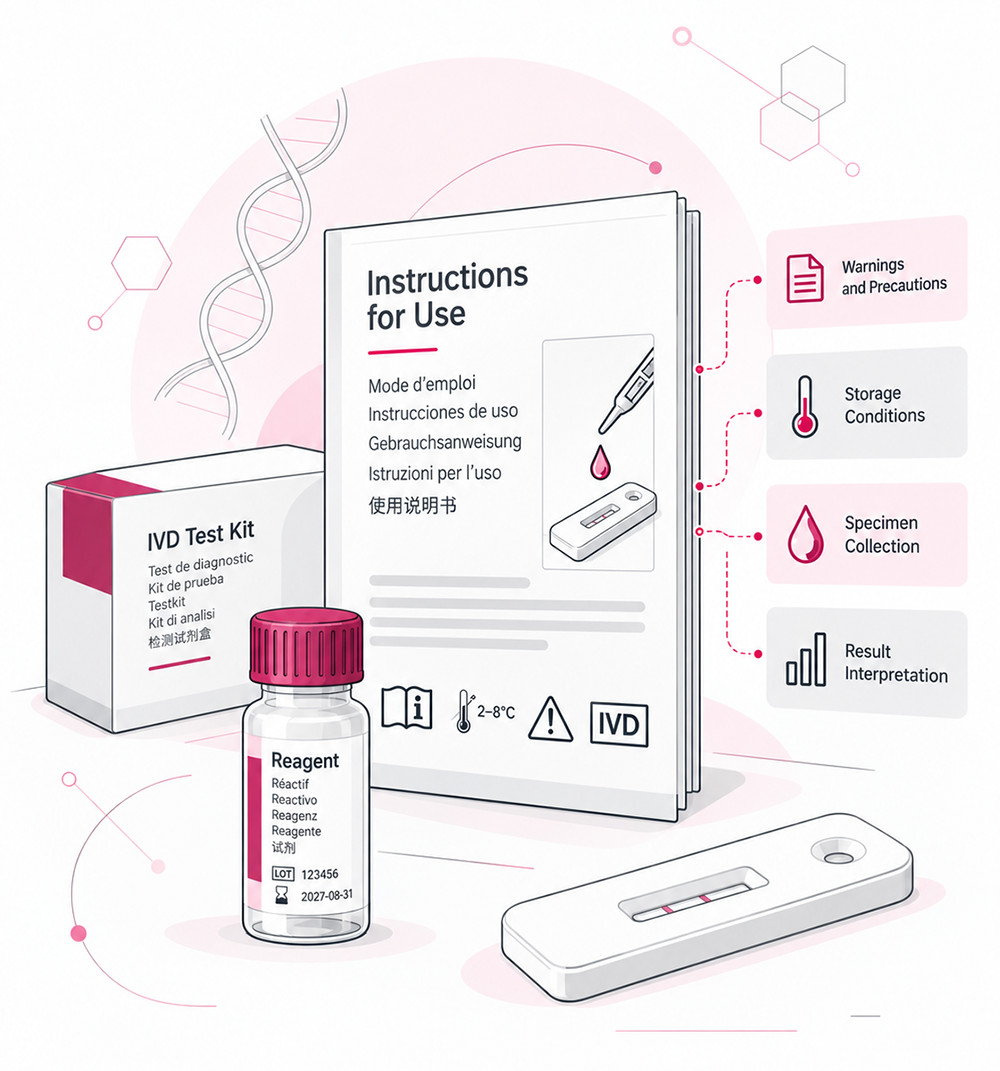
Translation Expertise Across IVD Technologies
Different diagnostic technologies create different linguistic and technical demands. Stepes supports a broad range of IVD products with translation workflows matched to the technology, documentation, intended users, and markets involved.
Molecular Diagnostics
PCR, nucleic acid testing, molecular assays, infectious-disease testing, and related scientific and product documentation.
Immunodiagnostics and Immunoassays
Multilingual content for antibody-, antigen-, and immunoassay-based products, reagents, testing procedures, and instruments.
Clinical Chemistry
Translation for analyzers, reagents, assays, controls, calibrators, laboratory procedures, and supporting documentation.
Hematology and Coagulation
Technical and product translation for diagnostic instruments, reagents, workflows, and laboratory professionals.
Microbiology and Infectious Disease
Translation of testing systems, specimen procedures, assay content, laboratory documentation, and user instructions.
Genetic and Genomic Diagnostics
Specialized language support for genetic tests, genomic diagnostic workflows, sequencing-related applications, and associated product content.
Companion Diagnostics
Consistent translation of diagnostic content used to support therapeutic selection, patient stratification, and related clinical workflows.
Pathology and Digital Pathology
Localization for pathology technologies, imaging workflows, digital pathology platforms, software, and technical content.
Blood Screening
Translation for blood-screening systems, reagents, instruments, procedures, product labeling, and regulated documentation.
Point-of-Care Diagnostics
Multilingual content for portable, rapid, and near-patient testing systems used outside centralized laboratories.
Self-Testing and Consumer Diagnostics
User-centered translation for products designed for patients and consumers, where clarity and correct interpretation are especially important.
Laboratory Automation
Localization for integrated analyzers, robotic workflows, middleware, connected instruments, software, and total laboratory automation systems.
Clear IVD Translation From the Laboratory to the Point of Care
Diagnostic testing is no longer confined to a centralized laboratory. IVD products may be used by laboratory scientists, clinicians, nurses, pharmacists, technicians, caregivers, or patients themselves.
The translation must reflect the knowledge and context of the intended user while preserving approved scientific and operating meaning. Stepes helps IVD companies translate point-of-care, near-patient, and self-testing content across the complete user experience.
For Laboratory Professionals
Technically precise assay procedures, reagent information, instrument instructions, calibration, quality-control documentation, maintenance procedures, and troubleshooting.
For Healthcare and Near-Patient Users
Clear setup, specimen collection, device operation, software prompts, warnings, result displays, and procedural content for decentralized testing environments.
For Patients and Consumers
Readable, usable translation of test preparation, specimen collection, procedural steps, warnings, limitations, result interpretation, and follow-up information without weakening approved meaning.
Localize the Digital Experience Behind Modern Diagnostics
Modern IVD systems increasingly connect assays and reagents with intelligent instruments, touchscreen interfaces, applications, middleware, cloud systems, and data-driven workflows.
Stepes localizes IVD software alongside the documentation and terminology that support it, helping product teams maintain one coherent multilingual experience across physical and digital touchpoints.
Software Localization ServicesIVD Software We Localize
Product references, screenshots, descriptions, string IDs, character limits, variables, placeholders, and final-interface review help linguists translate short software strings accurately and catch issues that standalone files cannot reveal.
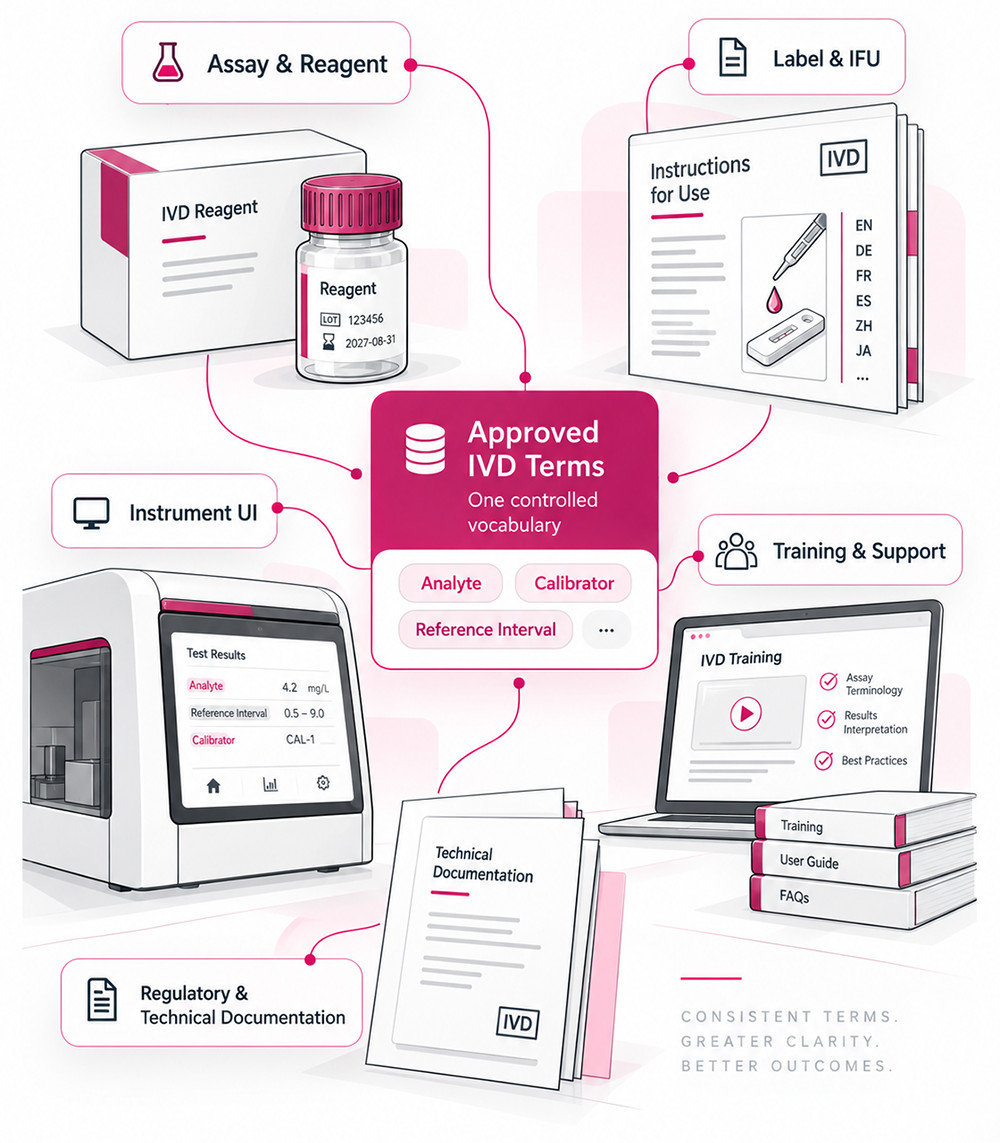
One IVD Vocabulary Across Every Product Touchpoint
IVD terminology rarely stays in one document. A single approved concept can appear across the assay, reagent label, IFU, instrument interface, software, training, regulatory documentation, website, and customer support.
Stepes uses terminology management to create and maintain controlled multilingual vocabulary for analytes, biomarkers, antibodies, antigens, enzymes, primers, reagents, controls, calibrators, specimen types, assay names, measurement units, reference intervals, instrument components, result classifications, product names, and abbreviations.
From Glossary to Governed Terminology
A useful IVD termbase can include definitions, context, product associations, approved equivalents, prohibited variants, abbreviations, status, usage notes, and language-specific guidance. Approved terminology can then be applied across translation, AI-assisted workflows, professional review, and QA.
Terminology ManagementKeep Every Language Aligned With Every IVD Release
IVD localization is rarely a one-time event. Assays change. Labels are revised. Software evolves. New markets are added. Product instructions and regulatory content are updated. Stepes helps manage multilingual updates as a controlled lifecycle instead of repeatedly retranslating content from the beginning.
Define Markets, Languages, and Content
Confirm target markets, languages, intended users, source revisions, file formats, content types, publishing requirements, and review responsibilities.
Prepare Source Content and Language Assets
Analyze source files and organize approved terminology, translation memories, previous translations, style guidance, product references, and other relevant materials.
Translate With IVD Expertise
Assign qualified linguists and configure professional, AI-assisted, and hybrid workflows according to the content, intended use, quality requirements, and risk.
Review and Quality Check
Evaluate terminology, meaning, completeness, numbers, units, formatting, tags, protected content, and other project-specific quality criteria.
Validate in Final Context
Review the actual label, IFU, PDF, interface, software build, or other final content experience where project requirements call for in-context validation.
Release and Reuse Approved Language
Retain validated translations, terminology decisions, and approved corrections in translation memory and language assets for future revisions.
This approach allows unchanged or previously approved content to be reused where appropriate while directing translation and review effort toward new or modified content. The result is faster multilingual updates without sacrificing control over terminology, consistency, or release quality.
Use AI Where It Adds Speed. Keep Experts Where Accuracy Matters.
AI is transforming translation, but regulated IVD content should not be treated as one uniform content category. Lower-risk reference content does not carry the same consequences as a product label, self-testing instruction, or safety-critical operating step.
AI-Assisted Efficiency
AI and translation automation can accelerate suitable high-volume or repetitive content through first-pass translation, translation-memory reuse, approved terminology application, repetitive-content processing, automated completeness checks, numerical QA, and workflow routing.
Professional IVD Review
Professional medical and scientific linguists review content where context, technical meaning, terminology, user comprehension, and product knowledge require human judgment, including source-to-target accuracy, IVD terminology, scientific meaning, numbers and units, warnings, instructions, and final readiness.
Specialist Validation
Regulated, safety-related, patient-facing, or otherwise high-consequence IVD content can be routed through stronger review and approval models, including independent linguistic revision, subject-matter review, in-country review, client approval, and final-context validation.
The objective is not to maximize AI use. It is to apply the right level of technology and human expertise to each content type so IVD companies can gain efficiency while protecting quality where errors matter most.
AI + Human Translation WorkflowQuality Designed for Regulated IVD Content
Translation quality is most dependable when it is built into the workflow from the beginning rather than added as a final proofreading step. Stepes combines ISO-certified processes, professional linguists, controlled language assets, automated QA, human review, and final-content validation to support demanding IVD translation programs.
Qualified Linguists
Select translators and reviewers based on language expertise, medical and scientific knowledge, project requirements, and content risk.
Terminology Governance
Apply approved IVD, product, scientific, technical, and regulatory terminology consistently across translators, AI workflows, reviewers, and content types.
Translation Memory
Reuse previously validated translations to improve consistency across document revisions, recurring content, software releases, and future projects.
Automated QA
Identify objective issues such as missing content, numerical discrepancies, terminology deviations, untranslated segments, tags, variables, and formatting inconsistencies.
Professional Human Review
Use qualified reviewers to evaluate meaning, context, fluency, scientific accuracy, intended-user clarity, and other issues that require judgment.
Final-Format Validation
Review multilingual labels, PDFs, software interfaces, graphics, and other finished content experiences to identify issues that appear only after integration or formatting.
IVD Translation in 100+ Languages
Launch diagnostic products across international markets with professional IVD translation and localization in more than 100 languages. Stepes can coordinate multilingual releases across languages, content types, and formats while maintaining common terminology, translation memory, quality requirements, and project governance.
Why IVD Companies Choose Stepes
Bring specialized language expertise, controlled workflows, software localization, terminology governance, and scalable global delivery together in one IVD translation program.
IVD Subject-Matter Expertise
Professional linguists experienced in medical, scientific, diagnostic, technical, and regulated content.
Regulated Content Experience
Controlled workflows for labeling, IFUs, technical documentation, regulatory materials, laboratory content, and other high-impact product information.
Documents + Software
One multilingual program across reagent labels, IFUs, instrument interfaces, diagnostic applications, training, and support.
Controlled Terminology
Consistent IVD vocabulary across products, documents, software, languages, reviewers, and releases.
Scalable Global Releases
Coordinate multiple languages and content types without rebuilding the translation process for every new market or product update.
AI + Human Quality
Apply translation automation where it creates value while routing higher-impact content to qualified professional reviewers and specialists.
ISO-Certified Processes
Support demanding life sciences and medical-device translation programs with processes aligned with ISO 13485, ISO 17100, and ISO 9001.
Frequently Asked Questions About IVD Translation
What are IVD translation services?
In vitro diagnostics translation services specialize in translating and localizing content associated with diagnostic reagents, assays, instruments, systems, and software used to examine specimens taken from the human body. IVD translation can include labels, IFUs, package inserts, reagent documentation, assay protocols, technical documentation, regulatory materials, instrument software, training, laboratory procedures, websites, and other product content.
What IVD documents can Stepes translate?
Stepes translates IFUs, labels, package inserts, assay and reagent documentation, technical files, performance documentation, regulatory materials, SOPs, laboratory procedures, quality documentation, instrument manuals, software interfaces, training materials, eLearning, websites, and commercial content. We can also support multilingual desktop publishing and software localization.
Can Stepes translate IVD labels and Instructions for Use?
Yes. Stepes translates IVD labels, package inserts, IFUs, reagent information, warnings, storage instructions, specimen procedures, operating information, calibration and quality-control content, limitations, result information, and related product documentation. Workflows can include professional translation, independent review, terminology control, translation-memory reuse, numerical QA, multilingual formatting, and final-format validation.
Does Stepes support EU IVDR language requirements?
Yes. Stepes supports multilingual IVD documentation for products distributed in European markets, including labels, IFUs, self-testing and near-patient information, technical and regulatory materials, and software or interface content where required. Applicable language requirements can vary by country, product, intended user, content type, and other factors. Manufacturers remain responsible for identifying the requirements that apply to each product and market; Stepes helps execute the defined multilingual scope.
Can Stepes translate point-of-care and self-testing devices?
Yes. Stepes translates point-of-care, near-patient, and self-testing diagnostic content for professional and lay users, including specimen collection, setup, test procedures, software prompts, warnings, troubleshooting, result displays, result interpretation instructions, training, and supporting product information.
Can Stepes localize IVD instrument software?
Yes. Stepes localizes analyzer interfaces, embedded software, diagnostic applications, touchscreens, result displays, alerts, error messages, online help, middleware, and connected diagnostic platforms. Workflows can support resource files, terminology, variables and placeholders, character constraints, screenshots, linguistic review, and in-context QA.
How does Stepes maintain IVD terminology across languages?
Stepes can create multilingual terminology databases that define approved IVD, scientific, product, software, and regulatory terminology. Approved terms are made available across translation, AI-assisted workflows, professional review, and QA so the same concept can remain consistent across labels, IFUs, assays, instruments, software, training, and supporting content.
Does Stepes use AI for IVD translation?
Stepes supports professional human translation, AI-assisted translation, and hybrid AI + human workflows. The appropriate model depends on the content, audience, consequences of error, quality expectations, timeline, and client requirements. Regulated, safety-related, patient-facing, or other high-impact materials can receive stronger professional and specialist review.
How does Stepes manage IVD translation updates?
Stepes uses translation memory, terminology management, workflow automation, and version-aware processes to support recurring IVD updates. Previously approved translations can be reused where appropriate, while new or modified content is identified for translation and review. Validated corrections and terminology decisions can then be retained for future releases.
Ready to Take Your IVD Products Into More Markets?
From assays and reagents to labeling, IFUs, instrument software, laboratory workflows, and regulatory documentation, Stepes helps IVD companies manage multilingual product content with greater accuracy, consistency, speed, and control.