
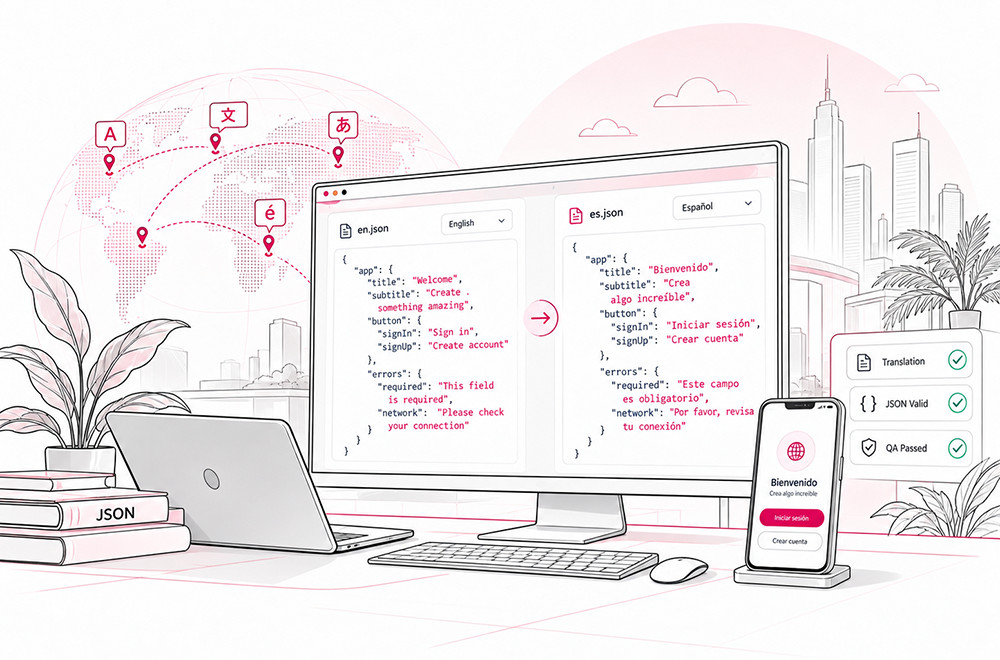
Translate JSON Files While Preserving Keys and Structure
JSON resources combine customer-facing language with identifiers, variables, configuration values, and structured data. Stepes identifies content intended for translation while keeping required technical elements intact.
{
      "checkout": {
        "title": "Complete your order",
        "greeting": "Hello, {name}",
        "save": "Save changes",
        "maxItems": 20,
        "helpUrl": "https://example.com/help"
      }
}{
"checkout": {
"title": "Finalisez votre commande",
"greeting": "Bonjour, {name}",
"save": "Enregistrer les modifications",
"maxItems": 20,
"helpUrl": "https://example.com/help"
}
}{name} placeholder protectedThe example translates user-facing values while keeping resource keys, the {name} token, the number, and the URL unchanged. Arrays, escape sequences, ICU messages, and language-specific plural forms may require additional handling based on your application.
JSON Translation for Software, Apps, and Digital Products
Stepes localizes JSON-based interface strings and structured content for technology companies, enterprise teams, and organizations bringing digital products to international markets.
Web & Mobile Applications
Localize navigation labels, menus, buttons, forms, onboarding instructions, alerts, settings, and other user-facing interface strings in web and mobile applications. Files can be prepared according to the localization library and resource conventions used by your product.
SaaS & Enterprise Software
Translate dashboards, account settings, permissions, workflow instructions, validation messages, system notifications, and product-specific terminology across cloud applications and enterprise software.
E-commerce & Digital Platforms
Localize product attributes, checkout instructions, payment messages, order notifications, customer accounts, and other multilingual digital-commerce experiences while protecting dynamic values and application references.
Structured Product Content
Translate JSON-based help text, knowledge resources, product descriptions, and other structured content intended for multilingual display without altering protected identifiers, configuration values, or operational data.
JSON Localization With Technical and Linguistic Quality Assurance
Valid JSON syntax does not guarantee accurate translations, and good translations may still fail when variables or resource rules are changed. Stepes addresses both linguistic quality and agreed file-level requirements.
Separate checks for separate risks. Structural validation, bilingual linguistic review, and optional in-context application testing serve different purposes.
Keys, Nested Objects & Data Types
Preserve protected keys, nested resource hierarchies, arrays, and nontranslatable data types. Customer-defined schemas and resource conventions can be incorporated into project instructions.
Placeholders & Dynamic Variables
Protect tokens such as {name}, {{username}}, %s, and numbered parameters according to the application's interpolation rules, while allowing natural target-language word order.
Pluralization & ICU Messages
Address locale-specific plural categories, ICU MessageFormat expressions, or framework-specific string variants according to the application and agreed resource requirements.
UTF-8, Unicode & Escaping
Handle multilingual character sets, special characters, escaping, and language-specific text conventions. Right-to-left layouts may require additional in-application testing.
UI Context & Text Expansion
Use available screenshots, string descriptions, glossaries, and character limits to clarify ambiguous UI text and evaluate potential display problems.
Technical Checks & Linguistic QA
Check agreed syntax and structural constraints alongside source-to-target accuracy, completeness, fluency, terminology, and locale conventions. In-context testing can be scoped separately.
Professional JSON Translation and Review Services
Choose the workflow that matches your source files and quality requirements. Stepes can produce new translations, manage AI-assisted translation with human review, or independently validate existing JSON translations.
New translations
Professional Human JSON Translation
Professional software linguists translate new JSON content with attention to interface context, technical terminology, target-language conventions, and consistent wording across related product features.
Specialized applications, high-visibility interfaces, new products, and terminology-sensitive content.
Managed AI + human workflow
AI JSON Translation With Human Review
AI-enabled translation accelerates production while professional linguists check meaning, terminology, completeness, contextual fit, and natural user-facing language before delivery.
Larger resource sets and recurring updates that call for a balance of turnaround, cost, and professional quality control.
Existing translations
JSON Translation Review & Validation
Already have translated JSON files? Stepes compares existing translations with the original source to identify errors, omissions, terminology problems, and unnatural language, while protecting required technical elements.
AI- or machine-translated files, previous-vendor output, internal translations, and inherited multilingual resources.
Have existing JSON translations? You do not need to recreate them to request independent bilingual review. Provide the original source and translated files so linguists can verify accuracy and correct identified issues.
Explore AI Translation Review ServicesHow Our JSON Translation Process Works
Submit a single JSON resource or coordinate a multilingual file set. The translation workflow is adapted to your source content, technical instructions, and selected review requirements.
Submit Your JSON Files
Upload JSON files, or share source and target resources for review. Include languages, deadlines, and any framework instructions.
Identify Translatable Content
Identify user-facing values and protect keys, variables, URLs, IDs, data types, and agreed schema requirements.
Translate or Review
Apply professional human translation, AI-assisted translation with human review, or independent bilingual review, supported by approved terminology.
Validate Quality & File Integrity
Check source-to-target accuracy and agreed technical requirements, including JSON syntax, required placeholders, and encoding.
Receive Localized JSON Files
Receive localized JSON files for integration. Additional in-context review and testing can be included in the project scope.
JSON Localization for Continuous Software Releases
New features and regular product updates create recurring multilingual resource changes. Stepes combines reusable translations, terminology management, professional review, and optional API integration to support ongoing JSON localization across releases.
Translation Memory
Reuse approved translations when new releases contain unchanged or repeated strings. Focus new work on modified and newly introduced content.
Explore Translation MemoryTerminology Management
Keep product names, feature labels, technical terms, and preferred language consistent across files, languages, and software releases.
Explore Terminology ManagementAPI-Connected Workflows
Connect supported content submission, translation and review, status tracking, and results delivery to existing systems through an agreed API integration.
Explore Translation APIRelease Quality Management
Apply repeatable review criteria, retain approved corrections, and add in-context checks where an interface or software change introduces additional risk.
Explore Translation QAFrequently Asked Questions About JSON Translation
Answers to common questions about file handling, translation review, technical requirements, software testing, and project pricing.
Can Stepes translate JSON files directly without converting them to another format?
Yes. Stepes provides JSON file translation that processes translatable content while retaining the required resource structure. You can submit JSON resources without manually extracting each string into Word or Excel. Project-specific schemas and formatting requirements can be reviewed during preparation.
Will JSON keys, placeholders, and nested structures remain unchanged?
Stepes protects resource keys, placeholders, and required structural elements according to your application's localization rules. Translatable values are distinguished from protected data, and appropriate checks can be applied. When a target language needs additional plural variants or other resource changes, the approach is agreed against your application's schema.
Can you review JSON translations created by AI or another provider?
Yes. Professional bilingual reviewers compare existing translations with their source strings for meaning, completeness, terminology, context, and locale suitability. This includes translations produced by AI, machine translation, external vendors, or internal teams. Technical constraints are considered alongside linguistic corrections.
Does every string value in a JSON file need to be translated?
No. JSON may contain customer-facing text alongside URLs, configuration strings, identifiers, product codes, and other data that must remain unchanged. The translation scope is defined by the file, the application's behavior, and your project instructions.
Can Stepes handle nested JSON files, plural forms, and ICU messages?
Stepes works with structured JSON resources and can assess ICU MessageFormat, plural expressions, and framework-specific string conventions. The exact requirements depend on the application, target locales, and resource format, so complex handling is confirmed during project setup.
Which languages are supported for JSON translation?
Stepes provides translation services in more than 100 languages, including French, Spanish, German, Japanese, Korean, Chinese, Arabic, and Portuguese. Specify the regional locale you need, such as fr-CA, es-MX, pt-BR, zh-CN, or zh-TW, when requesting a quote.
Can translated JSON files be tested inside our application?
Yes. In-context linguistic review and software localization testing can be arranged for projects that need additional assurance. These services may identify truncation, display, terminology, and locale-related interface issues beyond file-level syntax and linguistic checks.
Can JSON translation be automated for regular software updates?
Yes. Recurring programs can use translation memory, approved terminology, workflow automation, and API integration options. An agreed process can help manage new and changed content through translation, review, and delivery across releases.
How much does JSON translation cost?
Pricing depends on the amount of translatable content, language pairs, translation memory reuse, selected translation or review service, and technical requirements. Send your JSON files to Stepes for a quote based on the actual project scope.
Get a Quote for JSON Translation or Review
Send Stepes your JSON resource files for professional translation, AI-assisted translation with human review, or independent validation of existing translations. For recurring software releases or API integration, our team can help define the appropriate workflow.