
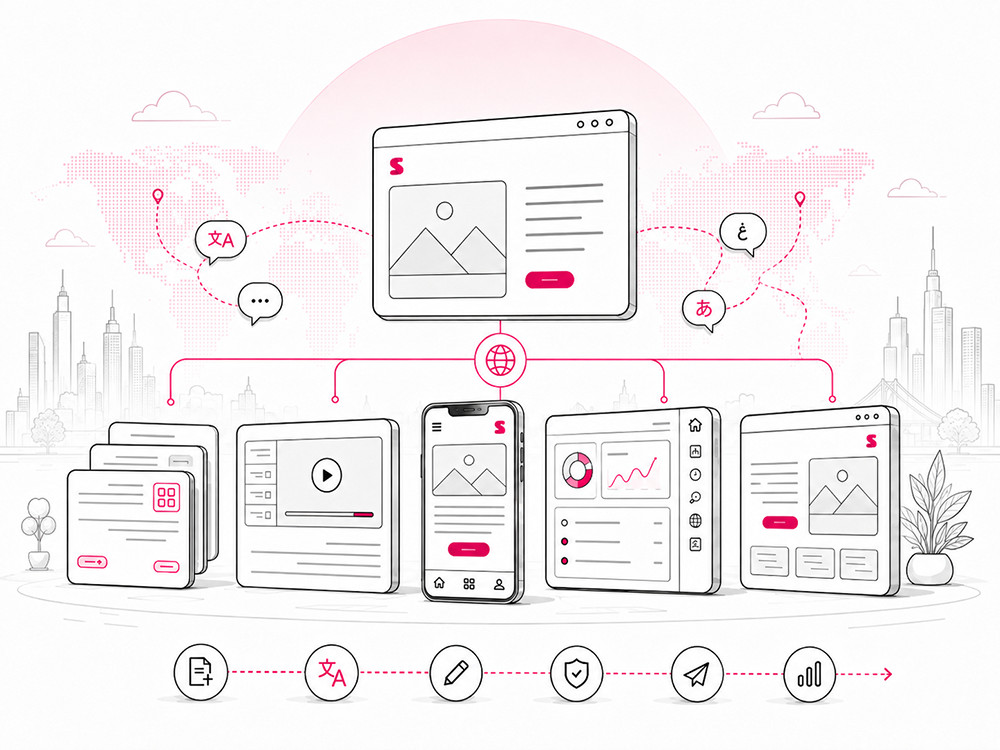
Localization Goes Beyond Translation
Translation changes content from one language into another. Localization adapts the complete experience for the language, market, technology, and expectations of the people who use it.
A website can be accurately translated but still contain search terms customers never use. A mobile app can have correct interface strings that no longer fit its buttons. A software product can support multiple languages while displaying dates, currencies, addresses, or plural forms incorrectly. Professional localization brings language, user experience, technology, and operations into one connected process so the final experience feels intentional in every market.
Content
Localize what customers, employees, partners, and users read, hear, watch, and interact with—from website copy and UI strings to product information, documentation, video, audio, graphics, learning materials, and notifications.
Experience
Adapt navigation, layouts, imagery, calls to action, forms, user journeys, writing direction, visual hierarchy, and regional conventions so the experience feels natural locally.
Technology
Prepare the systems that create, store, deliver, and update multilingual content across CMS platforms, repositories, resource files, APIs, structured content, applications, and digital platforms.
Operations
Coordinate terminology, translation memory, translation and review, quality assurance, stakeholder approvals, localization testing, release management, and ongoing multilingual updates.
Localize Every Digital Experience
Your customers move between websites, applications, product interfaces, learning content, video, support resources, notifications, and other digital touchpoints. Stepes provides specialized localization services for each experience while helping organizations keep language, terminology, quality standards, and multilingual workflows connected.
Website Localization
Build multilingual websites that are ready for customers, search engines, regional teams, and continuous content growth.
Corporate sites, ecommerce, portals, help centers, landing pages, metadata, forms, multimedia, multilingual SEO, CMS workflows, review, testing, and ongoing updates.
Explore Website LocalizationSoftware Localization
Make software products understandable, usable, and release-ready across languages and locales.
SaaS, enterprise applications, embedded systems, UI strings, resource files, localization engineering, locale adaptation, build validation, and testing.
Explore Software LocalizationApp Localization
Create mobile experiences that feel designed for each market rather than translated after development.
iOS, Android, onboarding, transactions, subscriptions, notifications, app-store content, resource engineering, in-context review, and device testing.
Explore App LocalizationGame Localization
Deliver engaging player experiences across languages, cultures, platforms, and ongoing releases.
UI, narrative, dialogue, tutorials, items, achievements, subtitles, downloadable content, player communications, creative adaptation, and localization QA.
Explore Game LocalizationeLearning Localization
Give global learners access to complete, coordinated learning experiences.
Courses, LMS content, assessments, narration, subtitles, video, graphics, interactive modules, course engineering, and functional QA.
Explore eLearning LocalizationMultimedia Localization
Adapt the language audiences both hear and see across multilingual media.
Video, subtitles, captions, voice-over, dubbing, transcription, on-screen text, graphics, animation, audio, timing, and technical delivery.
Explore Multimedia LocalizationOne Connected Localization Lifecycle
Successful localization is not a handoff between translation and launch. It is a connected lifecycle that begins with the source experience and continues through multilingual release and future updates.
Connect
Bring content into the localization workflow through supported files, content platforms, repositories, APIs, website technologies, or enterprise systems.
Prepare
Analyze scope, locale requirements, content, internationalization considerations, translation memory, terminology, context, roles, and review requirements.
Localize
Apply the right combination of AI translation, translation memory, professional linguists, post-editors, subject-matter specialists, and localization engineers.
Review
Validate accuracy, fluency, terminology, tone, completeness, technical integrity, brand language, and market appropriateness.
Test
Evaluate localized experiences in context across languages, devices, platforms, and representative user journeys.
Launch
Deliver production-ready localized resources or return approved content into the appropriate publishing and release process.
Keep Current
Preserve language assets, context, approvals, and review decisions so new and modified content can move through a repeatable workflow.
The Right Localization Workflow for Every Experience
Not every piece of content requires the same localization process. A high-volume knowledge base, product interface, regulated instruction, and global advertising campaign carry different risks and require different levels of human judgment.
Stepes helps organizations select an appropriate workflow based on content type, audience, visibility, risk, volume, turnaround, brand importance, and quality requirements.
AI Translation
Accelerate large volumes of suitable, frequently updated, or time-sensitive content when quality requirements and content risk support greater automation.
AI + Human Post-Editing
Combine machine speed with professional linguistic validation for accuracy, fluency, terminology, context, and agreed quality requirements.
Professional Human Translation
Use qualified native-language linguists when nuance, customer experience, or communication quality requires stronger human judgment.
Subject-Matter Translation
Match technical, legal, financial, medical, scientific, engineering, and other specialized content with professionals who understand its terminology and domain.
Transcreation
Adapt campaigns, headlines, taglines, product positioning, and other creative content around intended impact, tone, emotion, and persuasive effect.
Localization That Moves With Your Content
Digital content does not stand still. Product teams ship new features. Marketing teams launch campaigns. Websites publish new pages. Ecommerce catalogs change. Support teams update knowledge bases. Training programs add new modules. Apps release new versions.
If localization only begins after each source update is finished, multilingual markets can quickly fall behind. Continuous localization brings translation, review, quality assurance, and multilingual delivery closer to the content lifecycle so localization can move alongside recurring releases and updates.
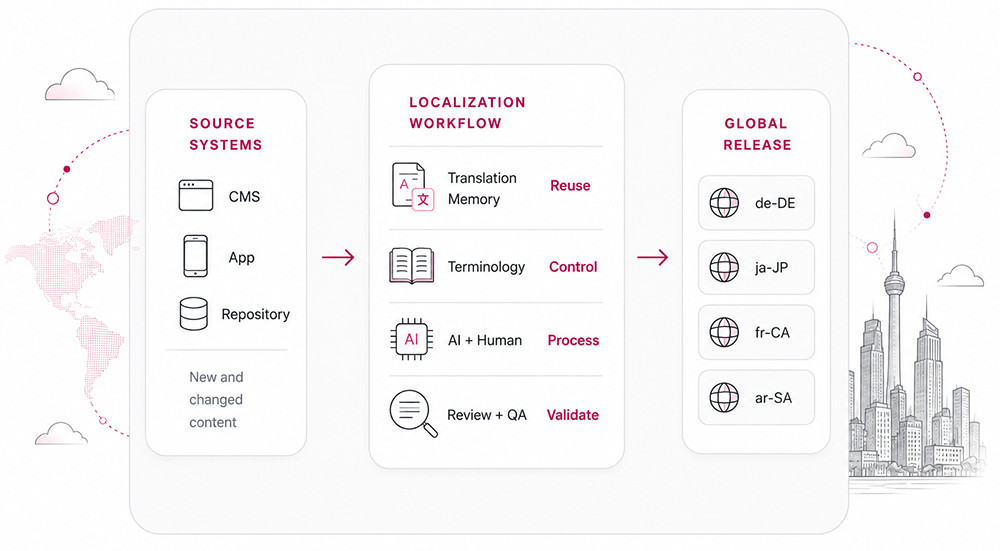
Connect Content at the Source
Reduce repeated file preparation by connecting localization with the systems where content is created and managed.
Route New and Changed Content
Focus localization effort on what actually changed while identifying reusable approved content and new content that requires translation.
Reuse Approved Language
Preserve translation memory, terminology, style guidance, and review decisions across products, channels, and markets.
Automate Repeatable Steps
Support content intake, analysis, assignment, translation-memory matching, notifications, review routing, status tracking, and delivery.
Keep Teams Aligned
Connect localization, product, engineering, marketing, content, legal, regional, and other stakeholders through clearer workflow ownership.
Support Faster Global Releases
Move localization alongside content development instead of treating it as a separate downstream phase.
Launch the Experience, Not Just the Translation
A translation can be linguistically accurate and still fail in the final product. Text may be truncated. A form may reject locally formatted information. A right-to-left screen may display incorrectly. Search metadata may remain in the source language.
Localization testing looks beyond individual translations to validate the complete experience in context. Stepes can tailor testing scope to your product, platform, languages, release risk, audience, and available test environment.
Explore Website Localization TestingLinguistic QA
Accuracy, completeness, fluency, grammar, terminology, tone, consistency, contextual meaning, and unintended source-language content.
Visual QA
Text expansion, truncation, overlapping elements, incorrect line breaks, alignment, unsupported fonts, layout imbalances, and other display issues.
Functional QA
Navigation, forms, search, links, inputs, validation, account flows, transactions, notifications, dynamic content, and interactive functionality.
Locale QA
Dates, times, currencies, numbers, measurements, names, addresses, telephone formats, sorting, and other locale-sensitive behavior.
RTL & Complex-Script QA
Directionality, mirrored layouts, mixed-language content, alignment, rendering, input behavior, and readability.
Device & Digital Experience QA
Browsers, operating systems, screen sizes, software environments, localized metadata, accessibility, multimedia, downloads, routing, and integrations where in scope.
Internationalize Once. Localize Efficiently Everywhere.
Localization adapts an experience for individual languages and markets. Internationalization prepares the underlying product or system to support those adaptations efficiently.
For software, apps, websites, and other digital products, addressing internationalization early can reduce avoidable engineering work and localization defects later in the release process.
Explore Internationalization ServicesSeparate Language From Code
Externalize translatable content so teams can update language resources without modifying executable code for every locale.
Support Unicode and Global Scripts
Prepare products to display the character sets and scripts required by target languages.
Design for Text Expansion
Build interfaces that can accommodate differences in word length, line wrapping, character density, and reading direction.
Handle Plurals and Grammar Correctly
Avoid source-language assumptions that prevent applications from supporting locale-specific plural rules and grammatical structures.
Support Right-to-Left Experiences
Plan interface behavior, alignment, navigation, icons, mixed-direction strings, and layout changes for languages such as Arabic and Hebrew.
Localize Regional Formats
Separate language from locale-sensitive elements such as dates, currencies, numbers, units, time formats, names, addresses, and sorting behavior.
Protect Flexible Resource Architecture
Use localization-ready resource structures, stable keys, placeholders, variables, and content models that can move efficiently through multilingual workflows.
Localize for 100+ Languages and Regional Markets
Global language strategy is about more than selecting a language name. The right localization program considers the exact audience and locale—whether you need Brazilian or European Portuguese, Canadian or European French, Latin American or European Spanish, Simplified or Traditional Chinese, or another market-specific language variant.
Stepes supports professional localization across more than 100 languages and regional variants, with linguists selected according to language pair, locale, subject matter, content type, and communication goal.
View All LanguagesStepes also supports right-to-left languages, CJK languages, complex scripts, and multilingual programs spanning many target markets at the same time.
Built for Enterprise Localization
Localization becomes more complex as content volume, languages, stakeholders, technologies, and release frequency grow. Enterprise organizations need reusable language assets, controlled workflows, quality processes, program visibility, and a scalable operating model that can support multilingual content over time.
Translation Memory
Turn previously approved translation work into a reusable enterprise asset for consistency and faster recurring localization.
Explore Translation MemoryTerminology Management
Control product names, technical terms, branded language, abbreviations, regulated terminology, and other high-value vocabulary.
Explore Terminology ManagementWorkflow Automation
Route multilingual content through repeatable processes based on content type, languages, teams, quality requirements, and review stages.
Explore Workflow AutomationQuality Management
Combine language assets, automated checks, professional review, contextual validation, specialist expertise, customer review, and localization testing.
Explore Quality ManagementCentralized Visibility
Give localization stakeholders clearer visibility into multilingual projects, languages, content, workflow status, reviews, and deliverables.
Explore Centralized VisibilitySecurity & Governance
Manage enterprise content through controlled workflows designed around appropriate access, roles, content handling, review responsibilities, and organizational requirements.
Explore Security & GovernanceLocalization Expertise for Specialized Industries
Language that works for one industry may be inappropriate for another. Product terminology, regulatory expectations, customer journeys, review requirements, content risk, and market conventions all affect how localization should be managed.
Stepes supports localization programs across regulated, technical, commercial, and customer-facing industries, matching workflows and linguistic resources to the subject matter and business context.
Explore IndustriesLife Sciences & Healthcare
Multilingual digital experiences, applications, training, patient and professional content, and regulated materials where terminology, accuracy, review discipline, and subject expertise matter.
Technology & Software
SaaS platforms, applications, product interfaces, developer content, help systems, documentation, onboarding, and continuous product releases.
Manufacturing & Engineering
Equipment interfaces, connected products, technical documentation, learning content, safety information, product support, and global operations.
Automotive & Transportation
Vehicle and mobility experiences, embedded interfaces, technical systems, service content, customer communications, and supporting documentation.
Financial Services
Digital financial experiences, customer communications, applications, disclosures, product information, and other content requiring precise language and controlled terminology.
Retail & Ecommerce
Product information, merchandising, websites, apps, promotions, checkout journeys, customer support, and continuously changing ecommerce content.
Education & eLearning
Courseware, learning platforms, assessments, training, multimedia, student content, and educational experiences.
Media & Entertainment
Subtitles, voice content, streaming experiences, games, marketing, metadata, apps, digital platforms, and ongoing global content releases.
Plan Better Global Experiences
Strong localization programs begin before the first translation is assigned. The Stepes Localization Guides provide practical guidance for teams planning, building, launching, testing, and scaling multilingual digital experiences.
Localization Guides
Understand the complete localization lifecycle across content, experience, technology, quality, and multilingual operations.
Explore Localization GuidesWebsite Localization Guide
Plan website content, technical implementation, review, multilingual SEO, testing, launch, and continuous updates.
Read Website Localization GuideSoftware Localization Guide
Prepare interfaces, resources, terminology, engineering, QA, release workflows, and recurring software updates for international markets.
Read Software Localization GuideMobile App Localization Guide
Prepare application architecture, resource files, context, terminology, testing, and release workflows for multilingual mobile experiences.
Read Mobile App Localization GuideWebsite Localization Testing Checklist
Validate language, layout, responsive behavior, functionality, locale conventions, RTL support, accessibility, search visibility, and market readiness before launch.
View Website Localization Testing ChecklistLocalization Services FAQs
Practical answers about localization scope, AI, continuous workflows, testing, integrations, internationalization, language coverage, and workflow design.
Localization services adapt content, products, and digital experiences for a specific language, locale, and market. The process typically includes translation but can also involve terminology, cultural and regional adaptation, interface considerations, localization engineering, locale formats, multimedia, in-context review, quality assurance, testing, and technical integration. For continuously updated products and content, localization can also include workflow automation, APIs, translation memory, terminology management, and recurring release support.
Translation primarily transfers meaning from one language into another. Localization goes further by adapting the complete experience for a particular audience and market. Depending on the content, this can include language, user-interface layouts, imagery, navigation, dates, currencies, measurements, regional conventions, multimedia, technical resources, search behavior, accessibility, and customer journeys. A translated product communicates in another language. A well-localized product is designed to work naturally in that market.
Stepes supports localization across websites, ecommerce experiences, software, SaaS products, enterprise applications, mobile apps, games, eLearning, multimedia, help centers, knowledge bases, digital product content, user interfaces, customer communications, and other multilingual experiences. We also support related content such as documentation, app-store content, notifications, subtitles, voice-over, product information, marketing assets, training, and support resources.
Continuous localization integrates translation and review into recurring content or product workflows instead of treating localization as a separate phase after source content is complete. New and changed content can be identified and moved through translation, review, QA, and delivery as websites, software, applications, documentation, or other content evolves. This approach is especially valuable for agile software development, frequently updated websites, ecommerce catalogs, support content, mobile applications, and other digital experiences with ongoing releases.
Yes. Stepes supports AI-enabled localization workflows and can combine AI translation, translation memory, terminology, automated quality processes, professional post-editing, human translation, subject-matter review, and transcreation based on project requirements. The appropriate model depends on factors such as content type, audience, volume, turnaround, quality expectations, visibility, and risk.
Yes. Localization testing can be configured according to the product, platform, languages, available test environment, and release requirements. Testing may include linguistic QA, visual review, functional testing, locale validation, right-to-left testing, device and browser coverage, text expansion, truncation, font rendering, navigation, forms, accessibility considerations, metadata, integrations, and other elements of the localized experience.
Yes. Stepes supports multiple localization integration models, including APIs, website technologies, structured content, localization resource files, repositories, and enterprise content workflows. The right implementation depends on where your content lives, how frequently it changes, who owns publishing, what review stages are required, and how multilingual content needs to return to production.
Internationalization—often abbreviated as i18n—is the process of designing or preparing a digital product so it can support multiple languages and locales without requiring substantial engineering changes for every market. It can include externalizing translatable strings, supporting Unicode, planning for text expansion, handling locale-specific formats, enabling right-to-left layouts, supporting plural rules, and separating language resources from application code.
Stepes supports professional translation and localization in more than 100 languages and regional variants. Coverage includes major European, Asian, Middle Eastern, African, and American languages as well as locale-specific combinations such as Brazilian Portuguese, Canadian French, Latin American Spanish, Simplified Chinese, and Traditional Chinese.
The best workflow depends on your content, audience, technology, languages, release cadence, quality requirements, and business risk. A frequently updated help center may benefit from a highly automated AI-assisted workflow, while an important product interface may require professional linguistic review and in-context validation. Regulated or technical content may require subject-matter specialists, while global campaign messaging may benefit from transcreation.
Take Your Digital Experience Global
Whether you are localizing a website, software platform, mobile app, learning program, multimedia content, or an interconnected digital ecosystem, Stepes can build a localization workflow around your content, technology, languages, quality requirements, and global growth goals.
Connect intelligent automation with professional linguistic expertise. Keep terminology and language assets consistent. Validate the complete localized experience. And build multilingual workflows that continue working as your content changes.