
AI Translation Insights
AI Translation for Medical Devices: A Risk-Based Human Validation Guide
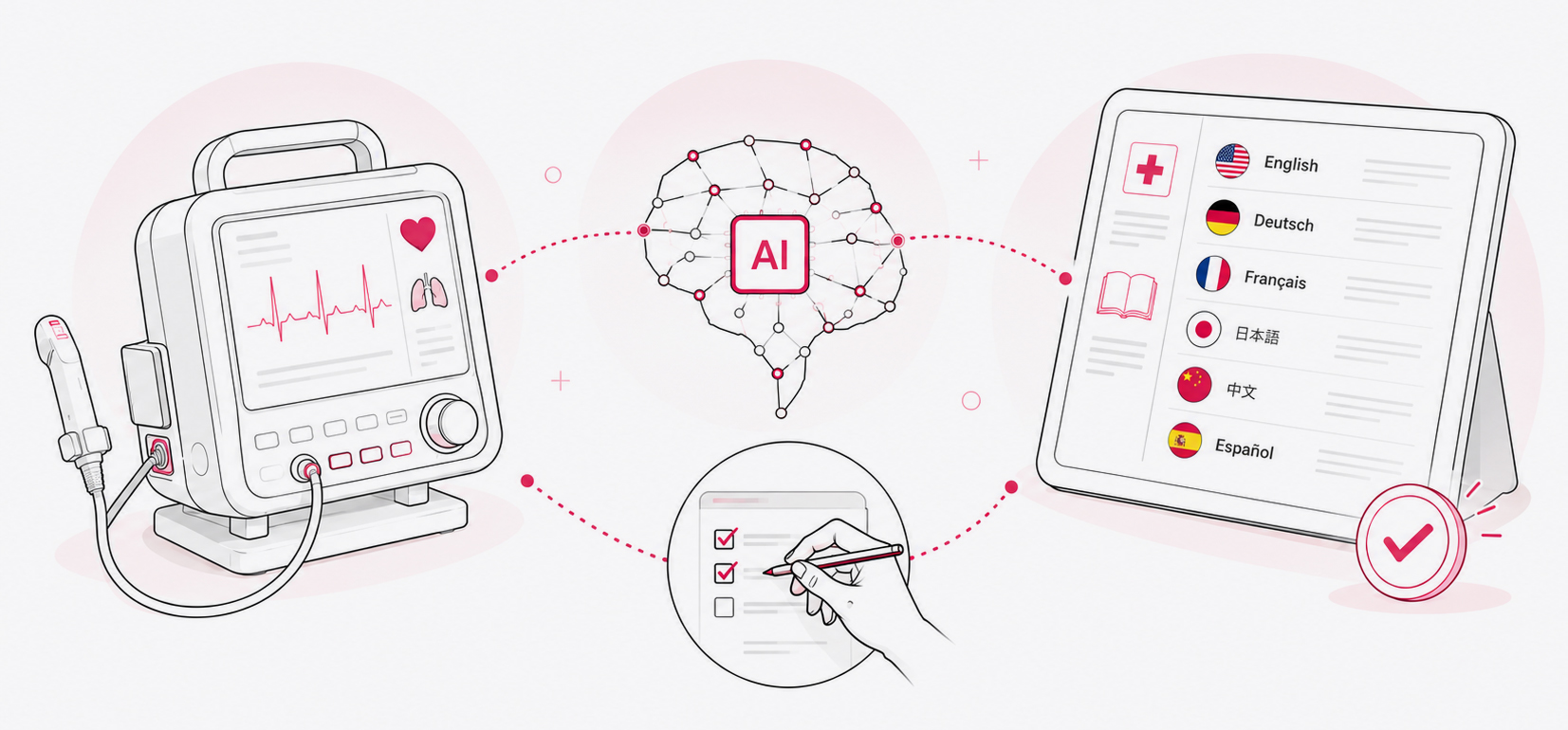
AI can help medical device companies translate recurring content more efficiently, apply terminology more consistently, and manage multilingual updates at greater scale. But fluent output is not the same as validated output—especially when content affects product use, patient understanding, regulatory documentation, or user safety.
Use this guide to identify where AI-assisted translation can add value, where qualified human validation remains essential, and how to build a secure, controlled, and traceable workflow for medical device content.
Important Scope Distinction
AI Translation Is Not the Same as an AI-Enabled Medical Device
This guide addresses the use of artificial intelligence, machine translation, and related automation to translate medical device content. It does not address the regulatory approval of devices whose clinical or operational functions incorporate artificial intelligence.
In this guide, human validation means qualified linguistic, technical, and contextual review against defined acceptance criteria. It does not by itself imply regulatory authorization or approval.
Review FDA Guidance on AI-Enabled Device Software FunctionsExecutive Summary
Five Principles for a Responsible Medical Device AI Translation Program
The strongest programs treat AI as one controlled component within a broader multilingual quality system—not as an independent release authority.
Classify Before Translating
Determine the audience, intended use, safety impact, confidentiality, and regulatory significance before selecting a translation workflow.
Control the Language Foundation
Use approved source content, terminology, translation memory, style guidance, and product references to reduce ambiguity before AI processing begins.
Match Human Review to Risk
The potential consequence of an error—not the document title alone—should determine who reviews the translation and how extensively it is validated.
Test the Complete Workflow
Evaluate the model, language assets, automated checks, professional reviewers, contextual QA, and approval process as one operating system.
Preserve Evidence
Maintain source versions, workflow decisions, quality results, reviewer records, corrections, approvals, and final release files.
In This Guide
What AI Translation Means in Medical Device Localization
AI translation is best understood as a collection of technologies and workflow capabilities rather than one universal translation method. Different systems may be appropriate for different content types, languages, update patterns, and quality requirements.
Neural Machine Translation
Neural machine translation produces target-language text by learning multilingual patterns from large datasets. It is commonly used for high-volume, recurring, or structured content and may be adapted with domain-specific language assets.
Large Language Model Translation
Large language models can use broader context, instructions, examples, and supporting references. This can improve flexibility for complex phrasing, but it can also introduce variability, unsupported wording, or inconsistent terminology when controls are weak.
Generative AI Assistance
Generative AI can help summarize source context, identify terminology candidates, compare revisions, classify content, and support reviewers. These uses should be governed separately from the final translation itself.
Automated Quality Estimation
Quality-estimation systems can predict which segments are more likely to contain errors and help prioritize review. A confidence score is not proof that a translation is correct.
Translation Memory
Translation memory stores approved bilingual segments for future reuse. It is not the same as AI translation, but it is often one of the strongest controls in recurring medical device programs.
Explore Translation MemoryTerminology Management
A governed termbase controls product names, components, procedures, warnings, clinical concepts, abbreviations, units, approved variants, and terms that must not be translated.
Explore Terminology ManagementNot every localization efficiency comes from AI.
Translation memory, structured content, terminology databases, automated QA, and workflow routing may contribute as much operational value as the translation model itself.
Why Medical Device Translation Requires Risk-Based Decisions
Medical device content ranges from early internal drafts to instructions that directly affect how a device is installed, operated, cleaned, maintained, or used in patient care. These materials do not carry the same level of risk and should not all follow the same translation workflow.
A short software string may contain a routine navigation label—or it may warn the user about an unsafe condition. A training slide may provide general background—or explain a procedure that must be performed in a precise sequence. A document described as marketing content may still contain product claims, intended-use language, or safety information.
Translation risk should therefore be assessed at the content, module, or segment level whenever practical.
ISO 14971 provides a systematic medical device risk-management process, while ISO 13485 establishes the broader quality-management framework used by device organizations and relevant suppliers. Neither standard prescribes an AI translation method, but their risk-based, documented, and process-controlled principles provide a useful foundation for multilingual workflow decisions.
The Central Question
What could happen if this content were translated incorrectly, incompletely, inconsistently, or without sufficient context?
The answer should determine whether AI is appropriate, which controls are required, who reviews the translation, whether in-context validation is needed, who can approve release, and what evidence must be retained.
AI may be part of a high-control workflow. It should not be treated as the release authority.
Risk Classification Framework
The Medical Device AI Translation Risk Model
Use six risk dimensions to classify content, then route each content type to the level of AI assistance, human review, contextual validation, and evidence appropriate to its potential impact.
Intended Use and Audience
Identify who will rely on the translated content, including healthcare professionals, patients, caregivers, service technicians, regulators, distributors, and internal teams.
Consequence of Error
Consider whether an error could affect patient or operator safety, product performance, diagnosis or treatment, installation, maintenance, regulatory acceptance, or market release.
Source-Content Maturity
Confirm that the source is approved, complete, internally consistent, and free from unresolved abbreviations or conflicting versions before translation begins.
Linguistic and Technical Complexity
Assess clinical and engineering terminology, abbreviations, procedural instructions, conditional logic, warnings, measurements, tables, symbols, and product-specific concepts.
Context and Presentation
Determine whether reviewers will see the content in its final IFU, label, diagram, software screen, training module, or other user-facing environment.
Technology, Language, and Data Risk
Evaluate the specific model, language pair, content type, confidentiality requirements, data-processing controls, and known failure patterns.
Risk-Based Routing Matrix
Apply the highest relevant tier when a document contains mixed-risk content. A mostly routine file may still contain safety-critical segments that require a higher-control route.
| Risk Tier | Typical Content | Recommended Approach | Minimum Controls |
|---|---|---|---|
|
Tier 1 Internal and Exploratory |
Early research, noncontrolled internal summaries, knowledge discovery, and preliminary content triage. | AI translation may support internal understanding when permitted by company policy. | Approved processing environment, clear nonrelease status, confidentiality controls, and proportionate sampling. |
|
Tier 2 Operational and Customer-Facing |
Product training, service documentation, support content, noncritical software strings, and general product communications. | AI-assisted translation followed by complete professional linguistic review. | Approved terminology and translation memory, automated QA, full human review, and product-context references. |
|
Tier 3 Regulated or Safety-Relevant |
Instructions for Use, warnings, precautions, labeling, patient materials, critical software strings, and regulatory documents. | AI may assist inside a controlled workflow, but unreviewed output should not be released. | Qualified medical linguist, independent revision or specialist validation, numeric and unit QA, contextual review, and documented approval. |
|
Tier 4 High-Criticality or Insufficiently Proven |
Content where an error could contribute to serious harm, novel products, difficult source content, newly introduced models, or insufficiently evaluated languages. | Human-led translation or rigorously validated AI-assisted translation with enhanced controls. | Dual review, subject-matter involvement, representative pilot evidence, formal acceptance criteria, in-context testing, release authorization, and ongoing monitoring. |
Tier 1
Internal and Exploratory
- Typical Content
- Early research, noncontrolled internal summaries, knowledge discovery, and preliminary content triage.
- Recommended Approach
- AI translation may support internal understanding when permitted by company policy.
- Minimum Controls
- Approved processing environment, clear nonrelease status, confidentiality controls, and proportionate sampling.
Tier 2
Operational and Customer-Facing
- Typical Content
- Product training, service documentation, support content, noncritical software strings, and general product communications.
- Recommended Approach
- AI-assisted translation followed by complete professional linguistic review.
- Minimum Controls
- Approved terminology and translation memory, automated QA, full human review, and product-context references.
Tier 3
Regulated or Safety-Relevant
- Typical Content
- Instructions for Use, warnings, precautions, labeling, patient materials, critical software strings, and regulatory documents.
- Recommended Approach
- AI may assist inside a controlled workflow, but unreviewed output should not be released.
- Minimum Controls
- Qualified medical linguist, independent revision or specialist validation, numeric and unit QA, contextual review, and documented approval.
Tier 4
High-Criticality or Insufficiently Proven
- Typical Content
- Content where an error could contribute to serious harm, novel products, difficult source content, newly introduced models, or insufficiently evaluated languages.
- Recommended Approach
- Human-led translation or rigorously validated AI-assisted translation with enhanced controls.
- Minimum Controls
- Dual review, subject-matter involvement, representative pilot evidence, formal acceptance criteria, in-context testing, release authorization, and ongoing monitoring.
Reassess the route when conditions change.
A previously validated workflow should be reassessed when the model, target language, product, intended use, content type, language assets, source complexity, or observed failure patterns change materially.
Where AI Can Improve Medical Device Translation Efficiency
The strongest AI translation programs use technology to remove repetitive work, identify risk, and help qualified reviewers focus their attention. They do not use automation simply to remove human accountability.
Create a First Translation Draft
For suitable content, AI can generate an initial translation that a professional linguist then corrects and validates. The benefit should be measured by final reviewer effort and accepted quality—not generation speed alone.
Accelerate Recurring Content Updates
AI can identify changed source segments, distinguish new text from approved translations, compare revisions, and route only affected content for review.
Improve Terminology Application
AI systems can be instructed or adapted to use approved terminology and can help identify terms that need clarification before translation begins.
Detect Potential Quality Issues
Automated checks can flag missing numbers, altered measurements, inconsistent terms, untranslated text, placeholder errors, formatting differences, and possible additions or omissions.
Route Review More Intelligently
Content classification and quality estimation can direct higher-risk or lower-confidence segments to more specialized reviewers.
Support Cross-Document Consistency
AI and comparison tools can help identify terminology or statement differences across IFUs, labeling, software, training, service manuals, patient education, and regulatory content.
Measure the benefit at approved release.
A stronger first draft may still be unsuitable if it creates unpredictable critical errors, weak terminology adherence, poor reproducibility, excessive reviewer effort, or unacceptable data risk. Generation speed alone is not a meaningful quality metric.
Research continues to improve control.
Current research explores terminology constraints, quality-aware deferral, and ways to reduce unsupported translation output. These advances are useful, but they do not remove the need to validate the complete medical device workflow.
Professional Oversight
Where Professional Human Validation Remains Essential
Human review is essential wherever the correct translation depends on technical meaning, intended use, user behavior, product context, risk, or approved regulatory language.
A translation can sound natural while changing the technical meaning.
Human validation makes the reviewer's role concrete: compare against the source, resolve ambiguity, verify product context, confirm the final presentation, and document approval.
Meaning and Technical Accuracy
Confirm that the translation preserves the same instruction, condition, limitation, relationship, and technical meaning as the approved source.
Warnings, Precautions, and Contraindications
Verify signal words, severity, affected users, required actions, prohibited actions, conditions, exceptions, symbols, and consistency with related device documentation.
Negation and Conditional Logic
Review negative instructions, double negatives, "only if" statements, "unless" clauses, conditional sequences, exceptions, and dependencies between procedural steps.
Numbers, Units, and Ranges
Verify decimal values, percentages, dates, doses, concentrations, temperatures, dimensions, pressures, tolerances, electrical values, and minimum or maximum ranges.
Product and Component Terminology
Confirm that similar device components, accessories, menu items, and procedures are not confused, and use product drawings, screenshots, glossaries, and related documents as context.
Abbreviations and Acronyms
Determine whether each abbreviation should be retained, expanded, translated, localized, replaced with an approved equivalent, or defined at first use.
Software Variables and Interface Behavior
Validate placeholders, variables, string concatenation, line breaks, character limits, alarms, bidirectional text, punctuation, and strings reused in multiple contexts.
Final-Format and In-Context Quality
Review the translation in its final document, eIFU, label, packaging, embedded display, application, training module, diagram, or callout.
The Human Roles in a Controlled Workflow
One person may perform more than one role when qualified and permitted by the organization's procedures. Responsibilities and approval authority should still be explicit.
| Role | Primary Responsibility |
|---|---|
| Medical Device Translator or Post-Editor | Validates meaning, terminology, grammar, fluency, completeness, and audience suitability against the source. |
| Independent Reviser | Performs a second bilingual review, focusing on errors that may have survived the first review. |
| Subject-Matter Expert | Resolves technical, clinical, engineering, product, or intended-use questions beyond purely linguistic judgment. |
| Localization Engineer | Protects tags, variables, file structure, software behavior, extraction, reintegration, and technical integrity. |
| In-Country or Market Reviewer | Confirms authorized local terminology, market conventions, and product-language expectations. |
| Quality or Regulatory Owner | Determines acceptance criteria and authorizes release under the organization's quality system. |
| Program Owner | Maintains workflow rules, language assets, model authorization, performance data, and improvement actions. |
Medical Device Translator or Post-Editor
Validates meaning, terminology, grammar, fluency, completeness, and audience suitability against the source.
Independent Reviser
Performs a second bilingual review, focusing on errors that may have survived the first review.
Subject-Matter Expert
Resolves technical, clinical, engineering, product, or intended-use questions beyond purely linguistic judgment.
Localization Engineer
Protects tags, variables, file structure, software behavior, extraction, reintegration, and technical integrity.
In-Country or Market Reviewer
Confirms authorized local terminology, market conventions, and product-language expectations.
Quality or Regulatory Owner
Determines acceptance criteria and authorizes release under the organization's quality system.
Program Owner
Maintains workflow rules, language assets, model authorization, performance data, and improvement actions.
Common AI Translation Risks for Medical Device Content
The most serious problems are not always obvious. Quiet errors—such as a missing qualifier, inconsistent component name, altered range, or unsupported explanation—may look fluent and plausible while changing the intended meaning.
Fluent but Incorrect Output
AI-generated translations can be grammatically polished while altering technical meaning, making some errors harder to detect than visibly poor translation.
Unsupported Additions
A generative system may add explanatory language, infer missing context, expand an abbreviation incorrectly, or make a statement sound more complete than the source.
Omissions
Models may omit qualifiers, repeated warnings, limitations, table content, negative particles, procedural steps, or text separated by formatting and extraction errors.
Hallucinated Translation
The output may introduce content that is not adequately supported by the source, even when the result sounds natural and authoritative.
Terminology Drift
The same product term may be translated differently across chapters, versions, related documents, software screens, or target languages.
Incorrect Normalization
AI may alter product names, catalog numbers, model identifiers, units, symbols, standards references, software commands, or other protected content.
Source Ambiguity
A system may silently choose one plausible interpretation of unclear source text rather than flagging the need for clarification.
Language-Pair Variability
A workflow that performs well for one high-resource language may behave differently in another language with different morphology, script, terminology, or training-data availability.
Model and Output Variability
Model versions, prompts, context, terminology resources, segmentation, and generation settings can materially change the resulting translation.
Confidentiality and Data Exposure
Submitting device specifications, patient-related content, regulatory files, or unreleased product information to an unapproved AI service can create serious governance risk.
Recommended Operating Model
A Controlled AI + Human Medical Device Translation Workflow
A responsible workflow connects content classification, approved language assets, authorized technology, automated checks, qualified professional review, final-context validation, release approval, and continuous improvement.
Prepare and Generate
Steps 1–5
Classify the Content
Document intended use, audience, markets, languages, safety relevance, regulatory significance, confidentiality, required reviewer qualifications, and final publishing environment.
Approve and Prepare the Source
Confirm that the source is complete, internally approved, clearly versioned, aligned with related materials, and accompanied by the references reviewers need.
Prepare Translation Memory and Terminology
Identify approved translations for reuse and prepare product names, components, procedures, warnings, units, abbreviations, interface labels, prohibited variants, and do-not-translate items.
Select and Authorize the Technology
Evaluate the system for the target language, content type, terminology adherence, completeness, numeric preservation, data processing, model-change controls, and known failure patterns.
Generate the Translation Draft
Apply the approved source, current language assets, style guidance, protected-text rules, relevant context, and authorized model configuration.
Validate, Release, and Improve
Steps 6–10
Run Automated Quality Checks
Check for missing or extra content, terminology deviations, untranslated text, number and unit mismatches, tag errors, punctuation anomalies, and protected-text changes.
Conduct Qualified Professional Review
A qualified native-language medical device linguist compares the output against the source and corrects meaning, terminology, completeness, grammar, fluency, and audience fit.
Validate the Final Context
Review text placement, page references, callouts, diagrams, symbols, tables, warnings, links, interface behavior, line wrapping, and cross-document consistency.
Approve and Release
Record what was approved, the source and target versions, language and locale, reviewers, accepted deviations, approval date, and final release destination.
Improve the Program
Feed validated corrections back into translation memory, terminology, model instructions, automated checks, reviewer guidance, and source-authoring practices.
-
01
Classify the Content
Document intended use, audience, markets, languages, safety relevance, regulatory significance, confidentiality, required reviewer qualifications, and final publishing environment.
-
02
Approve and Prepare the Source
Confirm that the source is complete, internally approved, clearly versioned, aligned with related materials, and accompanied by the references reviewers need.
-
03
Prepare Translation Memory and Terminology
Identify approved translations for reuse and prepare product names, components, procedures, warnings, units, abbreviations, interface labels, prohibited variants, and do-not-translate items.
-
04
Select and Authorize the Technology
Evaluate the system for the target language, content type, terminology adherence, completeness, numeric preservation, data processing, model-change controls, and known failure patterns.
-
05
Generate the Translation Draft
Apply the approved source, current language assets, style guidance, protected-text rules, relevant context, and authorized model configuration.
-
06
Run Automated Quality Checks
Check for missing or extra content, terminology deviations, untranslated text, number and unit mismatches, tag errors, punctuation anomalies, and protected-text changes.
-
07
Conduct Qualified Professional Review
A qualified native-language medical device linguist compares the output against the source and corrects meaning, terminology, completeness, grammar, fluency, and audience fit.
-
08
Validate the Final Context
Review text placement, page references, callouts, diagrams, symbols, tables, warnings, links, interface behavior, line wrapping, and cross-document consistency.
-
09
Approve and Release
Record what was approved, the source and target versions, language and locale, reviewers, accepted deviations, approval date, and final release destination.
-
10
Improve the Program
Feed validated corrections back into translation memory, terminology, model instructions, automated checks, reviewer guidance, and source-authoring practices.
How to Validate AI-Assisted Medical Device Translation
Validation should begin with predefined acceptance criteria rather than a subjective impression that the translation looks good. Test the complete operating workflow using representative content and qualified evaluators.
Build a Representative Evaluation Set
Include the types of content the workflow will process in production. Do not evaluate only short, simple, or repetitive sentences.
Test Every Intended Language
Performance in one language is not evidence for another. Include the actual locale, regional terminology, language-specific formatting, morphology, writing-system behavior, right-to-left requirements where relevant, and realistic reviewer expectations.
Compare realistic operating models:
- Professional translation and independent revision
- NMT plus full human post-editing
- LLM translation plus full human post-editing
- Translation memory plus AI for new segments
- Standard review versus risk-routed review
Define Error Categories Before Testing
Critical Errors
Errors that could contribute to patient or user harm, materially change intended use, alter a warning or contraindication, identify the wrong component, or create a serious regulatory or operational consequence.
Major Errors
Errors that significantly affect meaning, usability, terminology, completeness, or professional quality but do not meet the project's definition of critical.
Minor Errors
Localized issues that do not materially change meaning but should be corrected, such as limited grammar, punctuation, or stylistic problems.
Measure More Than Automated Scores
Automated metrics can support comparison, but they should not replace qualified medical device review. Track the measures that determine whether the workflow can reach approved release consistently.
Compare total operating performance.
The comparison should evaluate final quality, reviewer effort, turnaround, consistency, security, traceability, and total operating cost. A model that writes more fluently may still be unsuitable if its errors are difficult to predict or expensive to verify.
Auditability
Quality Records and Traceability
Traceability should show how a translated release was produced and approved. "Human reviewed" is not a complete quality record unless the organization can show what was reviewed, by whom, against which criteria, and with what result.
| Record | Purpose |
|---|---|
| Approved Source Version | Confirms the exact content used for translation. |
| Content Classification | Records intended use, audience, risk tier, and review route. |
| Technology Record | Identifies the authorized provider, system, model, and material configuration. |
| Translation Memory Version | Shows which approved bilingual content was applied. |
| Terminology Version | Shows which terms, definitions, and approved translations governed the project. |
| Automated QA Results | Records detected issues and their disposition. |
| Reviewer Record | Identifies qualified linguistic and specialist roles. |
| Correction History | Preserves material findings and approved resolutions. |
| In-Context QA Evidence | Confirms review in the final document, label, interface, or publication environment. |
| Approval Record | Identifies authorized release approval. |
| Released Target Files | Preserves the final approved multilingual deliverables. |
| Superseded Versions | Prevents outdated translations from being reused or distributed unintentionally. |
Approved Source Version
Confirms the exact content used for translation.
Content Classification
Records intended use, audience, risk tier, and review route.
Technology Record
Identifies the authorized provider, system, model, and material configuration.
Translation Memory Version
Shows which approved bilingual content was applied.
Terminology Version
Shows which terms, definitions, and approved translations governed the project.
Automated QA Results
Records detected issues and their disposition.
Reviewer Record
Identifies qualified linguistic and specialist roles.
Correction History
Preserves material findings and approved resolutions.
In-Context QA Evidence
Confirms review in the final document, label, interface, or publication environment.
Approval Record
Identifies authorized release approval.
Released Target Files
Preserves the final approved multilingual deliverables.
Superseded Versions
Prevents outdated translations from being reused or distributed unintentionally.
Security and Governance
Protect Confidential Content Before It Reaches an AI System
Medical device translation may involve technical specifications, product-development materials, regulatory files, cybersecurity information, patient-related content, and unreleased commercial information. Technology authorization must occur before content enters the system.
Do not use unapproved public AI tools.
Confidential content should not be submitted to a public AI service unless the service and its exact configuration have been formally approved for that use.
Evaluate the Processing Environment
Control Human Access
Define who may access each project, what qualifications and confidentiality obligations apply, how reviewers are authenticated, whether local downloading is permitted, and how access is revoked.
Protect Language Assets
Clarify ownership, reuse, data separation, retention, portability, deletion, and any use of translation memories, termbases, prompts, and bilingual corpora for model adaptation or training.
Govern Model Changes
Determine how model updates are communicated, which changes trigger re-evaluation, whether configurations can be reproduced, and how regressions are detected.
Plan for Incidents
Establish escalation, containment, notification, correction, business continuity, and supplier-management procedures for security or quality events.
Implementation Checklist
How to Run a Controlled Medical Device AI Translation Pilot
A pilot should determine where the workflow is suitable—not attempt to prove that one technology can translate every type of medical device content.
-
1
Define the Decision
State whether the pilot must determine suitability for a content type, compare models, reduce reviewer effort, improve terminology adherence, or establish a higher-risk review tier.
-
2
Select Representative Content
Include routine, difficult, safety-relevant, repetitive, terminology-dense, formatted, software, and historically problematic content.
-
3
Prepare Approved References
Provide source documents, translation memory, terminology, style guidance, product references, screenshots, known error examples, and market requirements.
-
4
Establish Acceptance Criteria
Define prohibited critical errors, major-error thresholds, terminology requirements, completeness requirements, reviewer qualifications, and approval authority.
-
5
Test the End-to-End Workflow
Include file preparation, AI processing, language assets, automated QA, human review, formatting, contextual validation, and approval.
-
6
Measure Reviewer Effort
Track time, rewriting, recurring error types, terminology research, AI verification effort, post-editing errors, and final QA findings.
-
7
Document the Decision by Risk Tier
Approve the workflow for defined content, controls, languages, and uses rather than issuing one organization-wide AI approval.
-
8
Monitor Production Performance
Track quality trends, model changes, terminology deviations, complaints, recurring corrections, and content that needs rerouting.
Use a content-specific approval outcome.
A pilot may approve the workflow for defined content types, languages, controls, or internal uses; approve it conditionally; or determine that it is not suitable. Avoid a single organization-wide "AI translation approved" decision.
Buyer Checklist
How to Evaluate an AI Translation Provider
A credible provider should be able to explain the complete quality and governance workflow—not only which AI model it uses.
Technology and Model Selection
- Which systems are used for each language and content type?
- How are models evaluated and model versions identified?
- How are terminology, numbers, units, additions, and omissions checked?
- Can specific content be excluded from generative AI processing?
Medical Device Expertise
- How are medical device linguists qualified?
- How are translators matched to the product and subject area?
- When are independent revision and subject-matter review required?
- How are warnings, critical instructions, and technical questions handled?
Quality Management
- How are critical, major, and minor errors defined?
- What acceptance criteria and automated checks are used?
- How are corrective actions recorded and returned to language assets?
- How are quality trends reported across language and content type?
Security and Data Governance
- Is customer content retained or used for model training?
- Where is data processed and hosted?
- Which subcontractors may access it?
- How are translation memories, terminology, retention, and deletion controlled?
Workflow and Traceability
- Can source and target versions be linked?
- Can review and approval status be tracked?
- Can content be routed by risk?
- Can the workflow support eIFUs, software strings, labels, and formatted documents?
Continuous Improvement
- How are approved translations and terminology reused?
- How are glossary conflicts resolved?
- How are regressions detected?
- What triggers workflow revalidation?
Clear answers are more informative than a general claim about AI quality.
Evaluate whether the provider can connect technology selection, medical device expertise, qualified reviewers, security controls, traceability, quality metrics, and continuous improvement into one coherent operating model.
Standards and Regulatory Context
Apply Each Requirement According to Its Actual Scope
AI does not make a translation compliant. Human review alone does not make it compliant either. The complete process and final content must satisfy the organization's applicable regulatory, quality, labeling, market, and product requirements.
EU MDR and IVDR Language Requirements
EU Member State language requirements differ by market, device context, and information type. Official materials focus on which languages are required; they do not certify a particular translation engine or make unreviewed AI output acceptable by default.
FDA Device Labeling
FDA device-labeling requirements address the content, language, prominence, and other requirements applicable to labeling. FDA change guidance also includes an example in which adding a foreign-language translation is documented rather than treated as a new 510(k) when the translation does not change the meaning of the directions for use. The manufacturer remains responsible for the risk-based assessment and documentation.
ISO 13485:2016
ISO 13485 defines quality-management-system requirements for organizations involved in medical devices and related services. Its process, documentation, supplier-control, and risk-based principles can inform multilingual workflow governance.
ISO 14971:2019
ISO 14971 specifies principles and a process for managing medical device risk throughout the lifecycle. Translation teams can apply the same fundamental logic when evaluating how multilingual content errors could affect safe and effective device use.
ISO 18587:2017
ISO 18587 establishes requirements for full human post-editing of machine translation output and post-editor competence. The published 2017 edition remains current. ISO/DIS 18587, a second edition covering post-editing of non-human translation output, is under development.
ISO 5060:2024
ISO 5060 provides guidance for evaluating human translation, post-edited machine translation, and unedited machine output using configured error types, sampling, penalty points, and qualified evaluators.
ISO 11669:2024
ISO 11669 provides general guidance for translation project stages and can support clearer specifications, responsibilities, communication, and acceptance requirements.
ISO 17100:2015
ISO 17100 specifies requirements for professional translation services. Its scope excludes raw machine translation output plus post-editing, so AI-assisted workflows should not be described as covered by ISO 17100 solely because human review occurred.
NIST AI Risk Management Framework
The NIST AI Risk Management Framework and Generative AI Profile provide voluntary guidance for organizing AI governance, risk mapping, measurement, monitoring, and response planning.
Standards should not be overextended.
Certification to one standard does not automatically establish compliance with every regulatory, security, medical device, or translation requirement. Apply the current published edition according to its stated scope and review changes when standards are revised.
Frequently Asked Questions
AI Translation for Medical Devices
These answers provide practical planning guidance. Specific regulatory, quality, security, and release decisions should follow your organization's procedures and applicable market requirements.
Can AI be used to translate medical device Instructions for Use?
AI can support IFU translation inside a controlled workflow. The source should be approved, terminology and translation memory should be applied, and the complete output should receive qualified professional review. Safety-relevant IFU content may also require independent revision, subject-matter clarification, final-format QA, and authorized approval. Unreviewed AI output should not be released as a medical device IFU.
Does EU MDR or IVDR prohibit AI translation?
EU MDR and IVDR language requirements focus on the information that must accompany a device and the languages required in individual Member States. Official language tables do not approve or certify a particular translation technology. Manufacturers remain responsible for ensuring that translated information is accurate, controlled, and appropriate for the intended market and audience.
Does FDA approve AI translation systems for device labeling?
FDA does not provide blanket approval of translation models for medical device labeling. Its labeling resources address the requirements applicable to the final labeling. The manufacturer remains responsible for the labeling and for documenting relevant changes and assessments.
Which medical device content requires complete human review?
Complete human review should be expected for regulated, safety-relevant, patient-facing, technically complex, or externally released content where an error could affect product use, understanding, compliance, or safety. Examples commonly include IFUs, warnings, precautions, labeling, patient materials, critical interface strings, service procedures, regulatory documents, and field safety communications.
Is machine translation post-editing the same as proofreading?
No. Full post-editing requires the linguist to compare machine-generated output against the source and correct every issue necessary to meet the project requirements. Proofreading is usually a narrower target-language check and may not include complete bilingual verification.
Can AI translate medical device software interfaces?
AI may help produce draft translations for medical device software, but software localization also requires technical and contextual validation. Teams should check variables, placeholders, concatenated strings, alarms, character limits, truncation, control labels, reuse across screens, right-to-left behavior, and the relationship between displayed text and device function.
How does terminology management improve AI translation?
Approved terminology gives the system and reviewers explicit guidance for product names, components, procedures, warnings, abbreviations, and technical concepts. It also enables automated checks for prohibited or inconsistent variants. Human review remains necessary where the correct term depends on grammar, meaning, audience, or market context.
Is AI translation suitable for low-resource languages?
Potentially, but suitability must be demonstrated through representative testing and qualified native-language evaluation. Performance can vary significantly by language, domain, and model, so results from one high-resource language should not be extrapolated automatically to another language.
Can AI reduce medical device translation cost?
AI may reduce effort for recurring, high-volume, or lower-risk content, especially when approved terminology and translation memory are already available. Savings are less certain when output requires extensive rewriting, multiple review rounds, technical reconstruction, or correction of unpredictable critical errors. The relevant measure is total cost to approved release—not raw generation cost.
Is confidential medical device content safe in public AI tools?
Confidential content should not be submitted to a public AI tool unless the tool and its exact configuration have been formally approved for that content. Evaluate data retention, training use, hosting, access, encryption, subcontractors, deletion, contractual protections, and incident response before processing begins.
How often should an AI translation workflow be revalidated?
Reassessment should occur when a material change could affect quality or risk, including a new model, model version, provider, prompt configuration, language, content type, product, intended use, language asset, integration, security requirement, or adverse quality finding. Periodic performance review is also advisable when no known material change has occurred.
How many human reviewers are needed?
The number and type of reviewers should reflect content risk, target market, and the organization's procedures. Lower-risk content may use one qualified reviewer. Safety-relevant or regulated content may require independent revision, subject-matter involvement, in-country validation, or a separate authorized approver. Reviewer count alone does not guarantee quality; each role needs a defined purpose and suitable qualifications.
Sources and References
Authoritative Sources Used in This Guide
Regulatory, standards, and AI-governance information should be reviewed against the current official source before a workflow or market decision is finalized.
-
Artificial Intelligence-Enabled Device Software Functions: Lifecycle Management and Marketing Submission Recommendations
U.S. Food and Drug Administration
-
Overview of Language Requirements for Manufacturers of Medical Devices
European Commission
-
General Device Labeling Requirements
U.S. Food and Drug Administration
-
Deciding When to Submit a 510(k) for a Change to an Existing Device
U.S. Food and Drug Administration
-
ISO 13485:2016 — Medical Devices — Quality Management Systems
International Organization for Standardization
-
ISO 14971:2019 — Medical Devices — Application of Risk Management
International Organization for Standardization
-
ISO 18587:2017 — Post-Editing of Machine Translation Output
International Organization for Standardization
-
ISO/DIS 18587 — Post-Editing of Non-Human Translation Output
International Organization for Standardization
-
ISO 5060:2024 — Evaluation of Translation Output
International Organization for Standardization
-
ISO 11669:2024 — Translation Projects — General Guidance
International Organization for Standardization
-
ISO 17100:2015 — Translation Services — Requirements for Translation Services
International Organization for Standardization
-
Artificial Intelligence Risk Management Framework: Generative Artificial Intelligence Profile
National Institute of Standards and Technology
-
WMT 2025 Paper on Terminology-Aware Machine Translation
Association for Computational Linguistics Anthology
-
EMNLP 2025 Paper on Quality-Aware Translation Deferral
Association for Computational Linguistics Anthology
-
NAACL 2025 Paper on Translation Hallucination
Association for Computational Linguistics Anthology
Build AI Translation Around Medical Device Quality
AI can make medical device translation faster and more scalable when it is applied to the right content, grounded in approved language assets, and governed by qualified professionals.
Use AI where it improves efficiency and control—not where it removes accountability.
A successful program classifies content before processing, applies approved terminology and translation memory, evaluates each language and workflow, routes review according to risk, validates translations in context, and preserves the evidence behind every approved release.
Plan a Controlled Multilingual Medical Device Workflow
Discuss your content types, target markets, languages, quality requirements, security needs, reviewer roles, and update workflows with the Stepes medical device translation team.