
Medical Device Localization Guide
Electronic IFUs (eIFUs): Multilingual Translation and Version Control
Coordinate multilingual electronic instructions for use across websites, software, downloadable files, product revisions, archived editions, and paper-copy workflows.
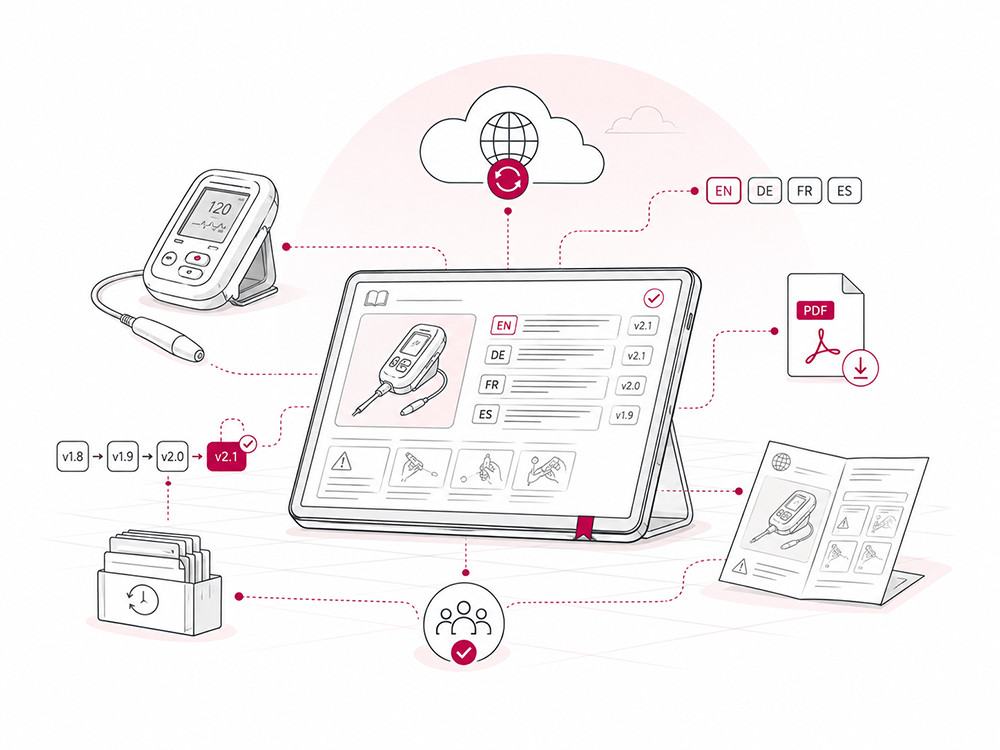
An electronic instruction for use is not simply a paper manual saved as a PDF.
Once an IFU is delivered through a website, software application, device display, downloadable document, or electronic storage medium, manufacturers must control a connected set of content relationships. Which IFU applies to each device and model? Which revision is approved in each market? Which languages are current? Do the website, software, downloadable file, and paper copy contain the same approved information? Can the complete release history be reconstructed when quality or regulatory teams need it?
For multilingual medical device programs, every approved source revision can affect multiple languages, markets, product configurations, delivery channels, and publication states. Without disciplined version control, a correct translation can still be attached to the wrong device, published under the wrong revision, left active after replacement, or allowed to diverge from the printed edition.
This guide complements broader Medical Device Translation Services planning by focusing specifically on multilingual release governance across the full eIFU lifecycle.
This guide provides practical localization and content-governance guidance. It does not replace market-specific regulatory, legal, quality-system, or product-safety advice.
Key Takeaways
Six Principles for a More Controlled Multilingual eIFU Program
One Governed Content Baseline
Every language and delivery format should trace back to an approved source revision.
Explicit Applicability
Product, market, language, intended user, revision, and channel relationships should be recorded rather than inferred.
Change-Based Localization
Each source revision should be assessed for linguistic, regulatory, functional, and publishing impact before translation begins.
Synchronized Release Channels
Website files, software-delivered instructions, device displays, downloads, and paper editions should be released from the same approved content state.
Visible Current and Historical Status
Users and responsible teams should be able to identify the current edition without confusing it with a superseded version.
Risk-Based Automation
Translation memory, terminology, AI, and automated QA can improve efficiency, while accountable human review remains essential for regulated content.
In This Guide
What Is an Electronic IFU?
An electronic instruction for use, commonly called an eIFU, is an IFU made available through an electronic delivery method rather than—or, in some cases, in addition to—a paper document.
Depending on the device, jurisdiction, intended user, and approved delivery model, an eIFU may be:
- displayed by the medical device;
- embedded in device software;
- included in a mobile, desktop, or web application;
- supplied on electronic storage media;
- published as a downloadable PDF;
- delivered through a dedicated e-labeling portal; or
- accessed through a stable URL, QR code, or product-support page.
Under the current EU framework, an eIFU remains complete textual information; symbols and graphics may be included, while video or audio may supplement rather than replace the required text. Electronic delivery does not reduce the need for content control. It introduces additional objects that must remain connected throughout the device lifecycle.
| Controlled Object | Examples |
|---|---|
| Device identity | Product family, catalog number, model, UDI-DI |
| Content identity | IFU number, source revision, document status |
| Language identity | Language, locale, and market-approved variant |
| Format | HTML, PDF, XML, application content, device display, paper |
| Delivery channel | Website, software, download repository, print workflow |
| Approval state | Draft, in review, approved, published, superseded |
| Time state | Approval, effective, publication, and retirement dates |
| Market applicability | Country, jurisdiction, intended user, regulatory route |
A multilingual eIFU program succeeds when every target edition can be traced to the correct device, market, source revision, approved language, delivery format, and publication state.
Why Multilingual eIFU Version Control Is Difficult
A source-language IFU may appear to be one document, but a global release can create dozens or hundreds of controlled outputs.
Consider an IFU that supports four related device models, 18 European markets, 14 language editions, a downloadable PDF, device-integrated help, a paper-on-request file, and one archived prior revision. That program is not simply a set of 14 translations. It is a network of product, language, market, revision, channel, and status relationships.
One Source Change Can Create Unequal Language Impact
A revision may require different actions in different languages and markets:
- a new translation in every affected language;
- a terminology decision in only selected locales;
- layout reflow where translated text expands;
- right-to-left interface changes for Arabic;
- new screenshots for localized software;
- an updated paper file in markets where paper remains necessary; or
- no change where the affected device configuration is unavailable.
Digital and Paper Releases Can Drift Apart
The website may receive a new PDF before the print file is approved. A regional team may continue using a locally saved obsolete edition. Software help can be updated in one release while the downloadable manual remains unchanged. The solution is not merely better naming; it is a controlled release process that treats all formats as manifestations of the same approved information.
The Regulatory and Quality Context
Electronic delivery requirements differ by jurisdiction, device type, intended user, and product-specific regulation. A global program needs a common operating model with documented market-specific controls.
Electronic IFUs in the European Union
Commission Implementing Regulation (EU) 2021/2226, as amended by Regulation (EU) 2025/1234, establishes conditions for supplying electronic IFUs under the EU Medical Device Regulation. The 2025 amendment broadened eligibility for covered devices intended for professional users while retaining paper instructions for lay users where lay use is reasonably foreseeable.
A documented eIFU risk assessment may need to consider:
- intended-user knowledge and experience;
- the use environment;
- access to required hardware, software, and internet resources;
- protection against content tampering;
- backup mechanisms and temporary service unavailability;
- emergency situations;
- website compatibility;
- paper-copy fulfillment; and
- management of different IFU versions.
EU Control Snapshot
Current eIFU Requirements With Direct Version-Control Impact
The following summarizes selected requirements in the consolidated EU framework. Confirm the exact application for the device, intended user, and target market.
| Control Area | Current EU Framework |
|---|---|
| Professional-use eligibility | Under the current EU framework, covered devices intended for professional users may use electronic IFUs instead of paper. Where lay use is reasonably foreseeable, instructions intended for lay users must be supplied in paper form. |
| Paper-copy fulfillment | A paper IFU must be available at no extra cost within the period defined by the risk assessment and, at the latest, within seven calendar days after a request—or with device delivery when requested at order. |
| Revision communication | Manufacturers need a system that clearly indicates revisions and informs users when a revision is necessary for safety reasons. |
| Retention periods | For expiry-dated, non-implantable devices: 10 years after the last device is placed on the market and at least two years after the final device expiry. For devices without an expiry date and implantable devices: 15 years after the last device is placed on the market. |
| Issued and obsolete versions | Issued electronic versions and publication dates must remain available during the applicable retention period; obsolete editions may be supplied upon request. |
| Website controls | The eIFU website must use a stable, directly accessible address, a commonly usable format readable with freely available software, content-tampering safeguards, and controls that reduce downtime and display errors. |
International Labeling Principles
The International Medical Device Regulators Forum’s 2024 labeling principles cover paper and electronic labeling while recognizing that individual authorities may impose additional requirements. A global eIFU program should distinguish the organization’s global content standard from product-specific, jurisdictional, language, and manufacturer-defined risk controls.
United States Quality-System Considerations
The FDA Quality Management System Regulation became effective on February 2, 2026 and incorporates ISO 13485:2016 by reference. Current 21 CFR 820.45 includes controls for labeling accuracy, documented release, and prevention of labeling and packaging mix-ups. FDA guidance also permits paper or electronic user manuals for specifically covered electronic products, but that guidance should not be generalized to every medical device. Electronic-delivery permissions remain product- and regulation-specific and should not be treated as a universal equivalent of the EU eIFU framework.
Content and Delivery Are Different Control Layers
ISO 20417:2026 addresses information supplied by medical device manufacturers but does not prescribe one universal delivery medium. Manufacturer-supplied information requirements and delivery-channel requirements are related, but they are not interchangeable. A valid digital channel does not correct incomplete content, and approved content can still fail when it is published under the wrong device, language, revision, or access path.
Stepes Control Framework
The Multilingual eIFU Control Framework
Manage multilingual eIFUs as a seven-stage content lifecycle in which each stage produces the evidence needed by the next.
Govern
Establish the approved source, document identity, revision, owner, and authoring environment.
Map
Connect each revision to the applicable products, models, markets, users, languages, and channels.
Assess
Classify every change by safety, regulatory, functional, linguistic, software, layout, and publishing impact.
Localize
Translate the approved delta while preserving validated content, terminology, and traceability.
Verify
Review changed segments in the complete IFU and validate the final formatted or integrated edition.
Release
Publish every applicable language and format through one coordinated release decision.
Archive and Monitor
Retain prior editions, protect retrieval, monitor access and feedback, and route future changes through the same controls.
Source approval produces the controlled revision. Applicability mapping produces the release matrix. Change assessment produces the localization scope. Translation and validation produce release evidence. Publication and archival preserve the complete history.
Create a Controlled Source of Truth
The source of truth is the approved content state from which every target-language edition is produced.
The source may reside in a controlled document management system, component content management system, XML or DITA repository, product lifecycle management environment, validated labeling platform, approved technical-publications workflow, or another governed system. The technology matters less than the controls around it.
Minimum Source-Control Information
- a unique document identifier and unambiguous revision;
- approval status, approval date, and effective date;
- identified product and intended-user scope;
- a documented content owner and change history;
- approved editable source files;
- controlled graphics and screenshots; and
- links to applicable terminology and reference materials.
Practical Distinction
A PDF Can Be an Approved Output Without Being an Adequate Multilingual Source
Translation teams may also need editable authoring files, linked images, embedded fonts, conditional-text rules, product variables, structured XML, software strings, cross-reference definitions, and a reliable comparison against the prior revision.
Control Reusable Content at the Component Level
Reusing approved warnings, procedures, and maintenance instructions can reduce inconsistent updates. Reuse should still be confirmed for meaning, device context, intended user, market, related graphics, cross-references, and language approval.
Build a Product–Market–Language Matrix
A controlled release matrix should answer one essential question: Which exact IFU edition is approved for each product, market, language, and delivery channel?
| Recommended Field | Control Purpose |
|---|---|
| Product family | Groups related devices while preserving model-level control |
| Device or model | Identifies the exact applicable configuration |
| Catalog or product number | Connects the IFU to commercial identification |
| Basic UDI-DI or UDI-DI | Supports controlled device identification where applicable |
| Jurisdiction | Identifies the governing market |
| Intended user | Distinguishes professional and lay-user requirements |
| Source document ID | Connects the target edition to its controlled source |
| Source revision | Identifies the approved content baseline |
| Language and locale | Distinguishes market-appropriate language variants |
| Target edition ID | Identifies the exact translated deliverable and its relationship to the source |
| Delivery format | PDF, HTML, software, device display, or paper |
| Approval status | Draft, in review, approved, released, or superseded |
| Publication and effective dates | Records when the edition became available and applicable |
| Paper-copy status | Identifies supplied, on-request, or not-applicable paper delivery |
| Archive location | Identifies where the prior edition can be retrieved |
| Release owner | Identifies the accountable approval authority |
Illustrative Record
One Product Family, Several Controlled Editions
| Product | Market | Language | Source → Target Edition | Channel | Status |
|---|---|---|---|---|---|
| Imaging Console X4 | Germany | German—Germany | IFU-4821 Rev 06 → IFU-4821 Rev 06 de-DE | Website PDF + paper on request | Current |
| Imaging Console X4 | France | French—France | IFU-4821 Rev 06 → IFU-4821 Rev 06 fr-FR | Website PDF + paper on request | Current |
| Imaging Console X3 | Germany | German—Germany | IFU-4821 Rev 05 → IFU-4821 Rev 05 de-DE | Archived PDF | Superseded |
The matrix should be controlled data, not a manually recreated spreadsheet attached to each release. Where spreadsheets are used, access, ownership, approval, and version history should be defined.
Assess Every Source Change Before Translation
Localization should begin with an approved change assessment—not merely a new file.
A complete change package should include:
- the newly approved source and prior approved source;
- a reliable redline or structured comparison;
- the change rationale and affected products or markets;
- safety or regulatory significance;
- the required release date;
- approved terminology changes;
- updated images, UI references, or software builds; and
- instructions for handling unchanged content.
These categories guide localization routing and review depth. They are not medical-device risk classifications.
Typical Content
Warnings, contraindications, emergency instructions, critical operating steps
Recommended Localization Response
Professional medical translation, independent review, full contextual validation, and documented quality and regulatory approval.
Typical Content
Intended use, indications, limitations, performance claims, symbols, manufacturer information
Recommended Localization Response
Specialist translation, terminology review, market-specific regulatory review, and documented approval.
Typical Content
Setup, operation, maintenance, troubleshooting, software procedures
Recommended Localization Response
Technical translation, in-context review, graphic or UI verification, and functional consistency checks.
Typical Content
Contact details, URLs, identifiers, addresses, document references
Recommended Localization Response
Targeted update, identifier verification, link testing, and controlled approval.
Typical Content
Typographical, stylistic, or formatting changes that do not alter meaning
Recommended Localization Response
Documented impact decision, with translation only where the target edition is genuinely affected.
Do Not Translate a Redline in Isolation
A changed sentence may depend on a warning immediately above it, a defined term introduced earlier, a numbered illustration, localized UI text, or a procedural sequence spread across several pages. Review the changed content in the complete IFU.
Distinguish Content Change From Format Change
A new source file may contain no meaningful linguistic change. A small source edit may require substantial target-language work. Separate semantic, terminology, numerical, identifier, layout, cross-reference, image, software-interface, metadata, and publication changes before assigning the localization scope.
Translate and Review Changed Content
A controlled multilingual workflow preserves approved legacy content while applying the right level of review to each new or changed element.
Prepare a Complete Localization Package
Provide the language team with:
- the approved source revision and marked comparison;
- product, intended-use, language, and market context;
- approved terminology and previous approved translations;
- reference graphics, screenshots, and software context;
- style, formatting, and restricted-terminology requirements; and
- the required review and approval pathway.
For broader planning, see the Medical Device IFU Translation Guide.
Use Translation Memory as Controlled Evidence, Not Automatic Approval
Translation Memory can identify content that has already been translated and approved. A previous translation should still be reconsidered when the device context, intended user, market, language variant, neighboring content, warning sequence, or quality history has changed. A 100% text match is not always a 100% context match.
Maintain Medical Device Terminology Centrally
A governed Terminology Management program should record source terms, approved translations, definitions, context, product and market applicability, preferred and prohibited terms, abbreviations, approval status, and change history.
Apply Risk-Appropriate Human Review
Review depth should reflect content risk, intended audience, regulatory significance, novelty, product complexity, language complexity, software or layout dependency, and prior quality history. Back translation may be appropriate when required by a defined process or risk decision, but it should not automatically replace direct expert review.
Validate the Complete Deliverable
Final review should cover:
- linguistic accuracy and medical technical terminology;
- warnings, precautions, numbers, values, and units;
- product identifiers, image callouts, tables, and cross-references;
- bookmarks, navigation, URLs, QR destinations, and metadata;
- fonts, text expansion, right-to-left presentation, and accessibility; and
- comparison with the approved source.
Multilingual Desktop Publishing should be integrated with linguistic and technical QA rather than treated as a purely cosmetic final step.
Synchronize Electronic and Paper Editions
Digital and paper delivery should be treated as two outputs of the same approved content state.
Under the current EU framework, an electronic IFU supplied in addition to a complete paper IFU must remain consistent with the paper content. The same operational principle is useful more broadly: each delivery format should be generated from one approved content state.
Recommended Synchronization Rules
- Use the same approved baseline. Do not maintain independent digital and print masters.
- Generate outputs through controlled production paths. Avoid manually recreating content in each channel.
- Apply one release decision. Record every applicable channel and language.
- Verify packaging and access instructions. Test printed URLs, QR codes, software links, and paper-request instructions.
- Control paper-on-request production. Print from an approved repository rather than local folders or email attachments.
- Record fulfillment where required. Preserve the requested language, device, edition, dates, and delivery method.
- Retire superseded print files. A new electronic release should trigger review of every paper-production repository.
Manage Page Numbers and References Carefully
Translation can change pagination. Section-based references, controlled heading identifiers, dynamically generated links, language-specific tables of contents, automated bookmarks, and final cross-reference validation are generally more robust than hard-coded page references.
Validate eIFU Websites, Software, and Downloads
A linguistically accurate file is not fully controlled if users cannot locate, identify, open, or navigate it reliably.
Make Product Identification Unambiguous
Users should be able to locate the correct IFU through suitable identifiers such as:
- device name, product family, and model;
- catalog number and software version;
- Basic UDI-DI or UDI-DI, where applicable;
- market and language; and
- document number, revision, date, and current or archived status.
Use Clear Language and Locale Labels
Use language names and locale distinctions where necessary, such as French—France, French—Canada, Portuguese—Brazil, Portuguese—Portugal, Chinese—Simplified, and Chinese—Traditional. Flags alone should not be used as language labels.
Test Stable Access and File Integrity
Operational testing should include:
- direct links, redirects, QR codes, and download behavior;
- browser compatibility, mobile presentation, and language-selector behavior;
- search results, authentication barriers, and error pages;
- content-delivery caching, backup, and recovery procedures; and
- protection against unauthorized content changes.
Validate Software-Integrated Instructions
Confirm that:
- the correct language package loads;
- the eIFU matches the software and device version;
- navigation labels match the localized interface;
- embedded links open the correct language edition;
- text is not truncated and warnings remain prominent;
- keyboard, touch, and right-to-left behavior remain usable; and
- offline or backup access behaves as intended.
Use the Medical Device Software Localization Checklist for a deeper software-focused validation workflow.
Control Archived Editions
Archived eIFUs should remain retrievable where required without appearing to be the current edition. Use a visible archived or superseded label, provide a route to the current edition, preserve publication dates, protect file integrity, apply documented retention rules, and prevent accidental overwriting.
Use AI Without Losing Control
AI can improve multilingual eIFU operations when it is assigned well-defined tasks inside a governed workflow.
Productive Uses of AI and Automation
- compare source revisions and identify changed segments;
- classify possible change impact for human confirmation;
- detect terminology candidates and inconsistent usage;
- pretranslate suitable new content;
- flag numbers, units, product names, and missing translations;
- compare warnings across languages;
- find broken links and incorrect metadata; and
- route higher-risk content to specialist review.
Keep Accountable Human Judgment Where It Matters Most
Professional human review remains particularly important for intended use, indications, contraindications, warnings, emergency instructions, procedural steps, clinical or performance statements, nuanced risk communication, and market-specific regulatory language. Fluency is not approval.
| Content Type | Possible Automation | Required Control |
|---|---|---|
| Previously approved unchanged content | Translation memory reuse | Applicability and context confirmation |
| Administrative updates | AI or automated draft | Identifier and target-language verification |
| Technical procedures | AI-assisted translation | Medical technical linguist review and in-context QA |
| Warnings and contraindications | Terminology-assisted drafting | Specialist translation, independent review, and quality approval |
| Regulatory statements | Controlled-language support | Regulatory and linguistic approval |
| Layout and metadata | Automated checks | Final technical validation |
Establish AI Governance
Define approved tools, data-handling requirements, confidentiality controls, permitted content categories, human-review thresholds, audit-log expectations, terminology sources, output-retention rules, exception handling, and final approval authority. Automation should accelerate a controlled process, not create a parallel one.
Explore AI Translation for Medical DevicesAvoid Common Multilingual Version-Control Failures
The most damaging failures are often ordinary operational shortcuts that break traceability or allow channels to drift apart.
The Source Changes During Translation
Different languages are translated from different source states.
Freeze the approved source for the release and process later edits through a documented change order.
Filenames Become the Only Version Record
Files are renamed, copied, or overwritten without preserving authoritative status.
Maintain version data in a controlled system or release register in addition to the filename.
Languages Are Released Independently Without a Defined Model
Users receive inconsistent information across markets or channels.
Define a synchronized global release, approved language waves, or another documented release model.
Translation Memory Matches Are Automatically Accepted
Correct legacy language is reused in the wrong product, market, or procedural context.
Confirm product, audience, market, and contextual applicability before approval.
Old PDFs Remain Easy to Mistake for Current Editions
Users download a superseded IFU believing it is current.
Display status clearly, direct users to the current version, and govern archive discoverability.
Paper Copies Come From Local Storage
A regional office or fulfillment provider prints an obsolete file.
Provide one controlled paper-production source and retire obsolete editions.
The Website Is Tested Only in the Source Language
Other languages contain broken downloads, truncated labels, or incorrect product mappings.
Test every target-language pathway and validate a risk-based sample of full downloads.
Safety Revisions Follow the Standard Publishing Queue
Important changes are delayed or users are not appropriately informed.
Define a separate escalation, approval, notification, and verification pathway.
Software and Documentation Releases Are Managed Separately
The eIFU describes controls or functions that do not match the localized software build.
Connect software version, resource-file release, screenshot approval, and IFU release records.
Version Control Ends at Publication
Access failures, user confusion, paper requests, and post-market findings are not incorporated.
Include eIFU delivery and usability in post-release monitoring and change management.
Multilingual eIFU Release Checklist
Use this checklist to verify the source, language, technical production, delivery channels, archive, and final release before publication.
Source and Scope
- Identify the approved source document and revision.
- Retain the prior approved revision for comparison.
- Document and classify source changes.
- Confirm affected products, models, and intended users.
- Confirm affected markets and languages.
- Identify every required electronic and paper channel.
- Assess the regulatory or safety significance of the change.
Translation and Language Assets
- Apply approved terminology consistently.
- Review translation memory matches for context.
- Complete the required professional review for changed content.
- Verify numbers, units, warnings, and product identifiers.
- Apply the correct market-specific language variants.
- Localize graphics and screenshots where required.
- Resolve reviewer comments and document final linguistic approval.
Formatting and Technical Production
- Review text expansion, page flow, fonts, and right-to-left presentation.
- Confirm tables, callouts, and graphics remain readable.
- Test bookmarks, the table of contents, and cross-references.
- Verify URLs and QR destinations.
- Confirm revision and publication metadata.
- Review accessible document properties.
- Compare the final output with the approved source.
Website and Software
- Associate the correct file with each product and language.
- Use clear language labels and visible current or archived status.
- Test direct downloads, mobile presentation, and browser behavior.
- Confirm the publication address is stable.
- Verify security, content integrity, backup, and downtime controls.
- Confirm software-integrated instructions match the applicable build.
Paper and Archival Controls
- Confirm the paper edition matches the approved electronic content.
- Verify paper-copy request instructions and the controlled print source.
- Retire obsolete print files.
- Archive the prior electronic edition with a clear superseded status.
- Assign retention dates and retain release evidence.
Final Release
- Complete regulatory, quality, and target-language approvals.
- Include every release channel in the release record.
- Independently verify publication.
- Complete any required safety-related communication.
- Assign post-release monitoring ownership.
Frequently Asked Questions
Practical answers to common questions about electronic IFUs, multilingual editions, revision control, AI, and digital delivery.
An IFU is the information supplied by a manufacturer to explain a medical device’s intended purpose, proper use, precautions, and other relevant information. An eIFU is an IFU delivered electronically through a website, software application, device display, storage medium, or another approved electronic channel. Content requirements and electronic-delivery requirements should be evaluated separately.
No universal rule applies across all products and markets. Eligibility depends on the jurisdiction, device, intended user, delivery method, and applicable risk assessment. Under the current EU framework, covered devices intended for professional users may use electronic IFUs instead of paper, while instructions intended for reasonably foreseeable lay use must be supplied in paper form.
There is no single numbering model for every manufacturer. A practical target-edition record should identify the controlled document, source revision, language or locale, applicable product, status, and publication or effective date. The relationship to the approved source must remain unambiguous.
Not necessarily. Some organizations use the source revision across every language and distinguish editions with locale codes. Others use separate target-edition identifiers. Either approach can work when the source-to-target relationship is controlled and easy to reconstruct.
The changed paragraph can often be processed as a translation delta, but the complete target IFU should still be reviewed for contextual and technical integrity. A small edit may affect terminology, cross-references, pagination, screenshots, warnings, or related procedural steps.
It may be possible when the included languages are accepted for the applicable markets, the content and device configuration are the same, navigation remains usable, and market-specific requirements are addressed. A multilingual PDF should not be used merely to simplify file management when it creates usability or applicability problems.
Requirements depend on the jurisdiction. Under the current EU framework, issued electronic versions and their publication dates must remain available during the applicable retention period, while obsolete editions may be made available upon request. Archived editions should always be clearly distinguished from the current edition.
For expiry-dated devices other than implantable devices, the current EU framework requires electronic IFUs to remain available for 10 years after the last device is placed on the market and at least two years after the expiry date of the final produced device. For devices without a defined expiry date and for implantable devices, the period is 15 years after the last device is placed on the market.
AI can support comparison, terminology assistance, first-pass translation, and automated QA. The process should be routed according to content risk. Safety-sensitive instructions, intended use, warnings, contraindications, and regulated statements should receive qualified human translation or review and accountable approval.
No. Translation memory retrieves previously translated content, but it does not independently determine whether that language remains correct for a new product, user, market, or surrounding context.
Approval responsibilities depend on the manufacturer’s quality system. A typical pathway may involve a qualified medical translator or reviewer, labeling or technical publications, regulatory affairs, quality assurance, a local-market reviewer, and product or engineering specialists.
Validation should cover both the controlled content and the delivery experience. Testing may include product and language mapping, download behavior, links, revision information, mobile presentation, browser compatibility, content integrity, archive status, security controls, and paper-request instructions.
Sources and References
The guide draws on official regulatory, standards, and quality-system sources. Product- and market-specific requirements should be confirmed before implementation.
Commission Implementing Regulation (EU) 2021/2226 — Consolidated Version
EUR-Lex
Electronic IFU eligibility, risk assessment, paper-copy availability, version management, retention, access, and website operation.
Commission Implementing Regulation (EU) 2025/1234
EUR-Lex
Amendment expanding electronic IFU eligibility for covered professional-use medical devices and addressing foreseeable lay use.
Principles of Labeling for Medical Devices and IVD Medical Devices — Edition 2
International Medical Device Regulators Forum
International principles for paper and electronic medical device labeling.
ISO 20417:2026 — Information to Be Supplied by the Manufacturer
International Organization for Standardization
International requirements and general principles for manufacturer-supplied medical device information.
Quality Management System Regulation
U.S. Food and Drug Administration
Current U.S. device quality-system framework and its incorporation of ISO 13485:2016 by reference.
21 CFR 820.45 — Device Labeling and Packaging Controls
Electronic Code of Federal Regulations
Current U.S. requirements for labeling accuracy, release, and controls intended to prevent mix-ups.
Acceptable Media for Electronic Product User Manuals
U.S. Food and Drug Administration
FDA guidance on paper and electronic delivery options for the specifically covered electronic products.
Plan a More Controlled eIFU Program
Multilingual eIFU management is most reliable when translation, labeling, software, quality, regulatory, and publishing activities operate as one connected lifecycle. Begin with the approved source, product–market–language matrix, change-assessment method, review pathway, delivery channels, release authority, and archive process.
Is the correct approved information available to the correct user, for the correct device, in the correct language and format—and can your team demonstrate how it got there?
Coordinate Translation, Review, Production, and Release Across Every eIFU Edition
Stepes helps medical device teams manage professional translation, terminology, multilingual production, software localization, quality review, and controlled delivery across global content programs.