
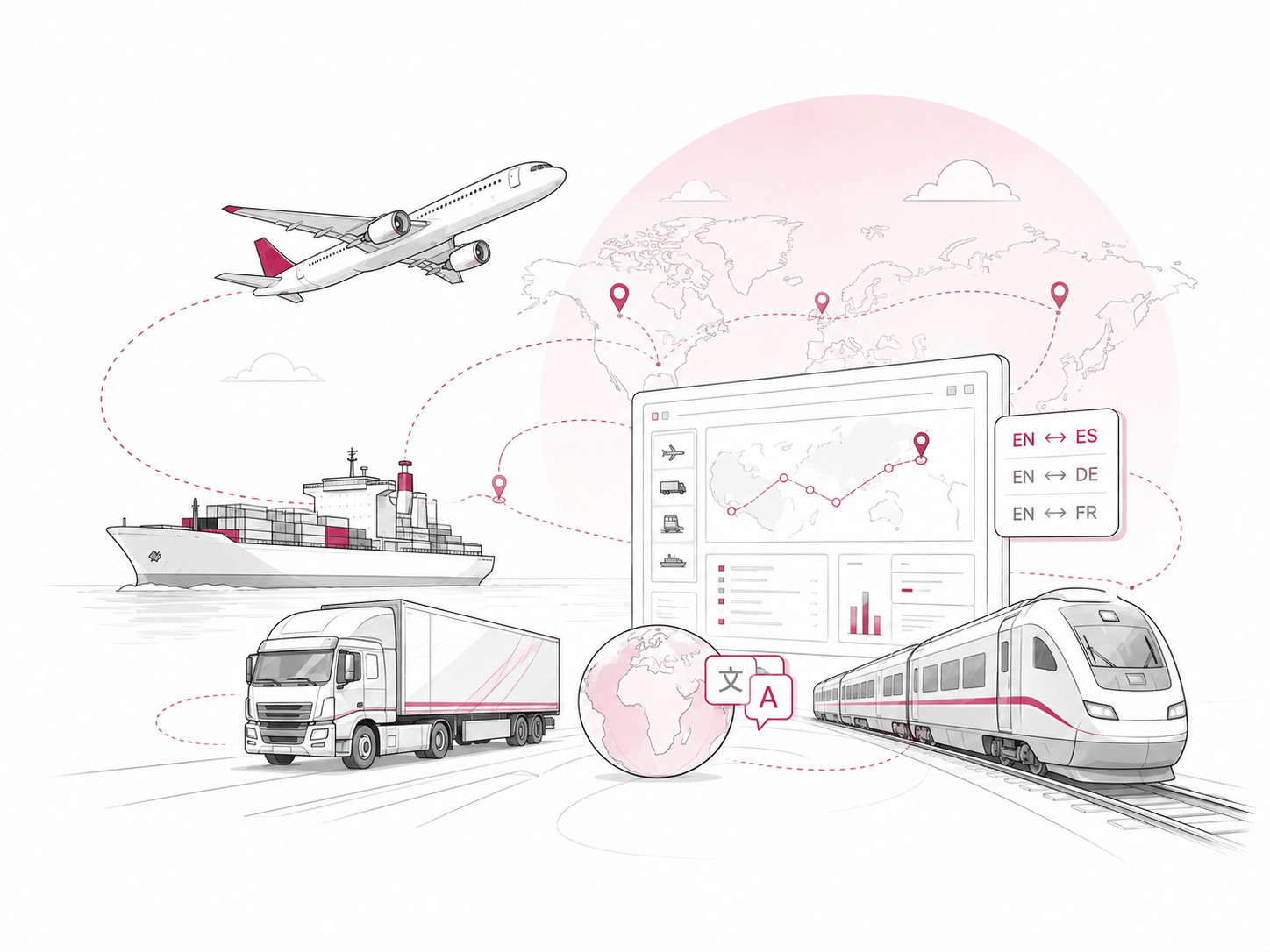
Trusted Across Transportation and Logistics
Transportation organizations use Stepes to support multilingual technical documentation, operations, logistics, technology, training, and customer-facing content.





Translation Across the Transportation Ecosystem
Modern transportation connects vehicles, infrastructure, operators, technology platforms, regulators, supply chains, passengers, and customers. Stepes builds localization workflows around the specialized language requirements behind each environment.
Rail & Transit
Translation for rolling stock, signaling, rail infrastructure, maintenance, station systems, operating procedures, training, safety, and passenger information.
Railroad Translation ServicesAviation & Air Cargo
Multilingual support for aircraft systems, aviation operations, MRO, ground operations, cargo, airport systems, technical publications, software, safety, and training.
Aviation Translation ServicesRoad, Fleet & Commercial Transportation
Localization for commercial vehicles, fleet operations, dispatch, routing, telematics, maintenance, driver content, service networks, and fleet technology.
Automotive Translation ServicesMaritime, Shipping & Ports
Translation across vessel operations, shipping services, ports, terminals, cargo handling, maritime equipment, safety, training, technical documentation, and digital shipping systems.
Logistics & Supply Chain
Transportation programs often connect directly to logistics and supply-chain operations. For freight, warehousing, distribution, customs, and deeper logistics workflows, Stepes provides a dedicated Logistics Translation Services practice.
Logistics Translation ServicesTransportation Technology & Digital Mobility
Localization for transportation management systems, fleet platforms, telematics, routing, dispatch, ticketing, passenger information, mobile apps, connected mobility, and other digital transportation experiences.
Software Localization ServicesContent Lifecycle
Multilingual Content Wherever Transportation Happens
Transportation content begins before a vehicle, system, or service enters operation and continues throughout deployment, daily use, maintenance, training, customer service, and ongoing updates.
-
Engineering & Design
Specifications, requirements, drawings, system documentation, component information, testing content, and supplier communications.
-
Manufacturing & Deployment
Manufacturing instructions, installation, commissioning, equipment documentation, inspection criteria, and deployment materials.
-
Operations
Operating manuals, SOPs, dispatch information, route procedures, fleet instructions, notices, and operational process content.
-
Safety & Compliance
Safety procedures, warnings, emergency instructions, inspection materials, dangerous-goods content, compliance training, and regulatory information.
-
Maintenance & Service
Maintenance manuals, repair procedures, troubleshooting, service information, parts documentation, and preventive maintenance content.
-
Training
Operator and technician training, eLearning, classroom materials, instructional video, assessments, and certification content.
-
Passenger & Customer Experience
Websites, apps, ticketing, passenger information, notifications, signage, customer support, help content, and marketing.
-
Continuous Updates
Software releases, fleet updates, procedural changes, regulatory revisions, updated manuals, route changes, and terminology updates.
Transportation Technology
Localize the Digital Systems Behind Modern Transportation
Transportation increasingly operates through connected software, APIs, digital interfaces, structured data, automation, and real-time information exchange. These systems have to work linguistically as well as technically in every market.
Stepes localizes transportation management systems, fleet platforms, telematics, routing and dispatch applications, passenger information systems, ticketing, mobile apps, web portals, connected mobility products, and the help, training, and documentation surrounding them.
Gleisänderung
Der Zug fährt heute von Gleis 6 ab.
Safety & Compliance
Accuracy Where Transportation Language Matters Most
Transportation language can influence equipment operation, worker safety, passenger safety, maintenance accuracy, emergency response, and compliance. These materials require more than fluent translation.
Stepes can configure workflows around technical complexity, intended use, audience, and risk using specialized linguists, controlled terminology, professional review, translation memory, and project-specific quality assurance.
Technical Translation ServicesResources matched to subject matter and content requirements.
Approved technical language across systems and documents.
Additional linguistic or specialist review based on project needs.
Checks for terminology, completeness, numbers, units, consistency, formatting, and other requirements.
Terminology Control
One Transportation Vocabulary Across Every Touchpoint
The same technical concept may appear in an engineering specification, software interface, maintenance procedure, training course, safety instruction, and passenger or customer communication.
Stepes uses client-specific glossaries, termbases, translation memory, style guidance, and linguistic instructions to keep important terminology aligned across content types, languages, teams, and future releases.
Transportation Content We Translate and Localize
Transportation organizations create multilingual content across engineering, operations, digital products, training, commercial teams, network communications, and passenger experiences.
Technical & Engineering
- Engineering specifications
- Technical manuals
- Installation instructions
- Equipment documentation
- Maintenance manuals
- Service procedures
- Parts information
- Test and validation content
Operations & Safety
- Standard operating procedures
- Operating manuals
- Driver and operator instructions
- Safety manuals
- Emergency procedures
- Inspection materials
- Dispatch instructions
- Warnings and signage
Software & Digital Products
- Transportation management systems
- Fleet platforms
- Telematics interfaces
- Mobile apps
- Web portals
- Control interfaces
- Passenger information systems
- Ticketing applications
Training & Learning
- eLearning courses
- LMS content
- Training manuals
- Operator courses
- Technician training
- Safety training
- Assessments
- Instructional video
Commercial & Network Communications
- Carrier and partner communications
- Supplier documentation
- Contracts and agreements
- Proposals and presentations
- Service notices
- Network communications
- Customer communications
- Market-facing content
Passenger & Customer Experience
- Websites
- Mobile applications
- Ticketing content
- Passenger information
- Service notifications
- Signage
- FAQs and support
- Marketing materials
AI + Human Workflows
The Right Translation Workflow for Every Type of Transportation Content
A safety procedure, fleet-management interface, technical manual, knowledge-base article, and customer-facing page do not carry the same linguistic risk or business requirements. Stepes configures the workflow around the content rather than forcing every project into one model.
Specialized & high-consequence content
Professional Human Translation
A strong fit for specialized technical, safety-sensitive, regulatory, high-visibility, or editorial content where professional linguistic judgment is central to the result.
Scale + professional oversight
AI Translation + Professional Human Review
AI can accelerate suitable transportation content while qualified linguists review meaning, terminology, fluency, consistency, and project-specific requirements.
High-volume, lower-risk use cases
AI-Enabled Translation
For appropriate content where speed and scalability are primary requirements, Stepes can apply AI-enabled translation with language assets, automated checks, and review matched to the program.
AI where scale matters. Professional expertise where judgment matters. Controlled terminology, translation memory, review, and QA can connect both approaches within one multilingual program.
A Translation Workflow Built for Transportation
Successful transportation localization connects content, terminology, people, technology, review, and delivery into one repeatable process.
-
01
Understand the Content
Review content type, audience, target languages, technical complexity, file formats, intended use, quality requirements, and delivery schedule.
-
02
Prepare Terminology & Language Assets
Apply existing glossaries, translation memories, approved translations, product terminology, style guidance, and reference materials.
-
03
Select the Right Workflow
Configure professional translation, AI-enabled translation, human review, localization engineering, DTP, testing, or the appropriate combination.
-
04
Translate & Localize
Assign suitable linguistic and technical resources and process documents, software, structured content, multimedia, and other transportation assets appropriately.
-
05
Review
Route content requiring additional oversight to a professional linguist, specialist reviewer, in-country stakeholder, or customer reviewer.
-
06
Run Linguistic & Technical QA
Check completeness, terminology, numbers, units, formatting, tags, consistency, layout, and in-context behavior according to the deliverable.
-
07
Deliver or Deploy
Return publication-ready documents, localized software resources, structured content, multimedia assets, or other agreed deliverables.
-
08
Reuse What Has Been Approved
Strengthen translation memory and terminology so future transportation updates begin with more context, consistency, and reusable language.
Continuous Localization
Built for Transportation Content That Never Stands Still
Routes change. Fleets evolve. Software releases continue. Procedures are revised. Training changes. New markets open. Stepes helps transportation teams turn localization into a repeatable multilingual content operation.
- Content Change
- Identify New & Modified Content
- Terminology + Translation Memory
- Translate & Review
- QA & Approval
- Multilingual Release
Translation Memory
Reuse approved multilingual content across revisions and recurring releases where context remains appropriate.
Explore Translation MemoryTerminology Management
Control technical terms, product names, abbreviations, and approved translations across teams and content types.
Explore Terminology ManagementTranslation API
Connect translation with content platforms, applications, repositories, and recurring digital workflows.
Explore Translation APIContinuous Localization
Support frequent software, documentation, website, knowledge-base, and digital-content updates without rebuilding the process each time.
Explore Continuous LocalizationLocalization Engineering
Translate More Than Text
Transportation information appears in technical documents, applications, training systems, diagrams, interfaces, multimedia, and structured data. Stepes supports both the language and production requirements needed to return content in usable final formats.
Transportation Translation in 100+ Languages
Stepes supports transportation organizations across North America, Latin America, Europe, Asia-Pacific, the Middle East, and Africa. Multilingual programs can share terminology, translation memory, instructions, review processes, and quality requirements across markets.
Explore All LanguagesWhy Stepes
Built for Global Transportation Teams
Modern transportation localization has to work across technical documentation, digital systems, operational content, training, and customer experiences without losing terminology or context between them.
Transportation & Technical Expertise
Professional linguists and reviewers selected for subject matter, content type, audience, and project requirements.
AI + Professional Human Expertise
Flexible translation models matched to quality, scale, speed, confidentiality, and content risk.
Consistent Transportation Terminology
Client-specific terminology, translation memory, references, and language guidance across systems and releases.
Technology-Enabled Localization
APIs, workflow automation, translation memory, terminology management, and continuous localization for recurring programs.
100+ Languages
Centralized multilingual support across major global and regional transportation markets.
Structured Quality Processes
Professional review, linguistic QA, technical checks, and customer-specific quality requirements throughout the workflow.
Transportation Translation Services FAQs
Answers about transportation content, software localization, terminology, safety-sensitive translation, AI workflows, formatting, multimedia, and ongoing global programs.
What types of transportation content does Stepes translate?
Stepes translates technical, engineering, operational, safety, maintenance, software, training, regulatory, passenger, shipping, customer, and commercial content for transportation organizations. This includes manuals, operating procedures, software interfaces, maintenance instructions, safety materials, eLearning, mobile applications, passenger information, websites, and multimedia.
Which transportation industries does Stepes support?
Stepes supports rail and transit, aerospace and aviation, road and fleet transportation, automotive, maritime and shipping, and transportation technology. Transportation programs that extend into freight, warehousing, distribution, customs, and supply-chain operations are supported through our dedicated Logistics Translation Services practice.
Can Stepes localize transportation software and mobile apps?
Yes. Stepes localizes user interfaces, mobile applications, transportation management systems, fleet-management platforms, telematics applications, passenger-information systems, ticketing platforms, web portals, and other digital transportation products. Projects can include resource-file localization, terminology management, in-context review, testing, and recurring release support.
How does Stepes maintain consistent transportation terminology?
Stepes can use client-specific glossaries, termbases, translation memories, style guidance, approved translations, and project instructions to keep terminology consistent across documents, software, training, maintenance information, safety content, and recurring transportation communications.
Does Stepes use AI for transportation translation?
Yes. Stepes supports professional human translation, AI translation with professional human review, and AI-enabled translation workflows. The appropriate approach depends on content purpose, technical complexity, audience, risk, volume, quality requirements, confidentiality, and turnaround.
Can Stepes support safety-sensitive transportation content?
Yes. Safety manuals, operating procedures, maintenance instructions, warnings, emergency content, and other sensitive technical materials can use workflows that include specialized linguists, terminology controls, professional review, and project-specific quality assurance.
Can Stepes support ongoing transportation localization programs?
Yes. Stepes supports recurring and continuous localization using translation memory, terminology management, workflow automation, APIs, professional project management, and reusable language assets. This is useful for frequent software releases, documentation updates, training revisions, operational changes, and multi-market programs.
Can Stepes preserve technical layouts and formatting?
Yes. Stepes supports multilingual document formatting and desktop publishing for many common business and technical file types. File requirements are reviewed as part of project setup so text expansion, tables, graphics, page layouts, and other multilingual production needs can be addressed appropriately.
Can Stepes translate transportation training, video, and multimedia?
Yes. Stepes supports eLearning translation, subtitles, captions, voiceover, multilingual graphics, video localization, and course engineering in addition to document and software translation.
Which languages does Stepes support for transportation translation?
Stepes provides transportation translation and localization in more than 100 languages, including major European, Asian, Latin American, Middle Eastern, and African languages. Multilingual programs can be managed through a centralized workflow with shared terminology and language assets.
Keep Global Transportation Moving Across Languages
Whether you are translating technical documentation, transportation software, operating procedures, safety information, training, shipping and network communications, or passenger experiences, Stepes can build the multilingual workflow around your content, markets, quality requirements, and release schedule.