
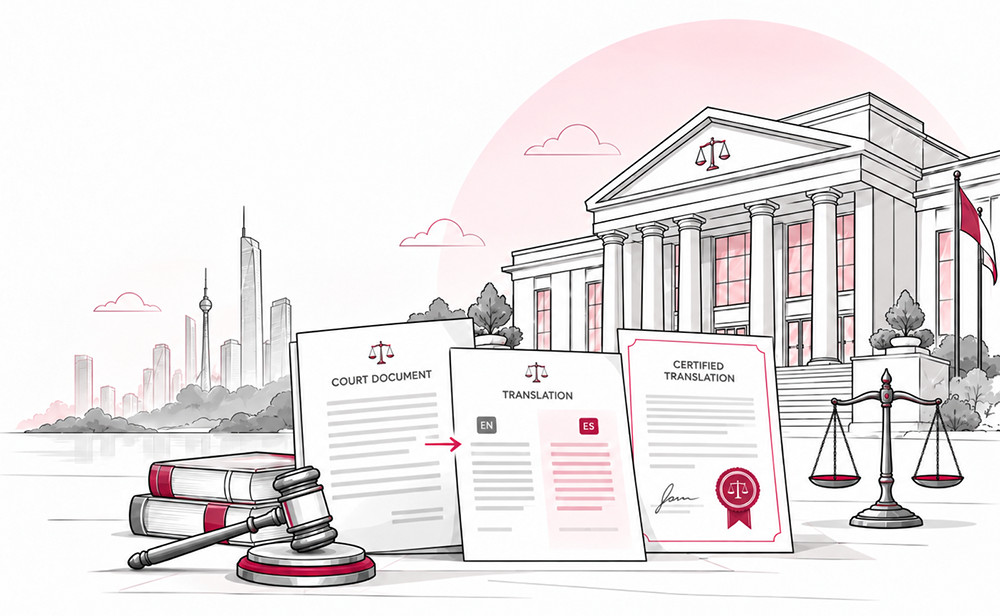
Accurate Translation for Court Filings and Proceedings
Legal Translation ServicesCourt documents establish claims, record decisions, preserve evidence, support legal arguments, and communicate procedural requirements. Their translation demands more than linguistic fluency.
Names, dates, case numbers, monetary amounts, defined legal terms, exhibit references, qualifications, and procedural language must remain accurate and consistent from the source document through final delivery.
Stepes provides specialized legal translation for court-filed, court-issued, and court-submitted documents. Each translation is planned around its intended use so translator qualifications, review, certification, formatting, and quality controls can align with the confirmed requirements.
Preserve Legal Meaning
Qualified legal linguists translate the meaning and function of the source rather than relying on literal substitution.
Protect Critical Case Details
Names, numbers, dates, case references, defined terms, citations, and exhibits receive focused attention.
Maintain Document Integrity
Headings, numbered paragraphs, tables, footnotes, schedules, signatures, seals, and cross-references remain clear and usable.
Match Controls to Intended Use
Internal review, evidentiary use, certified delivery, and formal submission can require different levels of review and documentation.
Court Documents We Translate
Stepes translates a broad range of court documents and supporting materials across civil, commercial, family, probate, immigration, administrative, and cross-border legal matters.
Complaints and Petitions
Initial pleadings, petitions, applications, responses, and other documents used to initiate or answer legal proceedings.
Motions and Legal Briefs
Motions, briefs, memoranda, responses, oppositions, and supporting legal arguments.
Court Orders
Procedural, interim, and final orders with careful handling of directives, deadlines, findings, names, dates, and related references.
Judgments and Decisions
Judgments, decisions, rulings, findings, and related court records for review, official submission, or cross-border use.
Affidavits and Declarations
Sworn statements, declarations, and supporting testimony with factual details, qualifications, and structure preserved.
Summonses and Subpoenas
Summonses, notices, subpoenas, service documents, and related procedural materials.
Evidence and Exhibits
Contracts, correspondence, financial records, medical documentation, business records, certificates, schedules, and other evidence.
Witness Statements
Written witness statements, testimony, declarations, and supporting records with chronology and factual distinctions maintained.
Hearing and Deposition Records
Hearing records, deposition materials, testimony, and related documents when written translation is required.
Settlement and Consent Documents
Settlement agreements, consent orders, stipulations, releases, and related documents arising from court proceedings.
Family and Probate Court Documents
Divorce decrees, custody orders, adoption records, probate records, estate materials, petitions, and supporting records.
Foreign Court Records
Foreign judgments, court orders, pleadings, decisions, and case records for cross-border legal review or official use.
Appeals and Supporting Records
Appellate documents and related decisions, briefs, exhibits, and records from the underlying proceeding.
Administrative and Tribunal Documents
Written records used before administrative courts, tribunals, boards, and similar authorities.
Why Court Documents Require Legal and Procedural Precision
A court document forms part of a record, filing, evidentiary package, or legal process in which wording and document relationships can matter significantly.
Legal Concepts Do Not Always Translate Directly
Legal systems develop their own concepts, institutions, procedures, and terminology. Legal translators must preserve source meaning without introducing unsupported interpretations or false equivalence between systems.
Case Details Must Remain Consistent
Variations in party names, corporate entities, dates, case numbers, amounts, addresses, or terminology can create confusion when multiple documents are compared.
Document Structure Supports Legal Review
Paragraph numbering, page references, headings, footnotes, exhibits, schedules, tables, signatures, stamps, and cross-references help legal teams understand how information relates across the record.
Intended Use Determines the Required Controls
A translation used for preliminary review may not need the same workflow as a document intended for formal submission or evidentiary reliance.
Court Translation Quality and Document Integrity Controls
For court documents, translation quality includes both linguistic accuracy and careful control of the details that make the document usable as part of a legal record.
Names and Legal Entities
Party names, companies, law firms, courts, government authorities, judges, attorneys, locations, and other named entities are reviewed for consistent treatment.
Dates, Numbers, and Monetary Values
Dates, times, case numbers, identification numbers, addresses, monetary values, percentages, measurements, and other numerical content receive focused checks.
Defined Terms and Legal Terminology
Recurring legal terminology and defined terms are maintained consistently within the document and, where appropriate, across related case materials.
Exhibits and Cross-References
Exhibit identifiers, paragraph references, footnotes, schedules, page references, citations, and related case-material references are checked for continuity.
Stamps, Seals, Signatures, and Annotations
Legible textual information in visible document elements can be translated or identified according to the agreed requirements.
Completeness Review
Quality assurance helps identify omissions, duplications, untranslated content, misplaced text, inconsistent terminology, and other issues that reduce usability.
Independent Revision
For high-consequence documents, a second qualified linguist can compare the translation against the source for accuracy, terminology, completeness, and consistency.
Certified Translation for Court Submission
Court documents intended for formal use may require a signed certification statement or other submission formalities. Requirements vary by court, jurisdiction, proceeding, document type, and receiving authority, so they should be confirmed before translation begins.
Stepes provides certified translation for court documents when certification is part of the confirmed submission requirements.
Certified Translation ServicesCertified Court Document Translation
A signed certification statement can confirm completeness and accuracy according to the agreed submission format.
Notarization When Required
Notarization is separate from certification and generally verifies the signer’s identity rather than independently assessing translation quality.
Recipient-Specific Requirements
Courts or authorities may specify certification wording, translator information, signatures, document format, or delivery method.
Confirm Requirements Before Filing
Clients should confirm current filing and acceptance requirements with the receiving court, authority, or qualified counsel.
Preserve Court Document Structure and Readability
Legal teams often need to compare a translated document with its source quickly and accurately. Stepes supports document formatting and layout workflows that help preserve the relationship between original content and translated text.
Numbered Paragraphs and Sections
Maintain identifiable numbering, section structure, headings, clause references, and organizational elements that support legal review.
Tables, Schedules, and Forms
Translate structured content while preserving row, column, field, and schedule relationships whenever the source format permits.
Footnotes and References
Keep footnotes, citations, annotations, and cross-references associated with the relevant translated content.
Exhibits and Attachments
Coordinate exhibits, schedules, appendices, and related attachments so multilingual document sets remain organized and easy to navigate.
Scanned Court Documents
Clear scans and image-based records can be translated; blurred, cropped, damaged, or illegible source content may require review first.
Stamps, Seals, and Handwritten Content
Legible text can be translated or identified according to project requirements without guessing at unreadable source content.
How Our Court Document Translation Process Works
A structured workflow aligns court document translation with document type, intended use, legal context, submission requirements, and level of legal risk.
Review the Document and Intended Use
Confirm languages, document type, intended use, receiving authority when relevant, deadline, certification, formatting, security, and review requirements.
Assign Qualified Legal Linguists
Match the language pair, legal subject matter, document type, jurisdictional context where relevant, and required quality level.
Translate With Legal and Document Controls
Preserve source meaning while maintaining terminology, names, dates, numbers, references, exhibits, and structure.
Perform Review and Quality Assurance
Apply the selected linguistic review, terminology verification, automated quality checks, completeness checks, and focused review of high-risk details.
Prepare Certification and Final Formatting
Complete the required certification, formatting, and delivery preparation when needed.
Complete Final Checks and Secure Delivery
Complete final quality checks and deliver securely in the requested format for attorney review, client use, or submission.
Court Documents Across Different Legal Proceedings
Court documents arise in many types of legal matters. This service remains focused on the written records, filings, evidence, and decisions used within those proceedings.
Civil and Commercial Litigation
Translate complaints, answers, motions, briefs, affidavits, exhibits, court orders, judgments, and supporting records in civil and commercial disputes.
Litigation Translation ServicesImmigration Court Proceedings
Translate affidavits, identity and civil records, financial documentation, supporting evidence, and other case materials based on the requirements supplied for the matter.
Immigration Document Translation ServicesFamily and Probate Matters
Support divorce, custody, support, guardianship, adoption, probate, inheritance, estates, and related matters with accurate court-document translation.
International and Cross-Border Proceedings
Translate foreign judgments, court orders, pleadings, evidentiary records, and related documentation used by counsel or authorities across jurisdictions.
Recognition and Enforcement Matters
Translate foreign judgments, orders, awards, and supporting materials used in recognition, enforcement, or related judicial review.
Arbitration-Related Court Proceedings
Translate court documents connected with enforcement, recognition, interim relief, or other judicial proceedings related to an arbitral matter.
Broader Litigation Translation SupportSecure Translation for Sensitive Court Documents
Court files can contain privileged communications, personal information, financial records, health information, witness details, proprietary business information, employment records, and other sensitive material.
Stepes Security & ConfidentialityControlled Access and Assignment
Files, instructions, comments, and deliverables are limited to authorized people involved in the translation, with assignments aligned to language, subject matter, confidentiality, and client requirements.
Confidentiality Obligations
Translators and reviewers work under confidentiality obligations appropriate to professional legal translation assignments.
Secure File Handling
Source documents, working files, translations, and deliverables are managed through controlled multilingual workflows designed for sensitive information.
Client-Specific Requirements
Organizations can review specific privacy, privilege, retention, procurement, vendor-management, or delivery requirements before translation begins.
Court Document Translation in 100+ Languages
Multilingual legal matters increasingly cross jurisdictions, markets, and language communities. Stepes provides court document translation in more than 100 languages and major regional variants.
For cases involving multiple target languages, Stepes can coordinate terminology, entity names, document structures, matter-specific instructions, and quality controls across the full multilingual document set.
Explore Translation LanguagesSupport for Individual Filings and Large Court Document Sets
Court translation needs range from a single document with an immediate deadline to hundreds of related files spanning languages and jurisdictions.
Individual Court Documents
Translate a judgment, order, affidavit, declaration, summons, or other individual document with the review, formatting, and certification required for its intended use.
Filing Packages
Coordinate multiple pleadings, exhibits, supporting records, and certifications as one organized translation project.
Urgent Court Deadlines
Rush service is available for qualifying projects when time-sensitive requirements call for accelerated turnaround. Feasibility depends on language pair, volume, document complexity, file quality, review level, and certification requirements.
Large Case Files
Scale translation across larger document collections while maintaining terminology, entity names, formatting conventions, matter-specific instructions, and review requirements.
Recurring Legal Translation
Law firms and legal departments with ongoing multilingual matters can maintain approved terminology, translation memory, reviewer feedback, and delivery preferences across future matters.
Why Legal Teams Choose Stepes for Court Document Translation
Court translation requires a provider that can combine legal-language expertise with disciplined document handling, scalable workflows, and accountability.
Specialized Legal Translation Expertise
Professional translators are assigned according to language pair, legal content, document type, intended use, and project requirements.
Document Integrity Controls
Names, dates, numbers, defined terms, cross-references, exhibits, signatures, seals, tables, and structure receive focused attention.
Independent Review for High-Risk Content
Additional revision by a second qualified linguist can be incorporated when greater assurance is appropriate for the intended use.
Certified Translation When Required
Certified court document translation and agreed supporting formalities can be prepared based on confirmed project requirements.
Secure Legal Workflows
Controlled access, confidentiality obligations, secure file handling, and client-specific requirements help protect sensitive legal content.
ISO-Certified Quality Processes
Documented translation and quality-management processes support consistent professional delivery across legal content.
100+ Languages
Coordinate individual documents and multilingual legal matters across major global and regional language combinations.
Scale Without Losing Consistency
Support one urgent filing or extensive multilingual document sets while maintaining terminology, instructions, quality controls, and project continuity.
Translation Technology With Expert Human Oversight
Technology can make multilingual legal workflows faster and more consistent, but court documents require controls that reflect their consequences and intended use.
Stepes uses translation technology, terminology resources, translation memory, automated quality checks, and workflow tools where they add appropriate value. Professional linguists provide the legal-language judgment needed to verify meaning, context, terminology, document details, and completeness.
Technology supports the process. Professional accountability remains central to high-stakes court translation.
Practical Guidance for Court and Legal Translation
Preparing documents and confirming submission requirements before translation begins can reduce uncertainty, rework, and avoidable filing delays.
Legal Translation Best Practices
A practical framework for translator qualifications, terminology management, confidentiality, independent review, certification, document integrity, and quality assurance.
Best Practices GuideWhen Legal Documents Need Certified Translation
Understand when legal documents may require certification and which submission requirements to confirm before ordering.
Certified Translation RequirementsLegal Translation vs. Certified Translation
Understand the difference between translating legal subject matter and providing a certification statement for official submission.
Compare Legal and Certified TranslationHow to Prepare Legal Documents for Translation
Prepare source files, exhibits, terminology, certification instructions, formatting requirements, confidentiality needs, and deadlines before the project begins.
Legal Document Preparation GuideCourt Document Translation FAQs
Answers to common questions about certification, filing, scanned documents, formatting, security, turnaround, and court-document translation workflows.
Not always. Certification requirements depend on the court, jurisdiction, proceeding, document type, receiving authority, and intended use. Some proceedings have specific requirements for foreign-language documents, while other translations may be used for attorney review without certification. Confirm the recipient's current requirements before translation begins so the appropriate service can be selected.
Yes. Stepes can provide certified translations of court documents when certification is part of the confirmed service requirements. Share any court-specific instructions, required certification wording, translator information, notarization requirements, or delivery specifications before translation begins.
Stepes translates complaints, petitions, motions, briefs, judgments, court orders, affidavits, declarations, summonses, subpoenas, exhibits, witness statements, hearing records, foreign court records, family and probate documents, settlement materials, and other supporting legal records.
Yes. Stepes can work with clear scanned PDFs, images, and other non-editable source documents. Translation quality depends in part on source legibility, so unclear, cropped, damaged, or handwritten content may require review before the translation requirements and timing can be confirmed.
In many cases, yes. Stepes can preserve or recreate headings, numbered paragraphs, tables, forms, footnotes, schedules, exhibits, page structure, and other formatting elements according to the source file, target language, intended use, and agreed delivery format.
Legible textual information in stamps, seals, signature blocks, and handwritten annotations can generally be translated or identified according to project requirements. Illegible text is handled transparently rather than guessed.
Court document workflows can include focused verification of party names, entity names, dates, monetary amounts, identification numbers, case numbers, exhibit labels, paragraph references, and other high-risk details. Independent revision can be added for documents requiring a higher level of assurance.
No. Certified translation and notarization are different requirements. Some receiving authorities may request certification only, while others may require notarization, a sworn or authorized translator, a specific certification statement, or another format. Requirements should be confirmed with the applicable court or authority.
Court document translation focuses specifically on court-filed, court-issued, and court-submitted documents such as complaints, motions, orders, judgments, affidavits, and exhibits. Litigation translation covers the broader multilingual dispute lifecycle and can include discovery, eDiscovery, depositions, large evidence collections, witness materials, arbitration, case review, and ongoing litigation support.
Turnaround depends on the language combination, word count, source-file quality, legal complexity, formatting requirements, certification needs, and selected review level. Rush translation is available for qualifying projects with urgent court deadlines. Providing complete files and requirements at the beginning helps determine the fastest responsible schedule.
Provide the source documents, source and target languages, required deadline, intended use, and requested delivery format. If the translation will be submitted formally, also include any known court or receiving-authority instructions covering certification, notarization, formatting, translator credentials, signatures, or other submission requirements.
Yes. Stepes supports confidential legal translation through controlled access, confidentiality obligations, secure file handling, restricted assignments, and client-specific workflows. Organizations with special privilege, privacy, data-handling, retention, or security requirements should identify them before translation begins.
No. Stepes provides professional translation, linguistic review, certification, terminology, formatting, and related language services. Stepes does not provide legal opinions or determine admissibility, filing compliance, legal validity, or case strategy. Clients should rely on the applicable court, receiving authority, or qualified legal counsel for legal and procedural requirements.
Translate Court Documents With Confidence
Whether you need one court order, certified documents for an upcoming filing, or multilingual records across a complex legal matter, Stepes combines specialized legal linguists, document integrity controls, secure workflows, and global language coverage.
Stepes provides professional translation and linguistic services, not legal advice. Filing, admissibility, certification, notarization, and other procedural requirements should be confirmed with the applicable court, receiving authority, or qualified legal counsel.