
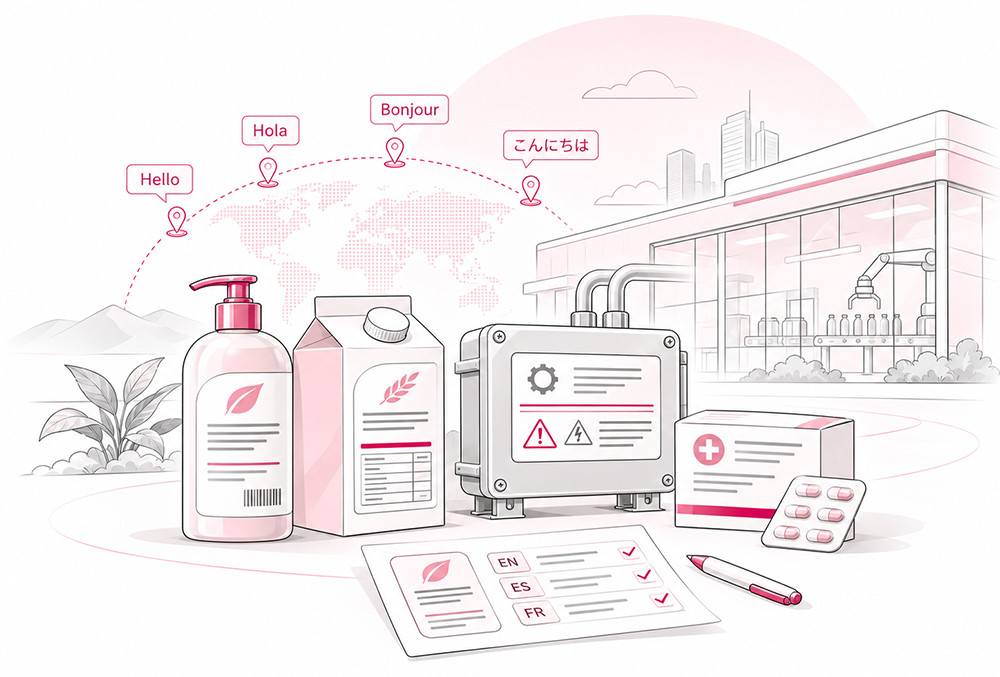
Why Product Labels Need Specialized Translation
A product label carries information in very little space. Names, claims, warnings, usage instructions, quantities, and symbols must be clear and consistent while remaining compatible with the available layout. Localizing label text requires attention to both language and production constraints.
Small Text, High Importance
Short phrases can be ambiguous without product context. We review their intended meaning rather than treating each label fragment in isolation.
Controlled Statements
Approved warnings, specifications, symbols, and claims require consistent wording and careful review.
Packaging Constraints
Text expansion, line breaks, font support, and space limitations affect how translations fit on a package.
Labels and Packaging Content We Translate
Stepes supports product label text across different packaging formats and content types, from a single label revision to multiple language versions of a product family.
Primary and Secondary Packaging
Consumer packaging, cartons, sleeves, inserts, outer labels, and product-identification content.
Warnings and Safety Instructions
Precautions, hazard statements, handling guidance, and safety notices supplied by the product owner.
Directions and Product Use
Assembly steps, dosage or usage instructions where applicable, handling requirements, storage, and maintenance guidance.
Product Facts and Specifications
Quantities, dimensions, ingredients or components, performance descriptions, and technical tables.
Labels for Industrial Products
Equipment plates, service labels, maintenance notices, operating instructions, and product markings.
Digital and Multilingual Label Assets
Electronic labels, packaging artwork text, multilingual label tables, and product information fields.
Content integrity
Protect Product Meaning and Controlled Content
Labels often include content that should not be changed simply for linguistic style. We can work from approved source language, designated terminology, and clear rules for values or fields that must remain intact.
Product Identifiers and Names
Preserve approved product, model, part, lot, and catalog references as instructed.
Numbers and Units
Check quantities, dimensions, dates, numerical values, and units against the approved source.
Symbols and Variables
Keep designated codes, symbols, placeholders, and production markers intact while translating the correct text.
Claims and Required Language
Flag ambiguous or jurisdiction-dependent wording for the product owner rather than independently rewriting controlled claims.
Adapt Labels for Different Packaging Environments
The same product information may appear on a bottle, carton, outer case, retail sleeve, shipping label, or electronic product record. Each destination has different space constraints and content priorities. Localization should coordinate the terminology and controlled statements without assuming that the exact same text length fits every label format.
Retail and Consumer Packaging
Balance readability, audience-appropriate wording, product identity, and print-space limitations.
Industrial and Equipment Markings
Protect abbreviations, part numbers, maintenance notices, and required safety language used in technical environments.
Medical or Regulated Packaging
Apply the manufacturer’s controlled source and market-specific labeling instructions without independently determining regulatory compliance.
Electronic Label Text
Coordinate on-screen labels, downloadable guides, and packaging language when they refer to the same product functions.
From Approved Label Text to Multilingual Artwork
A small packaging label may need English source text translated into multiple target languages while keeping the same warning hierarchy, part number, and visual references. Early review of content length helps avoid late packaging changes.
Approved source
Label copy and protected product data
Localization
Language and terminology review
Production readiness
Agreed artwork text and layout checks
How We Localize Product Labels
Our process begins with the finished label intent, not just a spreadsheet of disconnected strings.
01
Collect Sources and Context
Review approved copy, packaging examples, artwork files, target markets, and language requirements.
02
Confirm Protected Content
Identify product names, numbers, symbols, claims, and language that must remain unchanged.
03
Translate for the Intended User
Use professional linguists with relevant product and subject-matter context.
04
Review Text and Fit
Check linguistic accuracy, completeness, terminology, layout expansion, and agreed market variations.
05
Deliver Approved Content
Return translations in the agreed file or artwork-ready format and coordinate any further client approvals.
Review Translated Labels Before Artwork Release
Packaging changes can be expensive when they occur after artwork has been finalized. When translators receive source label context, editable content, and design dimensions early, they can identify long translations and ambiguous phrases before handoff to print production. The label owner still approves all substantive changes.
Source Copy Approval
Translate the correct version of the product claim, warning, ingredient or component name, and instruction.
Layout Feasibility
Review how each language affects line length, hierarchy, text expansion, and required formatting.
Artwork Handoff
Deliver traceable multilingual text with clear references so packaging or DTP teams can apply the translations consistently.
Support Packaging Production and Label Updates
Product teams often revise multiple labels at once or manage related versions across markets. Consistent language assets help maintain continuity as packaging evolves.
Packaging Artwork and DTP
Support layout handoff and multilingual desktop publishing when artwork adaptation is part of the agreed scope.
Product-Family Terminology
Reuse approved terms for common components, safety language, instructions, and product descriptions.
Controlled Revisions
Work from identified source versions and review revised label text against previously approved language.
Frequently Asked Questions
Answers to common questions about requirements, content, review, and delivery.
Can Stepes translate product labels into multiple languages?
Yes. We support multilingual label text for agreed markets and language variants, with terminology and review requirements established during scoping.
Can you preserve label codes and part numbers?
We can identify protected product identifiers, numerical values, variables, and other nontranslatable elements and include checks to preserve them.
Can you translate directly in packaging artwork?
Depending on the format, we can work with exported text or agreed editable artwork, with separate multilingual desktop publishing support where required.
Who determines regulatory label requirements?
The product owner and its regulatory specialists define the requirements for each jurisdiction. Stepes translates and supports review of the approved content according to that scope.
How do you handle text that is too long for the label?
We can identify expansion issues and collaborate on shorter phrasing for review, provided the product owner approves any changes to controlled meaning.
What should we provide for a quotation?
Send sample labels or artwork, source and target languages, target countries, editable files if available, and any required approval or formatting instructions.
Translate Product Labels and Packaging Information
Send us your labels, packaging copy, or artwork files. We will review the content types, languages, layout requirements, and review scope for a tailored quotation.