
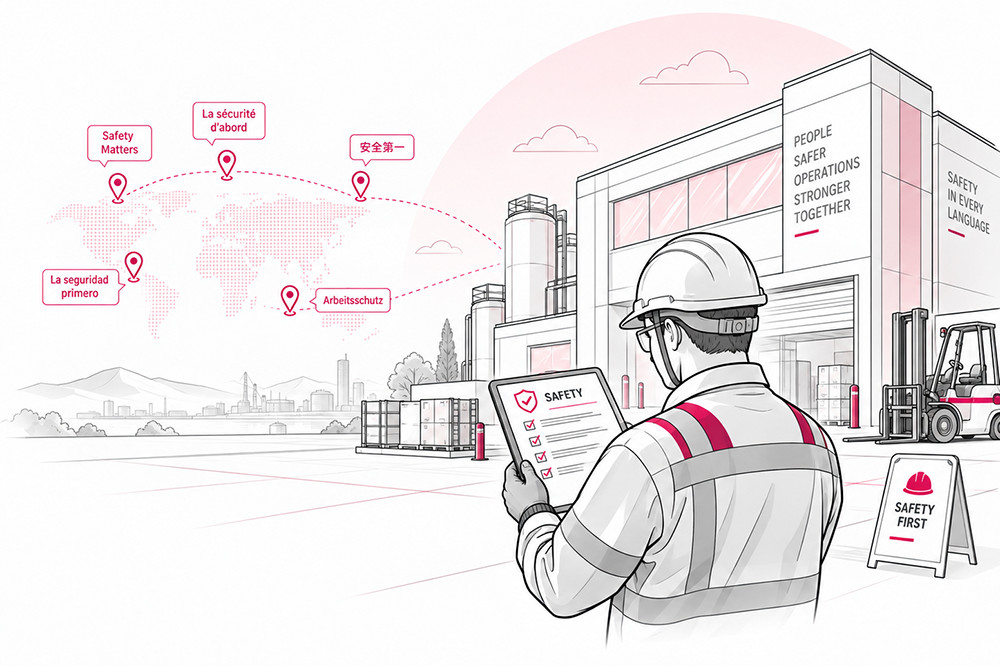
Make Critical Safety Information Clear Across Languages
Safety information only works when people can understand it and act on it.
Global organizations often rely on multilingual employees, contractors, technicians, operators, supervisors, suppliers, and field teams working across different facilities and regulatory environments. A procedure written for one location may become training for another. A risk identified during an inspection may lead to a revised work instruction, a new warning, and an updated toolbox talk.
Stepes helps connect these materials through accurate translation, consistent terminology, and reusable language assets so safety communication remains aligned across the workplace.
Translate Safety Content Across Your Operations
Safety documentation takes many forms. Stepes supports multilingual safety communication across the documents, systems, and operational materials global teams use every day.
Safety Policies & Programs
Translate corporate health and safety policies, EHS and HSE programs, safety compliance documentation, site safety requirements, employee guidance, contractor policies, and other organization-wide safety content.
Safety Procedures & Work Instructions
Translate safe operating procedures, job-specific instructions, permit-to-work documentation, lockout/tagout instructions, confined-space procedures, PPE requirements, and task-level safety content.
SOP Translation ServicesRisk & Hazard Assessments
Translate workplace risk assessments, job hazard analyses, job safety analyses, machinery risk evaluations, facility assessments, hazard registers, and mitigation plans.
Emergency Preparedness
Translate emergency response plans, evacuation procedures, fire safety instructions, spill-response procedures, severe-weather plans, crisis communications, and site-specific response materials.
Safety Training Materials
Translate employee onboarding, toolbox talks, refresher training, presentations, assessments, instructional videos, and digital learning content.
eLearning Translation ServicesSafety Audits & Inspections
Translate audit reports, inspection records, checklists, workplace observations, machinery inspection reports, corrective-action documentation, and follow-up findings.
Incident & Investigation Documentation
Translate incident reports, accident reports, near-miss reports, investigation findings, root-cause analyses, witness information, and corrective actions.
Workplace Warnings, Signs & Notices
Translate machine warnings, PPE notices, restricted-area signage, emergency signs, hazard notices, facility instructions, and other concise safety communication.
One Safety Vocabulary Across Every Workplace
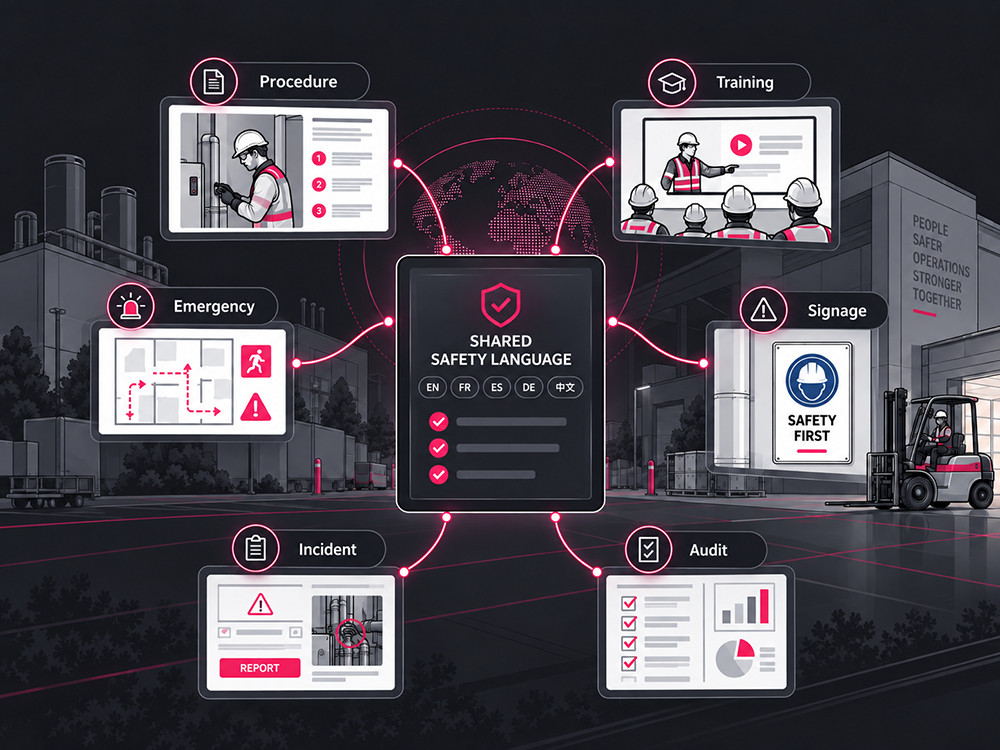
A hazard should not have one name in a procedure, another in training, and a third on a workplace sign.
Global safety programs often reuse the same technical concepts across hundreds or thousands of documents. Without terminology control, translations can gradually diverge as different teams, translators, facilities, and vendors make independent wording choices.
Stepes creates reusable multilingual language assets that help keep safety terminology aligned across your content ecosystem.
Hazards & Risk Terminology
Approved language for hazards, controls, severity, likelihood, mitigation, and corrective action.
Equipment & Process Terminology
Consistent names for components, tools, materials, operating states, and technical actions.
PPE & Workplace Language
Standardized protective equipment, locations, roles, responsibilities, and safety controls.
Emergency Terminology
Aligned evacuation language, response roles, assembly locations, warnings, and emergency communications.
Approved language gets more valuable over time. Translation memories and terminology resources can be reused as procedures change, facilities expand, and new languages are added.
Occupational Health & Safety Translation for Global Teams
Effective occupational health and safety programs depend on consistent communication from corporate policy to the individual workplace.
Safety Manual Translation ServicesStepes translates occupational health and safety documentation for manufacturers, construction companies, energy organizations, logistics providers, healthcare operations, technology companies, and other employers with multilingual workforces.
Support for Occupational Safety Management Systems
For organizations using occupational health and safety management frameworks such as ISO 45001, Stepes helps translate the policies, procedures, operational documentation, training, audits, incident information, and other multilingual content needed to support consistent safety communication.
Translation supports multilingual safety and compliance programs. Regulatory, legal, and safety determinations remain with your organization's designated professionals.
Translate Emergency Plans Before They're Needed
An emergency is not the time to discover that an instruction is difficult to understand.
Emergency plans frequently combine procedural language, facility-specific information, responsibilities, warnings, technical terminology, and time-sensitive actions. Multilingual versions need to preserve that information in a form people can quickly understand and use.
Keep the Entire Response System Aligned
Emergency plans rarely stand alone. The same terminology may appear in safety training, floor plans, warning signs, equipment instructions, PPE requirements, employee communications, and emergency alerts. Shared terminology and translation memory help keep those materials aligned.
Turn Safety Procedures Into Training People Can Understand
Written procedures establish what people should do. Training helps make those procedures part of everyday behavior.
Stepes translates safety training for multilingual employees, contractors, operators, technicians, supervisors, and field personnel across industries.
Keep Training Consistent With the Source Procedure
Using common translation memories and approved terminology helps ensure training does not introduce unnecessary language variations or conflicting instructions.
eLearning Translation ServicesKeep Safety Instructions Precise From Policy to Task
Operational safety becomes most concrete at the task level. Procedural translation requires close control of language that can change what a worker is expected to do.
Safety-Critical Procedures We Translate
Translation That Preserves the Instruction
Sequence
Keep steps, prerequisites, and dependencies in the correct order.
Commands
Preserve mandatory, conditional, and prohibited actions.
Warnings
Maintain distinctions between cautions, warnings, notes, and procedural instructions.
Terminology
Use consistent names for equipment, controls, tools, materials, and tasks.
Numbers & Units
Check measurements, limits, tolerances, times, temperatures, and other numerical information.
Roles & Responsibilities
Preserve who may, must, or must not perform each action.
From Hazard Identification to Corrective Action
Safety management generates information throughout an ongoing cycle of observation, assessment, action, and improvement. Stepes helps preserve continuity as information moves through that cycle.
Risk Assessments
Hazards, risk evaluations, controls, responsibilities, and mitigation plans.
Safety Inspections
Checklists, equipment findings, site observations, deficiencies, and actions.
Audit Documentation
Evidence, reports, findings, and follow-up materials.
Incidents & Near Misses
Factual details, technical descriptions, timelines, and immediate actions.
Root-Cause Analysis
Causal factors, contributing conditions, analyses, and recommendations.
Corrective Actions
Remediation steps, owners, deadlines, verification, and follow-up.
Use AI Where It Helps. Keep Expertise Where It Matters.
Modern safety translation does not require choosing between technology and professional expertise. Stepes combines AI-enabled language technology, translation memory, terminology management, workflow automation, professional linguists, and quality review according to content purpose, complexity, audience, and risk.
AI-Powered Language Operations
Technology can improve efficiency across large and repetitive safety-document portfolios.
Human Review for Safety-Critical Meaning
Experienced linguists and reviewers evaluate context that automated systems can misunderstand.
Quality Assurance Built for Safety-Critical Information
Safety-document quality is more than grammatical correctness.
The translation must preserve the operational meaning of instructions, warnings, data, responsibilities, and technical terminology while remaining clear to the intended audience.
Terminology
Approved safety, technical, equipment, and organization-specific language.
Numbers & Units
Measurements, temperatures, dimensions, limits, dates, times, percentages, and codes.
Warnings & Instructions
Imperatives, prohibitions, conditions, cautions, procedural relationships, and required actions.
Completeness
Checks for omissions, duplicated content, missing translations, and untranslated source text.
Formatting & Layout
Tables, numbered procedures, callouts, symbols, diagrams, and warning hierarchy.
In-Context Quality
Review for truncation, text expansion, misplaced warnings, broken layouts, and presentation issues.
A Structured Process From Source Content to Multilingual Delivery
Safety-critical content benefits from a repeatable workflow that protects terminology, meaning, structure, and usability from beginning to end.
Source Assessment
Review files, languages, audiences, content type, references, formatting needs, existing translations, and project requirements.
Terminology Preparation
Identify recurring safety, technical, equipment, process, and organization-specific terminology.
Translation
Assign professional linguists according to language pair, subject matter, content type, and workflow.
Professional Review
Review linguistic accuracy, terminology, procedural meaning, clarity, warnings, consistency, and intended audience.
Automated QA
Check terminology, numbers, units, omissions, repeated content, punctuation, formatting patterns, and untranslated text.
Layout & In-Context QA
Confirm text expansion, tables, callouts, warnings, diagrams, page flow, symbols, and readability.
Delivery & Language Assets
Deliver final files and retain approved translation memory and terminology for future updates.
Scale Safety Translation Across Sites, Languages, and Updates
For a multinational organization, safety translation is rarely a one-time document project. A global program may involve hundreds of procedures, multiple facilities, dozens of languages, recurring audits, training updates, local adaptations, and ongoing revisions.
Centralized Language Assets
Translation memory, terminology, style guidance, and reviewer decisions.
Efficient Updates
Reuse approved language while focusing effort on changed content.
CONTENT PROGRAM
Cross-Content Consistency
Align terminology across procedures, training, signage, audits, and incidents.
Multi-Site Coordination
Support central teams, regional operations, facilities, and local reviewers.
One Partner Across Languages
Manage multilingual safety content across 100+ languages without building a separate translation process for every country or site.
Built for Recurring Content
Reusable language assets become increasingly valuable as safety documentation changes over time. Each approved translation can contribute to a more consistent and efficient foundation for future updates.
Safety Translation Across High-Risk and Global Industries
Safety communication is especially important where people interact with machinery, hazardous processes, complex systems, field operations, or rapidly changing workplace conditions.
Manufacturing & Industrial Equipment
Plant procedures, operator instructions, machine warnings, inspections, risk assessments, emergency procedures, and workforce training.
Manufacturing Translation ServicesConstruction & Infrastructure
Site safety plans, contractor requirements, equipment procedures, work permits, hazard assessments, training, and inspection reports.
Construction Translation ServicesEnergy & Oil and Gas
Field safety procedures, operational controls, emergency response, maintenance instructions, contractor documentation, and incident materials.
Oil & Gas Translation ServicesTransportation & Logistics
Warehouse, fleet, terminal, material-handling, equipment safety, workforce training, and emergency communication content.
Transportation Translation ServicesIndustrial Automation & Robotics
Safety information for automated equipment, robot cells, control systems, maintenance teams, machine operators, and safeguarding procedures.
Industrial Automation TranslationChemical & Process Industries
Operational procedures, training, maintenance, emergency response, inspections, and workplace communication. SDS content is handled through our specialist service.
SDS Translation ServicesHealthcare & Life Sciences
Facility safety procedures, laboratory safety information, workplace policies, equipment instructions, emergency plans, and training.
Mining & Heavy Industry
Site risk assessments, equipment procedures, contractor requirements, emergency response, inspections, incident reporting, and safety training.
Safety Document Translation in 100+ Languages
Global safety programs need more than broad language coverage. They need consistent terminology and quality processes across the entire language set.
Explore All Translation LanguagesEurope
Spanish, French, German, Italian, Portuguese, Dutch, Polish, Czech, Romanian, Hungarian, Nordic languages, and more.
Asia-Pacific
Simplified Chinese, Traditional Chinese, Japanese, Korean, Vietnamese, Thai, Indonesian, Malay, Hindi, and more.
Americas
Latin American Spanish, U.S. Spanish, Brazilian Portuguese, Canadian French, and regional requirements.
Middle East & Global Markets
Arabic, Hebrew, Turkish, and additional languages supporting international workplaces and operations.
Built for Safety-Critical Multilingual Content
Safety documentation requires a translation partner that can combine linguistic expertise with technical understanding, controlled workflows, and enterprise-scale delivery.
Specialized Linguists
Professional linguists selected for relevant technical, industrial, occupational safety, manufacturing, engineering, healthcare, energy, construction, and related subject-matter expertise.
Controlled Terminology
Approved multilingual terminology helps keep hazards, equipment, processes, PPE, job roles, procedures, and safety concepts consistent across content.
AI + Human Workflows
Use AI, translation memory, workflow automation, and automated QA where they improve efficiency, with professional expertise where contextual judgment matters.
Structured Quality Assurance
Combine professional review, terminology checks, automated QA, and in-context verification according to project needs.
Enterprise Scale
Coordinate individual safety documents, recurring updates, multiple facilities, and multilingual programs through one connected translation partner.
Secure Workflows
Support business-critical content that may contain operational information, employee information, incident details, investigation findings, or proprietary processes.
Frequently Asked Questions
Common questions about workplace safety, EHS/HSE, occupational health and safety, safety-critical workflows, and multilingual program support.
Safety document translation services convert workplace, occupational, EHS, HSE, operational, and safety-critical documentation into other languages while preserving technical meaning, terminology, instructions, warnings, and document structure. Typical content includes safety policies, procedures, emergency plans, risk assessments, training materials, inspections, incident reports, work instructions, workplace warnings, and related documentation.
Stepes translates occupational health and safety policies, EHS/HSE documentation, safety procedures, work instructions, emergency response plans, risk assessments, job hazard analyses, inspection reports, audit materials, incident and near-miss reports, corrective actions, safety training, workplace signs, warnings, and related documentation. Dedicated services are also available for safety manuals, Safety Data Sheets, SOPs, technical documents, and complete eLearning localization.
Safety document translation covers the broader range of workplace, occupational, EHS/HSE, and operational safety communication used by organizations and their workforces. Safety Data Sheet translation is a specialized discipline focused on structured chemical hazard communication and the terminology, data, and regulatory context associated with SDS content.
SDS Translation ServicesYes. Stepes translates occupational health and safety documentation for multilingual workplaces, including policies, site safety plans, employee guidance, contractor requirements, PPE procedures, risk assessments, hazard reporting, emergency information, inspections, incident documentation, training, and other OHS content in 100+ languages.
Yes. Stepes supports EHS and HSE teams with multilingual policies, procedures, operational documentation, training, audits, inspections, incident materials, emergency plans, and related content. Shared terminology and translation memory can help maintain consistency across recurring documentation.
Yes. Stepes translates classroom materials, presentations, toolbox talks, job aids, assessments, instructional videos, subtitles, narration, and digital safety training. Complete course localization, interactive learning, voiceover, multimedia production, and LMS-ready content are available through our eLearning Translation Services.
eLearning Translation ServicesStepes uses terminology management, translation memory, customer glossaries, reference materials, professional review, and automated terminology checks to help maintain approved language across policies, procedures, work instructions, training, signage, emergency plans, inspections, and related content.
Stepes can use AI-enabled translation technology, translation memory, terminology management, workflow automation, and automated QA to improve efficiency and consistency. Safety-critical content can also be assigned to professional linguists and reviewers who evaluate technical meaning, procedural context, warnings, terminology, and audience comprehension.
Yes. Stepes supports multilingual safety programs spanning multiple facilities, countries, business units, and language requirements. Centralized translation memory, terminology, review workflows, and reusable language assets help organizations maintain greater consistency as documentation is updated and deployed across locations.
Accurate multilingual documentation can support an organization's regulatory and workplace safety communication requirements by helping intended audiences understand approved source information in their language. Translation does not replace legal, regulatory, occupational safety, engineering, or compliance decisions. Stepes can coordinate with your designated safety, legal, regulatory, or compliance professionals when required.
Stepes supports common business, technical, publishing, and multimedia formats, including Word, PDF, PowerPoint, Excel, structured files, design files, and other professional content formats. Multilingual desktop publishing and final-layout review can also be supported where required.
Yes. Translation memory and terminology management allow approved language from earlier versions to be reused when safety documentation changes, so translation and review can focus on new or modified content while preserving consistency with previously approved versions.
Make Safety Clear in Every Language
From a single emergency plan to an enterprise safety program spanning facilities, teams, documents, and languages, Stepes helps organizations communicate safety information clearly and consistently around the world.