
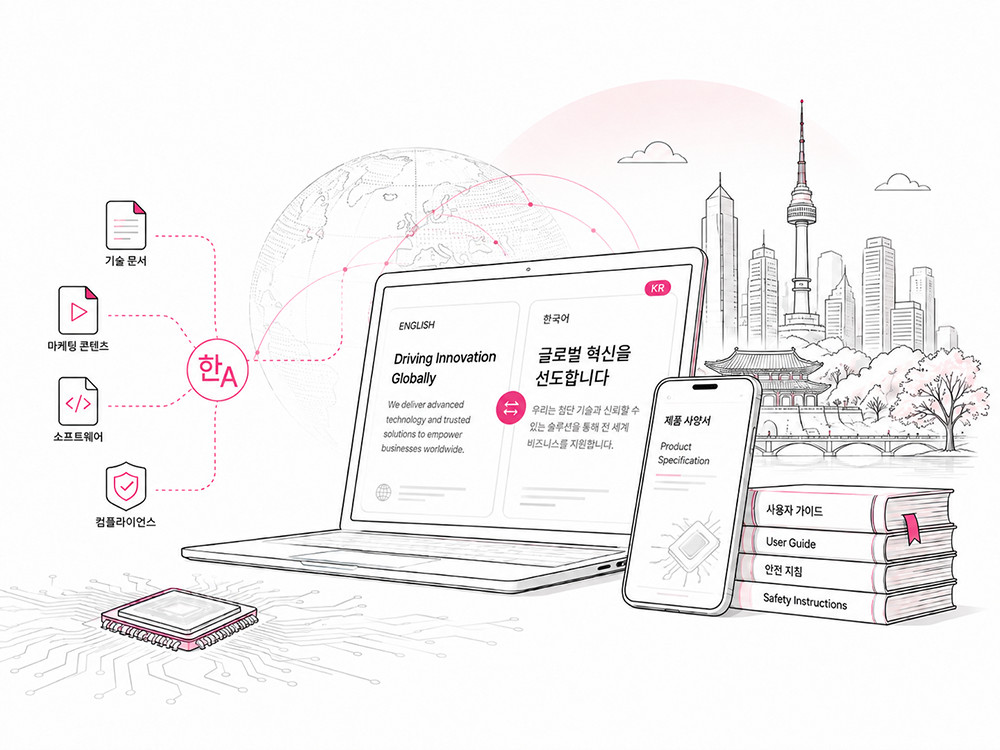
Native Korean Linguists
Korean language and market expertise.
Industry-Specialized Expertise
Technical, regulated, digital, and commercial content.
Enterprise Localization Technology
Translation memory, terminology, workflow automation, and QA.
AI + Human Translation
Flexible workflows with professional Korean review.
Korean Translation for Global Technology and Business
Korea plays an outsized role in global semiconductors, electronics, automobiles, advanced manufacturing, machinery, biotechnology, consumer technology, beauty products, and digital commerce. Korean companies operate extensive international supply chains, while global businesses increasingly need to serve Korean customers, work with Korean partners, and localize products for one of the world's most digitally sophisticated markets.
These connections create translation requirements far beyond basic business communications. Engineering teams exchange specifications and manufacturing documentation. Software companies localize interfaces and support content. Medical and life sciences organizations translate regulated information. Consumer brands adapt ecommerce experiences, product labels, and marketing campaigns. Corporate teams manage contracts, compliance documents, financial communications, and intellectual property across Korean and international operations.
Stepes provides Korean translation and localization services designed for these complex enterprise requirements. Whether you are bringing a product into Korea, supporting Korean customers abroad, collaborating with Korean suppliers, or translating Korean content for global markets, we help make multilingual communication accurate, scalable, and easier to manage.
Professional Korean Translation Services for Every Content Type
Enterprise translation spans products, departments, platforms, and customer journeys. Stepes supports the complete range of Korean business content with workflows tailored to format, subject matter, audience, and quality requirements.
Korean Document Translation
Business documents, reports, presentations, training materials, product information, policies, manuals, and other corporate content with formatting and multilingual publishing support.
Korean Technical Translation
Engineering specifications, technical manuals, manufacturing documentation, procedures, data sheets, and specialized product content translated with terminology and subject-matter controls.
Korean Website Translation
Corporate sites, product pages, ecommerce experiences, landing pages, support centers, portals, metadata, and web content localized for Korean audiences.
Korean Software and App Localization
UI strings, SaaS platforms, mobile applications, cloud products, help content, resource files, terminology management, and continuous release workflows.
Korean Marketing Translation
Campaigns, product launches, advertising, sales materials, brand communications, social content, and transcreation designed to preserve intent and voice.
Korean Multimedia Translation
Video, subtitles, elearning, training, audio, and voice-over projects supported by transcription, linguistic review, and multimedia QA.
English-to-Korean and Korean-to-English Translation
Support organizations entering the Korean market as well as Korean companies and international teams bringing Korean-origin content to global audiences.
English-to-Korean Translation
For companies introducing products, technologies, services, and information to Korean-speaking audiences. Effective localization requires careful decisions about terminology, register, tone, sentence structure, and when established English-derived terminology should remain visible.
- Product and technical documentation
- Websites and ecommerce content
- Software and mobile apps
- Marketing campaigns
- Medical and regulatory content
- Training and elearning
- Product labels and packaging
- Customer support content
Korean-to-English Translation
For global organizations working with Korean manufacturers, suppliers, research organizations, subsidiaries, customers, and business partners. The goal is precise meaning in clear, natural English while preserving specialized terminology and business context.
- Engineering and product specifications
- Supplier and quality documentation
- Research and technical reports
- Patents and intellectual property
- Contracts and corporate records
- Regulatory materials
- Financial communications
- Marketing and product information
Korean Localization Requires More Than Word-for-Word Translation
Korean and English differ in grammar, syntax, tone, information structure, and communication conventions. Professional localization considers how the language functions in the actual context where customers, employees, or users will see it.
Formality, Register, and Audience
Korean uses different writing styles depending on audience, relationship, context, and degree of formality. Technical manuals, ecommerce campaigns, mobile applications, corporate announcements, and customer support messages require different linguistic choices.
Technical Terminology and English-Derived Terms
Korean technology, engineering, business, and consumer content frequently incorporates terms originating from English. Translating every term can make content less natural, while other terms require standardized Korean equivalents, approved corporate terminology, or controlled transliteration.
Sentence Structure and Context
English and Korean organize information differently. Literal reproduction of English sentence structures can create awkward Korean, particularly in instructions, marketing copy, UI messages, and complex technical content.
Korean Spacing, Orthography, and Typography
Hangul spelling, spacing, punctuation, foreign-word conventions, numbers, units, and typographic presentation require careful attention—especially in user interfaces, product labels, graphics, packaging, and technical publications.
Consistent Language Across the Customer Experience
A product may appear across a website, application, help center, manual, ecommerce listing, training program, support system, and campaign. Translation memory, terminology management, style guidance, and QA help maintain one coherent Korean experience.
Korean Translation Expertise for High-Value Industries
Different industries require different terminology, regulatory knowledge, content workflows, and quality controls. Stepes matches Korean translators and reviewers with subject-matter expertise appropriate to each project.
Semiconductors and Electronics
Korean translation for semiconductor manufacturing, chips and components, electronics, displays, testing procedures, engineering specifications, firmware, technical training, and product documentation.
Automotive and Mobility
Vehicle engineering, EV technologies, service manuals, parts catalogs, manufacturing procedures, work instructions, automotive software, training, warranty, and customer-facing content.
Advanced Manufacturing and Engineering
Machinery, industrial automation, robotics, production documentation, SOPs, work instructions, equipment manuals, maintenance procedures, safety content, and supplier communications.
Medical Devices, Pharmaceutical, and Life Sciences
Medical device documentation, IFUs, product labels, clinical and regulatory content, quality documentation, training, patient information, pharmaceutical content, and digital health interfaces.
Beauty and Cosmetics
Product labels, packaging, ingredient-related content, ecommerce listings, product instructions, websites, campaigns, training materials, brand content, and regulatory documentation.
Software, AI, and Digital Products
Enterprise software, SaaS, cloud applications, AI products, mobile apps, support centers, knowledge bases, onboarding, structured files, and continuously updated release content.
Ecommerce and Consumer Brands
Product catalogs, marketplace listings, landing pages, mobile commerce, customer service content, loyalty programs, campaigns, product launches, and localized digital buying journeys.
Legal, Financial, and Corporate
Contracts, corporate records, compliance documentation, intellectual property, patent-related materials, financial reports, investor communications, due diligence, and M&A content.
AI-Powered Korean Translation With Expert Human Review
Artificial intelligence is transforming translation, but enterprise organizations need more than raw AI output. Different content carries different levels of linguistic, technical, regulatory, brand, and reputational risk.
Stepes combines AI, professional Korean linguists, translation memory, terminology management, and automated quality controls according to each project's content, audience, visibility, complexity, and intended use.
Start With Existing Korean Assets
Analyze approved translations, terminology, product names, style guidance, and translation memories so established language can be reused appropriately.
Apply AI Where It Adds Value
Use AI translation for suitable content when speed, scale, or frequent updates matter, while matching workflow intensity to risk and business purpose.
Review With Korean Language Experts
Validate accuracy, completeness, terminology, fluency, grammar, register, context, naturalness, and audience appropriateness.
Run Automated Quality Checks
Identify potential issues involving terminology, numbers, tags, formatting, omissions, and consistency.
Validate High-Visibility Content in Context
Review websites, software, apps, graphics, and visual content as users see them to catch truncation, layout, navigation, or context issues.
Consistent Korean Translation Across Every Product and Content Channel
Enterprise translation quality is not simply the quality of individual sentences. It also depends on whether terminology, style, product names, and recurring content remain consistent across thousands of strings, documents, projects, and releases.
Korean Terminology Management
Establish approved translations for product features, components, technical concepts, regulatory language, abbreviations, and recurring corporate terminology.
Translation Memory
Reuse approved Korean content to improve consistency, reduce repetitive work, accelerate updates, and preserve linguistic knowledge across long-term programs.
Linguistic Quality Assurance
Combine review with technology-assisted checks for terminology, numbers, punctuation, missing content, tags, units, formatting, and repeated content.
In-Context Review
Evaluate translations in buttons, product screens, packaging panels, graphics, and web pages where context and layout directly affect the user experience.
Korean Website, Software, and Mobile App Localization
Digital products create localization challenges that traditional document translation does not. Stepes supports interface context, structured files, terminology, ongoing releases, and visual QA across Korean digital experiences.
Korean Website Localization
Localize corporate sites, ecommerce platforms, product websites, customer portals, help centers, landing pages, navigation, metadata, forms, images, and support content for Korean visitors.
Korean Software Localization
Process enterprise applications, cloud platforms, SaaS products, resource files, strings, variables, placeholders, tags, and release content while keeping interface terminology aligned.
Korean Mobile App Localization
Handle short strings, ambiguous context, screen constraints, navigation, device layouts, screenshots, and in-context linguistic QA for Korean mobile experiences.
Reach Korean Customers With Localized Digital Experiences
Translation converts language; localization makes the complete experience work for Korean customers. Search behavior, ecommerce terminology, product discovery, customer journeys, and campaign language all benefit from market-aware localization.
Localize for Search Intent
Korean multilingual SEO should consider how users actually search, including terminology, page intent, titles, headings, metadata, and localized content—not direct keyword substitution.
Build Consistent Ecommerce Experiences
Product names, categories, descriptions, specifications, promotional language, and support information should use consistent terminology throughout the buying journey.
Adapt Marketing, Not Just Language
Campaigns may require different wording, emphasis, calls to action, or cultural framing. High-value content can combine translation with transcreation and market-focused linguistic review.
Scale Korean Translation Across Teams, Markets, and Content Systems
As organizations grow, Korean translation changes from a sequence of individual projects into an ongoing content operation. Websites, software, technical documentation, training, marketing, legal content, and product information all need shared linguistic assets and coordinated workflows.
Centralized Project Management
Coordinate Korean alongside additional languages, content types, business units, and recurring localization programs.
Shared Linguistic Assets
Maintain translation memories, terminology databases, style guidance, and references so teams build on approved language instead of starting again.
Continuous Localization
Support websites, software, apps, and digital platforms that change continuously with workflows designed around frequent updates and releases.
Localization Reporting and Visibility
Create greater visibility into project status, language activity, translation volumes, and workflow performance across enterprise programs.
Expand Beyond Korean
Manage Korean as part of broader Asian, European, Middle Eastern, and global localization strategies through one multilingual approach.
Korean Translation for Enterprise Content Formats
Localization workflows should work with the files and technologies your teams already use. Stepes supports common business, technical, publishing, software, web, and multimedia formats.
Business Documents
Word, Excel, PowerPoint, PDF, presentations, reports
Technical and Publishing
Adobe InDesign, Illustrator, XML, structured documentation, technical publishing files
Software and Applications
JSON, XML, YAML, resource files, localization strings, structured software content
Web Content
HTML, CMS exports, ecommerce content, web applications, help centers, knowledge bases
Multimedia
Video, audio, subtitles, elearning, training programs, voice-over projects
For complex files, translation can be combined with localization engineering, formatting, and multilingual desktop publishing to deliver production-ready content.
Korean Translation for Healthcare, Legal, and Public-Facing Communications
Korean translation is also important for organizations serving Korean-speaking communities outside Korea, particularly across healthcare, legal services, education, government programs, customer support, and other public-facing environments. For content affecting health, legal rights, safety, or access to important services, translation workflows can incorporate specialized translators and additional linguistic review appropriate to the material.
Common Korean Language-Access Content
- Healthcare information
- Patient communications
- Benefits information
- Legal notices
- Public information
- Educational materials
- Forms and policies
- Community communications
- Digital services
- Customer support information
Why Global Companies Choose Stepes for Korean Translation
Successful enterprise localization requires language expertise, specialized subject knowledge, technology, quality management, and the ability to support continuously changing content.
Native Korean Linguistic Expertise
Professional Korean linguists who understand the language as it is used across technical, business, digital, regulated, and consumer environments.
Industry-Specialized Translators
Project assignments aligned with subject matter so complex terminology and concepts can be translated appropriately.
Enterprise Localization Technology
Translation memory, terminology management, workflow automation, file engineering, and technology-assisted QA for scalable programs.
Flexible AI + Human Workflows
Professional human translation, AI translation, expert review, or hybrid workflows matched to content purpose and risk profile.
Digital Localization Expertise
Websites, software, mobile apps, ecommerce, structured files, and continuously changing digital content—not just conventional documents.
Multilingual Scalability
Manage Korean as part of larger global localization programs with translation, review, engineering, multimedia, and publishing support.
A Korean Translation Workflow Built Around Your Content
Every localization program is different. Stepes adapts the process according to content, audience, technology, industry, turnaround, and quality objectives.
Analyze
Review the source content, formats, subject matter, language direction, audience, existing translations, terminology, and quality requirements.
Prepare
Set up translation memories, terminology, style guidance, references, and project-specific localization instructions.
Translate
Use the appropriate professional, AI-assisted, or hybrid workflow based on content complexity, risk, purpose, and turnaround.
Review and QA
Validate Korean accuracy, terminology, fluency, consistency, formatting, and required quality criteria with human and technology-assisted checks.
Deliver and Improve
Deliver localized content in the required format while preserving approved translations and terminology for future updates.
Frequently Asked Questions
Answers to common questions about Korean translation quality, localization, AI workflows, technical content, timelines, and pricing.
How Do You Ensure Korean Translation Quality?
Do You Provide Both English-to-Korean and Korean-to-English Translation?
What Is the Difference Between Korean Translation and Korean Localization?
Do You Use Native Korean Translators?
Can AI Be Used for Korean Translation?
Can Stepes Translate Technical Korean Content?
Do You Provide Korean Website and Software Localization?
How Much Do Korean Translation Services Cost?
How Quickly Can Korean Translation Projects Be Completed?
Build a Stronger Korean Localization Program
Explore practical guidance for Korean language, digital localization, technical content, ecommerce, terminology, quality, and AI-assisted translation.
English-to-Korean Translation: What Global Businesses Need to Know
Terminology, tone, register, technical English usage, and practical considerations for adapting English content for Korean audiences.
View ResourceKorean Website and Software Localization Guide
Korean UI content, terminology, digital typography, structured files, contextual review, and continuous localization.
View ResourceHow to Localize a Mobile App for Korea
Mobile UX, interface translation, testing, screenshots, release workflows, and in-context linguistic QA.
View ResourceKorean Technical Translation Guide
How terminology, subject-matter expertise, translation memory, and document relationships affect engineering and manufacturing content.
View ResourceKorean Ecommerce Localization Guide
Product terminology, search intent, customer journeys, marketing language, and digital commerce localization for Korean consumers.
View ResourceKorean Translation Quality and Terminology Management
How terminology databases, style guides, translation memory, professional review, and QA improve enterprise consistency.
View ResourceAI Translation for Korean: When Human Review Matters
Where AI improves speed and scalability, where expert Korean review adds value, and how hybrid workflows can be matched to different content types.
View ResourceTranslate Your Content for Korean Audiences
Whether you are entering the Korean market, collaborating with Korean manufacturers, localizing software, translating regulated documentation, expanding ecommerce, or supporting Korean-speaking customers, Stepes combines Korean linguistic expertise, industry specialization, and localization technology to help you communicate accurately and at scale.