
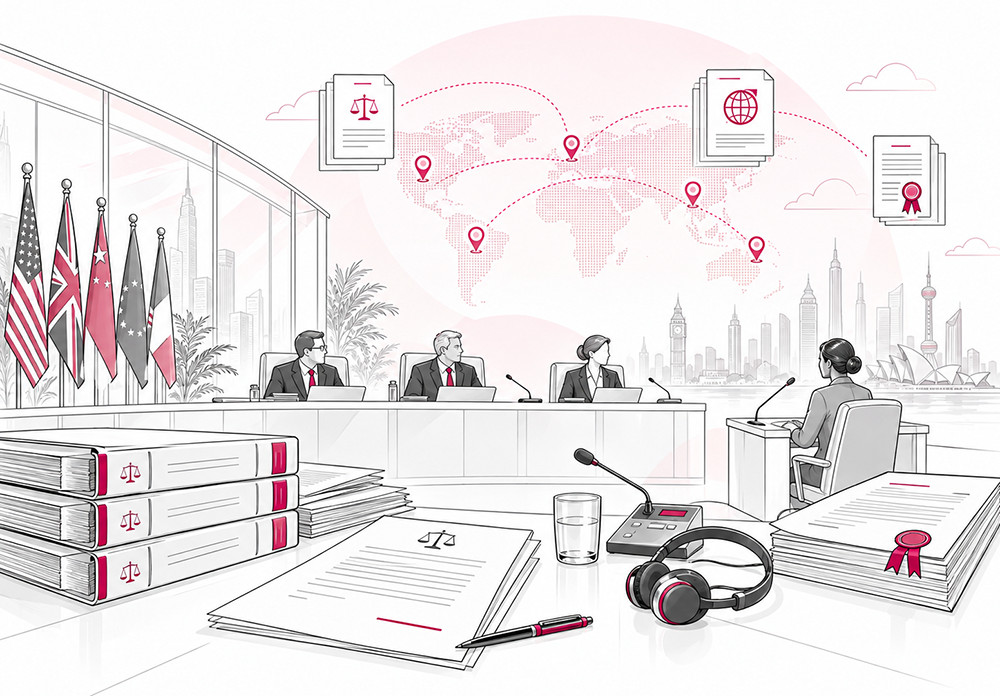
Language Support Across the International Arbitration Lifecycle
International arbitration rarely involves a single document or a single language requirement. Stepes supports the complete multilingual matter as it develops from commencement through recognition and enforcement.
Commence
Arbitration agreements, notices, requests, responses, counterclaims, and supporting documents.
Submit
Statements of claim and defense, memorials, replies, rejoinders, written submissions, and procedural correspondence.
Evidence
Contracts, correspondence, financial records, project documentation, technical materials, and exhibits.
Prepare
Witness statements, expert reports, bilingual reference materials, and preparation terminology.
Hear
Hearing materials plus simultaneous or consecutive interpreting for testimony and live proceedings.
Award
Procedural orders, interim decisions, partial awards, final awards, corrections, and related records.
Enforce
Awards, arbitration agreements, court filings, supporting evidence, and recognition or enforcement documentation.
International Arbitration Documents We Translate
From commencement documents and memorials to witness evidence, hearing bundles, awards, and enforcement materials, Stepes supports the full multilingual arbitration record with consistent terminology and matter-wide coordination.
Commencement & Pleadings
Support the documents that establish, frame, and advance the arbitration from the initial filing through the principal written submissions.
Documentary Evidence
Translate the commercial, financial, technical, corporate, and project records that form the multilingual evidentiary record.
Witness & Expert Evidence
Preserve factual meaning, specialist terminology, exhibit references, and analytical distinctions across witness and expert materials.
Hearing Materials & Procedure
Prepare multilingual materials for procedural milestones, hearing preparation, presentations, testimony, and the live proceeding itself.
Awards & Enforcement
Support the post-hearing record with precise translations for awards, corrections, recognition proceedings, and cross-border enforcement.
Translation and Interpreting in One Arbitration Workflow
Written translation and live interpreting solve different language requirements, but in international arbitration they often depend on the same evidence, terminology, people, and procedural context. Coordinating them helps preserve continuity as the matter moves from documents to testimony.
The Written Arbitration Record
- Requests, pleadings, memorials, and written submissions
- Contracts, evidence, exhibits, and documentary productions
- Witness statements and expert reports
- Procedural orders and hearing bundles
- Interim, partial, and final awards
Live Arbitration Proceedings
- Witness and expert preparation
- Attorney-client and case preparation meetings
- Witness and expert testimony
- Remote, hybrid, and on-site hearings
- Simultaneous and consecutive interpreting
Accurate Translation for Witnesses and Experts
Witness and expert evidence can be among the most consequential multilingual content in an arbitration. Translation must preserve meaning without introducing, omitting, or unintentionally changing material distinctions.
Witness Statement Translation
Witness statements often combine factual chronology, personal recollection, contractual terminology, project-specific language, names, dates, and exhibit references. Stepes focuses on preserving the evidence as it moves across languages and revised drafts.
- Factual meaning
- Chronology
- Tone and level of certainty
- Names and entities
- Dates and monetary values
- Defined terms
- Exhibit references
- Cross-references
Expert Report Translation
International arbitration frequently involves highly specialized experts. Stepes can match linguists to both the legal context and the subject matter, including tables, appendices, captions, footnotes, calculations, and supporting exhibits.
One Arbitration. One Controlled Multilingual Vocabulary.
Terminology decisions made early in a proceeding can reappear throughout the evidentiary record and ultimately in hearings and awards. Centralized language assets help keep those decisions aligned.
Build a reusable language foundation for the matter
Stepes can establish and maintain terminology resources around party names, entities, defined contractual terms, disputed provisions, technical concepts, financial language, abbreviations, and reviewer preferences.
Language Support for Complex International Arbitration Matters
International arbitration can involve commercial relationships, investments, government measures, technical projects, and financial claims. The underlying subject matter can be as important to translation quality as the legal terminology itself.
International Commercial Arbitration
Support for disputes arising from cross-border contracts, transactions, projects, joint ventures, licensing arrangements, supply relationships, and other international business activities.
- Construction and infrastructure
- Energy and natural resources
- Technology
- Manufacturing
- Life sciences
- Financial services
- Joint ventures
- Licensing and distribution
- Supply and procurement
- M&A-related disputes
Investor-State Arbitration
Multilingual support for records that may combine legal, governmental, commercial, economic, and technical content across several jurisdictions and languages.
- Treaties and investment agreements
- Concession agreements
- Government records
- Legislation and regulation
- Contracts and correspondence
- Corporate documentation
- Economic and financial evidence
- Witness statements
- Expert reports
- Awards and enforcement documents
International arbitrations may be conducted under frameworks such as ICC, ICSID, UNCITRAL, ICDR/AAA, LCIA, SIAC, or HKIAC rules. Language, translation, interpreting, filing, and procedural requirements depend on the applicable rules, tribunal directions, party agreements, and circumstances of the proceeding. References describe procedural contexts only and do not imply institutional affiliation or endorsement.
Legal Translation Backed by Subject-Matter Expertise
Many international arbitrations sit at the intersection of law and highly specialized technical or commercial subject matter. Stepes can align legal-linguistic capability with the underlying discipline of the dispute.
Construction & Infrastructure
Engineering specifications, project schedules, change orders, site records, delay analyses, technical expert reports, and quantum documentation.
Energy & Natural Resources
Oil and gas projects, power generation, renewables, concession arrangements, production records, technical reports, and regulatory materials.
Life Sciences
Pharmaceutical, biotechnology, clinical, medical device, manufacturing, quality, regulatory, licensing, and scientific evidence.
Technology
Software, telecommunications, technology licensing, intellectual property, development agreements, system records, and technical evidence.
Financial & Corporate Disputes
Financial statements, accounting records, valuation reports, damages models, banking records, transaction documents, and economic analyses.
Scale Multilingual Evidence Without Treating Every Document the Same
A document being screened for relevance does not necessarily require the same translation workflow as a witness statement, expert report, memorial, or final award. Stepes can match language processing to intended use, relevance, risk, volume, and counsel instructions.
Screen and prioritize multilingual content
Use AI-assisted language identification, terminology extraction, preliminary translation, and document prioritization to understand large foreign-language populations efficiently.
Match translation depth to intended use
Choose machine translation, post-editing, summary translation, selected-passage translation, or full professional translation based on how counsel will use the content.
Apply professional legal and subject expertise
Assign qualified linguists to documents central to case strategy, legal analysis, expert review, negotiation, or evidentiary use.
Add rigorous review where consequences are highest
Use professional human translation with independent review or enhanced QA for witness statements, expert reports, memorials, critical exhibits, hearing materials, awards, and enforcement documents.
Use AI where it improves speed and scale, and professional human judgment where legal context, nuance, terminology, evidentiary significance, and final quality require it.
Professional Interpreting for Arbitration Hearings
Support real-time communication among counsel, clients, witnesses, experts, and other participants who do not share the same working language.
Professional Interpreting ServicesSimultaneous Interpretation
Continuous real-time language support when participants need to follow spoken content without interrupting the proceeding.
Consecutive Interpretation
Support for witness interviews, preparation meetings, attorney-client discussions, expert sessions, and proceedings where speakers pause for interpretation.
Witness and Expert Testimony
Prepare interpreters with relevant matter terminology, participant names, exhibits, technical vocabulary, and other approved reference materials.
Remote, Hybrid, and On-Site Proceedings
Coordinate language support around the hearing format, locations, participants, languages, and scheduling requirements of the matter.
Arbitral Award Translation for Recognition and Enforcement
An international arbitration does not necessarily end when the tribunal issues its award. Cross-border recognition, challenge, or enforcement can create additional translation requirements depending on the jurisdiction, receiving court, language of the original materials, and procedural circumstances.
Stepes supports arbitration teams with translation of awards, arbitration agreements, recognition and enforcement applications, supporting court filings, foreign judgments, corporate records, evidentiary materials, and related correspondence.
Certified Translation Services Court Document Translation ServicesSecure Language Workflows for Confidential Arbitration Matters
International arbitration materials can contain commercially sensitive, legally privileged, personal, financial, technical, and strategic information. Stepes uses controlled workflows designed to protect sensitive content throughout the project lifecycle.
Controlled Project Access
Limit access to team members and linguistic resources assigned to the matter.
Secure File Handling
Manage source files, translations, reference materials, and deliverables through controlled project workflows.
Qualified Linguist Assignment
Select translators, reviewers, and interpreters according to language, subject matter, legal context, and project requirements.
Centralized Project Coordination
Keep files, terminology, feedback, language assets, and delivery requirements organized through a managed workflow.
Confidentiality Requirements
Incorporate project-specific confidentiality instructions and agreements where required.
Quality Management
Use structured ISO 17100 translation processes and an ISO 9001 quality management framework for repeatable project execution.
Built for International Arbitration Teams
A centralized language workflow can support the different stakeholders responsible for documents, evidence, testimony, expert analysis, hearings, and enforcement.
Law Firms
Support arbitration partners, associates, paralegals, case managers, and litigation-support professionals across submissions, evidence, witnesses, experts, hearings, awards, and enforcement.
Translation Services for Law FirmsCorporate Legal Teams
Support general counsel, disputes counsel, legal operations, and regional legal teams coordinating internal stakeholders, outside counsel, business units, and international offices.
Solutions for Corporate Legal TeamsExperts and Consultants
Support economic, engineering, accounting, damages, valuation, scientific, technical, and industry experts working with foreign-language evidence or preparing reports and testimony.
International Arbitration Translation in 100+ Languages
Cross-border arbitration can involve source documents created in several countries, witnesses who speak different languages, bilingual contracts, and proceedings conducted in one or more procedural languages. Stepes can coordinate the multilingual record through one language-services partner.
European Languages
French, German, Spanish, Italian, Portuguese, Dutch, Polish, Czech, Ukrainian, Russian, Swedish, Danish, Norwegian, Finnish, Romanian, Greek, and more.
Asian Languages
Simplified Chinese, Traditional Chinese, Japanese, Korean, Vietnamese, Thai, Indonesian, Malay, Hindi, and additional Asian languages.
Middle Eastern Languages
Arabic, Hebrew, Turkish, Persian, and additional regional languages.
Regional Variants
Coordinate locale, dialect, legal terminology, and regional language preferences where the matter requires more than a generic language label.
A Coordinated Workflow for International Arbitration Translation
Language requirements can change quickly as evidence appears, submissions evolve, experts revise reports, and hearing deadlines approach. A structured workflow helps the translation program adapt without losing matter knowledge.
Define Requirements
Confirm languages, document types, intended uses, deadlines, hearing dates, confidentiality, formatting, and certification requirements.
Build the Language Team
Match translators, reviewers, interpreters, and subject specialists to the matter and language combination.
Establish Terminology
Incorporate party names, defined terms, prior translations, technical vocabulary, expert terminology, and counsel-approved language.
Translate and Review
Apply the appropriate translation model based on document type, intended use, risk, and quality requirements.
Perform Quality Assurance
Check completeness, terminology, names, dates, numbers, monetary values, cross-references, exhibits, tables, and formatting.
Prepare for the Hearing
Coordinate interpreters, hearing materials, participant names, matter glossaries, and technical vocabulary.
Support the Matter as It Evolves
Process new submissions, evidence, witness materials, expert reports, orders, and hearing documents using established language assets.
Support Awards and Enforcement
Translate awards and related recognition or enforcement documentation according to confirmed jurisdictional requirements.
One Language Partner Across the Arbitration Matter
International arbitration requires more than isolated document translation. Stepes combines people, technology, process, and global linguistic capacity to support complex multilingual matters over time.
Legal + Subject-Matter Expertise
Match professional linguists to both the legal context and the technical or commercial subject matter of the dispute.
Translation + Interpreting
Coordinate written translations and real-time language support within the broader arbitration workflow.
Matter-Wide Terminology Control
Maintain approved names, defined terms, technical vocabulary, and recurring language across related documents and stages.
Scalable AI + Human Workflows
Use AI-assisted processing where speed and scale matter and professional human expertise where legal significance and final quality require judgment.
100+ Language Coverage
Coordinate major world languages, regional variants, and multilingual proceedings through one language-services partner.
Structured Quality and Security
Use controlled workflows and ISO-based quality processes for sensitive legal, financial, commercial, and technical content.
Plan an International Arbitration Translation Project
The earlier language requirements are defined, the easier it is to establish terminology, assemble the right team, and maintain consistency as the arbitration develops.
Source Files
Share available submissions, evidence, witness materials, expert reports, contracts, exhibits, and expected future batches where possible.
Languages
Identify source and target languages, regional variants, multilingual source files, and any expected procedural languages.
Intended Use
Clarify whether content is for screening, attorney review, expert analysis, witness preparation, formal submission, hearing use, enforcement, certification, or another purpose.
Arbitration Context
Provide applicable procedural information, document conventions, counsel instructions, and confirmed language requirements where relevant.
Key Deadlines
Identify filing dates, hearing dates, expert and witness deadlines, procedural milestones, internal review dates, and enforcement deadlines.
Reference Materials
Provide existing translations, glossaries, party names, defined terms, contracts, prior submissions, expert terminology, and technical references.
Hearing Requirements
Share languages, dates, location, remote or on-site format, participants, witness or expert requirements, and interpreting format.
Delivery Requirements
Confirm file formats, bilingual output, formatting, naming conventions, certification instructions, reference numbering, and security requirements.
International Arbitration Translation Services FAQs
Practical answers about multilingual arbitration documents, hearings, terminology, large evidence populations, awards, and enforcement.
Manage the Entire Multilingual Arbitration Matter Through One Language Workflow
From the request for arbitration and documentary evidence through witness statements, expert reports, hearing interpretation, final awards, and cross-border enforcement, Stepes can build a language workflow around your documents, deadlines, participants, hearing requirements, and intended use.