
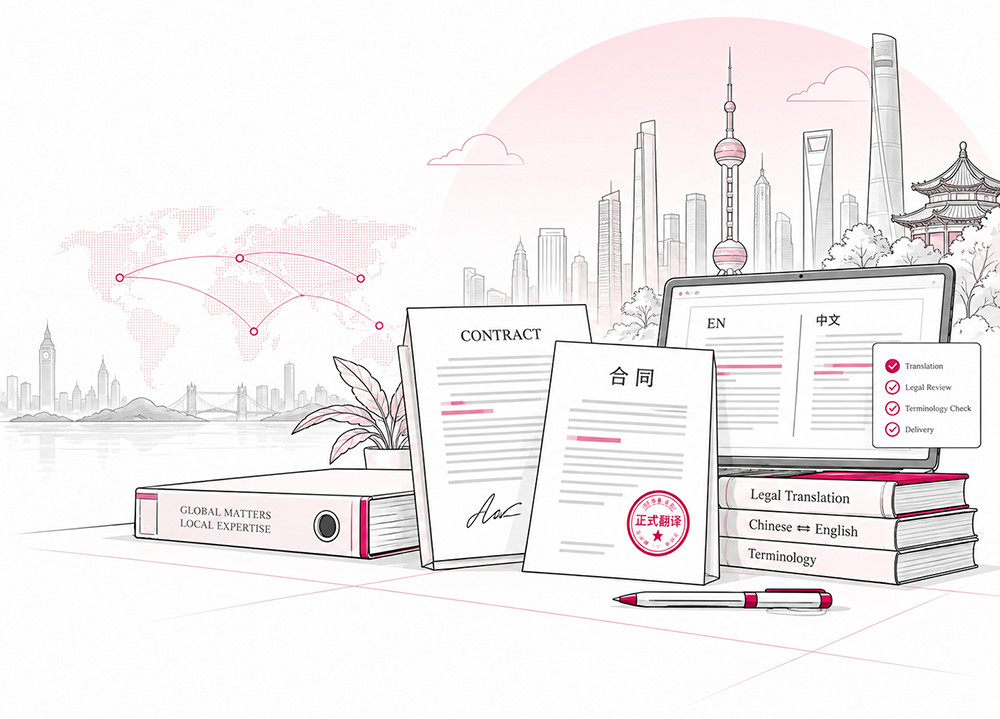
Chinese Legal Translation Across Languages, Legal Systems, and Markets
Legal translation between English and Chinese involves more than replacing words in one language with their closest equivalents in another.
Legal Translation ServicesLegal Concepts Do Not Always Map One-to-One
Contracts, court records, corporate documents, regulatory materials, and legal correspondence are created within specific legal, institutional, and commercial contexts. Professional Chinese legal translators must preserve the source meaning without introducing interpretations or apparent legal equivalents that the source does not support.
Legal Context Determines Terminology
The same English or Chinese term may require different treatment depending on whether it appears in a commercial agreement, court document, internal investigation, employment matter, corporate record, or regulatory communication. Stepes assigns linguists based on both the language pair and legal subject matter.
The Target Market Matters
Chinese is not one uniform legal-language requirement. Mainland China, Taiwan, Hong Kong, Singapore, and Chinese-speaking audiences in other countries use different written conventions, institutional vocabulary, and market-specific terminology.
Intended Use Determines the Workflow
A Chinese document translated for initial attorney review may not require the same process as an agreement being negotiated with a counterparty or a document prepared for formal submission. Stepes matches translation controls to purpose, risk, confidentiality, deadline, and required level of review.
Simplified and Traditional Chinese Legal Translation
Stepes provides professional legal translation for major Chinese-language markets and assigns linguists according to the intended audience, not simply the writing system.
Simplified Chinese for Mainland Legal and Business Content
Legal documents intended for Mainland China generally require Simplified Chinese localized for Mainland terminology and institutional usage. Stepes supports contracts, corporate records, compliance documents, business agreements, employment materials, regulatory correspondence, and other legal content used by organizations operating in or working with Mainland China.
Traditional Chinese with Taiwan-Specific Legal Terminology
Taiwan uses Traditional Chinese, but Taiwan legal and business terminology should not be created simply by converting Simplified Chinese characters. Stepes uses qualified Traditional Chinese linguists familiar with Taiwan legal and business usage for content requiring Taiwan-specific institutional language and writing conventions.
Traditional Chinese for the Hong Kong Legal and Business Environment
Hong Kong uses Traditional Chinese for formal written communication, but its legal, financial, governmental, and institutional terminology can differ from both Mainland China and Taiwan. Stepes localizes Hong Kong legal content for the appropriate context rather than treating Traditional Chinese as one universal version.
Audience-Led Chinese Legal Translation
Singapore commonly uses Simplified Chinese within a multilingual environment, while organizations in the United States and other international markets may require Simplified Chinese, Traditional Chinese, or both depending on their audiences. Stepes helps clients determine the appropriate locale based on the document, recipient, market, and intended use.
English-to-Chinese and Chinese-to-English Legal Translation
Legal translation requirements often differ significantly depending on the direction of translation. Stepes supports both directions with linguists, terminology, and review processes selected for the destination audience.
Legal Content for Chinese-Speaking Stakeholders
Global businesses, law firms, and corporate legal departments frequently need English legal content translated for Chinese-speaking counterparties, employees, subsidiaries, regulators, or business partners.
- Commercial agreements and contracts
- Non-disclosure agreements
- Corporate governance materials
- Policies and compliance documents
- Employment agreements and workplace notices
- Transaction and due-diligence materials
- Licensing and distribution agreements
- Legal correspondence
- Internal investigation materials
- Privacy and data-related legal documents
Reliable Access to Chinese-Origin Legal Documents
Chinese-origin documents are increasingly important to English-speaking legal teams handling cross-border transactions, litigation, investigations, compliance reviews, supplier matters, and corporate operations.
- Chinese contracts
- Corporate records
- Legal correspondence
- Court and dispute materials
- Regulatory documents
- Financial records
- Business communications
- Investigation files
- Due-diligence documents
- Supporting evidence
Chinese Legal Documents We Translate
Stepes supports Chinese legal translation across commercial transactions, corporate operations, disputes, investigations, compliance, employment, and formal documentation.
Contracts & Commercial Agreements
Translate agreements while maintaining defined terms, party names, obligations, recurring clauses, schedules, and document relationships.
- Master service agreements
- Non-disclosure agreements
- Sales and purchase agreements
- Licensing agreements
- Supplier and vendor agreements
- Distribution agreements
- Joint venture agreements
- Technology agreements
- Statements of work
- Amendments and schedules
Corporate & Transaction Documents
Support multinational corporate operations, investments, transactions, restructuring, and due diligence with consistent Chinese-English legal language.
- Corporate records
- Board materials
- Shareholder documents
- Entity documentation
- Governance records
- M&A documentation
- Investment materials
- Due-diligence files
- Corporate policies
Litigation & Dispute Materials
Help legal teams review and work with Chinese-language evidence and supporting documents throughout disputes and investigations.
- Pleadings and filings
- Exhibits
- Witness statements
- Expert reports
- Arbitration materials
- Legal correspondence
- Evidence
- Contracts relevant to disputes
- Supporting business records
Compliance & Investigations
Translate multilingual compliance and investigation content while maintaining confidentiality, terminology consistency, and document relationships.
- Codes of conduct
- Policies and procedures
- Internal investigation records
- Regulatory correspondence
- Ethics materials
- Audit documents
- Privacy-related materials
- Employee investigation records
Employment & Workplace Legal Content
Support international HR and legal teams with Chinese-language workplace documentation.
- Employment agreements
- Workplace policies
- Employee handbooks
- Disciplinary notices
- Separation documents
- Investigation materials
- Employee notices
- Benefits-related legal content
Certified & Official Legal Documents
Prepare professional Chinese translations with certification when required for the receiving organization or process.
- Corporate records
- Court records
- Powers of attorney
- Official certificates
- Supporting legal documents
- Personal and institutional records
Keep Chinese Contract Language Consistent From Clause to Clause
Contracts rarely exist as isolated documents. A commercial relationship may include a master agreement, statements of work, schedules, amendments, renewals, policies, exhibits, and related correspondence.
Stepes helps legal teams maintain continuity across the entire English-Chinese document family.
Contract Translation ServicesDefined Terms
Capture formally defined terms so approved translations remain consistent throughout the document and across related contracts.
Party and Entity Names
Control company names, subsidiaries, legal entities, individuals, departments, and product names using official bilingual names or established client references where available.
Recurring Clauses
Use translation memory to preserve validated language when commercial agreements reuse established source content across templates, subsidiaries, markets, and transactions.
Schedules, Exhibits, and Amendments
Keep terminology aligned from the main agreement through appendices, exhibits, subsequent amendments, and related documentation.
Counsel-Approved Language
Incorporate reviewed bilingual contracts, approved terminology, clause libraries, and legal-team feedback into future translation workflows.
Chinese Translation for Litigation, Discovery, and Investigations
Chinese-language evidence can appear throughout litigation, arbitration, internal investigations, regulatory matters, and due diligence. Legal teams may need to understand large volumes of content quickly while applying greater translation control only to the materials that become important to the matter.
Identify & Triage
For large Chinese document sets, secure AI-assisted translation or rapid professional translation can help legal teams understand general content, identify potentially relevant records, and determine which materials require deeper linguistic review.
Translate Priority Content
Documents selected for substantive legal review can be professionally translated by qualified Chinese legal linguists, including evidence, contracts, witness documents, correspondence, financial records, corporate records, and expert materials.
Apply Additional Controls
For higher-consequence content, Stepes can add independent linguistic review, structured QA, document-level verification, or certification where appropriate.
One Legal Vocabulary Across English and Chinese
Consistent legal translation depends on more than individual translator skill. Important language should be managed across documents, matters, reviewers, and time.
Defined Legal Terms
Capture terminology decisions so defined terms remain consistent throughout a file and across related documents.
Entity Names and Proper Names
Control corporate entities, individual names, agencies, institutions, products, departments, and transliteration conventions.
Counsel-Approved Language
Use existing bilingual agreements, legal templates, glossaries, terminology decisions, and reviewer feedback as approved references.
Matter-Level Consistency
Maintain continuity across contracts, evidence, correspondence, policies, exhibits, and related records.
Reusable Translation Memory
Preserve validated translations when identical or closely related source content appears again, accelerating updates and reducing unnecessary variation.
Preserve the Structure of Chinese Legal Documents
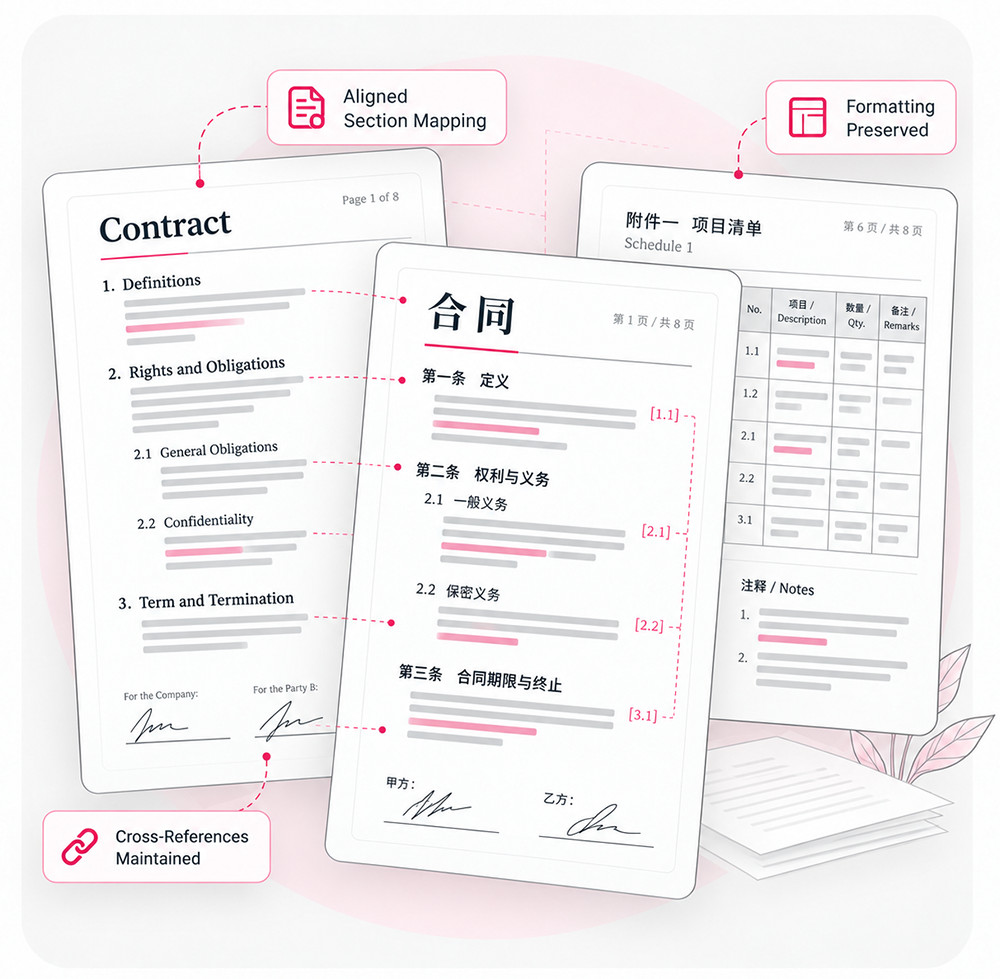
Legal meaning can depend on more than individual sentences. Clause numbering, cross-references, defined terms, footnotes, tables, exhibits, dates, names, signatures, and other document elements may all matter to how a legal file is reviewed and understood.
Document Structure
Maintain headings, numbering, clause relationships, tables, schedules, appendices, and other structural elements whenever the file format permits.
Names & Entity Information
Review Chinese names, English names, company names, entity identifiers, and recurring information for consistency throughout the document set.
Numbers & Dates
Apply focused QA to dates, monetary values, percentages, quantities, and other numeric information.
Cross-References
Check references to clauses, exhibits, schedules, sections, and related files during QA.
Seals, Signatures & Annotations
Identify and appropriately represent relevant source content without suggesting legal authentication or validation of the underlying document.
Bilingual & Production Files
Support Word, Excel, PowerPoint, PDF, scanned documents, InDesign, and other common legal and corporate file formats.
AI Where It Helps. Legal-Linguist Review Where It Matters.
AI has created powerful new ways to process multilingual legal content, particularly when teams need to understand large document volumes, reuse established language, or work under demanding deadlines.
But legal translation should not treat AI as the final authority. AI output can still introduce incorrect terminology, inconsistent defined terms, omitted qualifications, altered numbers, unsupported wording, or other problems that require professional review.
Internal Understanding & Triage
For lower-risk review and large document collections, secure AI-assisted translation can help legal professionals understand general meaning and identify records for deeper review. Human validation can be added selectively to priority content.
AI + Chinese Legal-Linguist Validation
Recurring or high-volume legal content may benefit from AI-assisted translation combined with professional post-editing, controlled terminology, translation memory, and structured QA.
Expert Human Legal Translation
Material agreements, external legal communications, important transaction documents, and other higher-risk content can be assigned directly to qualified professional translators with appropriate legal subject-matter expertise.
Independent Review / Higher-Control Workflow
Where documents carry greater legal, financial, evidentiary, or formal significance, Stepes can add independent linguistic revision, additional QA, certification, or other agreed controls.
Quality Control at the Document Level
Stepes configures Chinese legal translation around the language direction, target market, legal subject matter, intended use, risk, deadline, and client requirements.
Scope & Intended Use
Confirm the source and target languages, target Chinese locale, document type, audience, purpose, confidentiality requirements, certification needs, file format, and deadline.
Qualified Team Assignment
Select translators and reviewers based on Chinese locale, translation direction, legal subject matter, document type, and required level of control.
Reference & Terminology Setup
Review existing bilingual documents, counsel-approved language, defined terms, entity names, translation memories, glossaries, and client instructions before translation begins.
Translation
Translate the source while preserving meaning, qualifications, defined terminology, document structure, tone, and legally relevant details.
Human Review
Apply professional linguistic review according to the selected workflow. Higher-risk assignments may include independent revision by a second qualified linguist.
Linguistic & Automated QA
Check for omissions, inconsistent terminology, untranslated text, numbers, dates, names, punctuation, formatting, and other potential issues.
Document Integrity Review
Verify headings, tables, cross-references, exhibits, schedules, footnotes, signatures, seals, and other file-level elements relevant to delivery.
Controlled Delivery
Prepare final files in the agreed format and deliver them through the approved project workflow.
Protect Confidential Chinese Legal Content Throughout the Workflow
Chinese legal translation can involve commercially sensitive, privileged, personal, proprietary, or otherwise confidential information.
Stepes supports controlled handling throughout project intake, assignment, translation, review, delivery, and language-asset management.
Controlled Project Access
Project files are assigned only to the linguists and team members needed for the approved workflow.
Confidentiality Obligations
Professional resources are subject to applicable confidentiality requirements and client-specific project controls.
Secure File Handling
Sensitive source and target files can be managed through controlled Stepes workflows rather than informal document exchange.
Protected Language Assets
Client glossaries, translation memories, reference documents, and approved terminology can be managed as program-specific resources.
Client-Specific Requirements
For sensitive matters, Stepes can review project-specific confidentiality, access, retention, or delivery expectations before work begins.
Risk-Appropriate Workflow
Security and review controls can be aligned with the legal content, intended use, language direction, and matter requirements.
Chinese Legal Translation for Law Firms and In-House Counsel
Stepes supports both individual Chinese legal matters and recurring enterprise programs, giving legal professionals a scalable way to manage multilingual documents without losing terminology control or project visibility.
Law Firms
Support cross-border matters involving Chinese-language documents across:
- Commercial litigation
- Arbitration
- Investigations
- Discovery
- Corporate transactions
- Due diligence
- Contracts
- Regulatory matters
- Intellectual property
- Client communications
Stepes can scale from a single priority document to coordinated handling of large multilingual matters involving multiple files, reviewers, and deadlines.
Corporate Legal Departments
Global legal teams use Stepes to manage recurring translation across:
- Commercial contracting
- Corporate governance
- Compliance and ethics
- Employment
- Internal investigations
- Privacy
- Transactions
- Regulatory communication
- Policies and procedures
- Cross-border operations
For ongoing programs, Stepes can centralize project intake, approved terminology, reviewer feedback, translation memories, project history, and delivery workflows.
Certified Chinese Legal Translations When Required
Legal translation and certified translation are related but different requirements. Not every Chinese legal translation requires certification.
Stepes can prepare certified Chinese translations when requested for legal, corporate, institutional, regulatory, or other formal purposes.
Certified Translation ServicesDescribes the subject matter of the document and the expertise needed to translate it appropriately.
Refers to a formal statement accompanying a completed translation when certification is requested or required.
What We Need for Your Chinese Legal Translation
A few project details help Stepes recommend the appropriate Chinese locale, legal linguists, translation workflow, review controls, and delivery approach.
Not sure which Chinese variant or workflow you need? Tell us where the document will be used, who will rely on it, and what you need the translation to accomplish. Stepes can recommend an appropriate approach.
Source and Target Languages
Let us know whether you need English-to-Chinese, Chinese-to-English, or another language combination.
Target Chinese Market
Identify Mainland China, Taiwan, Hong Kong, Singapore, the United States, or another audience when known.
Simplified or Traditional Chinese
If you already know the required Chinese variant, include it with your project instructions. If not, tell us where and how the translation will be used.
Legal Document Type
Provide the source files and identify whether they are contracts, litigation documents, corporate records, compliance materials, investigation files, or another legal content type.
Intended Use
Let us know whether the translation is intended for internal review, negotiation, external communication, litigation support, submission, certification, or another purpose.
Existing Legal Language
Share previous translations, bilingual agreements, glossaries, approved terminology, entity names, style guidance, or counsel-reviewed content when available.
Review and Certification Requirements
Tell us if your legal team will review the translation or if independent revision, certification, or another formal requirement applies.
Deadline and Delivery Format
Provide the requested delivery date and any file-format or multilingual publishing requirements.
Frequently Asked Questions
Answers to common questions about Chinese legal documents, language variants, terminology, AI-assisted workflows, certification, and interpreting.
What are Chinese legal translation services?
Chinese legal translation services translate documents connected with legal rights, obligations, proceedings, compliance, corporate activities, transactions, or official processes between Chinese and other languages. Professional Chinese legal translation requires knowledge of the language pair, legal subject matter, document purpose, target market, and relevant terminology. Stepes supports both English-to-Chinese and Chinese-to-English legal translation for law firms, corporate legal departments, and global organizations.
Does Stepes translate legal documents from Chinese to English as well as English to Chinese?
Yes. Stepes provides both English-to-Chinese and Chinese-to-English legal translation. English-to-Chinese projects commonly include contracts, corporate documents, policies, compliance materials, employment content, and legal correspondence intended for Chinese-speaking audiences. Chinese-to-English projects commonly include Chinese contracts, corporate records, litigation evidence, regulatory materials, investigation files, due-diligence records, financial documents, and legal correspondence needed by English-speaking legal teams.
Should my legal translation use Simplified or Traditional Chinese?
The right Chinese version depends primarily on the target market and audience. Mainland China generally uses Simplified Chinese. Taiwan and Hong Kong generally use Traditional Chinese, but they use different regional terminology and conventions. Singapore commonly uses Simplified Chinese, while U.S. programs may require Simplified Chinese, Traditional Chinese, or both depending on the audience. Stepes assigns translators according to the target locale rather than simply converting characters between Simplified and Traditional Chinese.
Is Chinese legal terminology different in Mainland China, Taiwan, and Hong Kong?
Yes. Legal, institutional, corporate, financial, and governmental terminology can differ among Mainland China, Taiwan, and Hong Kong. The distinction extends beyond Simplified versus Traditional characters. A professional legal translation should use terminology appropriate to the target market, document type, audience, and context.
Can Stepes translate Chinese contracts and commercial agreements?
Yes. Stepes translates commercial agreements including master service agreements, NDAs, licensing agreements, purchase agreements, distribution contracts, supplier agreements, joint venture agreements, statements of work, amendments, and related schedules. For recurring contract programs, Stepes can also manage defined terms, party names, approved clauses, translation memory, and counsel-reviewed language across related documents.
Can Stepes support Chinese documents for litigation and eDiscovery?
Yes. Stepes supports Chinese-language documents used in litigation, arbitration, investigations, discovery, and legal review. For high-volume document sets, legal teams can use rapid or AI-assisted translation for initial understanding and triage, then apply professional human translation and additional review to priority evidence or documents requiring greater linguistic control.
Can AI be used for Chinese legal translation?
Yes, when the workflow is appropriate to the intended use and level of risk. AI-assisted translation can be valuable for document triage, high-volume review, repeated content, and other suitable legal workflows. However, important legal documents generally require professional human oversight because AI can introduce terminology errors, omissions, inconsistent defined terms, altered numbers, or unsupported wording. Stepes matches AI, professional legal translation, terminology management, review, and QA to the purpose of the project rather than applying the same workflow to every document.
Do Chinese legal translations need to be certified?
Not always. Legal translation describes the subject matter of a document, while certified translation involves a formal certification accompanying the translation. Certification requirements depend on the receiving court, government agency, institution, jurisdiction, or purpose. Clients should confirm the required form of certification or other formalities with the receiving authority or qualified legal counsel before translation begins. Stepes can provide certified translations when required.
How does Stepes maintain terminology across related Chinese legal documents?
Stepes can use client glossaries, approved bilingual documents, translation memory, terminology databases, entity-name lists, defined terms, and legal-team feedback to maintain consistency across related documents. When client reviewers approve terminology or preferred wording, those decisions can be captured and applied to future work.
Can Stepes use translations that our legal team has already approved?
Yes. Previously approved contracts, bilingual templates, terminology lists, legal-team feedback, clause libraries, and other reference materials can be incorporated into the project. Using established client language can improve consistency and reduce unnecessary terminology changes across related matters and future translations.
Can Stepes translate scanned Chinese legal documents?
Yes. Stepes can support scanned legal documents and PDFs as well as editable Word, Excel, PowerPoint, and other common file formats. The workflow may include file preparation, text extraction, translation, formatting, and final document QA depending on the quality and complexity of the source files.
Does Stepes provide Mandarin and Cantonese legal interpreting?
Yes. Stepes can provide Mandarin and Cantonese interpreting for appropriate legal meetings, interviews, depositions, investigations, conferences, and other professional settings. The language, interpreter qualifications, delivery mode, and other requirements should be determined according to the participants and setting. Formal court or regulated interpreting may require specific credentials or approvals.
Need Chinese Legal Translation Support?
From a single Chinese contract to a complex cross-border legal matter, Stepes helps law firms and corporate legal teams translate business-critical legal content with the right combination of Chinese language expertise, legal-linguist review, terminology control, translation technology, and quality assurance.