
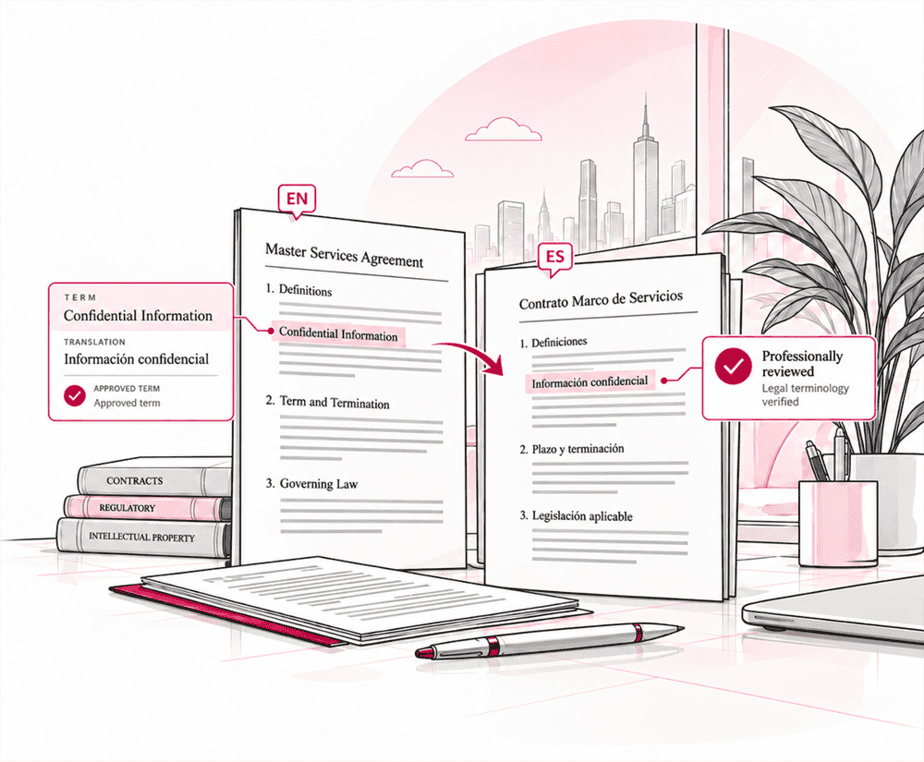
Legal Translation Built Around Intended Use and Risk
Legal documents can establish rights and obligations, preserve evidence, communicate regulatory requirements, and support decisions with legal, financial, and operational consequences. The appropriate translation workflow depends on how the content will be used.
Intended Use and Audience
We identify whether the translation is for internal understanding, due diligence, negotiation, litigation, regulatory review, execution, filing, certification, or another purpose.
Legal Subject Matter
Commercial contracts, intellectual property, employment, privacy, litigation, corporate governance, compliance, M&A, and other legal disciplines require relevant subject-matter knowledge.
Legal Systems and Jurisdictions
Legal concepts do not always have direct equivalents across common-law, civil-law, or jurisdiction-specific systems. Qualified linguists evaluate meaning in context rather than substituting superficially similar terms.
Terminology and Reference Language
Defined terms, entity names, recurring clauses, counsel-approved language, bilingual precedents, translation memories, and project glossaries can provide critical context and continuity.
Review and Delivery Requirements
Some content is appropriate for rapid multilingual review. Other documents require expert human translation, independent revision, certification, formatting, or institution-specific delivery requirements.
Legal Translation Services for Complex Global Work
From commercial transactions, litigation, arbitration, and investigations to employment, competition, corporate governance, intellectual property, legal interpreting, and official submissions, Stepes provides specialized language support across the legal lifecycle.
Commercial Contracts and Agreements
Translate master service agreements, sales and distribution agreements, licensing terms, supplier contracts, NDAs, amendments, schedules, and related contractual documents while maintaining defined terms, clause relationships, and recurring legal language.
Litigation and Cross-Border Disputes
Support multilingual disputes with translation of pleadings, discovery records, depositions, exhibits, expert reports, correspondence, judgments, settlement materials, and other litigation content.
International Arbitration
Coordinate multilingual arbitration content from requests, claims and defenses through memorials, witness and expert evidence, hearing bundles, procedural orders, awards, and enforcement-related materials.
eDiscovery and Multilingual Document Review
Identify languages, understand large document collections, prioritize relevant records, and professionally translate selected content for discovery, investigations, attorney review, production, or evidentiary use.
Court Documents and Proceedings
Translate complaints, motions, orders, judgments, affidavits, declarations, summonses, exhibits, hearing records, and other court-related materials with close attention to completeness, terminology, and document structure.
Internal and Regulatory Investigations
Support multilingual fact-finding across whistleblower matters, interviews, email and chat records, hotline reports, internal audit findings, policies, financial records, witness statements, regulatory requests, and investigation reports.
Compliance and Regulatory Content
Communicate policies, codes of conduct, regulatory requirements, ethics programs, compliance training, regulatory correspondence, and related documentation clearly across languages and regions.
Antitrust and Competition Matters
Translate merger-control submissions, Second Request materials, competition investigations, information requests, market studies, internal correspondence, economic and financial evidence, witness materials, and regulatory submissions.
Corporate Legal and Governance
Maintain consistent multilingual legal communication across subsidiaries and stakeholders with translation of board materials, governance records, entity documents, corporate policies, resolutions, and recurring legal operations.
Mergers, Acquisitions, and Cross-Border Transactions
Coordinate multilingual content across due diligence, negotiation, financing, regulatory review, signing, closing, and post-merger integration, including legal, financial, corporate, technical, and operational documents.
Employment Law and Workplace Matters
Translate employment agreements, restrictive covenants, disciplinary materials, workplace investigations, severance documents, disputes, collective bargaining content, works council materials, and legally sensitive employment policies.
Privacy and Data Protection
Support multilingual privacy notices, data-processing agreements, consent materials, retention policies, data-governance documentation, and other content related to the collection, processing, use, and protection of personal information.
Intellectual Property, Patents, and Trademarks
Combine legal, technical, and linguistic expertise across patent applications, claims, specifications, office actions, prior art, trademark filings, oppositions, licensing, enforcement, IP disputes, and portfolio-management materials.
Legal Interpreting
Support depositions, witness interviews, attorney-client meetings, arbitration hearings, legal proceedings, internal investigations, and other multilingual legal conversations with interpreters matched to the setting and requirements.
Certified and Official Legal Documents
Prepare complete professional translations with supporting certification when requested for courts, government agencies, immigration authorities, academic institutions, employers, corporate filings, and other official uses.
Why Legal Translation Requires Professional Judgment
Legal language carries meaning through terminology, context, structure, precedent, and relationships between provisions. A translation can be linguistically fluent and still be unsuitable if it changes an obligation, weakens a qualification, introduces inconsistency, or fails to reflect the function of the original document.
Stepes provides linguistic and subject-matter expertise for multilingual legal content. Qualified client counsel remains responsible for interpreting applicable law and determining legal validity, enforceability, jurisdiction-specific filing requirements, and legal strategy.
Legal Concepts Do Not Always Map Directly
A term used within one legal system may not have an exact equivalent in another. Qualified legal linguists evaluate meaning and context instead of relying on literal substitution.
Defined Terms Require Consistency
Contracts, policies, pleadings, and other legal documents frequently establish terminology that must remain consistent throughout the text, schedules, exhibits, amendments, and related documents.
Qualifications and Exceptions Matter
Negation, conditions, limitations, exceptions, references, and small wording differences can materially affect how a legal statement is understood.
Document Integrity Matters
Headings, clause numbering, tables, footnotes, exhibits, schedules, names, dates, amounts, stamps, seals, signatures, and cross-references may all contribute to the function of a legal document.
Context Determines the Right Translation
The same term can require a different rendering depending on the jurisdiction, legal field, document type, audience, and intended use.
Choose the Right Translation Workflow for Each Legal Use Case
Not every legal document carries the same purpose or consequence. Stepes helps clients balance quality requirements, turnaround, scale, and cost by applying the level of linguistic control appropriate for the content.
Multilingual Review and Triage
For large document sets where legal teams need fast multilingual understanding, filtering, or prioritization before selected content moves to deeper review.
AI-Assisted Translation + Legal-Linguist Validation
For suitable recurring or higher-volume content where AI and reusable language assets can improve speed while a qualified legal linguist validates meaning, terminology, completeness, and key details.
Expert Human Legal Translation
For agreements, legal correspondence, transaction documents, policies, corporate records, and other content requiring close attention to meaning, context, and legal terminology.
Independent Revision or Certification
For content requiring a second qualified reviewer, enhanced QA, certification, specialized formatting, or other formal controls requested by the client or receiving institution.
These are configurable workflows rather than rigid packages. Tell us how the translation will be used, and Stepes can help determine the appropriate translation and review workflow.
Talk to a Legal Translation ExpertBuild Quality Into Every Stage of Legal Translation
Strong legal translation quality begins before translation starts. It depends on understanding the purpose of the content, assigning appropriate resources, preparing terminology and reference materials, applying the right review model, and verifying the final deliverable.
Scope the Requirements
Confirm languages, document type, intended use, audience, legal context, deadline, file format, certification requirements, references, security needs, and review expectations.
Assign Qualified Resources
Select professional linguists and reviewers according to the language combination, legal discipline, document type, complexity, intended use, and required quality controls.
Prepare Language Assets
Review defined terms, existing translations, legal glossaries, translation memory, entity names, precedent language, style preferences, and counsel-approved references.
Translate in Context
Preserve source meaning, qualifications, defined terms, document relationships, names, numbers, dates, and legally relevant details while producing clear target-language content.
Review and Quality Assurance
Apply the appropriate combination of linguistic review, independent revision, terminology checks, automated QA, completeness verification, formatting review, and document-integrity checks.
Controlled Delivery
Prepare final files in the agreed format, resolve project questions, incorporate approved changes, and deliver through the designated project workflow.
Govern Legal Terminology Across Matters and Languages
Recurring legal language becomes more valuable when it is managed as a reusable knowledge asset rather than recreated for every project. Stepes can combine project-specific glossaries, translation memory, counsel-approved language, bilingual precedents, and validated reviewer feedback to support consistency across related documents, languages, matters, and future work.
Legal Glossaries
Centralize approved translations for defined terms, entity names, departments, regulatory expressions, specialized legal concepts, and recurring language.
Translation Memory
Reuse previously approved bilingual content across contracts, policies, templates, revisions, and recurring documents while keeping professional contextual review in the loop.
Translation MemoryCounsel-Approved and Precedent Language
Use existing bilingual agreements, clause libraries, policies, templates, prior translations, or other approved language as controlled reference material.
Reviewer Feedback
Capture validated changes from in-house counsel, outside counsel, subject-matter experts, and client reviewers so future work reflects established preferences.
Governed Terminology
Maintain definitions, approved translations, usage guidance, ownership, and review status for important legal terminology across languages and programs.
Terminology ManagementProtect Confidential Legal Content Throughout the Project Lifecycle
Legal translation can involve privileged communications, personal information, transaction-sensitive records, investigation materials, trade secrets, intellectual property, financial information, and other confidential content. Stepes supports controlled handling from file intake through review and delivery.
Review Stepes SecurityControlled File Access
Limit access to project content according to approved roles and workflow requirements.
Controlled Linguist and Reviewer Assignment
Assign linguists and reviewers according to language, subject matter, confidentiality, and client-specific requirements.
Secure Project Delivery
Exchange and deliver project files through approved professional translation workflows.
Centralized Communication
Keep translation questions, reviewer input, terminology decisions, and project coordination within a controlled workflow.
Client-Specific Requirements
Configure project processes around agreed confidentiality, retention, access, delivery, or vendor-management requirements where applicable.
Use AI Where It Adds Value. Apply Legal Expertise Where It Matters.
AI is changing how multilingual legal content can be processed, particularly when organizations need to understand large document volumes or translate recurring content quickly. Faster output, however, does not remove the need to evaluate legal meaning, terminology, omissions, qualifications, defined terms, names, numbers, and context.
Rapid Multilingual Understanding
For discovery, investigations, due diligence, and other high-volume review, AI-assisted translation can help teams identify potentially relevant content and decide where professional human attention is most valuable.
AI + Professional Validation
For suitable recurring or structured legal content, AI can accelerate initial translation while legal-linguist validation verifies the output against the source and applicable terminology.
Expert Human Translation
Contracts, filings, external legal communications, transaction documents, critical policies, and other material content can be routed directly to qualified professional translators when greater linguistic control is required.
Additional Review for High-Consequence Content
Independent linguistic revision, certification, document-level QA, or other controls can be added when your legal content or formal-use requirements call for additional assurance.
Built for Law Firms and Global Legal Teams
Stepes supports both matter-driven legal work and recurring enterprise legal operations, from a single urgent translation to programs spanning multiple business units, jurisdictions, reviewers, content types, and languages.
For Law Firms
Coordinate multilingual content across litigation, arbitration, investigations, transactions, discovery, competition matters, intellectual property, regulatory work, interpreting, and client communications.
- Litigation and cross-border disputes
- International arbitration matters
- Internal and regulatory investigations
- Multilingual discovery and document review
- Antitrust and competition matters
- Transactions, contracts, and due diligence
- IP, trademark, and patent matters
- Legal interpreting and urgent matter support
For Corporate Legal Departments
Centralize recurring multilingual work across commercial contracting, governance, compliance, investigations, employment law, privacy, transactions, competition matters, intellectual property, and international operations.
- Commercial contracts and agreements
- Corporate governance and entity records
- Compliance, ethics, and investigations
- Employment law and workplace matters
- Privacy and data-protection content
- M&A, antitrust, and due diligence
- Intellectual-property and trademark support
- Recurring policy and legal communications
One Operating Model for Multilingual Legal Work
Legal Translation in 100+ Languages
Assignments are based on more than language fluency alone. Stepes considers the target locale, legal subject matter, document type, intended audience, use case, and required review model when selecting translation resources.
Explore Legal Translation Solutions
Use this pillar as the starting point for Stepes legal language services. Each dedicated page below goes deeper into the matter type, workflow, documents, and buyer needs without duplicating the broader legal translation guidance on this page.
Contract Translation Services
Commercial agreements, NDAs, licenses, supply contracts, amendments, schedules, and other contractual documents.
ExploreLitigation Translation Services
Multilingual support for disputes from discovery and case preparation through hearings, judgments, settlements, and enforcement.
ExploreInternational Arbitration Translation Services
Written submissions, evidence, witness and expert materials, hearing content, awards, and enforcement across international arbitration matters.
ExploreeDiscovery Translation Services
Multilingual ESI for document review, investigations, discovery, relevance assessment, and selected professional translation.
ExploreCourt Document Translation Services
Court-filed, court-issued, and supporting legal documents with careful handling of terminology, completeness, references, and structure.
ExploreInternal & Regulatory Investigation Translation Services
Whistleblower matters, interviews, internal records, evidence, regulatory requests, and multilingual fact-finding workflows.
ExploreEmployment Law Translation Services
Employment agreements, workplace investigations, disciplinary actions, severance, disputes, collective bargaining, and works council materials.
ExploreAntitrust & Competition Translation Services
Merger control, Second Requests, competition investigations, market studies, evidence, information requests, and regulatory submissions.
ExploreM&A Translation Services
Due diligence, negotiation, regulatory review, transaction documents, closing materials, and cross-border integration content.
ExploreIntellectual Property Translation Services
Patents, trademarks, industrial designs, copyright, trade secrets, licensing, technology transfer, disputes, and global IP portfolios.
ExploreTrademark Translation Services
Trademark filing, prosecution, portfolio management, commercialization, disputes, enforcement, and global brand-protection content.
ExploreLegal Interpreting Services
Professional interpreting for depositions, witness interviews, attorney-client meetings, arbitration, hearings, investigations, and remote legal sessions.
ExploreAI-Enabled Legal Translation Services
Translation technology, terminology, translation memory, professional legal review, and structured QA for appropriate legal workflows.
ExploreLaw Firm Translation Services
Matter-driven multilingual support for law firms across disputes, transactions, arbitration, investigations, regulatory work, IP, and client communications.
ExploreCertified Translation Services
Professional translations with supporting certification for official, legal, immigration, corporate, academic, government, and institutional use.
ExploreSolutions for Legal Teams
Centralized multilingual legal operations across contracts, governance, compliance, employment, privacy, transactions, disputes, and recurring legal content.
ExplorePractical Guidance for Multilingual Legal Content
Planning the translation process before work begins can improve consistency, reduce avoidable questions, and help legal teams apply the right level of review to each document.
Legal Translation Best Practices
Learn how intended use, qualified resources, terminology, security, review, document integrity, and quality controls support reliable multilingual legal content.
Read Legal Translation Best PracticesLegal Translation vs. Certified Translation
Understand the difference between legal subject-matter expertise and formal certification requirements for courts, agencies, institutions, and other receiving organizations.
Compare Legal and Certified TranslationHow to Prepare Legal Documents for Translation
Prepare source files, references, terminology, exhibits, certification instructions, formatting requirements, and reviewer information before project kickoff.
Prepare Legal Documents for TranslationAI in Legal Translation
Explore where AI can improve multilingual legal workflows, where professional validation matters, and how human expertise can be applied according to content risk and intended use.
Explore AI in Legal TranslationLegal Translation FAQs
Common questions about legal translator selection, confidentiality, certification, AI, independent revision, timelines, and professional scope.
Legal translation is the professional translation of documents and communications connected to legal rights, obligations, proceedings, transactions, compliance requirements, intellectual property, corporate governance, or official processes. It may include contracts, litigation materials, court documents, corporate records, compliance policies, employment documents, privacy content, patents, immigration records, and many other document types. Effective legal translation requires linguistic expertise together with familiarity with legal terminology, document conventions, subject matter, and the intended use of the translated content.
Stepes selects linguistic resources according to the source and target languages, target locale, legal subject matter, document type, intended use, complexity, deadline, and required review model. Depending on the project, relevant experience may include commercial contracts, corporate law, litigation, compliance, employment, intellectual property, privacy, M&A, immigration, or another specialized area. Projects requiring additional quality control can include independent review by a second qualified linguist.
Legal translation describes translation involving legal subject matter. Certified translation refers to a translated document accompanied by a signed statement attesting to the completeness and accuracy of the translation. A legal translation does not automatically require certification, and a certified translation is not limited to legal documents. Requirements vary by receiving institution and jurisdiction, so any specific submission instructions should be shared with Stepes before the project begins.
Explore Certified Translation ServicesStepes supports controlled handling of sensitive legal content through secure project workflows, controlled access, restricted assignments, centralized communication, confidentiality commitments, and agreed file-delivery procedures. Legal teams with specific privacy, data-handling, retention, access, or vendor-management requirements can review those requirements with Stepes before project kickoff.
Review Stepes SecurityYes, when the workflow is appropriate for the purpose and risk of the content. AI-assisted translation can be useful for document triage, internal understanding, discovery, due diligence, investigations, and recurring content. Material legal documents may require professional legal-linguist validation or expert human translation, while higher-consequence content can receive independent linguistic revision, certification, or additional document-level QA.
Explore AI-Enabled Legal Translation ServicesIndependent review can provide an additional level of linguistic control for content that will be externally relied upon, formally submitted, executed, published, or used in a higher-consequence legal setting. The appropriate review level depends on the document, intended use, receiving requirements, deadline, and the client's quality expectations.
Turnaround depends on the language combination, word count, document complexity, subject matter, file format, required review level, certification requirements, and number of target languages. For time-sensitive matters, Stepes can configure accelerated workflows when feasible, while large projects can use coordinated multilingual teams and phased delivery schedules.
Yes. Stepes provides professional legal interpreting for depositions, witness interviews, attorney-client meetings, arbitration hearings, legal proceedings, internal investigations, and remote legal sessions. Interpreter selection can reflect the language, dialect, subject matter, delivery format, requested qualifications, confidentiality requirements, and the specific setting.
Explore Legal Interpreting ServicesNo. Stepes provides professional linguistic and subject-matter translation services. Client counsel and other qualified legal professionals remain responsible for interpreting applicable law, evaluating legal rights and obligations, determining enforceability, providing legal advice, and confirming jurisdiction-specific filing or submission requirements.
Discuss Your Legal Translation Requirements
Whether you need one legal document translated, support for an urgent multilingual matter, or a scalable translation program for ongoing global legal operations, Stepes can help you select a workflow that fits your content, languages, deadline, and intended use.