
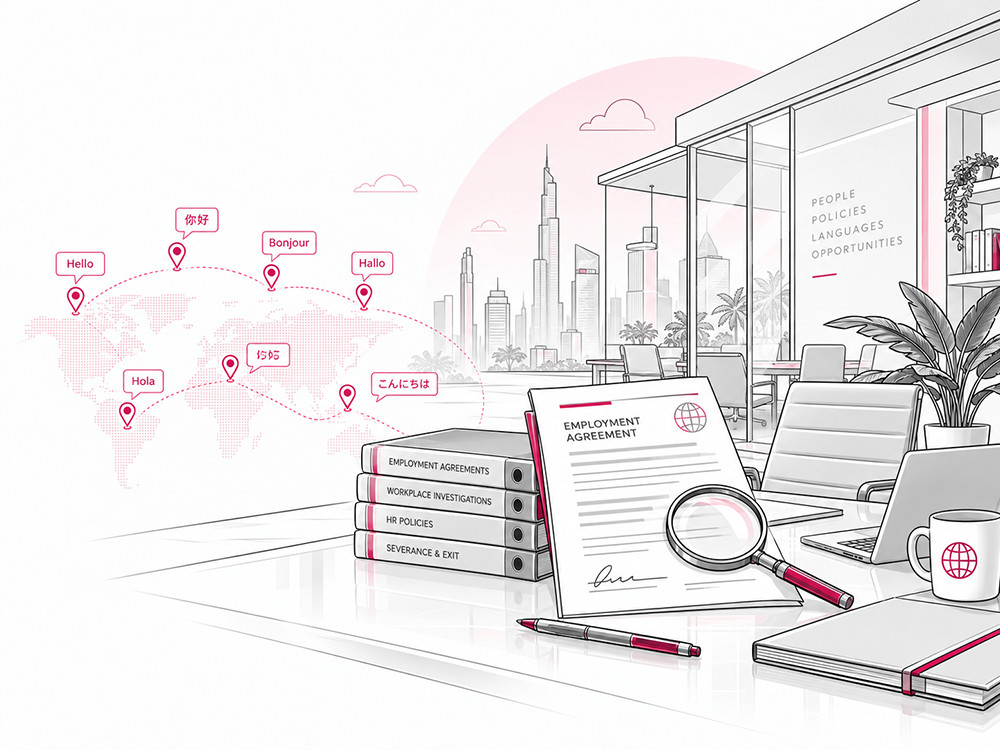
Legal Translation for the Employment Relationship
Employment-related content ranges from everyday workforce communications to documents that establish legal rights, obligations, restrictions, claims, and remedies. Those materials should not all be translated the same way.
For legally significant workplace content involving rights, obligations, disputes, investigations, employee representation, termination, and formal employment relationships.
For recruiting, onboarding, benefits, training, employee engagement, HR systems, talent programs, and everyday workforce communications.
Some content, including employee handbooks and workplace policies, can involve both areas. The appropriate workflow depends on the document's purpose, legal significance, audience, and intended use.
Explore Human Resources Translation ServicesTranslation Across the Employment Law Lifecycle
Stepes supports employment and labor law matters from establishing the employment relationship through policy management, investigations, collective employment matters, separations, and disputes.
Employment Agreements & Executive Arrangements
Translate employment agreements and related contractual documents while preserving defined terms, obligations, restrictions, cross-references, and consistent legal language across document families.
- Employment and executive agreements
- Amendments, addenda, and offer-related legal documentation
- Confidentiality, IP assignment, and restrictive covenants
- Non-compete and non-solicitation provisions
- Compensation-related and international assignment agreements
Workplace Policies & Employee Relations
Translate workplace policies where precise wording can affect employee rights, responsibilities, company procedures, and legal interpretation.
- Employee handbooks and codes of conduct
- Anti-harassment and anti-discrimination policies
- Disciplinary and grievance procedures
- Remote, hybrid, leave, and workplace conduct policies
- Employee notices, acknowledgments, and compliance policies
Workplace Investigations
Support multilingual workplace investigations with professional translation of complaints, interviews, evidence, findings, and related employee documentation.
- Employee complaints and whistleblower reports
- Witness statements and interview records
- Emails, messages, and supporting evidence
- Personnel and disciplinary records
- Investigation reports, findings, and follow-up materials
Termination, Separation & Restructuring
Translate documents used when individual employees or larger workforces transition out of an organization.
- Termination and redundancy notices
- Severance and separation agreements
- Release agreements and settlement documents
- Restructuring and employee transfer materials
- Legally significant offboarding documentation
Employment Disputes & Litigation
Support counsel handling employment claims, litigation, tribunal proceedings, settlement, and other workplace disputes across languages.
- Discrimination, harassment, retaliation, and wrongful termination matters
- Wage and hour disputes
- Pleadings, declarations, affidavits, and witness statements
- Discovery, evidence, exhibits, and expert materials
- Settlement agreements, attorney correspondence, and decisions
Collective Bargaining & Labor Relations
Translate collective employment materials requiring consistent terminology across management, employees, unions, representatives, and legal teams.
- Collective bargaining and union agreements
- Bargaining proposals and negotiation materials
- Labor-management communications
- Grievance and labor dispute documentation
- Employee representative and consultation materials
Works Councils & Employee Representation
Support multinational employers and counsel managing multilingual information and consultation processes involving works councils and employee representatives.
- Works council and European Works Council materials
- Consultation documentation and meeting materials
- Minutes, management presentations, and representative communications
- Restructuring and collective consultation documents
- Cross-border workforce change communications
Employment Law Across Languages and Legal Systems
Employment relationships operate within different legal, regulatory, and cultural environments. Concepts that appear similar in two languages may not have identical legal meaning, and employment terminology can vary significantly across jurisdictions.
Stepes matches translators and reviewers according to the language pair, target locale, legal subject matter, document type, and intended use, while applying client glossaries, previous translations, approved templates, and counsel-provided terminology where available.
Stepes provides linguistic and legal-translation expertise. Client counsel or qualified local counsel remains responsible for determining applicable law, enforceability, statutory requirements, filing requirements, and legal strategy.
Preserve Meaning Across Employment Agreements and Related Documents
Employment agreements rarely exist in isolation. Stepes helps maintain continuity as approved language moves across offers, agreements, policies, investigations, amendments, and separation documents.
Maintain Consistent Employment-Law Language Across Matters
Employment-law terminology often repeats across agreements, policies, investigations, employee notices, dispute materials, and communications with outside counsel. Stepes combines professional legal linguists with terminology management and translation memory to create continuity across projects.
Matter-Specific Glossaries
Maintain recurring legal terms, party names, organizational terminology, abbreviations, employment concepts, and client-preferred language.
Counsel-Approved Language
Incorporate previously approved translations, agreement language, policy terminology, reviewer decisions, and legal-team preferences.
Defined-Term Control
Track defined employment terms so the same source concept remains consistent throughout individual documents and related document sets.
Translation Memory
Reuse validated bilingual content when templates, clauses, policies, notices, or other recurring language appears in later projects.
Cross-Language Harmonization
Coordinate equivalent concepts across multiple target languages while allowing each translation to read naturally in its locale.
Reviewer Feedback
Capture approved corrections and terminology decisions so client and outside-counsel feedback improves future translations.
Apply the Right Translation Control to Each Employment Matter
An internal investigation containing thousands of emails does not require the same workflow as an executive employment agreement that will be signed or a document prepared for formal proceedings. Stepes configures translation around purpose, sensitivity, complexity, scale, and consequence.
Internal Review & Triage
For high-volume content that legal teams initially need to understand, classify, or prioritize, including investigation populations, emails, discovery screening, and multilingual evidence identification.
Recurring Employment Content
For repeatable documentation where terminology consistency and efficient language reuse matter, including policies, legal notices, standardized forms, and recurring multi-country updates.
Material Legal Documents
For documents defining rights, obligations, restrictions, or separation terms, including employment agreements, restrictive covenants, severance documents, settlements, and formal notices.
High-Consequence & Formal Use
For court, tribunal, evidentiary, filed, or otherwise formally relied-upon content where additional quality controls or formalities may be required.
AI Where It Adds Efficiency. Human Judgment Where It Matters.
AI can accelerate multilingual legal work, but employment content can contain contractual language, allegations, confidential employee information, defined terms, jurisdiction-specific concepts, and material facts that require professional judgment.
AI Can Support
- Initial multilingual document understanding
- High-volume investigation screening
- Large employment document populations
- Recurring policy content
- Repeated contractual language
- Translation memory leverage and terminology application
- Automated linguistic QA
Professional Human Expertise Supports
- Legal meaning and context
- Defined terms and ambiguous source language
- Contractual rights and obligations
- Material employment documents
- Jurisdiction-sensitive terminology
- Formal-use content
- Final linguistic quality
Stepes brings DomainAI, translation memory, terminology management, professional legal linguists, automated quality checks, and final human review into one coordinated workflow. AI improves efficiency where appropriate; professional review remains central wherever meaning, context, consequence, or final quality requires human judgment.
Protect Sensitive Employment Information Across Languages
Employment matters can involve some of an organization's most sensitive information, including investigation allegations, compensation data, disciplinary records, separation terms, employee communications, personal information, and legal strategy.
Translate employee records, compensation information, workplace complaints, disciplinary documentation, investigation evidence, and other sensitive workforce materials using workflows appropriate to the project.
Limit project participation to the translators, reviewers, project professionals, and authorized stakeholders required for the assignment.
Support confidential agreements, disputes, investigations, settlements, and attorney-directed materials through managed translation workflows.
Align AI use with client requirements, content sensitivity, and the agreed workflow rather than applying it indiscriminately to every employment document.
Coordinate source files, translated documents, reviewer feedback, and final deliverables through defined project processes.
Multilingual Support for Workplace Investigations
Workplace investigations can combine legal, employment, compliance, and human considerations within a single matter. Stepes translates written investigation materials and can coordinate interpreting for multilingual interviews and meetings when required.
Complaint
Employee complaints, hotline reports, whistleblower submissions, allegations, and initial case documentation.
Interviews
Interview questions, notes, transcripts, witness statements, declarations, and supporting materials.
Evidence
Emails, chat messages, documents, personnel records, policies, photographs containing text, and relevant records.
Findings
Investigation reports, factual findings, recommendations, management responses, and related legal documentation.
Follow-Up
Disciplinary materials, employee notices, corrective actions, settlement documents, and other post-investigation content.
Matter-specific terminology can be maintained across complaints, interviews, evidence, reports, and subsequent legal proceedings so investigators and counsel work from consistent multilingual language.
Support Collective Employment and Employee Representation Across Languages
Multinational employers may need to communicate with unions, employee representatives, works councils, and other workforce bodies across multiple countries and languages. Stepes provides coordinated multilingual support for negotiation, consultation, organizational change, recurring meetings, and legally significant documentation.
Collective Bargaining & Labor Relations
Translate collective bargaining agreements, proposals, counterproposals, negotiation materials, memoranda, grievance materials, and labor-management communications.
Works Councils & European Works Councils
Coordinate multilingual agreements, meeting materials, presentations, minutes, consultation documents, and recurring employee-representation communications.
Restructuring & Organizational Change
Support consultation documents, workforce change materials, management presentations, employee notices, and related legal content across jurisdictions.
Built for Law Firms and In-House Employment Counsel
Employment law translation requirements can originate with outside counsel, corporate legal departments, legal operations, compliance functions, regional counsel, or HR legal stakeholders. Stepes provides one multilingual workflow that can support the professionals involved.
Translation Services for Employment Law Firms
Help employment attorneys work efficiently across languages during advisory matters, investigations, negotiations, disputes, and litigation.
- Employment agreements
- Executive matters
- Restrictive covenants
- Workplace investigations
- Employee disputes
- Collective bargaining
- Employment litigation
- Cross-border issues
Translation Solutions for In-House Employment Counsel
Support recurring employment requirements across subsidiaries, countries, business units, regional teams, and outside law firms.
- Recurring agreements
- Global policy rollouts
- Employee investigations
- Disciplinary matters
- Separation documentation
- Works council matters
- Outside-counsel translations
- Restructuring documentation
From One Employment Agreement to Global Employment Programs
Employment law translation needs can begin with one urgent agreement and expand into recurring multilingual support across regions, business units, document types, and legal matters.
Translate one agreement, severance document, complaint, investigation report, or other high-priority legal document.
Translate agreements, policies, notices, consultation materials, or other legal content across multiple workforce markets.
Maintain reusable terminology and approved translations as agreements, policies, notices, and workplace requirements evolve.
Create repeatable multilingual workflows across corporate legal, HR, compliance, regional counsel, and outside law firms.
Build translation memories, glossaries, approved terms, and reviewer decisions that support future employment matters.
Translate Employment Legal Content in the Formats Your Teams Use
Employment matters can involve agreements, evidence, policies, presentations, spreadsheets, portals, scanned records, email, and multimedia. Stepes coordinates translation, formatting, quality review, and related language services so legal teams receive usable deliverables.
A Translation Workflow Built Around the Employment Matter
Every employment matter has its own combination of languages, deadlines, legal significance, confidentiality, document types, and review requirements. Stepes configures the workflow around those realities.
Define the Matter and Intended Use
Confirm languages, document types, jurisdictions, audience, legal purpose, deadlines, confidentiality requirements, certification needs, and client instructions.
Review Existing Legal Language
Incorporate previous translations, templates, counsel-approved language, glossaries, defined terms, policy terminology, party names, and related references.
Select the Translation Workflow
Determine the right combination of AI assistance, translation memory, professional human translation, independent review, interpreting, certification, and quality control.
Translate and Review
Match translators and reviewers to the language pair, locale, employment-law subject matter, document type, complexity, and intended use.
Perform Legal-Linguistic QA
Review completeness, defined terms, employment terminology, entity names, dates, numbers, compensation amounts, cross-references, clause numbering, formatting, and untranslated text.
Deliver and Reuse Approved Language
Deliver the agreed files and capture approved terminology, translations, and reviewer feedback for future matters when appropriate.
Employment Law Translation in 100+ Languages
A multinational organization may require agreements in one set of languages, investigation support in another, and works council or restructuring documentation across an entire regional workforce.
European Languages
Spanish, French, German, Italian, Portuguese, Dutch, Polish, Czech, Romanian, Hungarian, Swedish, Danish, Norwegian, Finnish, Greek, Bulgarian, Slovak, Slovenian, Croatian, Serbian, Ukrainian, and more.
Asian Languages
Simplified Chinese, Traditional Chinese, Japanese, Korean, Vietnamese, Thai, Indonesian, Malay, Tagalog, and additional Asian languages.
Middle Eastern & South Asian Languages
Arabic, Hebrew, Turkish, Persian, Hindi, Bengali, Urdu, and other regional languages.
Regional language expertise matters. Employment translation assignments can consider country, region, legal context, audience, document purpose, terminology, and reviewer requirements in addition to the language pair.
Why Legal Teams Choose Stepes for Employment Law Translation
Employment legal work combines language, law, people, confidentiality, deadlines, and business risk. Stepes brings linguistic expertise and translation technology together in one coordinated solution.
Employment-Law Expertise
Match translators and reviewers to legal subject matter, employment terminology, document type, language, and intended use.
AI + Human Workflows
Use automation where it improves speed and scalability while applying professional human judgment where meaning and consequence require it.
Legal Terminology Governance
Maintain defined terms, counsel-approved language, employee terminology, party names, and recurring legal expressions across related documents.
Secure Enterprise Workflows
Support sensitive employee, investigation, dispute, contractual, and corporate information through controlled project processes.
Enterprise Scalability
Translate one urgent agreement or coordinate recurring multilingual employment content across multiple regions and business units.
100+ Languages
Centralize employment-law translation across major global markets, regional languages, and multilingual workforce requirements.
Related Employment & Legal Translation Solutions
Employment matters often intersect with contracts, investigations, litigation, HR operations, and broader corporate legal requirements. Stepes connects these services through coordinated multilingual workflows and reusable language assets.
Build Better Multilingual Employment Workflows
Strong employment-law translation begins before the first document is translated. Preparing terminology, clarifying intended use, identifying related documents, and planning review can improve consistency across the entire matter.
Employment Agreements Across Languages
Plan for defined terms, recurring clauses, related agreements, amendments, and counsel-approved language before multilingual production begins.
Workplace Investigations
Coordinate confidentiality, interviews, evidence, terminology, large document sets, and investigation reporting across languages.
Severance & Separation Agreements
Preserve defined obligations, payment terminology, release provisions, dates, conditions, and related employment terms.
Collective Bargaining Agreements
Maintain recurring terminology across complex collective-employment documents, negotiations, amendments, and related communications.
Works Council Documentation
Coordinate agreements, meeting materials, consultation documents, presentations, minutes, and recurring employee-representation communications.
Employment Law Translation Services FAQs
Employment law translation services provide professional translation for documents and communications involving the legal relationship between employers and employees. These can include employment agreements, workplace policies, investigations, disciplinary documents, restrictive covenants, severance agreements, employment disputes, collective bargaining materials, works council documentation, litigation records, and other legally significant workplace content.
Employment law translation focuses on content with legal significance, such as employment agreements, restrictive covenants, workplace investigations, disciplinary matters, separations, employee disputes, collective bargaining, and employee-representation documentation. HR translation covers the broader employee experience, including recruiting, onboarding, benefits, training, employee communications, talent programs, HR systems, and everyday workforce information.
Stepes translates employment agreements, executive agreements, workplace policies, employee handbooks, restrictive covenants, confidentiality agreements, disciplinary records, investigation documents, severance agreements, termination notices, settlement materials, collective bargaining agreements, union documentation, works council materials, employment litigation records, and many other employment-related legal documents.
Yes. Stepes translates employment agreements and related documents including amendments, confidentiality provisions, IP assignment clauses, non-solicitation provisions, non-compete clauses, compensation-related agreements, executive arrangements, and international assignment documentation. Terminology management and translation memory can help keep defined terms and recurring contractual language consistent across related agreements and versions.
Yes. Stepes supports multilingual workplace investigations involving complaints, witness statements, interview materials, emails, messages, supporting evidence, personnel records, investigation reports, findings, disciplinary materials, and other relevant documentation. Professional interpreting can also be coordinated for multilingual interviews or meetings when required.
Yes. Stepes translates severance agreements, separation agreements, release agreements, termination notices, redundancy documentation, settlement terms, employee transfer documents, and related separation materials. The workflow can be configured according to intended use, document significance, language pair, deadline, and review requirements.
Yes. Stepes translates collective bargaining agreements, bargaining proposals, union agreements, negotiation materials, labor-management communications, grievances, collective employment policies, employee representative documents, and related labor relations content. Terminology management can be especially useful where recurring provisions and concepts appear across agreements, negotiations, amendments, and later communications.
Yes. Stepes supports translation of works council agreements, European Works Council materials, consultation documents, meeting materials, presentations, minutes, restructuring communications, employee-representation documents, and related legal content. Multilingual coordination is particularly important when the same materials must be reviewed or distributed across multiple employee populations and jurisdictions.
Yes. Stepes supports employment litigation and other disputes involving pleadings, claims, evidence, witness statements, discovery materials, attorney correspondence, expert materials, settlement agreements, court or tribunal documents, and related case content. Workflows can change as the matter develops, from initial document screening to professional translation of priority evidence or formal-use documents.
Employment matters may contain personal, disciplinary, compensation, investigation, commercial, or other sensitive information. Stepes configures project handling according to the confidentiality, access, workflow, and delivery requirements agreed for the assignment. Clients should identify specific security, access, confidentiality, AI-use, or data-handling requirements when the project begins.
Yes, when appropriate for the content and project requirements. AI can improve efficiency for large document populations, investigation screening, recurring policy content, repeated contractual language, and other suitable materials. Higher-consequence content may require professional human translation, legal-linguistic review, independent review, or additional quality controls.
Additional human review may be appropriate for employment agreements, severance documents, settlement materials, evidence, formal notices, court or tribunal submissions, and other content where accuracy has significant legal or business consequences. The appropriate level of review depends on intended use, jurisdiction, document type, client requirements, and the receiving party's expectations.
Stepes can provide certified translation services when required. Certification, notarization, sworn translation, legalization, and other formal requirements can vary by jurisdiction, institution, and intended use. Clients should confirm the applicable requirement with the receiving court, agency, institution, employer, or qualified legal counsel before translation begins.
Yes. Stepes supports recurring employment-law translation across countries, business units, law firms, internal legal teams, and document types. Translation memory, terminology databases, client-approved language, reviewer feedback, and standardized workflows can help improve consistency and efficiency as agreements, policies, investigations, disputes, and workforce requirements evolve.
Stepes supports employment law translation across more than 100 languages, including major European, Asian, Middle Eastern, Latin American, and regional languages. Resource selection can consider the language pair, country or locale, legal subject matter, document type, intended audience, professional qualifications, and project-specific requirements.
Translate Employment Matters with Confidence Across Languages
Whether you need one employment agreement translated urgently or ongoing multilingual support across policies, investigations, labor relations, severance documents, and employment disputes, Stepes can build the translation workflow around your legal matter. Tell us about your documents, languages, jurisdictions, intended use, deadlines, review requirements, and confidentiality needs.